English Small Talk Phrases
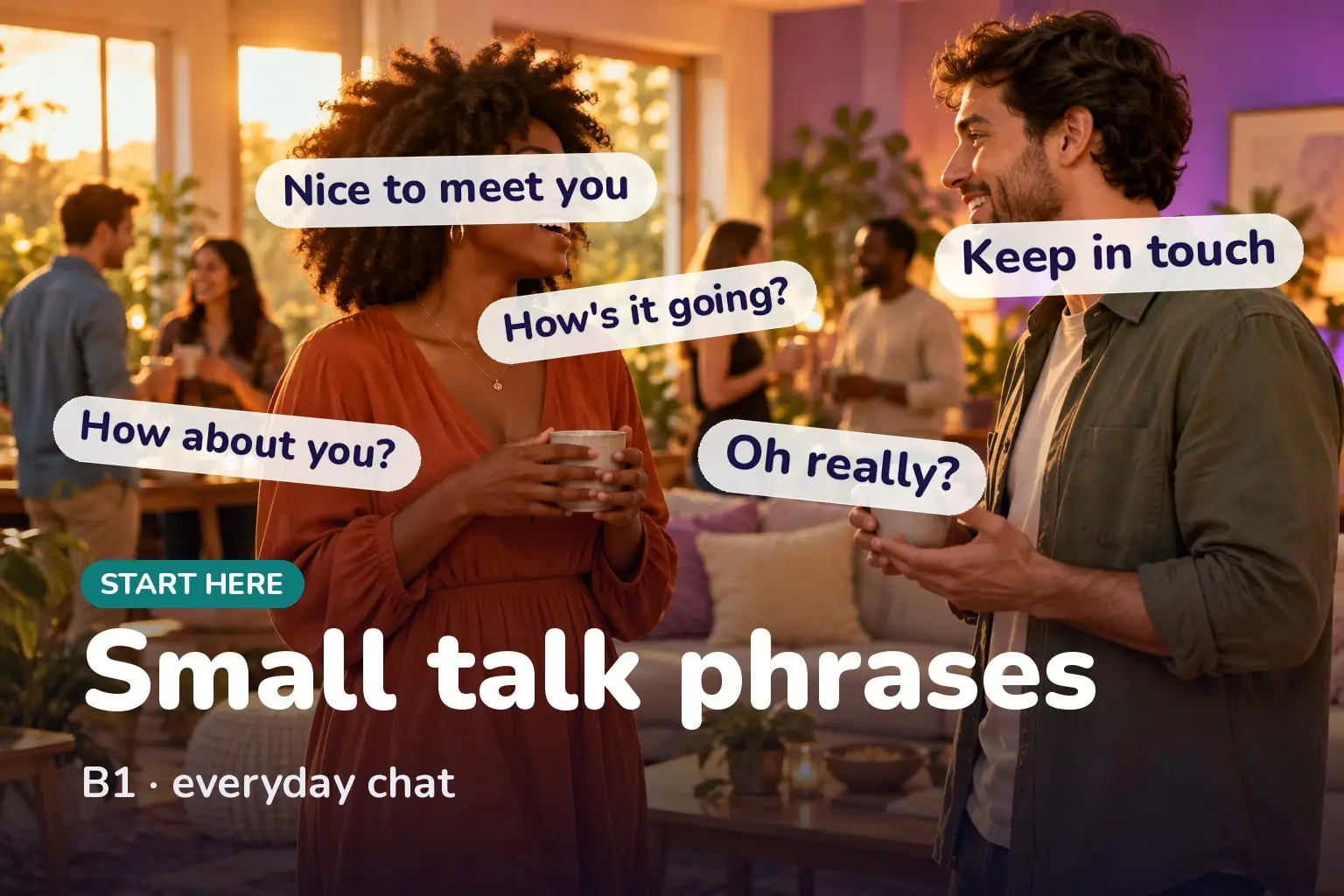
Small talk is light, friendly chat. Open with 'How's it going?' or a comment on the place, react warmly ('Oh really?'), bounce the question back ('How about you?'), and exit politely ('It was lovely to meet you').
Level: B1. This is a phrasebook, not a grammar lesson. Grab the line you need — an opener, a reaction, a way out — and say it aloud with the audio. Each phrase is tagged with its register (how formal it sounds) so you pick the right one for the person in front of you. For the skills behind the phrases — choosing safe topics, taking turns, keeping a chat alive — follow the linked Small Talk & Networking lesson.
By the end of this page you can…
…reach for the right small-talk phrase in the moment: start a chat, keep it going, and leave politely, in a formal or a relaxed setting.
Openers
The first line only has to be friendly and easy to answer. Comment on something you share — the place, the event, the weather.
| Phrase | When to use | Register |
|---|---|---|
| How do you do? | A first formal introduction (reply with the same words) | Formal |
| Pleased to meet you. | Meeting someone at work or an event | Neutral–formal |
| How’s it going? | A relaxed, all-purpose opener | Neutral |
| How are you finding the event? | Starting a chat at a shared occasion | Neutral |
| Lovely weather today, isn’t it? | A classic, low-risk opener | Neutral |
| What’s up? / How’s things? | Friends or close colleagues only | Informal |
Reactions that keep it going
A chat dies if you only answer. Show interest, then pass the turn back. These are your “keep talking” phrases.
| Phrase | When to use | Register |
|---|---|---|
| Oh really? That’s interesting. | Reacting to almost anything | Neutral |
| That sounds great. | Warm, positive reaction | Neutral |
| No way! / You’re kidding! | Surprise, with friends | Informal |
| How about you? / And yourself? | Bouncing the question back | Neutral |
| I know what you mean. | Showing you agree and relate | Neutral |
Safe fillers and agreeing
Short signals tell the other person you are listening without taking the floor.
| Phrase | When to use | Register |
|---|---|---|
| Right. / I see. / Mm-hmm. | Backchannel: “go on, I’m listening” | Neutral |
| Exactly. / That’s a good point. | Agreeing | Neutral |
| Fair enough. | Accepting someone’s point | Neutral–informal |
| I couldn’t agree more. | Strong agreement | Neutral–formal |
Polite exits
Ending a chat is a skill. Signal that you are closing, give a warm reason, and leave the door open.
| Phrase | When to use | Register |
|---|---|---|
| It was lovely to meet you. | Leaving after a first meeting | Neutral |
| Anyway, it’s been great talking to you. | Signalling the end | Neutral |
| I should let you get on. | A kind way to free the other person | Neutral |
| Let’s keep in touch. | Keeping a contact open | Neutral |
| I’d better make a move. | Announcing you are leaving | Informal |
Example phrases to say aloud
Play each line and copy the rhythm. These carry a friendly chat from hello to goodbye.
- How's it going?A warm, easy opener for almost anyone.
- Pleased to meet you.A neutral-to-formal first greeting.
- How do you do?A formal introduction; reply with the same phrase.
- Have you been to one of these before?Small talk about the shared event.
- Lovely weather today, isn't it?A classic opener using a question tag.
- So, what do you do?The standard way to ask about someone's job.
- Oh really? That's interesting.A warm reaction that invites more.
- That sounds great.A positive reaction to good news.
- I'm a nurse. How about you?Answer, then bounce the question back.
- And yourself?A short way to pass the turn back.
- I know what you mean.Showing you relate to what they said.
- Right, I see.A backchannel signal that says 'go on'.
- That's a good point.Agreeing with what someone said.
- Anyway, it's been great talking to you.Signalling a polite exit.
- I should let you get on.A kind way to end the chat.
- It was lovely to meet you.Past tense, because the meeting is ending.
- Let's keep in touch.Leaving the door open for next time.
- I'd better make a move.An informal way to say you are leaving.
A short conversation
Lena: Hi, how’s it going? Have you been to one of these before? Sam: First time, actually. It’s bigger than I expected. How about you? Lena: I come most years. So, what do you do, Sam? Sam: I’m a software developer. And yourself? Lena: I work in design. Oh, that sounds interesting — we probably end up on the same projects. Sam: Ha, probably! Anyway, I should let you mingle, but it was great to meet you. Let’s keep in touch. Lena: Definitely.
Common mistakes
- ❌ How much do you earn? → ✅ So, what do you do? (Ask about the job, not the salary.)
- ❌ Nice to meet you (as you leave) → ✅ It was nice to meet you. (Use the past when the chat is ending.)
- ❌ I am agree with you. → ✅ I agree with you. (Agree is a verb; no am.)
- ❌ How do you do? answered with I’m fine, and three meetings today… → ✅ reply How do you do? (It is a fixed formal greeting, not a real question.)
- ❌ What’s up? to your boss’s boss → ✅ How’s it going? or Pleased to see you. (Match the register to the person.)
Usage notes
- Register, not politeness: What’s up? is not rude — it is just informal. The error is using it where something neutral fits better. When unsure, choose a neutral phrase.
- Question tags: isn’t it?, aren’t they? turn a statement into a friendly question. See question tags for how they are formed.
- Open questions keep chat alive: start with how, what or where rather than yes/no questions. The question words lesson has the full set.
- BrE vs AmE: British Are you all right? / How are you getting on?; American How’s it going? / How are you doing? All are friendly, neutral openers.
Practice
Small talk phrases practice
Try each one, then press Check. No sign-up, nothing is sent anywhere — it all runs in your browser.
Hint: How ___ you?
Show answer
about — 'How about you?' hands the turn back to the other person.
4 Put the words in order for a warm reaction.
Show answer
Oh really that's interesting — 'Oh really, that's interesting' reacts warmly and invites more.
5 Match each phrase to its job.
- How's it going?
- Oh really?
- And yourself?
- Let's keep in touch.
Show answer
- How's it going? → open a chat
- Oh really? → react
- And yourself? → bounce back
- Let's keep in touch. → exit warmly
These four moves cover a whole small-talk exchange.
Hint: a fixed formal phrase
Show answer
do — The reply to 'How do you do?' is simply 'How do you do?'
Recap cheat-sheet
| Move | Neutral phrase | Register note |
|---|---|---|
| Open | How’s it going? | What’s up? = informal |
| Ask about work | So, what do you do? | Never ask salary |
| React | Oh really? That’s interesting. | No way! = informal |
| Bounce back | How about you? / And yourself? | Keeps the chat alive |
| Exit | It was lovely to meet you. | Past tense when leaving |
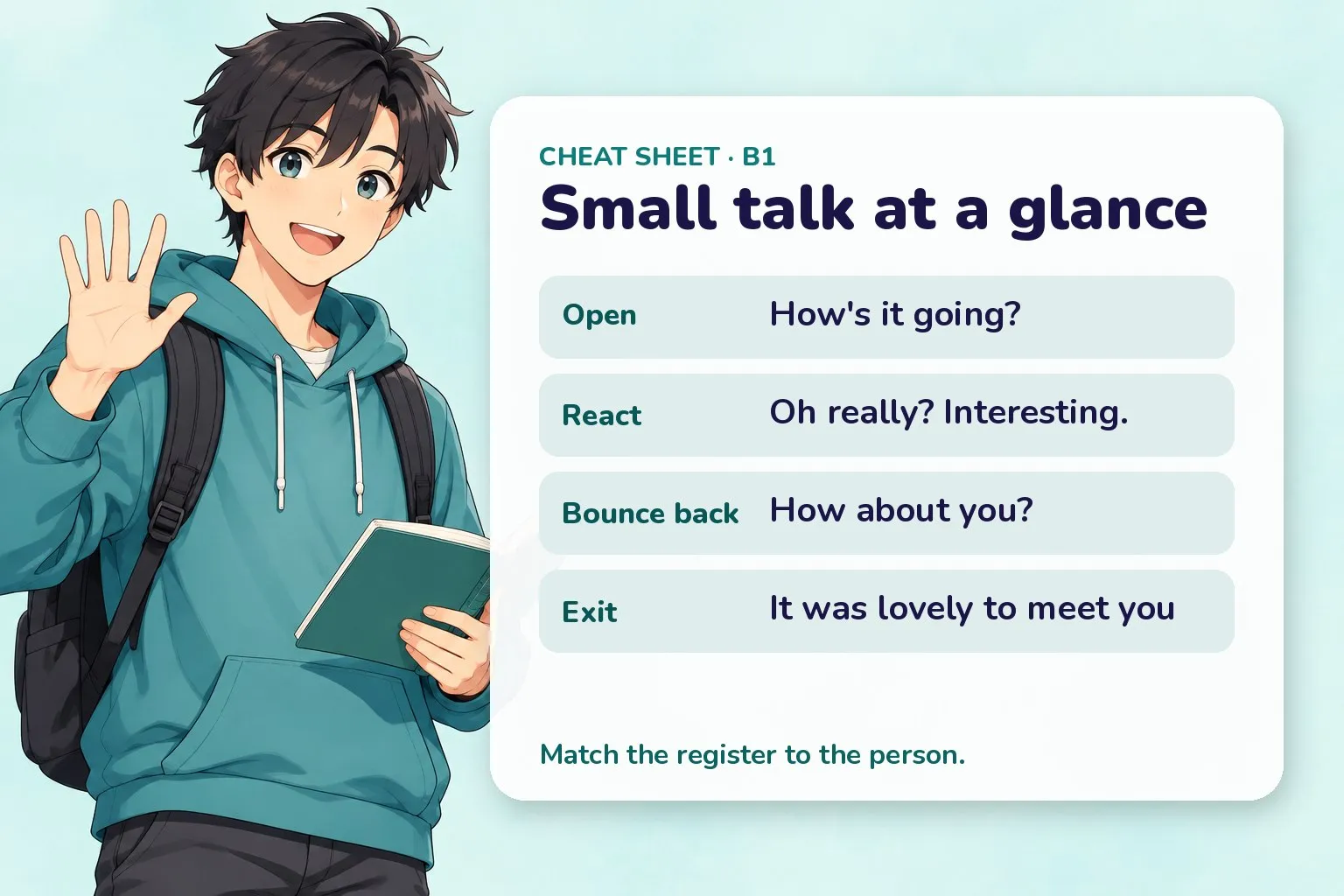
Quick recap before the quiz.
Quiz
Small talk phrases quiz
10 questions · pick an answer and you'll see straight away if it's right.
-
Show answer
How's it going? — 'How's it going?' suits almost anyone in a relaxed, neutral way.
-
Show answer
How do you do? — 'How do you do?' is a formal, fixed greeting.
-
Show answer
How do you do? — It is a fixed greeting; reply with the same words.
-
Show answer
about — 'How about you?' passes the turn back.
-
Show answer
Mm-hmm, right, I see — Backchannel signals like 'mm-hmm' and 'I see' mean 'go on'.
-
Show answer
I agree with you. — 'Agree' is a verb, so no 'am': I agree with you.
-
Show answer
It was nice to meet you. — Use the past when the meeting is ending.
-
Show answer
I should let you get on. — 'I should let you get on' is a kind, standard exit.
-
Show answer
What's up? — 'What's up?' is informal; save it for friends and close colleagues.
-
Show answer
isn't it — A positive statement with 'is' takes the negative tag 'isn't it?'.
Next
- Learn the technique: English: Small Talk & Networking
- Next phrase set: English Phone & Call Phrases
- More phrases: the English phrases hub
- New here? Start with Start Learning English Here
All English phrases topics
Vocabulary, pronunciation, phrases, practice and exam help, ordered by level. Pick a topic and go straight to it. New lessons go live every day, so topics marked Coming soon fill in over the next weeks.
Phrases
A1 4 topics · 4 ready
A2 7 topics · 7 ready
B1 8 topics · 8 ready
- 12 English Small Talk Phrases You are here
- 13 English Phone & Call Phrases
- 14 English Social & Making-Friends Phrases
- 15 English Doctor & Pharmacy Phrases
- 16 English Opinion & Discussion Phrases
- 17 English Agreeing & Disagreeing Phrases
- 18 English Texting & Chat Phrases
- 19 English Complaint & Problem Phrases