English Texting & Chat Phrases
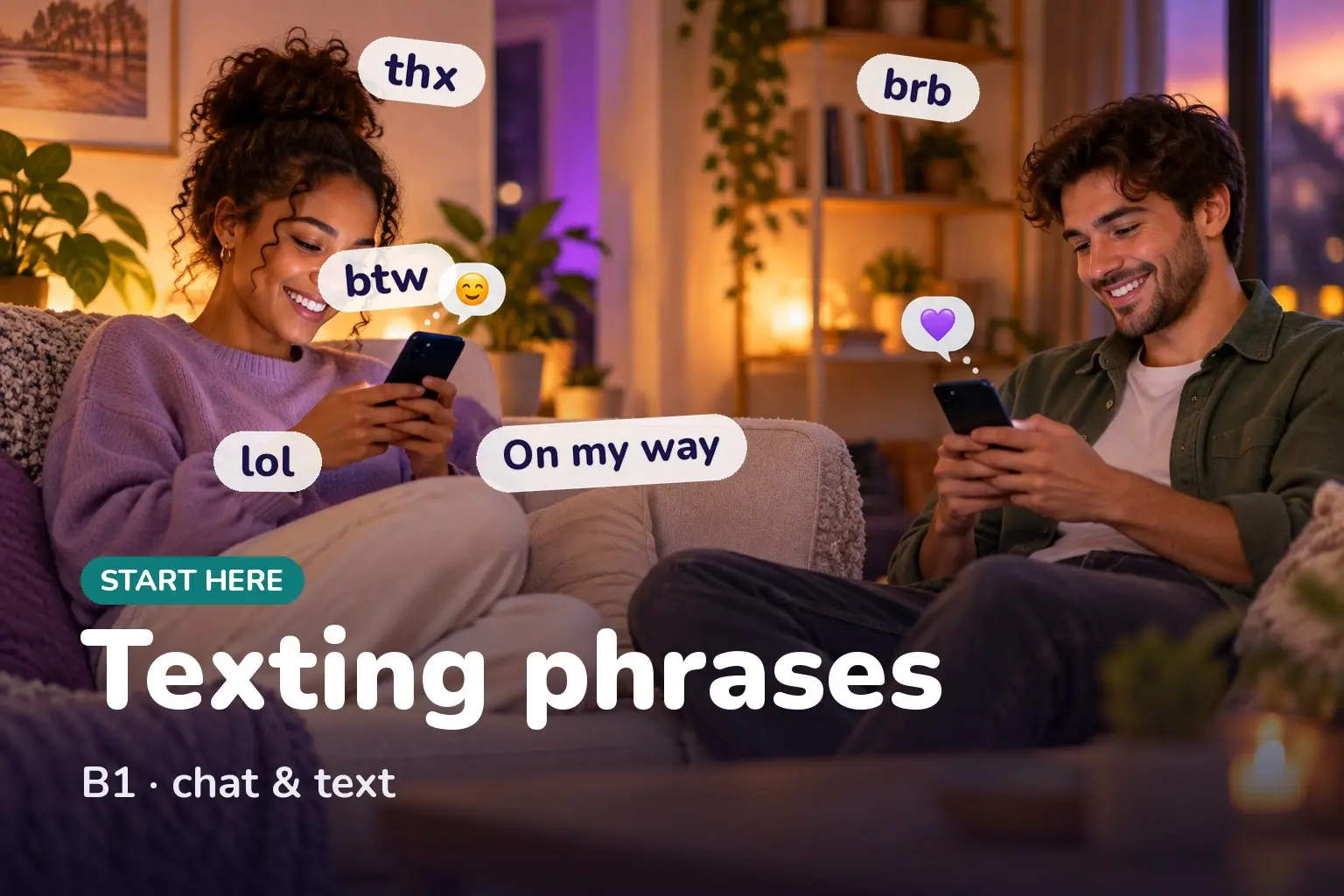
In English texts, keep it short and friendly: common short forms are 'thx' (thanks), 'lol' (laughing), 'btw' (by the way), 'brb' (be right back) and 'np' (no problem). Drop small words ('On my way') and save full sentences for formal messages.
Level: B1. This is a phrasebook for the way people really write to friends — texts, WhatsApp, chat. Grab the short form you need, learn what it means, and see when it is fine (with friends) and when it is not (at work). Many of these are written, not spoken, so a few of the audio lines read the full phrase the short form stands for. For the whole skill of messaging — openers, replies and formal vs informal — follow the Phone & Messaging lesson, and for choosing the right tone see Formal vs Informal Register.
By the end of this page you can…
…read and write a casual English text: understand the common short forms and emojis, drop small words naturally, and judge when a message should stay full and formal instead.
Everyday texting abbreviations
These are the short forms you will see every day. They are informal — fine with friends, not for a job application.
| Short form | Means | Note |
|---|---|---|
| thx / ty | thanks / thank you | thx is very casual |
| np | no problem | A friendly reply to thanks |
| lol | laughing out loud | Shows something is funny or light |
| omg | oh my God | Surprise or excitement |
| btw | by the way | Adds an afterthought |
| idk | I don’t know | Casual uncertainty |
| imo | in my opinion | Marks a personal view |
| brb | be right back | Stepping away briefly |
| ttyl | talk to you later | A casual sign-off |
| np / nvm | nevermind (nvm) | Cancel what you just said |
Short replies and reactions
Quick, friendly one-liners keep a chat moving without full sentences.
| Phrase | Means | Register |
|---|---|---|
| On my way / omw | I’m coming now | Informal |
| Sounds good! | I agree / that works | Informal–neutral |
| No worries | It’s fine / don’t stress | Informal |
| Same here | I feel the same | Informal |
| Will do | I’ll do that | Informal–neutral |
| Got it | I understand | Informal–neutral |
| k / kk / okay | okay | k can read as cold; okay is safer |
Dropping words (text ellipsis)
Texts often leave out the subject and the auxiliary verb when the meaning is obvious. This is the same ellipsis & substitution used in speech, taken a step further.
| Full sentence | Text version | What was dropped |
|---|---|---|
| I am on my way. | On my way. | I am |
| That sounds good. | Sounds good. | That |
| I can’t talk right now. | Can’t talk now. | I |
| Do you want to come? | Wanna come? | Do you + contraction |
| Are you coming? | Coming? | Are you |
Tone and emojis
Text has no voice or face, so small signals carry the tone your voice normally would.
| Signal | How it reads | Use |
|---|---|---|
| 🙂 / 😊 | friendly, warm | Softens a short message |
| 😂 | that’s funny | Reaction to a joke |
| 🙏 | thanks / please | Gratitude or a favour |
| 👍 | okay / got it | Quick, neutral agreement |
| ALL CAPS | shouting / excited | Avoid unless truly excited |
| full stop. | can read as serious/cold | Friends often skip it in chat |
Example phrases to say aloud
A few of these read the full phrase behind the short form, so you know how to say it. Play each line.
- Thanks so much!The full phrase behind 'thx'.
- No problem.The friendly reply behind 'np'.
- By the way, are we still meeting at six?The full phrase behind 'btw'.
- I don't know, to be honest.The full phrase behind 'idk'.
- In my opinion, the first idea was better.The full phrase behind 'imo'.
- Be right back.The full phrase behind 'brb'.
- Talk to you later!The full phrase behind 'ttyl'.
- On my way.A dropped-subject reply: 'I am' is left out.
- Sounds good!A dropped-subject reply: 'That' is left out.
- Can't talk right now, call you later.Dropping 'I' in a quick text.
- Do you want to come?The full form behind 'wanna come?'.
- Are you coming?The full form behind a one-word 'Coming?'.
- No worries, take your time.A relaxed, reassuring reply.
- Same here!Agreeing that you feel the same.
- Will do, thanks!Confirming you'll do something.
- Got it, see you there.Confirming you understand.
- Sorry, I missed your message!A polite catch-up opener.
- Let me check and get back to you.Buying time politely.
- Okay, sounds like a plan.A warmer 'okay' than a single 'k'.
- Thanks for letting me know.A full, polite thank-you for a message.
A short conversation
Mia: hey, still on for dinner tonight? 🙂 Jon: yeah! omw now, maybe 10 mins late Mia: no worries, I’ll grab a table Jon: perfect, thx 🙏 Mia: btw they only take cash Jon: good to know, got it. see you soon!
Common mistakes
- ❌ Using lol, omg, idk in a job application → ✅ keep abbreviations for friends; write full words in anything formal.
- ❌ Thx for the information, dear Sir (mixing casual + formal) → ✅ pick one register: casual thx with friends, or Thank you for the information in a formal email.
- ❌ Reading a plain k as friendly → ✅ a lone k often sounds cold; reply okay or sure.
- ❌ Your welcome → ✅ You’re welcome. (You’re = you are; see the its/it’s family in texting too.)
- ❌ Me coming? for Am I coming? → ✅ drop words from the start, not the middle: Coming? keeps the verb, not the subject.
Usage notes
- Register first: the single biggest texting error for learners is using chat style where full English is expected. When in doubt (a stranger, a boss, a teacher), write it out in full.
- Short forms are written, not spoken: you write brb, but you say “be right back”. Do not say “bee-arr-bee” aloud except as a joke.
- Ellipsis is natural here: dropping I am / Are you mirrors real speech; it is covered as grammar in ellipsis & substitution.
- Punctuation carries tone: in casual chat many people skip the final full stop because it can read as serious; a smiley or ! keeps it warm. In formal writing, punctuate normally.
- BrE vs AmE: short forms are shared worldwide online. cheers (BrE) is a casual “thanks” in texts; np and no worries are used everywhere.
Practice
Texting and chat practice
Try each one, then press Check. No sign-up, nothing is sent anywhere — it all runs in your browser.
1 Match each short form to its meaning.
- btw
- idk
- brb
- ttyl
Show answer
- btw → by the way
- idk → I don't know
- brb → be right back
- ttyl → talk to you later
These four are the everyday chat abbreviations.
Hint: leave out 'I am'
Show answer
On my way — 'On my way' drops 'I am' — natural in a quick text.
5 Put the words in order for a friendly reassurance.
Show answer
no worries, take your time — 'No worries, take your time' is a relaxed, kind reply.
Hint: you are = …
Show answer
You're — 'You're welcome' = 'you are welcome'; 'your' is possessive.
Recap cheat-sheet
| Short form | Means | Watch out |
|---|---|---|
| thx / np | thanks / no problem | Informal only |
| btw / idk / imo | by the way / don’t know / in my opinion | Not for work |
| brb / ttyl / omw | right back / later / on my way | Written, not said |
| k vs okay | okay | Lone k reads cold |
| 🙂 / 👍 / 🙏 | warm / got it / thanks | Carry the tone |
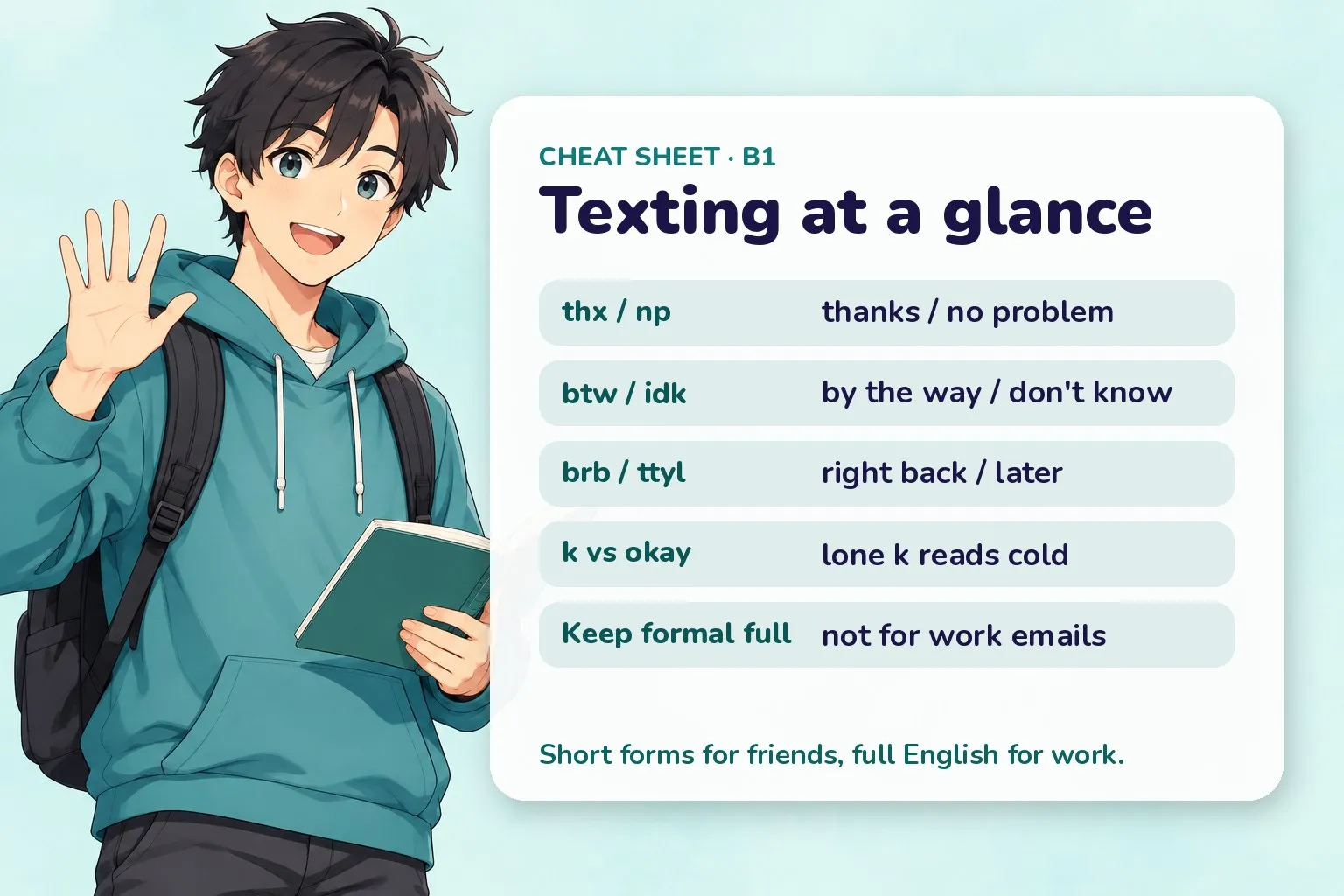
Quick recap before the quiz.
Quiz
Texting and chat quiz
11 questions · pick an answer and you'll see straight away if it's right.
-
Show answer
by the way — 'btw' = by the way, used to add an afterthought.
-
Show answer
I don't know — 'idk' = I don't know.
-
Show answer
Thank you, I look forward to hearing from you. — Formal situations need full, polite English, not chat abbreviations.
-
Show answer
On my way. — Drop 'I am' from the start: 'On my way.'
-
Show answer
It can read as cold or annoyed — A lone 'k' often sounds dismissive; 'okay' or 'sure' is friendlier.
-
Show answer
be right back — 'brb' = be right back.
-
Show answer
You're welcome! — 'You're' = 'you are'; 'your' is possessive.
-
Show answer
talk to you later — 'ttyl' = talk to you later, a casual sign-off.
-
Show answer
Coming? — 'Coming?' drops 'Are you' from the start; the verb stays.
-
Show answer
You say the full phrase, not the letters — You write 'brb' but say 'be right back' — the short forms are for writing.
-
Show answer
🙂 — A friendly 🙂 adds the warm tone a bare word can miss in chat.
Next
- Learn the technique: English: Phone & Messaging and Formal vs Informal Register
- Previous phrase set: English Agreeing & Disagreeing Phrases
- More phrases: the English phrases hub
- New here? Start with Start Learning English Here
All English phrases topics
Vocabulary, pronunciation, phrases, practice and exam help, ordered by level. Pick a topic and go straight to it. New lessons go live every day, so topics marked Coming soon fill in over the next weeks.
Phrases
A1 4 topics · 4 ready
A2 7 topics · 7 ready
B1 8 topics · 8 ready
- 12 English Small Talk Phrases
- 13 English Phone & Call Phrases
- 14 English Social & Making-Friends Phrases
- 15 English Doctor & Pharmacy Phrases
- 16 English Opinion & Discussion Phrases
- 17 English Agreeing & Disagreeing Phrases
- 18 English Texting & Chat Phrases You are here
- 19 English Complaint & Problem Phrases