50 English Survival Phrases
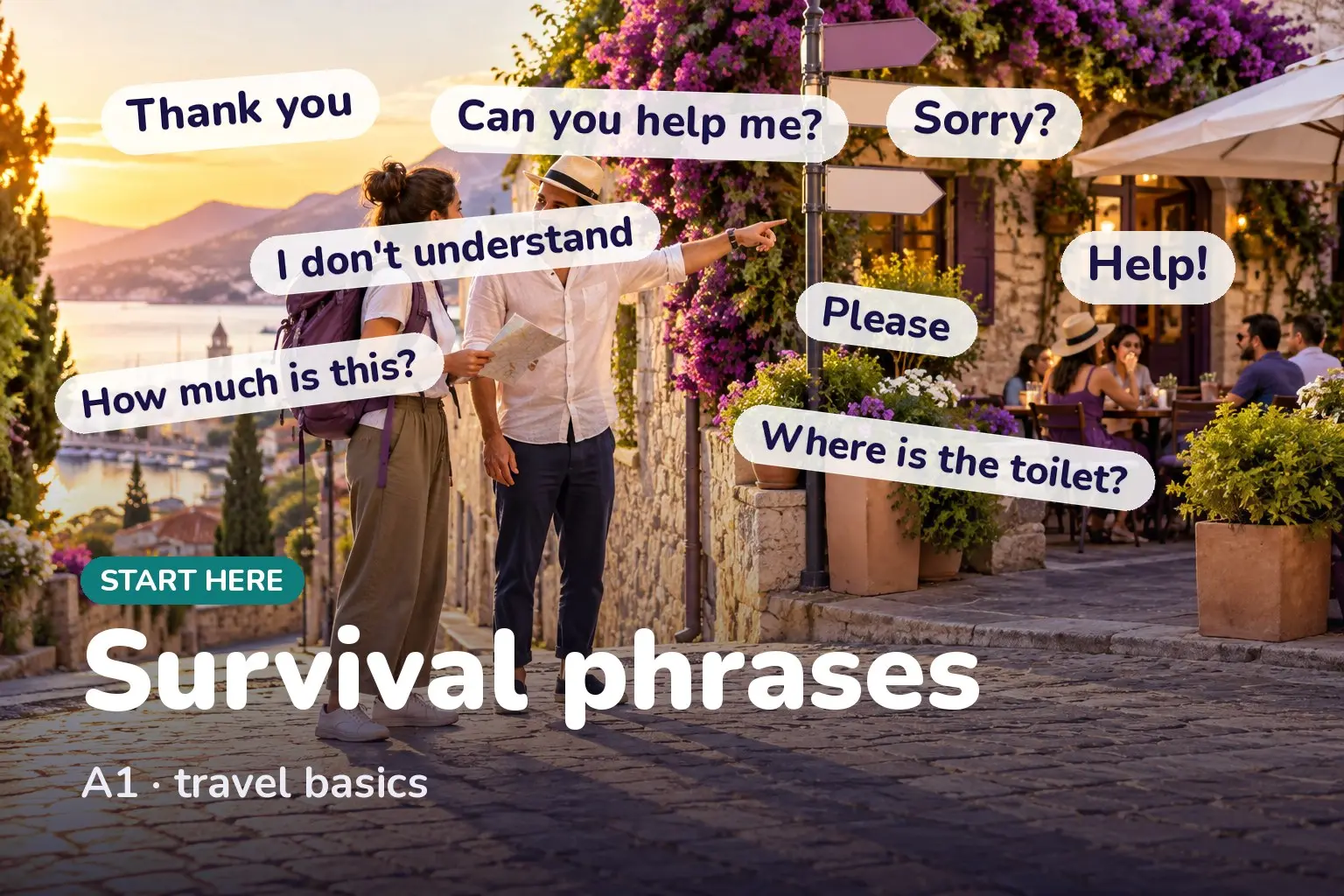
Survival phrases are short, fixed sentences that get you through everyday moments abroad: asking for help, ordering food, finding the toilet, and saying you do not understand. Learn a handful by heart and you can cope almost anywhere.
On this page14 sections · tap to jump
- 01By the end of this page you can…
- 02How to use this list
- 03The basics: hello, please, thank you
- 04When you don’t understand
- 05Getting around: help, directions, prices
- 06Food, shopping and paying
- 07Time, numbers and small exchanges
- 08Emergencies and health
- 09The social glue
- 10Example sentences
- 11Common mistakes
- 12Practice
- 13Quiz
- 14Recap cheat-sheet
Level: A1. These are the fifty phrases that keep you moving when your English runs out: how to ask for help, understand a reply, find a toilet, order something, and call for help in an emergency. Each one is a fixed chunk — learn it whole, say it as one piece.
By the end of this page you can…
…greet people, say you don’t understand and ask them to repeat, ask the way and the price, order food, and call for help if something goes wrong — all with short, ready-made phrases.
How to use this list
Don’t try to memorise all fifty at once. Learn the eight basics first (the greetings, please and thank you), then the “I don’t understand” set, because those two groups rescue almost any conversation. Add the rest as you need them. A register note tells you how formal each phrase is: polite is safe with strangers, casual is for friends, and urgent phrases are for emergencies only.
The basics: hello, please, thank you
| Phrase | Meaning / when to use | Register |
|---|---|---|
| Hello. | A greeting for anyone, any time | Neutral |
| Goodbye. / Bye. | When you leave | Neutral / Casual |
| Yes. / No. | The two most useful words you own | Neutral |
| Please. | Add it to any request to sound polite | Polite |
| Thank you. / Thanks. | Showing you are grateful | Neutral / Casual |
| You’re welcome. | The reply to ‘thank you’ | Neutral |
| Excuse me. | Getting attention, or passing by someone | Polite |
| Sorry. | Apologising, or asking someone to repeat | Neutral |
When you don’t understand
This is the set that saves you most often. There is no shame in using it — asking clearly is what good communicators do.
| Phrase | Meaning / when to use | Register |
|---|---|---|
| Do you speak English? | Finding a shared language | Polite |
| I don’t speak much English. | Setting expectations early | Neutral |
| I don’t understand. | Signalling a problem | Neutral |
| Sorry? / Pardon? | A one-word ‘please repeat that’ | Polite |
| Could you say that again, please? | Asking for a repeat | Polite |
| Could you speak more slowly, please? | Slowing the other person down | Polite |
| What does this mean? | Asking for a meaning | Neutral |
| How do you say this in English? | Asking for a word you need | Neutral |
| Can you write it down, please? | Getting it in writing | Polite |
Getting around: help, directions, prices
| Phrase | Meaning / when to use | Register |
|---|---|---|
| Can you help me? | Asking anyone for help | Neutral |
| Where is the toilet? | Finding a toilet (BrE); AmE: restroom | Neutral |
| Where is the station? | Finding transport | Neutral |
| How do I get to …? | Asking the way to a place | Neutral |
| Is it far? | Checking the distance | Casual |
| I’m lost. | Explaining your situation | Neutral |
| Can you show me on the map? | Asking for it to be pointed out | Polite |
| How much is this? | Asking a price | Neutral |
Food, shopping and paying
| Phrase | Meaning / when to use | Register |
|---|---|---|
| I’d like …, please. | Ordering or requesting politely | Polite |
| This one, please. | Pointing to what you want | Neutral |
| A table for two, please. | Arriving at a restaurant | Polite |
| Water, please. | Asking for a drink | Casual |
| I’m allergic to … | A health warning (nuts, eggs, dairy) | Neutral |
| Can I have the bill, please? | Paying in a restaurant (AmE: check) | Polite |
| Do you take cards? | Checking how you can pay | Neutral |
| Just looking, thanks. | Telling a shop assistant you don’t need help | Casual |
Time, numbers and small exchanges
| Phrase | Meaning / when to use | Register |
|---|---|---|
| What time is it? | Asking the time | Neutral |
| What time does it open? | Checking opening hours | Neutral |
| What time does it close? | Checking closing time | Neutral |
| One moment, please. | Asking someone to wait a second | Polite |
| Here you are. | Handing something over | Neutral |
Emergencies and health
Keep these ready but hope you never need them. Say the urgent ones loudly and clearly.
| Phrase | Meaning / when to use | Register |
|---|---|---|
| Help! | Calling for urgent help | Urgent |
| I need a doctor. | Asking for medical help | Neutral |
| Call an ambulance! | A medical emergency | Urgent |
| Call the police! | A crime or danger | Urgent |
| There’s been an accident. | Reporting what happened | Neutral |
| I don’t feel well. | Telling someone you feel ill | Neutral |
| It hurts here. | Showing where the pain is | Neutral |
The social glue
| Phrase | Meaning / when to use | Register |
|---|---|---|
| Nice to meet you. | At a first introduction only | Polite |
| How are you? | A friendly opener, not a real question | Neutral |
| See you later. | A relaxed goodbye | Casual |
| No problem. | Reassuring someone; also ‘you’re welcome’ | Casual |
| Have a nice day! | A warm way to part | Neutral |
Example sentences
Play each line and say it along with the audio. These are the exact phrases you’ll reach for most.
- Excuse me, can you help me?A polite way to start almost any request to a stranger.Excuse me first, then the question.
- Do you speak English?Ask this before launching into a question.A friendly opener in any country.
- Sorry, I don't understand.The honest, useful thing to say when you're lost.Say it with a small smile.
- Could you say that again, please?Asks the other person to repeat themselves.Learn it as one chunk.
- Could you speak more slowly, please?Buys you time to follow the words.Most people slow down happily.
- How do you say this in English?Point at the thing and ask for the word.A great way to learn on the spot.
- Can you write it down, please?Useful for addresses, times and prices.Numbers are easier to read than hear.
- Where is the toilet?The most-searched phrase for a reason.AmE: Where is the restroom?
- How do I get to the station?Asks the way to a specific place.Swap in any place you need.
- I'm lost. Can you show me on the map?Explains the problem and asks for help.Hold up your phone map.
- How much is this?Asks the price of one thing you're holding.Point as you say it.
- I'd like a coffee, please.A polite way to order.I'd like is softer than I want.
- This one, please.Point when you don't know the word.A gesture plus a phrase is enough.
- Can I have the bill, please?Asks to pay in a restaurant.AmE: Can I have the check, please?
- Do you take cards?Checks whether you can pay by card.Ask before you order if unsure.
- I'm allergic to nuts.A short, clear health warning.Say it before you order food.
- What time does it open?Checks opening hours.Use close for closing time.
- I don't feel well.Tells someone you feel ill.Add It hurts here and point.
- I need a doctor.Asks for medical help calmly.For an emergency, say Call an ambulance!
- Have a nice day!A warm, friendly way to say goodbye.Common from shop and cafe staff.
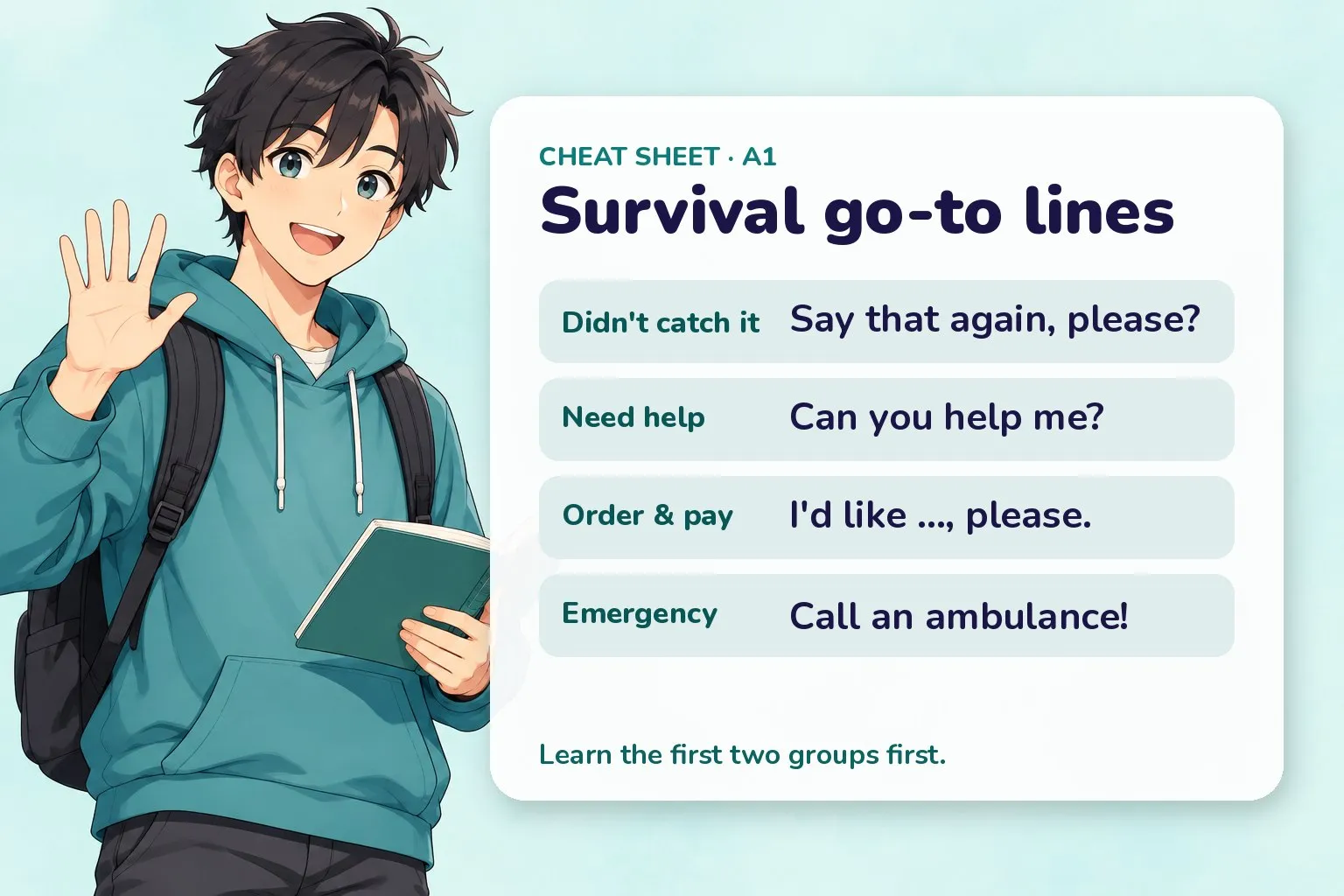
Quick recap before you practise.
Common mistakes
- ❌ I want water. → ✅ Water, please. / Could I have some water, please? — ‘I want’ alone can sound blunt; ‘please’ or ‘Could I have…’ softens it.
- ❌ Repeat, please. → ✅ Could you say that again, please? — the bare command sounds abrupt; the fuller phrase is normal and polite.
- ❌ Where is toilet? → ✅ Where is the toilet? — keep the little word the before the place.
- ❌ How much this? → ✅ How much is this? — don’t drop the verb is from the question.
- ❌ Saying Nice to meet you every time → ✅ Say it only at the first meeting; after that, a plain Hello is right.
Practice
Survival phrases practice
Try each one, then press Check. No sign-up, nothing is sent anywhere — it all runs in your browser.
Hint: a three-letter verb of movement
Show answer
get — The fixed phrase is 'How do I get to …?' for asking the way.
Hint: the verb 'to be'
Show answer
is — Keep the verb 'is' in the question: 'How much is this?'
5 Put the words in order to ask for help politely.
Show answer
Can you help me? — The question is 'Can you help me?'
6 Match each phrase to the situation.
- Where is the toilet?
- Can I have the bill, please?
- Call an ambulance!
- Do you speak English?
Show answer
- Where is the toilet? → you need a toilet
- Can I have the bill, please? → you want to pay
- Call an ambulance! → a medical emergency
- Do you speak English? → finding a shared language
Each survival phrase fits one common moment.
Quiz
Survival phrases quiz
12 questions · pick an answer and you'll see straight away if it's right.
-
Show answer
Excuse me. — 'Excuse me' is the standard opener for approaching someone politely.
-
Show answer
I'm lost. Can you help me? — It states the problem and asks for help.
-
Show answer
I'd like a coffee, please. — 'I'd like …, please' is the natural polite request form.
-
Show answer
Could you say that again, please? — The full phrase is polite; a bare 'What?' can sound rude.
-
Show answer
I'm allergic to nuts. — 'I'm allergic to …' is the clear, standard health warning.
-
Show answer
How much is this? — 'How much is this?' asks the price of the item.
-
Show answer
Can I have the bill, please? — In British English you ask for the 'bill' (AmE: 'check').
-
Show answer
Call an ambulance! — 'Call an ambulance!' is for a medical emergency and is said loudly and clearly.
-
Show answer
Only at the first meeting — It belongs to a first introduction only.
-
Show answer
Point and say 'This one, please.' — A gesture plus a known phrase gets you understood.
-
Show answer
I don't speak much English. — Saying it early tells the other person to keep things simple.
-
Show answer
a friendly ritual expecting a short reply — It is a polite ritual; a brief positive answer is expected.
Recap cheat-sheet
| Situation | Go-to phrase |
|---|---|
| Didn’t understand | Could you say that again, please? |
| Need help / lost | Can you help me? / I’m lost. |
| Ordering & paying | I’d like …, please. / Can I have the bill, please? |
| Emergency | Help! / Call an ambulance! |
Next
- Next: English Greetings & Goodbyes
- Related lesson: English: Greetings & Introductions
- New here? Start with Start Learning English Here
All English phrases topics
Vocabulary, pronunciation, phrases, practice and exam help, ordered by level. Pick a topic and go straight to it. New lessons go live every day, so topics marked Coming soon fill in over the next weeks.
Phrases
A1 4 topics · 4 ready
- 01 50 English Survival Phrases You are here
- 02 English Greetings & Goodbyes
- 03 English Politeness & Please/Thank-You
- 04 English Classroom Phrases