English Agreeing & Disagreeing Phrases
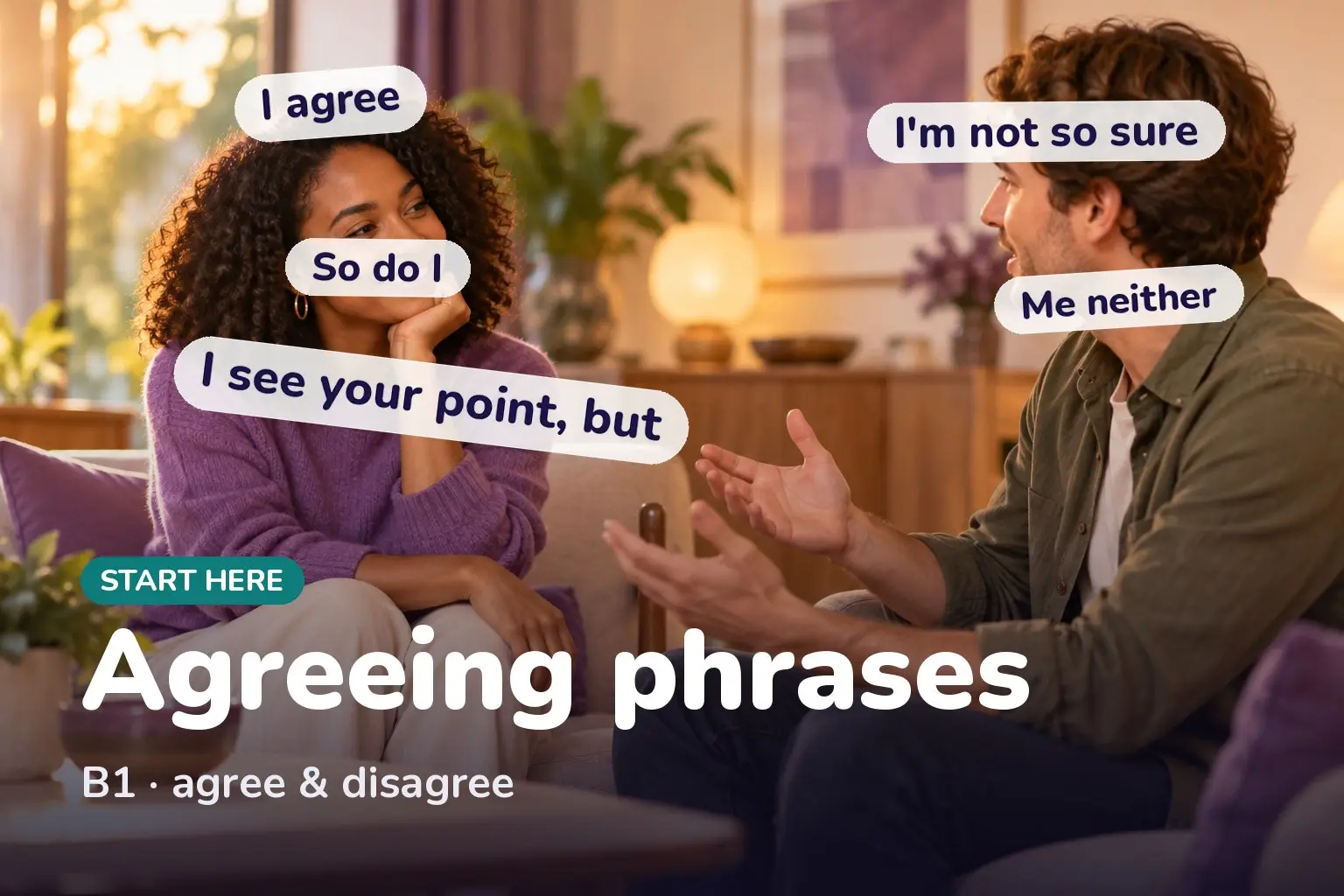
To agree, use 'So do I', 'Exactly' or 'I couldn't agree more'. To disagree politely, soften first: 'I see your point, but…', 'I'm not so sure', 'I'm afraid I disagree'. Match the short reply to the verb: 'So do I' / 'Neither do I'.
Level: B1. This is a phrasebook, not a grammar lesson. Grab the line you need — a quick yes, a strong yes, a gentle no — and say it aloud with the audio. Each phrase is tagged with its register (how formal it sounds) and its strength (how firmly it agrees or disagrees). For the technique behind the phrases — building a point, defending it, changing someone’s mind — follow the Expressing Opinions lesson and the Debating & Argumentation lesson.
By the end of this page you can…
…agree and disagree at the strength you mean, using the short reply that matches the verb, and say a polite “no” without sounding rude.
Agreeing
Pick the strength you mean. A plain I agree is fine everywhere; the stronger ones add warmth or emphasis.
| Phrase | When to use | Register / strength |
|---|---|---|
| I agree. | The plain, all-purpose yes | Neutral |
| Exactly. / Absolutely. | Firm, enthusiastic agreement | Neutral |
| That’s true. / Good point. | Accepting what someone just said | Neutral |
| I couldn’t agree more. | The strongest everyday agreement | Neutral–formal, strong |
| Fair enough. | Accepting a point you had resisted | Neutral–informal |
| I suppose so. | Weak, reluctant agreement | Neutral, weak |
Short agreement replies (So do I / Neither do I)
To agree with a whole statement in one breath, copy the speaker’s auxiliary verb and flip the subject. Use So… after a positive, Neither/Nor… after a negative.
| They say | You agree with | Why |
|---|---|---|
| I love this song. | So do I. | Positive + love (do) → So do I |
| I’m tired. | So am I. | Positive + am → So am I |
| I can swim. | So can I. | Positive + can → So can I |
| I don’t like it. | Neither do I. / Me neither. | Negative + don’t → Neither do I |
| I can’t come. | Neither can I. | Negative + can’t → Neither can I |
Disagreeing politely
English speakers rarely say a flat No, you’re wrong. Soften first — acknowledge the point, then give yours.
| Phrase | When to use | Register / strength |
|---|---|---|
| I see your point, but… | Acknowledge, then push back | Neutral, soft |
| I’m not so sure (about that). | Gentle doubt | Neutral, soft |
| I’m afraid I disagree. | Polite but clear disagreement | Neutral–formal |
| I don’t really think so. | Soft everyday no | Neutral |
| That’s not how I see it. | Stating a different view firmly | Neutral |
| I totally disagree. | Strong, direct disagreement | Neutral–informal, strong |
Partly agreeing
Real discussions are rarely all-or-nothing. These phrases let you agree with a part while keeping your doubt.
| Phrase | When to use | Register / strength |
|---|---|---|
| Yes and no. | You agree only partly | Neutral–informal |
| That’s true, but… | Accept one point, add a caveat | Neutral |
| I agree up to a point. | Agree partly, with a limit | Neutral–formal |
| I take your point, but… | Accept the point, then disagree | Neutral–formal |
Example phrases to say aloud
Play each line and copy the rhythm. These carry you through agreeing, half-agreeing and saying a polite no.
- I agree.The plain, all-purpose yes.
- Exactly, that's just what I thought.Firm, enthusiastic agreement.
- Absolutely.A strong one-word yes.
- That's a good point.Accepting what someone just said.
- I couldn't agree more.The strongest everyday agreement.
- Fair enough, let's do that.Accepting a point you had resisted.
- I suppose so.Weak, reluctant agreement.
- I love this song. — So do I.Short reply: positive statement with 'love'.
- I'm tired. — So am I.Short reply: positive with 'am'.
- I can't come on Friday. — Neither can I.Short reply: negative with 'can't'.
- I don't like horror films. — Me neither.An easy informal way to agree with a negative.
- I see your point, but it costs too much.Acknowledge, then push back.
- I'm not so sure about that.Gentle doubt.
- I'm afraid I disagree.Polite but clear disagreement.
- I don't really think so.A soft everyday no.
- That's not how I see it.Stating a different view firmly.
- I totally disagree.Strong, direct disagreement.
- Yes and no.You agree only partly.
- That's true, but there's another side.Accept a point, then add a caveat.
- I agree up to a point.Agree partly, with a clear limit.
A short conversation
Ravi: I think we should book the earlier flight. It’s cheaper. Tom: That’s true, but it leaves at five in the morning. Ravi: Fair enough. I hadn’t thought about the taxi. Tom: And I can’t sleep on planes anyway. Ravi: Neither can I, to be honest. So the later one? Tom: I couldn’t agree more.
Common mistakes
- ❌ I am agree with you. → ✅ I agree with you. (Agree is a verb; no am.)
- ❌ I agree with that. / I agree to your idea. → ✅ I agree with you / I agree with that idea. (Agree with a person or opinion.)
- ❌ So I do. → ✅ So do I. (In the short reply, the auxiliary comes before the subject: So do I.)
- ❌ Me too after a negative → ✅ Me neither / Neither do I. (After a negative, use neither, not too.)
- ❌ I’m not agree. → ✅ I disagree / I don’t agree. (There is no be + agree.)
Usage notes
- Agree with vs agree to vs agree on: you agree with a person or opinion, agree to a proposal or request, and agree on a shared decision (We agreed on a date).
- “Me too” / “Me neither”: the quick, informal versions. Me too mirrors a positive; Me neither mirrors a negative. Full forms (So do I / Neither do I) sound a touch more careful.
- Soften before a strong no: a short I’m afraid… or I see your point, but… makes even total disagreement sound civil.
- The auxiliary carries the meaning: short replies lean on the same helper-verb system as ellipsis & substitution — the main verb is dropped and the auxiliary stands in.
- BrE vs AmE: both use So do I and Me neither; Me either is heard in informal American English for Me neither.
Practice
Agreeing and disagreeing practice
Try each one, then press Check. No sign-up, nothing is sent anywhere — it all runs in your browser.
Hint: used after a negative
Show answer
Neither — After a negative, use 'Neither can I' (or 'Nor can I').
4 Put the words in order for the strongest agreement.
Show answer
I couldn't agree more — 'I couldn't agree more' is the strongest everyday yes.
5 Match each phrase to its strength.
- I suppose so.
- Exactly.
- I'm not so sure.
- I totally disagree.
Show answer
- I suppose so. → weak yes
- Exactly. → firm yes
- I'm not so sure. → soft no
- I totally disagree. → strong no
Agreement and disagreement each run from soft to strong.
Hint: 'agree' is a verb
Show answer
agree — 'Agree' is a verb, so there is no 'am': I agree with you.
Recap cheat-sheet
| Move | Phrase | Note |
|---|---|---|
| Agree | I agree / Exactly | I couldn’t agree more = strongest |
| Short yes | So do I / So am I | Match the auxiliary |
| Short no | Neither do I / Me neither | After a negative |
| Disagree softly | I see your point, but… | Acknowledge first |
| Disagree firmly | I totally disagree | Still no name-calling |
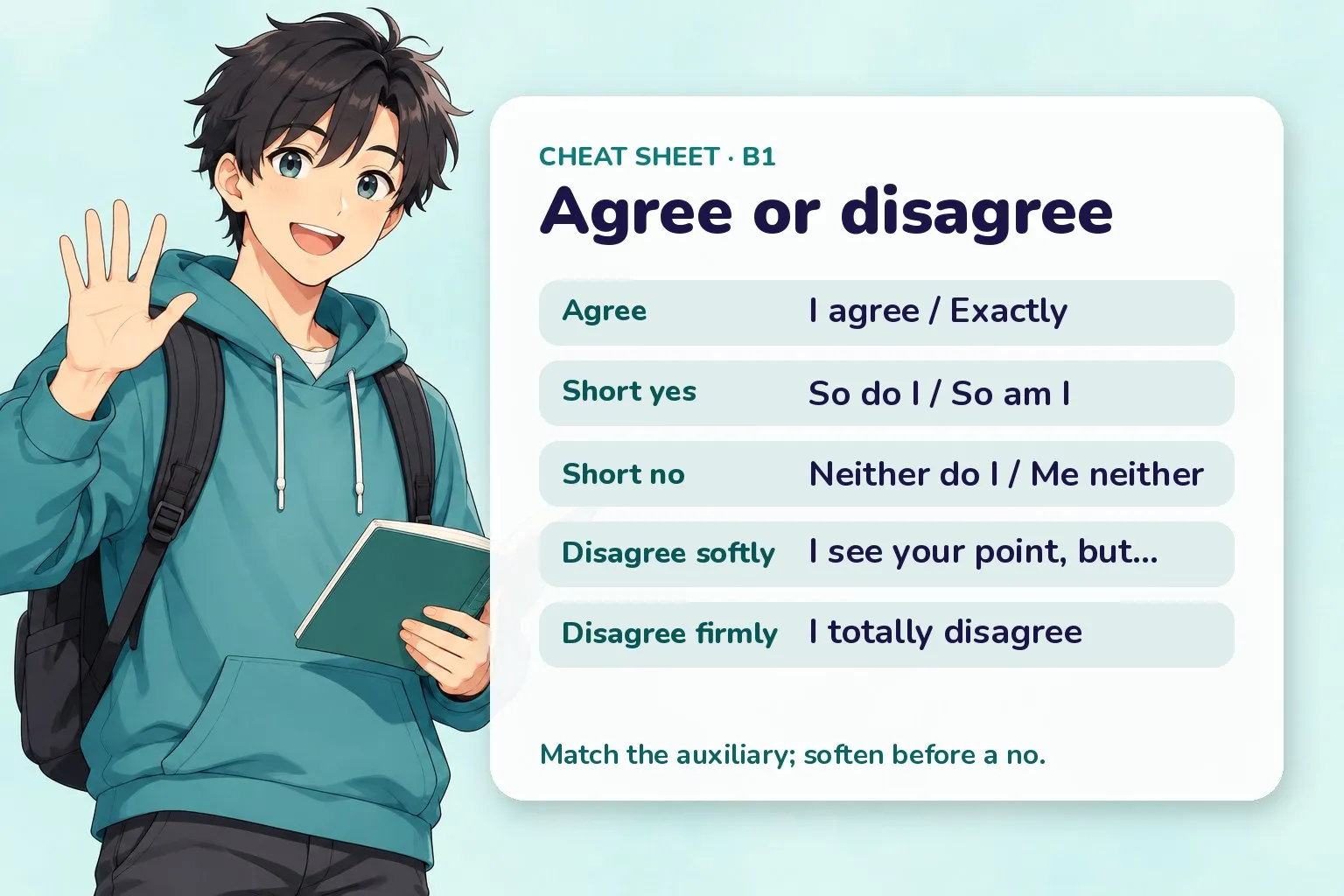
Quick recap before the quiz.
Quiz
Agreeing and disagreeing quiz
11 questions · pick an answer and you'll see straight away if it's right.
-
Show answer
I agree with you. — 'Agree' is a verb, so no 'am': I agree with you.
-
Show answer
So do I. — Positive with 'love' (do) → 'So do I', auxiliary before subject.
-
Show answer
So am I. — The verb is 'am', so the reply is 'So am I'.
-
Show answer
Me neither. — After a negative, use 'Me neither' (or 'Neither do I'), not 'Me too'.
-
Show answer
I couldn't agree more. — 'I couldn't agree more' is the strongest everyday agreement.
-
Show answer
Neither can I. — The auxiliary is 'can', after a negative → 'Neither can I'.
-
Show answer
I see your point, but… — Acknowledging the point first softens the disagreement.
-
Show answer
I suppose so. — 'I suppose so' is a weak, half-hearted yes.
-
Show answer
agreed on — You 'agree on' a shared decision like a date.
-
Show answer
I'm afraid I disagree. — 'I'm afraid I disagree' is polite but unmistakably a no.
-
Show answer
I don't agree. — Use 'I don't agree' or 'I disagree'; there is no 'be + agree'.
Next
- Learn the technique: English: Debating & Argumentation and Expressing Opinions
- Previous phrase set: English Opinion & Discussion Phrases
- Next phrase set: English Texting & Chat Phrases
- More phrases: the English phrases hub
- New here? Start with Start Learning English Here
All English phrases topics
Vocabulary, pronunciation, phrases, practice and exam help, ordered by level. Pick a topic and go straight to it. New lessons go live every day, so topics marked Coming soon fill in over the next weeks.
Phrases
A1 4 topics · 4 ready
A2 7 topics · 7 ready
B1 8 topics · 8 ready
- 12 English Small Talk Phrases
- 13 English Phone & Call Phrases
- 14 English Social & Making-Friends Phrases
- 15 English Doctor & Pharmacy Phrases
- 16 English Opinion & Discussion Phrases
- 17 English Agreeing & Disagreeing Phrases You are here
- 18 English Texting & Chat Phrases
- 19 English Complaint & Problem Phrases