English Opinion & Discussion Phrases
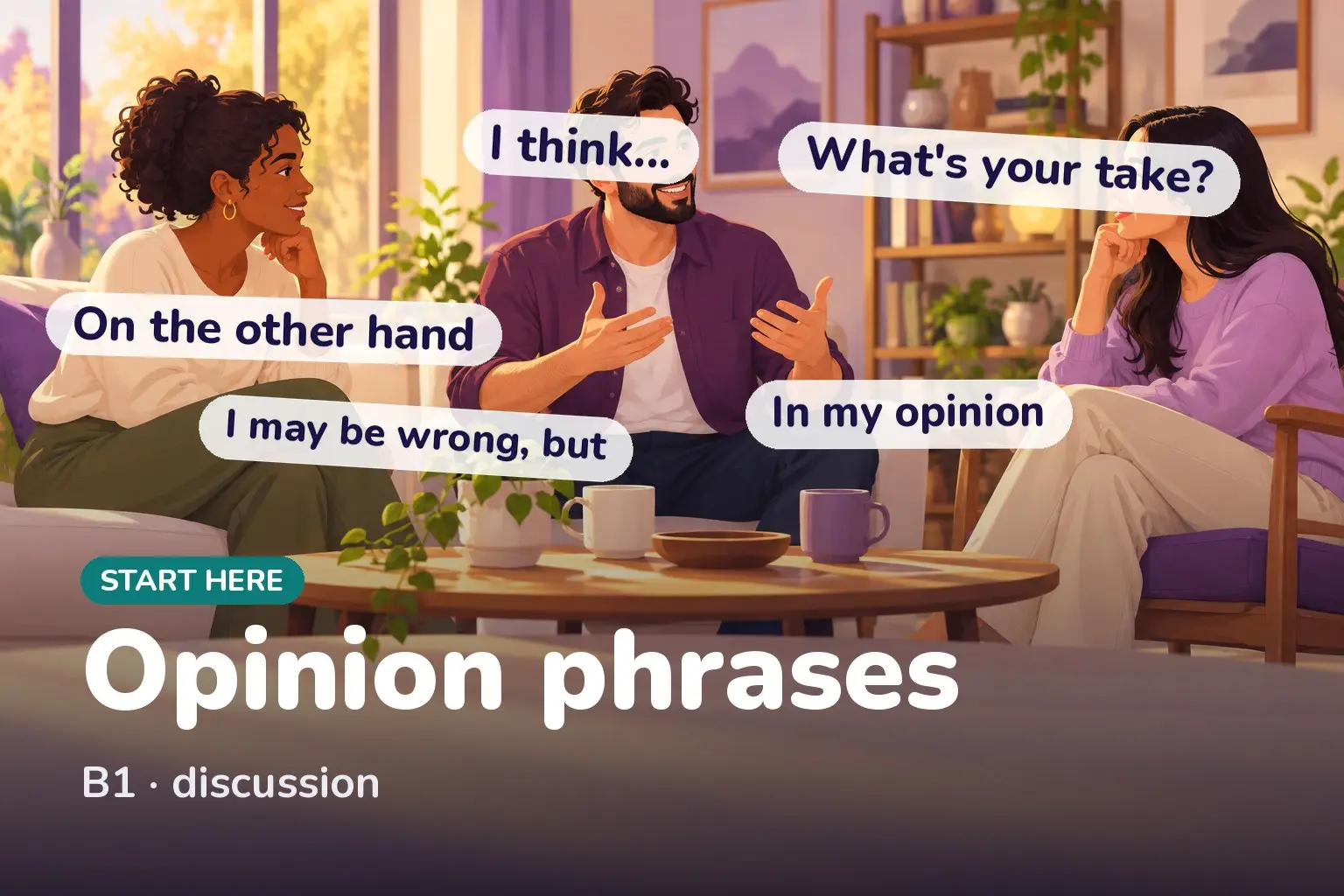
To give an opinion, start with a signpost: 'I think…', 'In my opinion…' or the stronger 'I'm convinced that…'. Soften it with 'It seems to me…', ask back with 'What do you think?', and build on others with 'That's a good point, but…'.
On this page12 sections · tap to jump
Level: B1. This is a phrasebook, not a grammar lesson. Grab the line you need — a way to state a view, soften it, ask for someone else’s, or build on a point — and say it aloud with the audio. Each phrase is tagged with its register (how formal it sounds) and its strength (how certain it makes you sound). For the skills behind the phrases — giving reasons, structuring an argument, handling disagreement — follow the Expressing Opinions lesson and the Debating & Argumentation lesson.
By the end of this page you can…
…reach for the right opinion phrase in the moment: state what you think at the strength you mean, soften it when you need to, ask for others’ views, and keep a discussion moving politely.
Giving your opinion
Start with a short signpost so the listener knows an opinion is coming. The phrase you choose signals how sure you are.
| Phrase | When to use | Register / strength |
|---|---|---|
| I think (that)… | The all-purpose opener for any view | Neutral |
| In my opinion,… | A clear, slightly more formal signpost | Neutral–formal |
| If you ask me,… | A relaxed, personal opener | Informal |
| I’d say (that)… | A gentle, tentative view | Neutral, soft |
| As far as I’m concerned,… | Your personal position, firmly | Neutral |
| I’m convinced (that)… | A strong, confident claim | Strong |
| There’s no doubt in my mind that… | The strongest everyday claim | Strong, formal |
Softening an opinion (hedging)
Hedging makes a view sound thoughtful rather than pushy, and leaves room for the other person. It is the key to a civil discussion.
| Phrase | When to use | Register / strength |
|---|---|---|
| It seems to me (that)… | Presenting a view as an impression | Neutral, soft |
| I may be wrong, but… | Making room for disagreement | Neutral, soft |
| I tend to think (that)… | A careful, measured view | Neutral, soft |
| As far as I know,… | Flagging that your facts might be partial | Neutral |
| Correct me if I’m wrong, but… | Inviting a check before you commit | Neutral |
Asking for someone’s opinion
A discussion stalls if only one person talks. Hand the turn back with a question.
| Phrase | When to use | Register / strength |
|---|---|---|
| What do you think? | The standard way to ask | Neutral |
| What’s your take on this? | Asking for a considered view | Neutral–informal |
| How do you feel about…? | Asking about a reaction or preference | Neutral |
| Wouldn’t you agree? | Inviting agreement after your point | Neutral |
| Do you see what I mean? | Checking the other person follows | Neutral–informal |
Building and ordering a discussion
These linkers let you add reasons, give examples and change direction without sounding abrupt. They are the glue of a longer answer.
| Phrase | When to use | Register / strength |
|---|---|---|
| The main reason is (that)… | Giving your strongest reason first | Neutral |
| For example,… / For instance,… | Backing a point with a case | Neutral |
| On the other hand,… | Introducing the opposite side | Neutral |
| That’s a good point, but… | Agreeing a little, then pushing back | Neutral |
| To be honest,… | Signalling a frank, personal view | Neutral–informal |
Example phrases to say aloud
Play each line and copy the rhythm. These carry a view from the first signpost to the question you hand back.
- I think we should leave a bit earlier.The neutral, all-purpose way to give a view.
- In my opinion, the first plan was better.A clear, slightly more formal signpost.
- If you ask me, it's not worth the money.A relaxed, personal opener.
- I'd say it depends on the weather.A gentle, tentative view.
- As far as I'm concerned, the matter is settled.Stating your personal position firmly.
- I'm convinced this is the right call.A strong, confident claim.
- It seems to me that nobody was told.Presenting a view as an impression.
- I may be wrong, but I think it's too late.Making room for disagreement first.
- I tend to think the smaller team works better.A careful, measured view.
- Correct me if I'm wrong, but the shop shuts at six.Inviting a check before you commit.
- What do you think?The standard way to ask for a view.
- What's your take on this?Asking for a considered opinion.
- How do you feel about working from home?Asking about a reaction or preference.
- Wouldn't you agree?Inviting agreement after your point.
- The main reason is that it saves time.Giving your strongest reason first.
- For example, last year the same thing happened.Backing a point with a case.
- On the other hand, it would cost more.Introducing the opposite side.
- That's a good point, but I still have doubts.Agreeing a little, then pushing back.
- To be honest, I wasn't keen on the idea.Signalling a frank, personal view.
- Do you see what I mean?Checking the other person is following.
A short conversation
Priya: So, what’s your take on the new office hours? Marco: Honestly, I think they’re a mistake. The main reason is that nobody can get childcare that early. Priya: That’s a good point. On the other hand, the roads are quieter at seven. Marco: True. I may be wrong, but I’d say the downside is bigger than the upside. How do you feel about it? Priya: As far as I’m concerned, they should ask the whole team first. Marco: Couldn’t agree more.
Common mistakes
- ❌ I am agree with you. → ✅ I agree with you. (Agree is a verb; no am.)
- ❌ In my opinion, I think that… → ✅ In my opinion,… or I think that… (Use one signpost, not both — they mean the same thing.)
- ❌ According to me,… → ✅ In my opinion,… / If you ask me,… (According to is for other people and sources, not yourself.)
- ❌ I am convinced of that it is true. → ✅ I’m convinced that it is true. (No of before that.)
- ❌ What do you think about it? — I think so too. → ✅ I think so too is for agreeing with a statement, not answering an open question; give your actual view instead.
Usage notes
- Match strength to certainty: English speakers hedge a lot. Starting every sentence with I’m absolutely convinced sounds aggressive. Neutral I think / I’d say is the safe default.
- “I think” can move: you can also end with it — It’s too expensive, I think. — which sounds even softer.
- Linkers signal structure: words like on the other hand and for example tell the listener what is coming. See advanced discourse markers for the full set.
- Agreeing and disagreeing have their own set of phrases — So do I, I’m not so sure, I totally disagree. See the agreeing & disagreeing phrases.
- BrE vs AmE: both use What do you reckon? informally (more common in BrE); What’s your take? is common in both.
Practice
Opinion phrases practice
Try each one, then press Check. No sign-up, nothing is sent anywhere — it all runs in your browser.
Hint: a modal of possibility
Show answer
may — 'I may/might be wrong, but…' hedges before a clear point.
4 Put the words in order to agree a little, then push back.
Show answer
That's a good point, but — 'That's a good point, but…' concedes first, then introduces your doubt.
5 Match each phrase to its job.
- In my opinion,
- It seems to me,
- What do you think?
- On the other hand,
Show answer
- In my opinion, → give a view
- It seems to me, → soften a view
- What do you think? → ask for a view
- On the other hand, → add the other side
Signpost, hedge, question and linker: the four moves of a discussion.
Hint: 'agree' is a verb
Show answer
agree — 'Agree' is a verb, so there is no 'am': I agree with you.
Recap cheat-sheet
| Move | Neutral phrase | Note |
|---|---|---|
| Give a view | I think… / In my opinion,… | I’m convinced = strong |
| Soften it | It seems to me… / I may be wrong, but… | Keeps it friendly |
| Ask back | What do you think? | Hands the turn over |
| Add other side | On the other hand,… | Links two views |
| Concede + push | That’s a good point, but… | Polite disagreement |
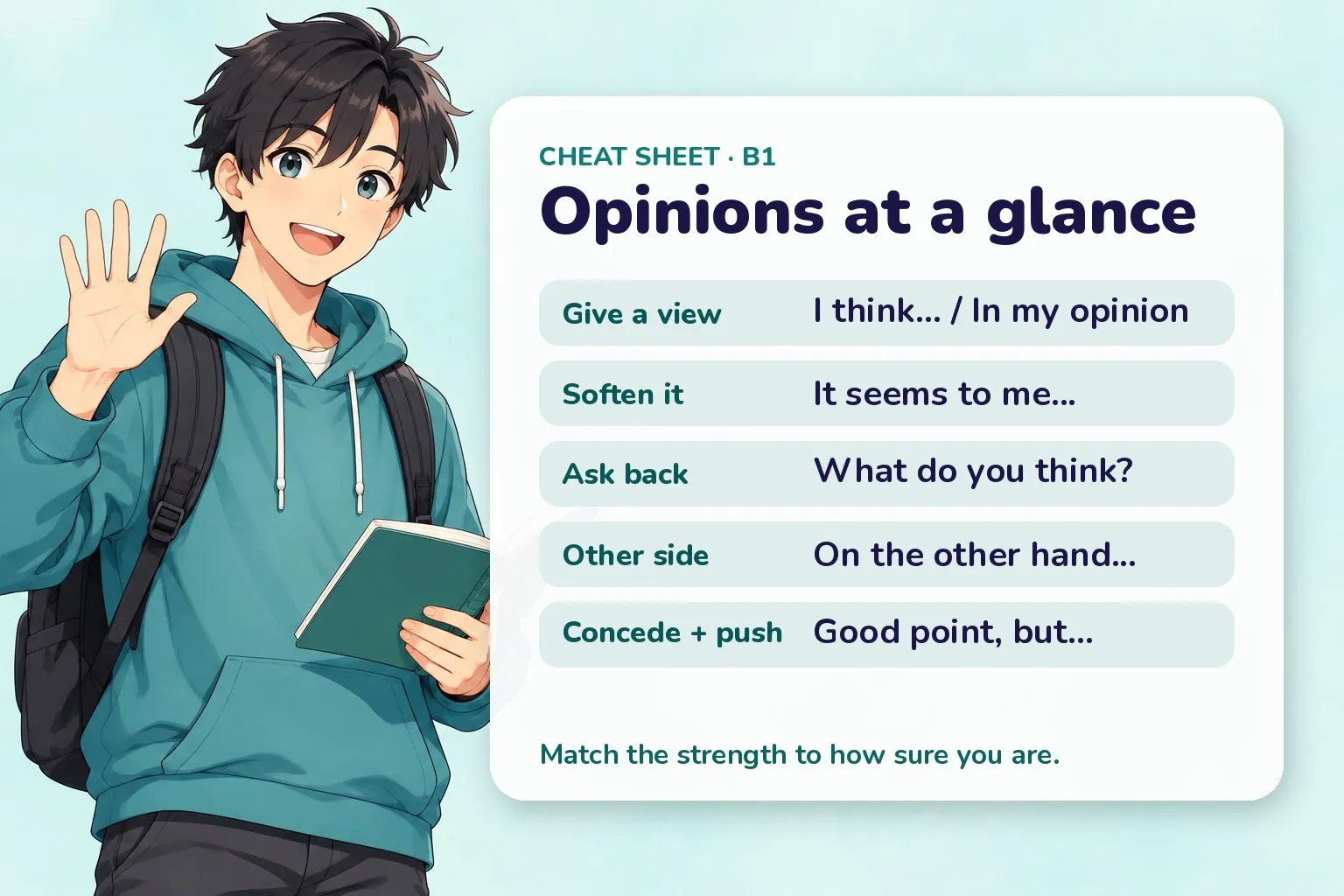
Quick recap before the quiz.
Quiz
Opinion phrases quiz
11 questions · pick an answer and you'll see straight away if it's right.
-
Show answer
I think — 'I think' is the default neutral signpost in English.
-
Show answer
I'm convinced that — 'I'm convinced that…' claims a high level of certainty.
-
Show answer
I agree with you. — 'Agree' is a verb, so no 'am': I agree with you.
-
Show answer
In my opinion, — 'In my opinion' is standard; 'according to' is for other people or sources.
-
Show answer
I may be wrong, but — 'I may be wrong, but…' softens the claim and invites disagreement.
-
Show answer
What's your take on this? — 'What's your take on this?' asks for a thought-out opinion.
-
Show answer
On the other hand, — 'On the other hand' signals the contrasting view.
-
Show answer
That's a good point, but I still have doubts. — 'That's a good point, but…' concedes a little before pushing back politely.
-
Show answer
seems — 'It seems to me that…' presents a view as a careful impression.
-
Show answer
I'm convinced that it is true. — Use 'I'm convinced that…' with no 'of' before 'that'.
-
Show answer
If you ask me, — 'If you ask me' is a relaxed, informal way to give a personal view.
Next
- Learn the technique: English: Expressing Opinions and Debating & Argumentation
- Next phrase set: English Agreeing & Disagreeing Phrases
- More phrases: the English phrases hub
- New here? Start with Start Learning English Here
All English phrases topics
Vocabulary, pronunciation, phrases, practice and exam help, ordered by level. Pick a topic and go straight to it. New lessons go live every day, so topics marked Coming soon fill in over the next weeks.
Phrases
A1 4 topics · 4 ready
A2 7 topics · 7 ready
B1 8 topics · 8 ready
- 12 English Small Talk Phrases
- 13 English Phone & Call Phrases
- 14 English Social & Making-Friends Phrases
- 15 English Doctor & Pharmacy Phrases
- 16 English Opinion & Discussion Phrases You are here
- 17 English Agreeing & Disagreeing Phrases
- 18 English Texting & Chat Phrases
- 19 English Complaint & Problem Phrases