English Phone & Call Phrases
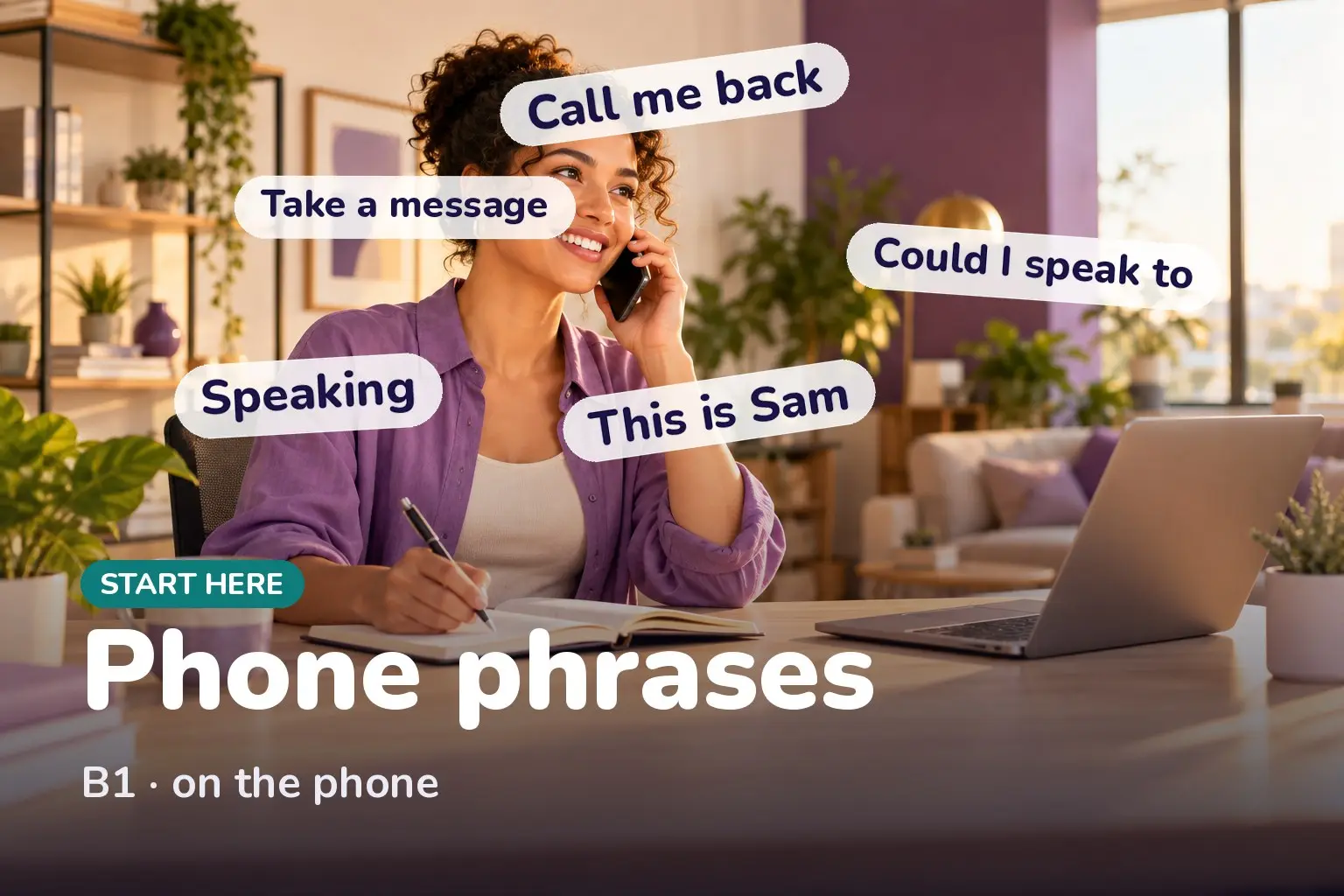
On the phone, answer with 'Hello?' or 'Good morning, [company]'. Ask with 'Could I speak to …, please?' and give your name with 'This is …'. If the person is out, leave a short voicemail: who, why, your number, and what you want them to do.
On this page12 sections · tap to jump
Level: B1. The phone is harder than face-to-face talk — no gestures, no lip-reading, sometimes a bad line. English has a set of fixed phone phrases that do the heavy lifting. Learn these and most calls follow a predictable shape. Each phrase is tagged with its register so you sound right whether it is a work call or a mate ringing you. For calls that set up meetings, pair this with the Phone & Messaging lesson and Making Appointments.
By the end of this page you can…
…answer a call, ask for the person you want, say who you are, take or leave a message, handle a bad line, and end the call politely.
Answering and giving your name
How you answer depends on where you are. At home a simple Hello? is normal; at work you usually name the company or yourself.
| Phrase | When to use | Register |
|---|---|---|
| Hello? | Answering a personal call | Neutral |
| Good morning, Acme Ltd, Sam speaking. | Answering a work call | Formal |
| Hi, it’s Sam. / This is Sam. | Saying who you are | Neutral |
| Hey, it’s me. | A friend who knows your voice | Informal |
| Speaking. | “You are already talking to that person” | Neutral |
Asking for someone
The polite request forms do the work here. The softer the form, the more polite it sounds.
| Phrase | When to use | Register |
|---|---|---|
| Could I speak to Mr Lee, please? | Standard polite request | Neutral–formal |
| Is Jo there, please? | A relaxed request | Neutral |
| I’m calling about the invoice. | Saying why you called | Neutral |
| I’d like to speak to someone in accounts. | Asking for a department | Neutral–formal |
Connecting, holding and messages
These are the phrases the person answering uses — and the ones you will hear.
| Phrase | When to use | Register |
|---|---|---|
| Hold the line, please. / Bear with me. | Asking the caller to wait | Neutral |
| I’ll put you through. | Transferring the call | Neutral |
| I’m afraid she’s not available. | The person can’t take the call | Formal |
| Can I take a message? | Offering to pass something on | Neutral |
| Could you ask him to call me back? | Leaving a message | Neutral |
Voicemail and ending the call
No answer? Leave a short, clear voicemail. Then close the call warmly.
| Phrase | When to use | Register |
|---|---|---|
| Hi, this is Sam from Acme, it’s about the order. | Opening a voicemail | Neutral |
| Could you call me back on 07… | Giving your number | Neutral |
| Thanks for your help. | Closing warmly | Neutral |
| I’ll let you go. / Speak soon. | Ending a friendly call | Neutral–informal |
| Thank you for calling. Goodbye. | Ending a work call | Formal |
Example phrases to say aloud
Play each line and copy the intonation — the phone rewards clear, calm speech.
- Good morning, Acme Ltd, Sam speaking.A formal way to answer a work call.
- Hello?The normal way to answer a personal call.
- Hi, this is Sam.Giving your name — note 'this is', not 'I am'.
- Could I speak to Mr Lee, please?A standard polite request.
- Speaking.Means you are already the person they asked for.
- I'm calling about the invoice.Saying why you called.
- Hold the line, please.Asking the caller to wait.
- I'll put you through.Transferring the call to someone else.
- I'm afraid she's not available at the moment.The person can't take the call.
- Can I take a message?Offering to pass something on.
- Could you ask him to call me back?Leaving a message.
- Could you speak up a little?Asking someone to talk louder.
- Sorry, you're breaking up.Telling someone the line is bad.
- Let me just read that back to you.Checking you noted a number correctly.
- Could you call me back on 07700 900123?Giving a callback number in a voicemail.
- Thanks for your help.Closing warmly before you hang up.
- Thank you for calling. Goodbye.Ending a work call politely.
- Speak soon!An informal way to end a friendly call.
A short conversation
Receptionist: Good morning, Bright Design, how can I help? Caller: Hello, could I speak to Maria in accounts, please? Receptionist: May I ask who’s calling? Caller: This is Tom Harris from Acme. It’s about last month’s invoice. Receptionist: I’m afraid Maria’s not available right now. Can I take a message? Caller: Yes, please — could you ask her to call me back on 07700 900123? Receptionist: Of course. I’ll pass that on. Thank you for calling.
Common mistakes
- ❌ I am Tom. (on the phone) → ✅ This is Tom. / It’s Tom. (Fixed phone phrase.)
- ❌ I want to speak to Mr Lee. → ✅ Could I speak to Mr Lee, please? (Softer request sounds polite.)
- ❌ Please waiting. → ✅ Hold the line, please. / Bear with me. (Use the set phrase.)
- ❌ Who are you? → ✅ May I ask who’s calling? (The direct question sounds rude on a call.)
- ❌ What? What? (on a bad line) → ✅ Sorry, you’re breaking up. (Name the problem clearly.)
Usage notes
- Register on work calls: open with the company name and yourself (Acme Ltd, Sam speaking); on personal calls a plain Hello? is normal.
- “This is” vs “It’s”: both give your name; This is Sam is a touch more formal, It’s Sam a touch more relaxed.
- Polite requests: Could you…? and Would you mind…? soften an order. See requests with can and could.
- BrE vs AmE: British Are you all right to talk?; American Is now a good time? Both check it is a good moment to call.
- Numbers: say phone numbers digit by digit, grouping with small pauses; 0 is often “oh” in British English.
Practice
Phone phrases practice
Try each one, then press Check. No sign-up, nothing is sent anywhere — it all runs in your browser.
Hint: the fixed phone phrase
Show answer
This — English uses 'This is Sam', not 'I am Sam', on the phone.
4 Put the words in order for a polite request.
Show answer
Could I speak to Maria, please — 'Could I speak to Maria, please?' is the standard polite request.
5 Match each phone phrase to its job.
- This is Sam.
- Can I take a message?
- I'll put you through.
- You're breaking up.
Show answer
- This is Sam. → give your name
- Can I take a message? → offer to pass it on
- I'll put you through. → transfer the call
- You're breaking up. → report a bad line
Each is a fixed phone phrase for one job.
Hint: a fixed phrase
Show answer
line — 'Hold the line, please' asks the caller to wait.
Recap cheat-sheet
| Step | Phrase | Register note |
|---|---|---|
| Answer (work) | Good morning, Acme Ltd, Sam speaking. | Formal |
| Give your name | This is Sam. | Not “I am Sam” |
| Ask for someone | Could I speak to …, please? | Could = polite |
| Take a message | Can I take a message? | Neutral |
| End (work) | Thank you for calling. Goodbye. | Formal |
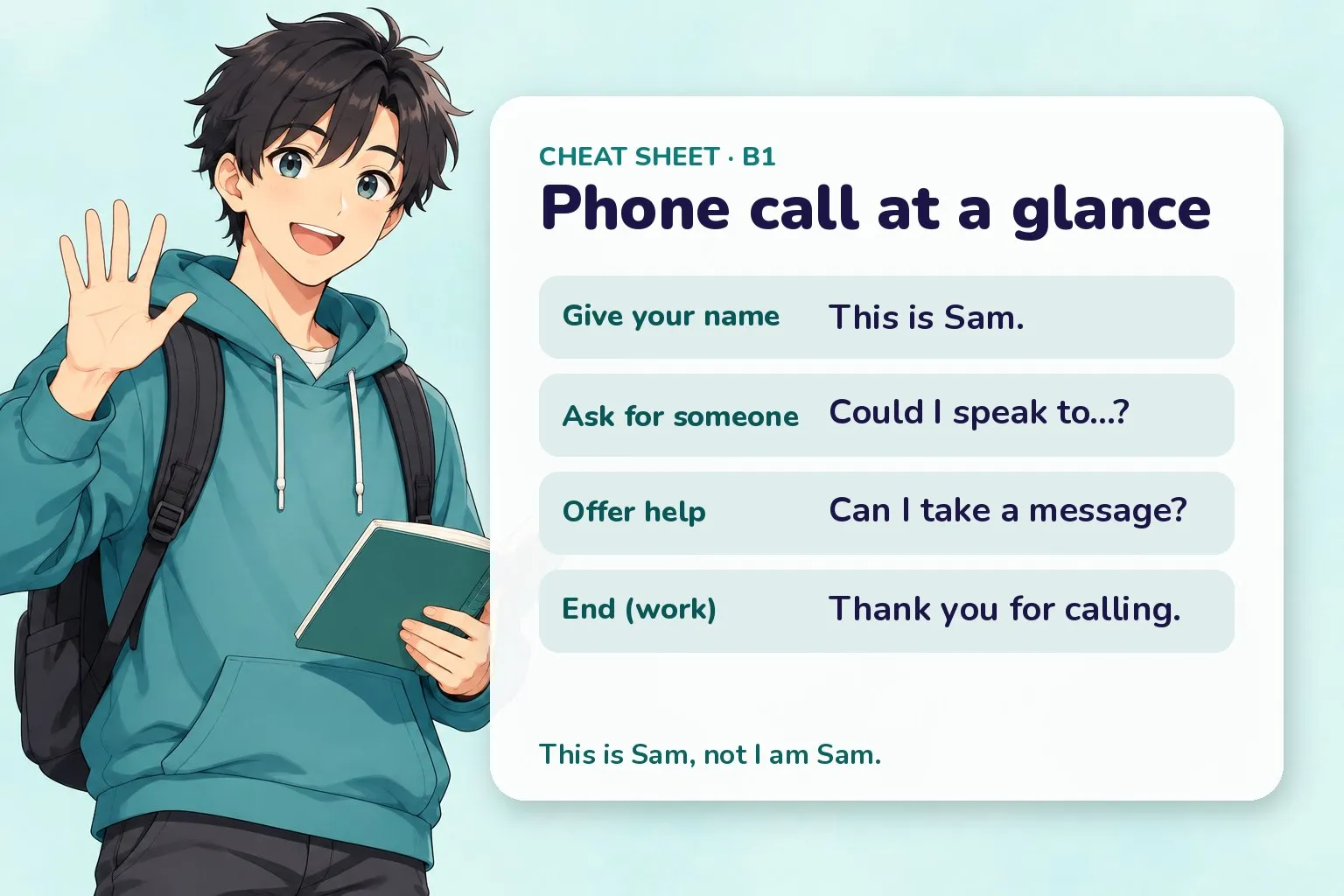
Quick recap before the quiz.
Quiz
Phone and call phrases quiz
10 questions · pick an answer and you'll see straight away if it's right.
-
Show answer
This is Sam. — The fixed phone phrase is 'This is Sam'.
-
Show answer
Speaking. — 'Speaking' means you are the person they asked for.
-
Show answer
Could I speak to Mr Lee, please? — 'Could I … please?' is the softest, most polite request.
-
Show answer
Hold the line, please. — 'Hold the line, please' is the set phrase.
-
Show answer
Can I take a message? — 'Can I take a message?' offers to pass something on.
-
Show answer
Sorry, you're breaking up. — Name the problem: 'Sorry, you're breaking up.'
-
Show answer
Thank you for calling. Goodbye. — 'Thank you for calling. Goodbye.' is formal and clear.
-
Show answer
A long life story — Keep a voicemail short: who, why, your number, next step.
-
Show answer
Hey, it's me. — 'Hey, it's me' is informal, for someone who knows your voice.
-
Show answer
May I ask who's calling? — 'May I ask who's calling?' is the polite form on a call.
Next
- Learn the whole call: English: Phone & Messaging
- Related lesson: English: Making Appointments
- Previous phrase set: English Small Talk Phrases
- Next phrase set: English Business Meeting Phrases
- New here? Start with Start Learning English Here
All English phrases topics
Vocabulary, pronunciation, phrases, practice and exam help, ordered by level. Pick a topic and go straight to it. New lessons go live every day, so topics marked Coming soon fill in over the next weeks.
Phrases
A1 4 topics · 4 ready
A2 7 topics · 7 ready
B1 8 topics · 8 ready
- 12 English Small Talk Phrases
- 13 English Phone & Call Phrases You are here
- 14 English Social & Making-Friends Phrases
- 15 English Doctor & Pharmacy Phrases
- 16 English Opinion & Discussion Phrases
- 17 English Agreeing & Disagreeing Phrases
- 18 English Texting & Chat Phrases
- 19 English Complaint & Problem Phrases