Building a Daily English Habit
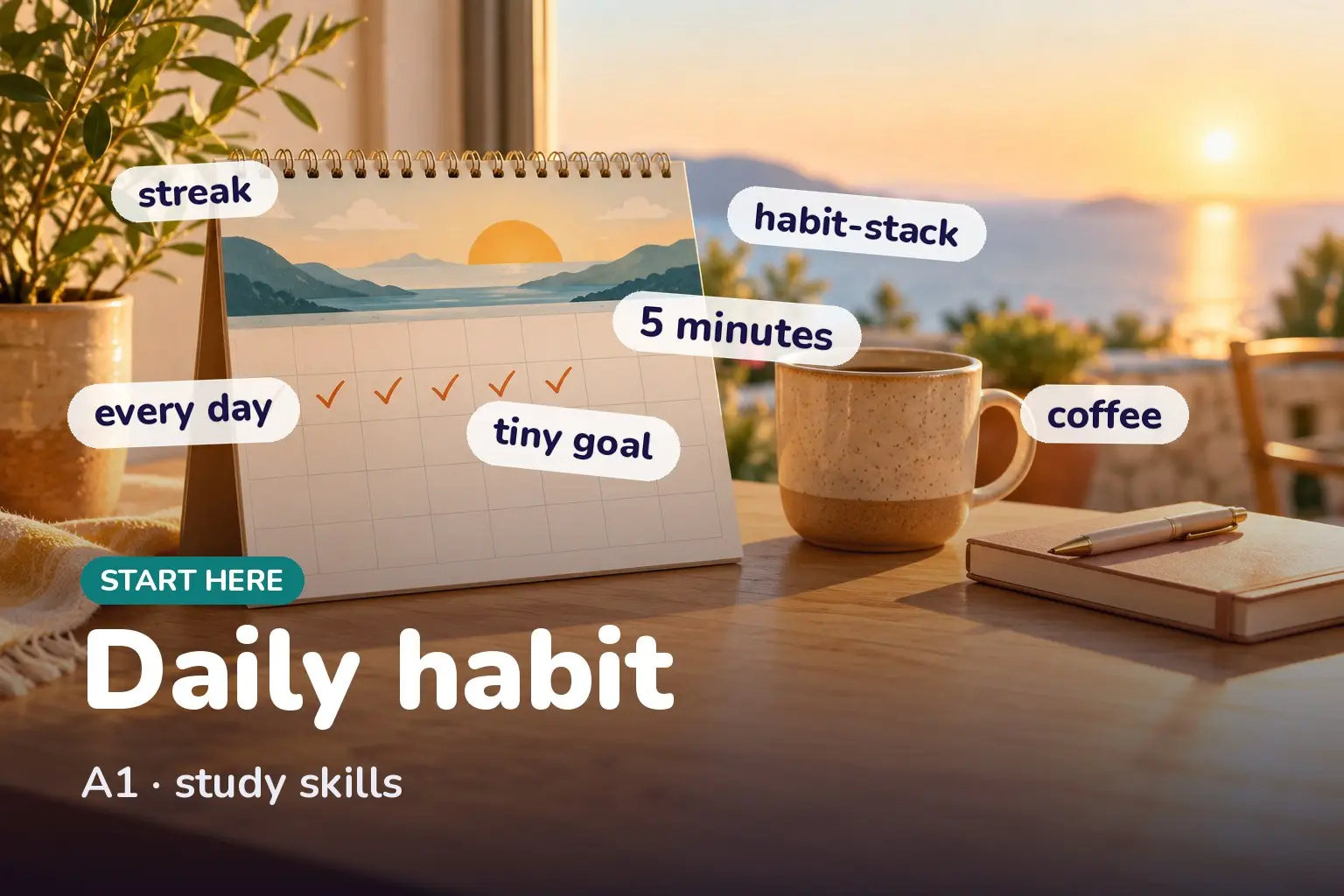
A daily English habit sticks when you make it small and automatic. Attach a few minutes of English to something you already do every day, keep the goal tiny enough that you never want to skip it, track the days you succeed, and get straight back on after a miss.
Level: A1. Motivation comes and goes, so you cannot rely on it. A habit is better: something you do without deciding every time. The goal of this page is to help you make English a small, automatic part of your day — one that survives a bad mood.
By the end of this page you can…
…set up a daily English habit that is small enough to keep, attached to your routine, and tracked so you can see your progress.
Start small — really small
The most common reason a study plan fails is that it is too big. A huge goal feels good on day one and impossible on day three. A tiny goal is easy to keep on a tired day, and keeping it is what builds the habit.
- Aim for five minutes a day, not an hour.
- One tiny goal might be: review five flashcards, read one short paragraph, or learn one new phrase.
- You can always do more. The rule is only that you never do less than the tiny goal.
Habit-stacking: attach English to your day
Habit-stacking means linking a new habit to something you already do every day. The old action becomes the reminder, so you do not have to remember or find motivation.
The pattern is: After I [existing habit], I will [English habit].
- After I make my morning coffee, I will review five English flashcards.The coffee is the cue; the review follows it.
- After I sit on the bus, I will listen to one English podcast.A fixed daily moment becomes study time.
- After I brush my teeth at night, I will learn one new phrase.A small, reliable end-of-day anchor.
- After I finish lunch, I will read one short English paragraph.Pair English with a meal you never skip.
Pick one existing habit that happens every single day and attach your English to it. Keep the same cue for a few weeks so the link becomes automatic.
Track your streak
Tracking turns an invisible effort into something you can see. Each day you keep your tiny goal, mark it. A row of ticks becomes a chain you will not want to break.
- Use a wall calendar, a notebook, or a habit app — whatever you will actually look at.
- Mark the day only when you have done your tiny goal.
- Watching the chain grow is its own small reward.
When you miss a day
You will miss a day — everyone does. A missed day does not undo your progress. What matters is the next day.
- Never miss twice. One skipped day is a blip; two in a row is the start of quitting.
- Do not try to make up for it with a giant session the next day. Just do your normal tiny goal.
- Do not feel guilty and quit. Guilt ends more habits than missed days do.
A simple daily routine to copy
- Pick your cue (coffee, bus, after dinner).
- Do your tiny goal: five flashcards, one paragraph, or one phrase.
- Mark the day on your tracker.
- If you missed yesterday, just start again today.
Tools on this site
- Build your five daily cards with How to Use Flashcards for English.
- Keep those words with spaced repetition.
- Print a tracker with the printable language worksheets.
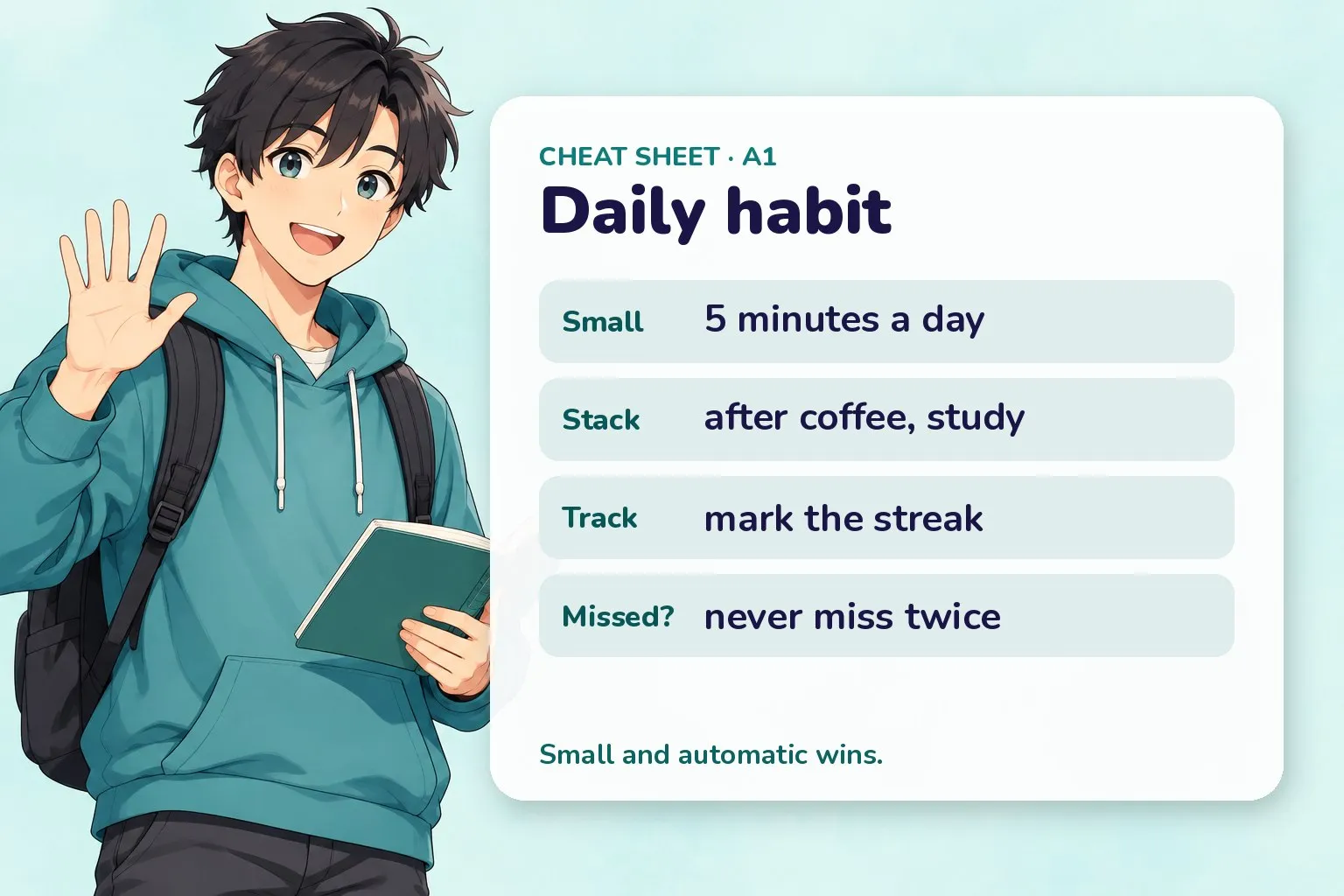
Quick recap before you practise.
Practice
Daily habit practice
Try each one, then press Check. No sign-up, nothing is sent anywhere — it all runs in your browser.
Hint: you build one habit on top of another
Show answer
stacking — Habit-stacking links the new habit to an existing daily cue.
4 Match each existing routine with an English habit you could stack on it.
- after morning coffee
- after sitting on the bus
- after brushing teeth at night
- after lunch
Show answer
- after morning coffee → review 5 flashcards
- after sitting on the bus → listen to a podcast
- after brushing teeth at night → learn one phrase
- after lunch → read one paragraph
Each daily action becomes the cue that triggers a small piece of English.
Quiz
Daily English habit quiz
7 questions · pick an answer and you'll see straight away if it's right.
-
Show answer
it does not depend on how you feel — Motivation comes and goes; a habit runs even on a bad day.
-
Show answer
five minutes or less — Make it too small to fail, then keep it every day.
-
Show answer
attaching a new habit to one you already do daily — The existing daily action becomes the cue for your English.
-
Show answer
After I make my coffee, I will review five flashcards. — The pattern After I [routine], I will [English] gives a clear, automatic cue.
-
Show answer
to make your effort visible and keep going — A visible chain of successful days becomes its own reward.
-
Show answer
never miss twice in a row — One missed day is normal; two in a row is how a habit dies.
-
Show answer
do a one-minute version to keep the chain — Doing the tiny version keeps the streak and the habit alive.
Next
- Browse all topics in the English start-here section
- Fill your five daily minutes with How to Use Flashcards for English
- New here? Start with Start Learning English Here
All English study topics
Vocabulary, pronunciation, phrases, practice and exam help, ordered by level. Pick a topic and go straight to it. New lessons go live every day, so topics marked Coming soon fill in over the next weeks.
Study topics
Start here 6 topics · 6 ready
- 01 Start Learning English Here
- 02 English Level Self-Test (A1-C1 Guide)
- 03 How to Use Flashcards for English
- 04 Spaced Repetition Explained
- 05 Top Mistakes English Learners Make
- 06 Building a Daily English Habit You are here
Lessons 56 topics · 56 ready
See the lessons page →- 07 English: Greetings & Introductions
- 08 English: Numbers 0 to 100
- 09 English: Introducing Yourself
- 10 English: Days, Months & Dates
- 11 English: Telling the Time
- 12 English: Giving Personal Information
- 13 English: Family Members
- 14 English: Describing People
- 15 English: Colours & Shapes
- 16 English: Food & Drink Basics
- 17 English: Ordering at a Cafe
- 18 English: Shopping & Prices
- 19 English: Clothing & Sizes
- 20 English: Asking for Directions
- 21 English: Using Public Transport
- 22 English: At the Hotel
- 23 English: Weather & Seasons
- 24 English: Hobbies & Free Time
- 25 English: Daily Routine
- 26 English: Housing & Rooms
- 27 English: Household Chores
- 28 English: At the Doctor
- 29 English: Parts of the Body
- 30 English: Emotions & Feelings
- 31 English: Making Appointments
- 32 English: Making Plans & Invitations
- 33 English: Phone & Messaging
- 34 English: Expressing Opinions
- 35 English: Talking About Past Experiences
- 36 English: Future Plans & Goals
- 37 English: School & Education
- 38 English: Jobs & Professions
- 39 English: At the Office
- 40 English: The Job Interview
- 41 English: Formal Writing & Emails
- 42 English: Money & Banking
- 43 English: Restaurant & Dining Out
- 44 English: Supermarket & Groceries
- 45 English: Travel & the Airport
- 46 English: Sightseeing & Tourism
- 47 English: Emergencies & Safety
- 48 English: Technology & the Internet
- 49 English: News & Current Affairs
- 50 English: Environment & Nature
- 51 English: Health & Lifestyle
- 52 English: Culture & Traditions
- 53 English: Describing Trends & Data
- 54 English: Debating & Argumentation
- 55 English: Idioms & Colloquialisms
- 56 English: Formal vs Informal Register
- 57 English: Storytelling & Narration
- 58 English: Complaints & Solving Problems
- 59 English: Giving a Short Presentation
- 60 English: Small Talk & Networking
- 61 English Small-Talk & Politeness Culture
- 62 Writing Business Emails in English
Vocabulary 47 topics · 47 ready
See the vocabulary page →- 63 100 Most Common English Words
- 64 English Words 101-250 (Frequency)
- 65 English Words 251-500 (Frequency)
- 66 English Words 501-1000 (Frequency)
- 67 English Words 1001-1500 (Frequency)
- 68 English Words 1501-2000 (Frequency)
- 69 English Words 2001-3000 (Frequency)
- 70 100 Essential English Verbs
- 71 Common English Adjectives
- 72 Everyday English Adverbs
- 73 English Connectors & Linking Words
- 74 English Question Words & Phrases
- 75 English Time Expressions
- 76 English Food & Cooking Vocabulary
- 77 English Animals Vocabulary
- 78 English Body & Health Vocabulary
- 79 English Clothing Vocabulary
- 80 English House & Furniture Vocabulary
- 81 English Kitchen & Tableware Vocabulary
- 82 English Transport & Travel Vocabulary
- 83 English Places in Town Vocabulary
- 84 English Nature & Geography Vocabulary
- 85 English Weather Vocabulary
- 86 English Jobs & Professions Vocabulary
- 87 English Technology & Internet Vocabulary
- 88 English Money & Shopping Vocabulary
- 89 English Emotions & Feelings Vocabulary
- 90 English Sports & Exercise Vocabulary
- 91 English Education & School Vocabulary
- 92 English Business & Work Vocabulary
- 93 English Family & Relationships Vocabulary
- 94 English Colours Vocabulary
- 95 English Verbs of Motion
- 96 English Opinion & Attitude Vocabulary
- 97 English Academic Vocabulary
- 98 English Medical & Pharmacy Vocabulary
- 99 English Admin & Paperwork Vocabulary
- 100 English Environment & Climate Vocabulary
- 101 English Arts, Music & Film Vocabulary
- 102 100 Essential English Phrasal Verbs
- 103 Commonly Confused English Words
- 104 British vs American English
- 105 English Irregular Verbs Reference
- 106 Academic Word List: Set 1
- 107 Academic Word List: Set 2
- 108 Linking Words for Essays
- 109 English Numbers, Dates & Money
Pronunciation & writing 11 topics · 11 ready
See the pronunciation & writing page →- 110 English Pronunciation Overview
- 111 The English Alphabet & Its Sounds
- 112 English Vowel Sounds (IPA)
- 113 English Consonant Sounds (IPA)
- 114 English Word Stress
- 115 Sentence Stress & Rhythm
- 116 English Intonation Patterns
- 117 English Silent Letters
- 118 English Spelling Rules & Patterns
- 119 English Contractions & Reductions
- 120 English Connected Speech (Linking)
Practice 9 topics · 9 ready
See the practice page →- 121 Shadowing to Improve English Speaking
- 122 How to Practise English Listening
- 123 English Reading Practice: Beginner
- 124 English Reading Practice: Elementary
- 125 English Reading Practice: Intermediate
- 126 English Reading Practice: Upper-Intermediate
- 127 How to Practise English Writing
- 128 Common English Collocations
- 129 English Minimal Pairs Practice
Phrases 20 topics · 20 ready
See the phrases page →- 130 50 English Survival Phrases
- 131 English Greetings & Goodbyes
- 132 English Politeness & Please/Thank-You
- 133 English Travel Phrases
- 134 English Restaurant Phrases
- 135 English Hotel Phrases
- 136 English Shopping Phrases
- 137 English Asking Directions Phrases
- 138 English Emergency Phrases
- 139 English Small Talk Phrases
- 140 English Phone & Call Phrases
- 141 English Business Meeting Phrases
- 142 English Social & Making-Friends Phrases
- 143 English Airport Phrases
- 144 English Doctor & Pharmacy Phrases
- 145 English Opinion & Discussion Phrases
- 146 English Agreeing & Disagreeing Phrases
- 147 English Texting & Chat Phrases
- 148 English Classroom Phrases
- 149 English Complaint & Problem Phrases
Exams 21 topics · 21 ready
See the exams page →- 150 English Exams: Which One & How to Prepare
- 151 IELTS Overview: Format & Scoring
- 152 IELTS Listening: Format & Strategies
- 153 IELTS Reading: Format & Strategies
- 154 IELTS Academic Writing Task 1
- 155 IELTS Writing Task 2 (Essay)
- 156 IELTS Speaking: Parts 1-3
- 157 Understanding IELTS Band Scores
- 158 TOEFL iBT Overview: Format & Scoring
- 159 TOEFL Reading Strategies
- 160 TOEFL Listening Strategies
- 161 TOEFL Speaking Tasks
- 162 TOEFL Writing (incl. Integrated)
- 163 Cambridge English Exams Explained
- 164 A2 Key (KET) Overview
- 165 B1 Preliminary (PET) Overview
- 166 B2 First (FCE) Overview
- 167 C1 Advanced (CAE) Overview
- 168 C2 Proficiency (CPE) Overview
- 169 Exam Essay & Writing Skills
- 170 Exam Speaking Strategies