Indonesian Agentive Passive: Pronoun + Verb
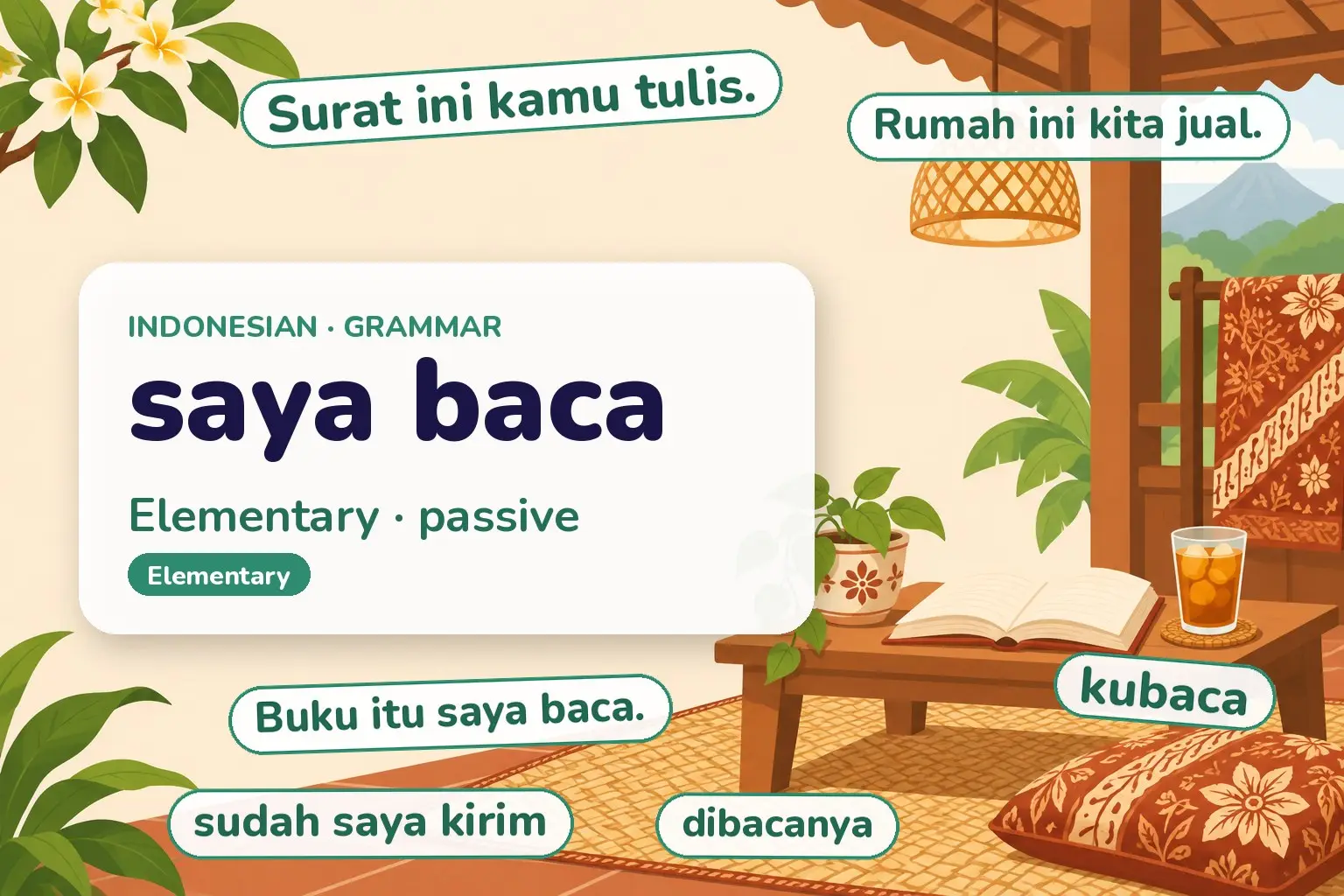
With a first- or second-person agent, Indonesian makes the passive from the pronoun plus the bare verb: Buku itu saya baca ('I read that book'). No di-, no meN-, no oleh — the object starts the clause and the pronoun sits directly before the verb.
Level: Elementary. Indonesian has two ways to say “that book was read”: the familiar di- passive, and a second pattern that puts the reader in the sentence — Buku itu saya baca. The second one is the one you hear in conversation, in messages and in stories, and it takes about ten minutes to master once you see what it is doing.
The rule
A passive clause takes the thing acted on and makes it the starting point of the sentence. English does this with be plus a participle: That book was read by me. Indonesian does it without any helping verb at all.
There are two shapes. The first is the di- passive: attach di- to the base verb and name the doer after oleh if you need to. Buku itu dibaca Budi — “that book was read by Budi”. The di- form carries no information about who is doing the reading, so the doer is either named afterwards or left out.
The second shape, the one this page is about, is used when the doer is you or me — a first- or second-person pronoun. Here Indonesian does something that looks strange from an English angle: it puts the pronoun directly before the bare verb and leaves the verb completely unaffixed. Buku itu saya baca. No di-, no meN-, no oleh.
So the verb membaca (“to read”, active) has three related shapes:
| Shape | Form | Example | Who acts |
|---|---|---|---|
| active | meN- + base | Saya membaca buku itu. | the subject before the verb |
| di- passive | di- + base | Buku itu dibaca Budi. | named after oleh, or left out |
| agentive passive | pronoun + bare base | Buku itu saya baca. | the pronoun before the bare verb |
The agentive passive is not a casual shortcut. It is the standard pattern for a first- or second-person agent, and it is what makes Indonesian dialogue sound natural: the thing being discussed starts the sentence, and the person doing it is a light word in the middle.
The forms
The pronoun set is short, and the pattern is identical for every member of it.
| Agent | Passive clause | Active counterpart |
|---|---|---|
| saya | Buku itu saya baca. | Saya membaca buku itu. |
| aku | Buku itu aku baca. | Aku membaca buku itu. |
| kami | Buku itu kami baca. | Kami membaca buku itu. |
| kita | Buku itu kita baca. | Kita membaca buku itu. |
| kamu | Buku itu kamu baca. | Kamu membaca buku itu. |
| engkau | Buku itu engkau baca. | Engkau membaca buku itu. |
| kalian | Buku itu kalian baca. | Kalian membaca buku itu. |
The verb does not change for person, number or tense. What changes is the pronoun — and the fact that the meN- prefix of the active verb disappears completely.
The same erasure happens with every base verb, which is why the pattern transfers so quickly:
| Base | Active (meN-) | Agentive passive with saya |
|---|---|---|
| baca | membaca (to read) | saya baca |
| tulis | menulis (to write) | saya tulis |
| kirim | mengirim (to send) | saya kirim |
| beli | membeli (to buy) | saya beli |
| lihat | melihat (to see) | saya lihat |
| cuci | mencuci (to wash) | saya cuci |
| bawa | membawa (to bring) | saya bawa |
| pesan | memesan (to order) | saya pesan |
Notice what the passive does not have: no ber-, no ter-, no -kan added on top. If the base verb already contains a suffix — kirimkan, bacakan — the suffix stays, and only the meN- goes: surat itu saya kirimkan (“I sent the letter”).
Where the adverbs go
The pronoun and the verb form a tight pair. Anything that modifies the action — sudah (already), belum (not yet), akan (will), harus (must), bisa (can), tidak (not) — stands before the pronoun:
| Wrong place | Right place | Meaning |
|---|---|---|
| Buku itu saya sudah baca. | Buku itu sudah saya baca. | I have already read that book. |
| Surat itu saya belum kirim. | Surat itu belum saya kirim. | I haven’t sent that letter yet. |
| Pesanan itu saya akan bayar. | Pesanan itu akan saya bayar. | I’ll pay that order. |
| Tas itu saya tidak bawa. | Tas itu tidak saya bawa. | I didn’t bring that bag. |
The order is: topic — adverb or auxiliary — pronoun — bare verb. It is the same order an English speaker already uses with a time word in front (that book, I have already read), so the rhythm is easier than the labels suggest.
Example sentences
- Buku itu saya baca.I read that book.pronoun + bare verb
- Surat ini saya tulis.I wrote this letter.tulis, no meN-
- Nasi itu sudah saya makan.I've already eaten that rice.sudah before the pronoun
- Sudah kamu minum kopinya?Have you drunk the coffee?question keeps the same order
- Mobil itu kami beli tahun lalu.We bought that car last year.kami as agent
- Rumah ini kita jual.We're selling this house.kita includes the listener
- Film itu belum saya lihat.I haven't seen that film yet.belum + pronoun + verb
- Pesanan itu sudah saya kirim.I've sent that order.kirim stays bare
- Sepatu ini saya beli di Jakarta.I bought these shoes in Jakarta.a place phrase can follow
- Baju itu harus kamu cuci.You have to wash that shirt.harus before kamu
- Kabar itu saya dengar dari teman.I heard that news from a friend.dengar = to hear
- Buku yang saya baca itu tebal.The book I'm reading is thick.relative clause: yang + saya + verb
- Surat itu akan saya balas besok.I'll answer that letter tomorrow.akan before saya
- Tas ini bisa saya bawa?Can I take this bag?bisa = can
- Kopi itu saya minum setiap pagi.I drink that coffee every morning.habit, no tense marker
- Apa yang kamu cari?What are you looking for?cari = to look for
- Itu yang saya maksud.That's what I mean.maksud = to mean
- Pesan ini saya tulis untuk kamu.I wrote this message for you.untuk = for
- Semua sudah kami siapkan.We've prepared everything.sudah kami siapkan
- Buku itu dibaca oleh dia.That book was read by him.third person: di- + oleh
Common mistakes
- ❌ Buku itu saya membaca. → ✅ Buku itu saya baca. The meN- prefix belongs to the active verb; after a pronoun agent the verb is bare.
- ❌ Buku itu saya dibaca. → ✅ Buku itu saya baca. di- is for third-person agents; with saya it doubles the passive.
- ❌ Buku itu saya baca oleh saya. → ✅ Buku itu saya baca. oleh is not used with a pronoun agent.
- ❌ Buku itu baca saya. → ✅ Buku itu saya baca. The pronoun comes before the verb, not after it.
- ❌ Buku itu saya lihat sudah. → ✅ Buku itu sudah saya lihat. The adverb does not trail the verb either; it sits in front of the whole agent–verb unit.
A short conversation
Di kantor pos — at the post office: — Paket ini mau dikirim ke mana? (Where is this parcel going?) — Ke Surabaya. Sudah saya tulis alamatnya di sini. (To Surabaya. I’ve written the address here.) — Baik. Formulirnya sudah Bapak isi? (Fine. Have you filled in the form, sir?) — Belum. Bagian mana yang harus saya isi? (Not yet. Which part do I have to fill in?) — Nama dan nomor telepon saja. Bisa saya bantu kalau perlu. (Only the name and phone number. I can help if needed.)
Usage notes
- ku- is aku, glued on. In writing and fast speech, aku fuses with the verb as ku-: Buku itu kubaca, Aku sudah bilang → Sudah kubilang (“I already said it”). Recognise it in reading; produce it once the bare pattern is automatic.
- -nya marks the third person. The compact third-person passive attaches -nya to the di- verb instead of naming the agent: Buku itu dibacanya, Surat itu dikirimnya kemarin. This is how most narrative prose handles “he read it”.
- The relative clause loves this pattern. Buku yang saya baca, film yang kami tonton — after yang the agentive passive is the normal way to say “the book that I read”. You will meet it constantly.
- It is a topic-comment sentence, not a word-for-word passive. The opening noun is what the conversation is about; the pronoun-plus-verb says what happened to it. That is why a place or time phrase can still follow: Sepatu ini saya beli di Jakarta.
- akrab vs polite pronouns. aku/kamu are for friends and family; saya/Anda are the neutral-polite pair. The passive pattern is identical — only the pronoun changes. See Indonesian personal pronouns.
Compared with the di- passive
Both clauses are passive and both start with the thing acted on. The difference is entirely the person of the agent.
| di- passive | Agentive passive | |
|---|---|---|
| Agent | third person, a name, or unnamed | saya, aku, kami, kita, kamu, engkau, kalian |
| Verb form | di- + base | bare base, no affix |
| Agent marker | after oleh, or nothing | the pronoun itself |
| Example | Buku itu dibaca (oleh Budi). | Buku itu saya baca. |
| Typical use | reports, news, unknown doer | conversation, messages, first person |
The di- form is the one a news report reaches for, because the doer often does not matter. The agentive form is the one you reach for, because the doer is you. The full di- paradigm, including di-…-kan and di-…-i, is on Indonesian passive with di-; the active side it mirrors is on Indonesian meN- verbs.
How to say it
| Point | How to say it |
|---|---|
| c | “ch” as in check: baca = “BA-cha”, cuci = “CHU-chi”. |
| final -k | a soft catch in the throat, not a hard “k”: tidak = “tee-DAH”, pak = “pah”. |
| ng | one sound as in singer: kirim keeps a clean “m”, but dengar = “DEH-ngar”. |
| stress | light and even, on the second-last syllable of a word: membaca = “mem-BA-cha”, dikirim = “di-KI-rim”. |
Practice
Agentive passive practice
Try each one, then press Check. No sign-up, nothing is sent anywhere — it all runs in your browser.
Hint: bare base verb, no meN-
Show answer
kirim — belum + saya + bare verb: belum saya kirim.
Hint: before the pronoun
Show answer
sudah — sudah stands before saya, not between saya and baca.
5 Build: 'We bought that car last year.'
Show answer
Mobil itu kami beli tahun lalu — Topic first, then agent pronoun, then bare verb and the time phrase.
6 Match each agent to the right passive clause.
- saya
- kamu
- dia
- Budi
Show answer
- saya → Buku itu saya baca.
- kamu → Buku itu kamu baca.
- dia → Buku itu dibacanya.
- Budi → Buku itu dibaca Budi.
First and second person take the bare verb; third person takes di-.
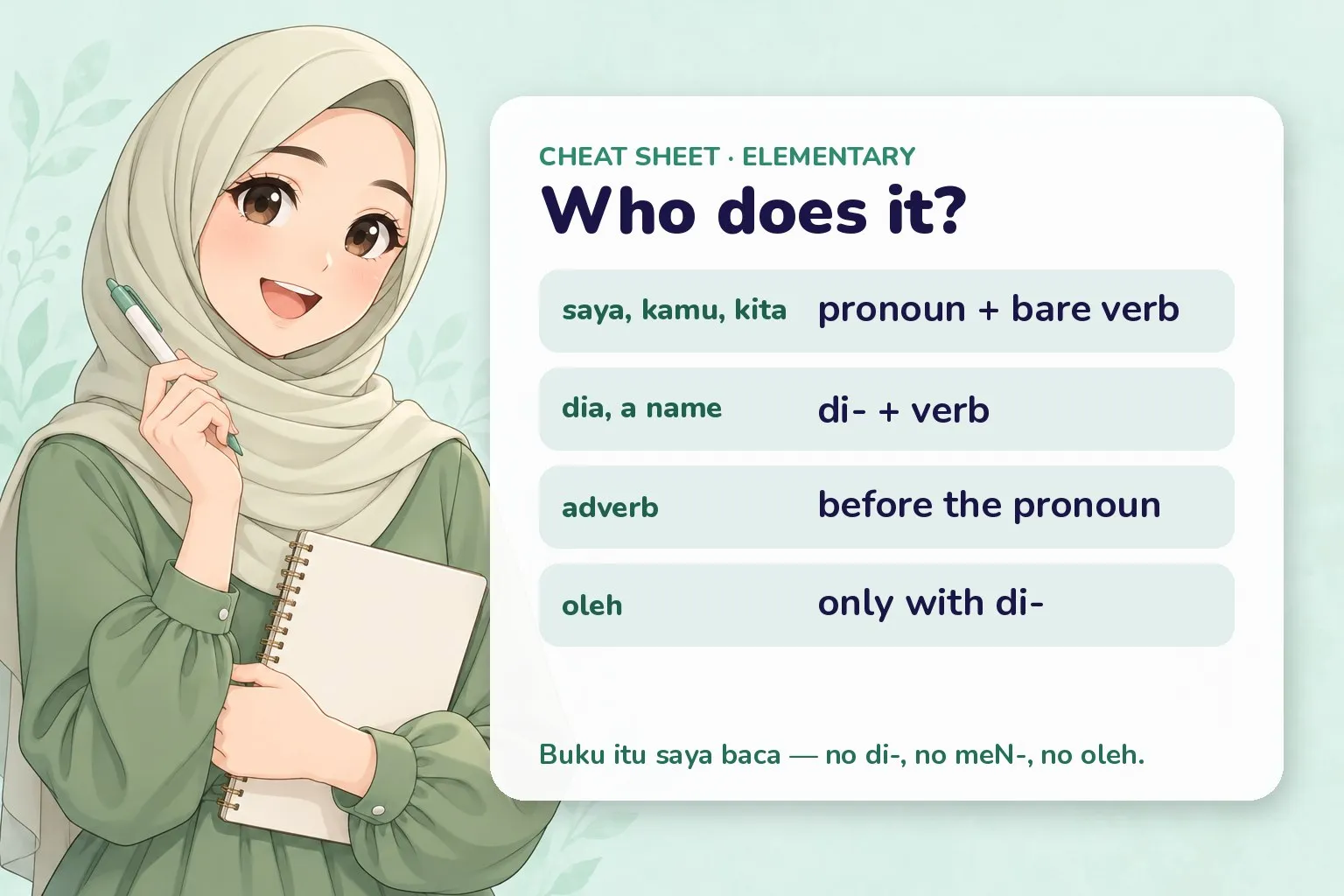
Quick recap before the quiz.
Quiz
Indonesian agentive passive
12 questions · pick an answer and you'll see straight away if it's right.
-
Show answer
pronoun plus the bare verb — The pronoun precedes the unaffixed base verb.
-
Show answer
saya — First and second person pronouns take it; names and dia take di-.
-
Show answer
I read that book. — Topic first, then saya + baca.
-
Show answer
Surat ini kamu tulis. — kamu + bare verb, no meN- and no di-.
-
Show answer
before the pronoun — Adverbs precede the pronoun–verb pair: sudah saya baca.
-
Show answer
di- on the verb — dia and names take the di- passive, often with -nya.
-
Show answer
he or she read it — The -nya marks a third-person agent.
-
Show answer
Buku itu saya sudah baca. — The adverb cannot sit between the pronoun and the verb.
-
Show answer
aku — aku fuses with the verb: ku- + baca.
-
Show answer
a relative clause — yang + agentive passive forms the relative clause 'that I read'.
-
Show answer
the pronoun alone marks a first-person agent — oleh belongs with di- and a named third-person agent.
-
Show answer
lihat — lihat stays bare after the pronoun.
Recap cheat-sheet
| Agent | Form | Example |
|---|---|---|
| saya / aku | pronoun + bare verb | Buku itu saya baca. |
| kami / kita | pronoun + bare verb | Rumah ini kita jual. |
| kamu / engkau / kalian | pronoun + bare verb | Baju itu harus kamu cuci. |
| dia / a name | di- (+ oleh / -nya) | Buku itu dibaca oleh dia. |
| adverbs | before the pronoun | Sudah saya baca. |
| relative clause | yang + pronoun + bare verb | buku yang saya baca |
Next
- The third-person partner of this page: Indonesian passive with di-
- The active prefix that disappears here: Indonesian meN- verbs
- The pronouns in full: Indonesian personal pronouns
- Where the topic goes in a sentence: Indonesian word order
- Back to the Indonesian grammar section, or start at Start Learning Indonesian Here
All Indonesian grammar topics
Every grammar point in order, from your first sentence to advanced structures. Pick one and go straight to it. New lessons go live every day, so topics marked Coming soon fill in over the next weeks.
Grammar path
Beginner 18 topics · 18 ready
- 01 Indonesian Personal Pronouns
- 02 Basic Word Order (Subject-Verb-Object)
- 03 Sentences Without 'To Be'
- 04 Noun + Adjective Order
- 05 Possession (Noun + Owner)
- 06 Plurals and Reduplication
- 07 Yes/No Questions (apakah, intonation)
- 08 Question Words (apa, siapa, di mana)
- 09 Negation: tidak vs bukan
- 10 Demonstratives (ini, itu)
- 11 Numbers and Classifiers
- 12 Common Prepositions (di, ke, dari)
- 13 Existence and 'Have' with ada / punya
- 14 Manner Deixis (begini, begitu) & sini/situ/sana
- 15 Particles -lah, -kah, -pun
- 16 Question Tags (kan, ya, bukan)
- 17 Adverbs of Frequency (selalu, sering, kadang)
- 18 Telling the Time
Elementary 24 topics · 4 ready
- 19 The Prefix ber-
- 20 The Prefix meN- (Active Transitive)
- 21 The Passive with di-
- 22 Agent-Focus Passive (Pronoun + Verb) You are here
- 23 Aspect Markers (sudah, sedang, akan, belum, masih) Coming soon
- 24 Modal Words (bisa, boleh, harus, mau, ingin) Coming soon
- 25 Comparatives and Superlatives Coming soon
- 26 Ordinal Numbers and Dates Coming soon
- 27 Basic Conjunctions (dan, tetapi, atau, karena) Coming soon
- 28 Imperatives and Requests Coming soon
- 29 Adverbs and Intensifiers (sangat, sekali, agak) Coming soon
- 30 Only / Just (hanya, cuma, saja) Coming soon
- 31 Again / Still / More (lagi, masih, tambah) Coming soon
- 32 Experience (pernah, belum pernah) Coming soon
- 33 Purpose Clauses (untuk, supaya, agar) Coming soon
- 34 Cause Clauses (karena, sebab, gara-gara) Coming soon
- 35 Quantifiers (semua, setiap, beberapa, banyak) Coming soon
- 36 Complement Clauses with bahwa Coming soon
- 37 The Suffix -an (Result Nouns) Coming soon
- 38 The Prefix ke- (ketua, kekasih) Coming soon
- 39 Adverbial -nya (biasanya, sebenarnya) Coming soon
- 40 The Clitic -nya as a Definite Marker Coming soon
- 41 Sequencing (lalu, kemudian, setelah itu) Coming soon
- 42 Before & After (sebelum, setelah, sesudah) Coming soon
Intermediate 20 topics
- 43 The meN-...-kan Construction Coming soon
- 44 The meN-...-i Construction Coming soon
- 45 Nominalising Affixes (pe-, pe-an, per-an, ke-an) Coming soon
- 46 The Prefix ter- (Accidental/Superlative/Stative) Coming soon
- 47 The Prefix se- (One/Same/As) Coming soon
- 48 Relative Clauses with yang Coming soon
- 49 Subordinating Conjunctions (jika, meskipun) Coming soon
- 50 Types of Reduplication Coming soon
- 51 Classifiers and Quantity Expressions Coming soon
- 52 Passive Register (di- vs ter- vs ke-an) Coming soon
- 53 Reciprocal (saling, satu sama lain) Coming soon
- 54 Intensive & Reflexive (diri, sendiri) Coming soon
- 55 Correlative Conjunctions (baik...maupun) Coming soon
- 56 Degree (terlalu, cukup, kurang) Coming soon
- 57 The More...The More (makin, semakin) Coming soon
- 58 Simultaneous Actions (sambil, selagi, sementara) Coming soon
- 59 The Prefix memper- (Causative) Coming soon
- 60 ke-...-an Adversative Verbs (kehujanan) Coming soon
- 61 The Frame se-...-nya (sebaiknya, secepatnya) Coming soon
- 62 Compound Words (kata majemuk) Coming soon
Advanced 11 topics
- 63 Advanced Nominalisation & Formal Syntax Coming soon
- 64 Discourse Markers & Cohesion Coming soon
- 65 Formal (baku) vs Colloquial Indonesian Coming soon
- 66 Advanced Passive & Object Preposing Coming soon
- 67 Idiomatic & Layered Affixation Coming soon
- 68 Conditionals & Hypotheticals (seandainya, andai) Coming soon
- 69 Large Numbers, Fractions & Approximation Coming soon
- 70 Compound & Complex Sentences Coming soon
- 71 Topic, Focus & Cleft (yang...itu) Coming soon
- 72 Apposition and Appositive Clauses Coming soon
- 73 Restoring Dropped Affixes (Formal Writing) Coming soon