Indonesian Prepositions: di, ke, dari and more
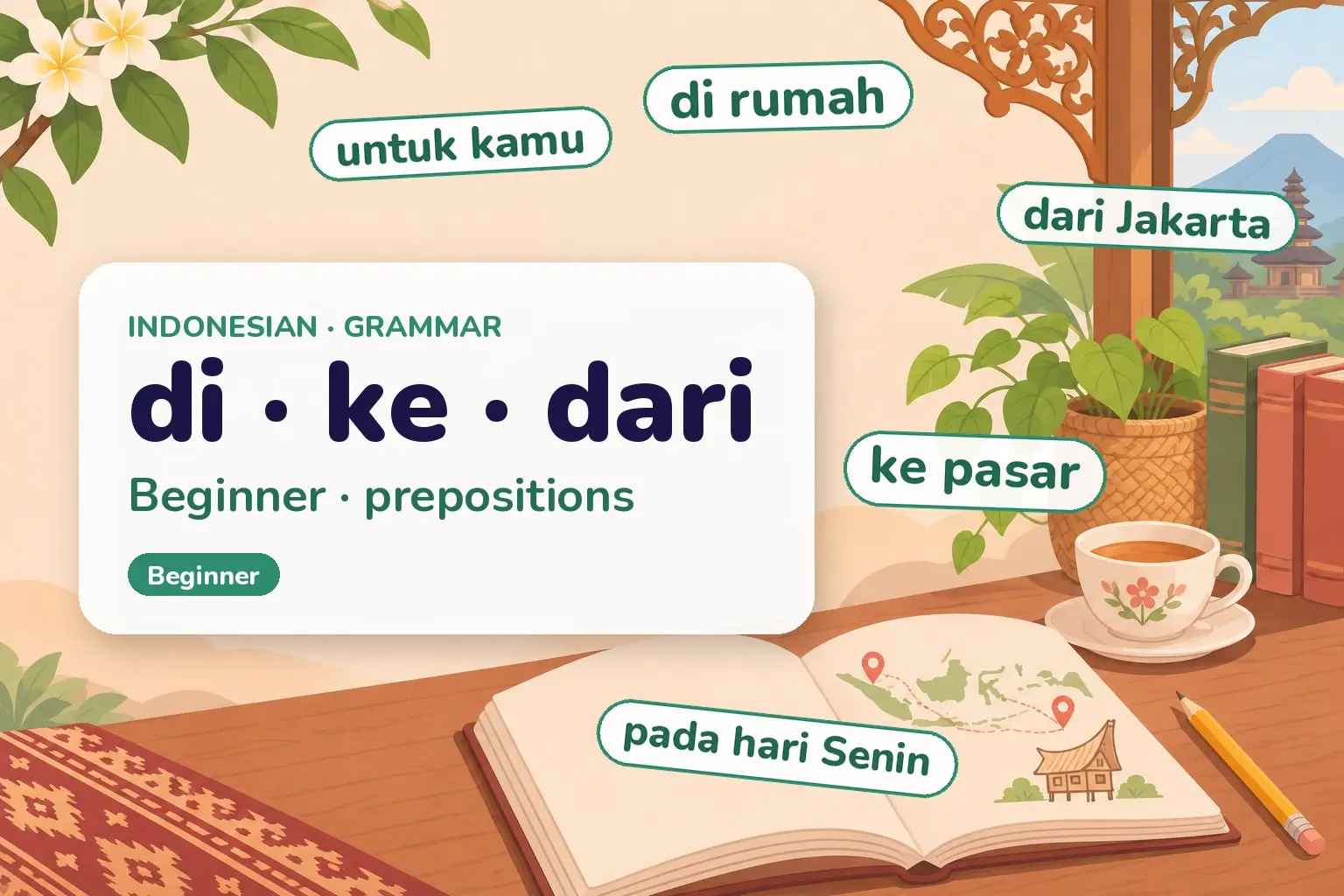
The core Indonesian prepositions are di (at/in a place), ke (to a place) and dari (from). As prepositions they are written as separate words — di rumah, ke pasar, dari Jakarta — unlike the attached prefix di-.
Level: Beginner. Prepositions are the little words that place things — at, to, from, for, with. Indonesian gets a long way with just a handful, and the main thing to master is how they are spelled.
The rule
A preposition links a noun to the rest of the sentence, usually showing place, direction, time or purpose. The three you need first are:
- di — at / in / on a place: di rumah (at home), di sekolah (at school).
- ke — to / towards a place: ke pasar (to the market), ke Jakarta (to Jakarta).
- dari — from: dari kantor (from the office), dari Bali (from Bali).
Three more cover most everyday needs:
- pada — at / on, used for time and before people or abstract things: pada hari Senin (on Monday).
- untuk — for (purpose or recipient): untuk kamu (for you).
- dengan — with: dengan teman (with a friend).
The single most important point: as prepositions, di and ke are written as separate words before the place. There is also a prefix di- (and ke-) that is joined to the following word and does something completely different — more on that below.
The forms at a glance
| Preposition | Meaning | Example | English |
|---|---|---|---|
| di | at / in / on (place) | di rumah | at home |
| ke | to (place) | ke pasar | to the market |
| dari | from | dari Jakarta | from Jakarta |
| pada | at / on (time, people) | pada pukul tujuh | at seven o’clock |
| untuk | for | untuk ibu | for mother |
| dengan | with | dengan sepeda | with/by bicycle |
| kepada | to (a person) | kepada guru | to the teacher |
di the preposition vs di- the prefix
This is the classic Indonesian spelling trap, worth its own section:
- di + place (separate): di meja (on the table), di sini (here), di mana? (where?).
- di- + verb root (joined): dibaca (is read), ditulis (is written), dimakan (is eaten). This di- makes a passive verb; it is not about place at all.
A quick test: if the word after di is a place or location, write a space. If it attaches to a verb and means something is being done, join it. The same logic separates ke pasar (to the market) from the prefix in kehujanan (caught in the rain).
Example sentences
- Saya di rumah.I am at home.di + place, separate
- Dia ada di sekolah.She is at school.
- Buku ada di meja.The book is on the table.
- Kami pergi ke pasar.We are going to the market.ke + place
- Saya mau ke Jakarta.I want to go to Jakarta.
- Dia datang dari kantor.He comes from the office.dari = from
- Saya dari Indonesia.I am from Indonesia.
- Kami bertemu pada hari Senin.We meet on Monday.pada for time
- Toko buka pada pukul sembilan.The shop opens at nine o'clock.
- Ini untuk kamu.This is for you.untuk = for
- Saya membeli hadiah untuk ibu.I am buying a gift for mother.
- Dia pergi dengan teman.He goes with a friend.dengan = with
- Saya menulis dengan pena.I write with a pen.dengan = with/using
- Di mana kamu tinggal?Where do you live?di mana = where
- Surat itu dari nenek.That letter is from grandmother.
- Buku ini dibaca oleh anak.This book is read by the child.di- prefix, joined, passive
- Nasi sudah dimakan.The rice has been eaten.di- prefix, joined
- Saya memberi uang kepada adik.I give money to my little sibling.kepada before a person
Common mistakes
- ❌ dirumah (meaning “at home”) → ✅ di rumah. A place after di needs a space.
- ❌ di baca (meaning “is read”) → ✅ dibaca. The passive prefix di- joins the verb.
- ❌ di hari Senin → ✅ pada hari Senin. Use pada, not di, for a point in time.
- ❌ untuk dengan kamu → ✅ untuk kamu or dengan kamu. Pick one preposition; they are not stacked.
- ❌ Saya memberi kepada… / di adik → ✅ kepada adik. Giving something to a person uses kepada, not di.
A short conversation
Di stasiun: — Permisi, kamu mau ke mana? — Saya mau ke Bandung. Kamu dari mana? — Saya dari Jakarta. Kereta berangkat pada pukul delapan.
Usage notes
- dengan can mean “by”: with a tool or means of transport it reads as “by” — dengan bus (by bus), dengan tangan (by hand).
- kepada vs untuk: kepada marks the person you give/send something to; untuk marks who or what it is for. Hadiah untuk ibu (a gift for mother) vs memberi kepada ibu (giving to mother).
- di sini / di situ / di sana: place words combine with di just like nouns — here, there (near), there (far).
Compared with…
- The passive prefix di- — written joined to the verb, it makes a passive (dibaca, ditulis), which is a different grammar point from the place preposition. See word order and basic sentences for how verbs behave.
- Question words — di mana (where), ke mana (where to) and dari mana (where from) are built from these prepositions. See Indonesian question words.
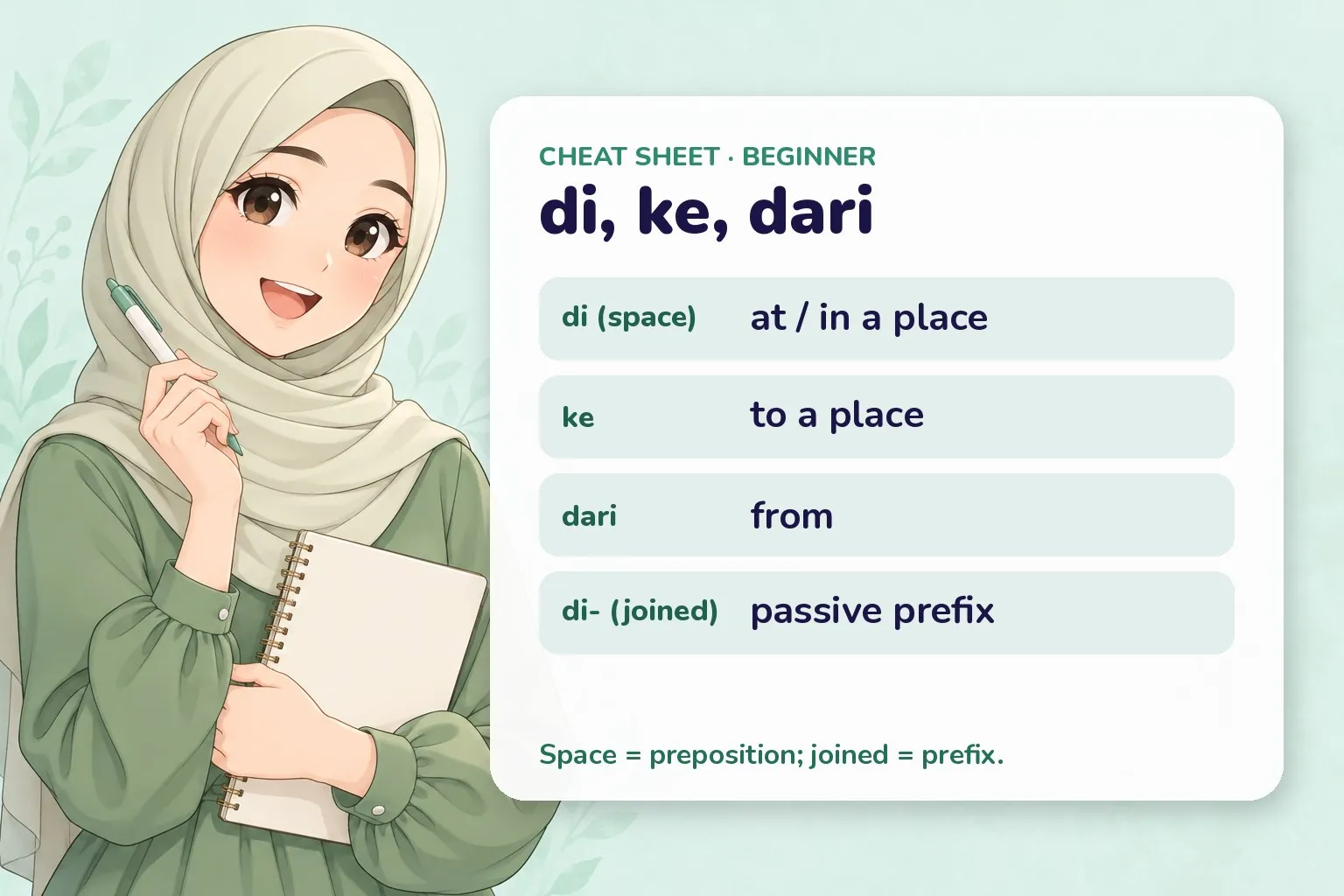
Quick recap before the quiz.
Practice
Preposition practice
Try each one, then press Check. No sign-up, nothing is sent anywhere — it all runs in your browser.
Show answer
ke — ke marks direction toward a place.
Show answer
dari — dari = from.
4 Order the words: 'We meet on Monday.'
Show answer
Kami bertemu pada hari Senin — Use pada for time: pada hari Senin.
5 Match each preposition to its meaning.
- di
- ke
- dari
- untuk
Show answer
- di → at / in a place
- ke → to a place
- dari → from
- untuk → for
di = location, ke = direction, dari = source, untuk = purpose.
Quiz
Indonesian prepositions
11 questions · pick an answer and you'll see straight away if it's right.
-
Show answer
di — di marks a place: di rumah.
-
Show answer
ke — ke marks direction to a place.
-
Show answer
dari — dari = from.
-
Show answer
di rumah — As a preposition, di is a separate word.
-
Show answer
a passive prefix — The passive prefix di- attaches to the verb.
-
Show answer
pada — Use pada for time, not di.
-
Show answer
untuk — untuk = for.
-
Show answer
dengan — dengan = with.
-
Show answer
kepada guru — kepada marks the person you give to.
-
Show answer
Di — di mana = where (at what place).
-
Show answer
a preposition and a prefix — Separate di = preposition of place; joined di- = passive prefix.
Recap cheat-sheet
| Word | Job | Example |
|---|---|---|
| di (space) | at / in a place | di rumah |
| ke | to a place | ke pasar |
| dari | from | dari Bali |
| pada | time / before people | pada hari Senin |
| di- (joined) | passive prefix | dibaca |
Next
- Previous topic: numbers and classifiers
- Back to the Indonesian grammar section
- New here? Start with Start Learning Indonesian Here
All Indonesian grammar topics
Every grammar point in order, from your first sentence to advanced structures. Pick one and go straight to it. New lessons go live every day, so topics marked Coming soon fill in over the next weeks.
Grammar path
Beginner 18 topics · 12 ready
- 01 Indonesian Personal Pronouns
- 02 Basic Word Order (Subject-Verb-Object)
- 03 Sentences Without 'To Be'
- 04 Noun + Adjective Order
- 05 Possession (Noun + Owner)
- 06 Plurals and Reduplication
- 07 Yes/No Questions (apakah, intonation)
- 08 Question Words (apa, siapa, di mana)
- 09 Negation: tidak vs bukan
- 10 Demonstratives (ini, itu)
- 11 Numbers and Classifiers
- 12 Common Prepositions (di, ke, dari) You are here
- 13 Existence and 'Have' with ada / punya Coming soon
- 14 Manner Deixis (begini, begitu) & sini/situ/sana Coming soon
- 15 Particles -lah, -kah, -pun Coming soon
- 16 Question Tags (kan, ya, bukan) Coming soon
- 17 Adverbs of Frequency (selalu, sering, kadang) Coming soon
- 18 Telling the Time Coming soon
Elementary 24 topics
- 19 The Prefix ber- Coming soon
- 20 The Prefix meN- (Active Transitive) Coming soon
- 21 The Passive with di- Coming soon
- 22 Agent-Focus Passive (Pronoun + Verb) Coming soon
- 23 Aspect Markers (sudah, sedang, akan, belum, masih) Coming soon
- 24 Modal Words (bisa, boleh, harus, mau, ingin) Coming soon
- 25 Comparatives and Superlatives Coming soon
- 26 Ordinal Numbers and Dates Coming soon
- 27 Basic Conjunctions (dan, tetapi, atau, karena) Coming soon
- 28 Imperatives and Requests Coming soon
- 29 Adverbs and Intensifiers (sangat, sekali, agak) Coming soon
- 30 Only / Just (hanya, cuma, saja) Coming soon
- 31 Again / Still / More (lagi, masih, tambah) Coming soon
- 32 Experience (pernah, belum pernah) Coming soon
- 33 Purpose Clauses (untuk, supaya, agar) Coming soon
- 34 Cause Clauses (karena, sebab, gara-gara) Coming soon
- 35 Quantifiers (semua, setiap, beberapa, banyak) Coming soon
- 36 Complement Clauses with bahwa Coming soon
- 37 The Suffix -an (Result Nouns) Coming soon
- 38 The Prefix ke- (ketua, kekasih) Coming soon
- 39 Adverbial -nya (biasanya, sebenarnya) Coming soon
- 40 The Clitic -nya as a Definite Marker Coming soon
- 41 Sequencing (lalu, kemudian, setelah itu) Coming soon
- 42 Before & After (sebelum, setelah, sesudah) Coming soon
Intermediate 21 topics
- 43 The meN-...-kan Construction Coming soon
- 44 The meN-...-i Construction Coming soon
- 45 Nominalising Affixes (pe-, pe-an, per-an, ke-an) Coming soon
- 46 The Prefix ter- (Accidental/Superlative/Stative) Coming soon
- 47 The Prefix se- (One/Same/As) Coming soon
- 48 Relative Clauses with yang Coming soon
- 49 Subordinating Conjunctions (jika, meskipun) Coming soon
- 50 Types of Reduplication Coming soon
- 51 Classifiers and Quantity Expressions Coming soon
- 52 Reciprocal & Stative (ber-an, ber-kan) Coming soon
- 53 Passive Register (di- vs ter- vs ke-an) Coming soon
- 54 Reciprocal (saling, satu sama lain) Coming soon
- 55 Intensive & Reflexive (diri, sendiri) Coming soon
- 56 Correlative Conjunctions (baik...maupun) Coming soon
- 57 Degree (terlalu, cukup, kurang) Coming soon
- 58 The More...The More (makin, semakin) Coming soon
- 59 Simultaneous Actions (sambil, selagi, sementara) Coming soon
- 60 The Prefix memper- (Causative) Coming soon
- 61 ke-...-an Adversative Verbs (kehujanan) Coming soon
- 62 The Frame se-...-nya (sebaiknya, secepatnya) Coming soon
- 63 Compound Words (kata majemuk) Coming soon
Advanced 11 topics
- 64 Advanced Nominalisation & Formal Syntax Coming soon
- 65 Discourse Markers & Cohesion Coming soon
- 66 Formal (baku) vs Colloquial Indonesian Coming soon
- 67 Advanced Passive & Object Preposing Coming soon
- 68 Idiomatic & Layered Affixation Coming soon
- 69 Conditionals & Hypotheticals (seandainya, andai) Coming soon
- 70 Large Numbers, Fractions & Approximation Coming soon
- 71 Compound & Complex Sentences Coming soon
- 72 Topic, Focus & Cleft (yang...itu) Coming soon
- 73 Apposition and Appositive Clauses Coming soon
- 74 Restoring Dropped Affixes (Formal Writing) Coming soon