Question Words (apa, siapa, di mana)
The Indonesian question words are apa (what), siapa (who), di/ke/dari mana (where), kapan (when), mengapa or kenapa (why), bagaimana (how), berapa (how much/many) and yang mana (which). They usually sit where the answer would go.
Level: Beginner. Indonesian question words (the “wh-” words) let you ask for a thing, a person, a place, a time, a reason, a way, an amount or a choice. The good news: you do not reshuffle the whole sentence — the question word usually just takes the slot of the missing answer.
The rule
A question word asks for the one piece of information you are missing. In Indonesian the main ones are:
- apa — what (things)
- siapa — who (people, and names)
- mana — where, with a preposition: di mana (at), ke mana (to), dari mana (from)
- kapan — when
- mengapa / kenapa — why
- bagaimana — how
- berapa — how much / how many
- yang mana — which (one)
Most of the time the question word sits where the answer would go: Kamu mau apa? (“You want what?”) mirrors the reply Saya mau teh (“I want tea”). You can also move it to the front, often with yang: Apa yang kamu mau? Both are correct; the in-place version is the everyday one.
Indonesian verbs do not change for questions, and there is no “do” helper as in English. The question word — plus a slight rise in the voice — does all the work.
The question words at a glance
| Word | Asks about | Example | Translation |
|---|---|---|---|
| apa | a thing (what) | Ini apa? | What is this? |
| siapa | a person / name (who) | Siapa itu? | Who is that? |
| di mana | place — at | Kamu di mana? | Where are you? |
| ke mana | place — to | Kamu pergi ke mana? | Where are you going? |
| dari mana | place — from | Kamu dari mana? | Where are you from? |
| kapan | time (when) | Kapan kamu datang? | When are you coming? |
| mengapa / kenapa | reason (why) | Mengapa kamu sedih? | Why are you sad? |
| bagaimana | manner (how) | Bagaimana kabarmu? | How are you? |
| berapa | amount (how much/many) | Berapa harganya? | How much is it? |
| yang mana | choice (which) | Yang mana punyamu? | Which one is yours? |
How to say it
Indonesian is read as written, with even, pure vowels:
- Stress is light and usually on the second-to-last syllable: siapa ≈ “see-AH-pa”, bagaimana ≈ “ba-gai-MA-na”.
- ng is a single sound as in “singer”: mengapa ≈ “muhng-A-pa”.
- e is sometimes a short “uh” (schwa): berapa ≈ “b’-RA-pa”, mengapa starts “muhng-”.
- c (not in these words but common) is “ch” as in “church”; every vowel is pronounced fully.
Example sentences
- Ini apa?What is this?apa in place, after the noun
- Apa itu?What is that?
- Siapa nama kamu?What is your name?lit. 'Who is your name?' — use siapa
- Siapa itu?Who is that?
- Kamu tinggal di mana?Where do you live?di mana = at which place
- Kamu mau pergi ke mana?Where do you want to go?ke mana = to where
- Kamu dari mana?Where are you from?dari mana = from where
- Kapan kamu datang?When are you coming?
- Kapan ulang tahunmu?When is your birthday?
- Mengapa kamu sedih?Why are you sad?
- Kenapa kamu terlambat?Why are you late?kenapa = colloquial why
- Bagaimana kabar kamu?How are you?
- Bagaimana cara ke stasiun?How do I get to the station?
- Berapa harganya?How much is it?
- Berapa umur kamu?How old are you?berapa for age
- Kamu mau minum apa?What do you want to drink?apa stays in place
- Yang mana punya kamu?Which one is yours?
- Jam berapa sekarang?What time is it now?berapa for clock time
Common mistakes
- ❌ Nama kamu apa? → ✅ Siapa nama kamu? To ask a person’s name, standard Indonesian uses siapa, not apa.
- ❌ Kamu pergi di mana? → ✅ Kamu pergi ke mana? Movement needs ke (to), not di (at).
- ❌ Kamu tinggal ke mana? → ✅ Kamu tinggal di mana? Staying/living is a location, so use di.
- ❌ Apa umur kamu? → ✅ Berapa umur kamu? Age is an amount; use berapa.
- ❌ Berapa ini? (for “what is this”) → ✅ Apa ini? Berapa asks a number, apa asks a thing.
A short conversation
— Halo! Siapa nama kamu? — Nama saya Budi. Kamu tinggal di mana? — Saya tinggal di Jakarta. Kapan kamu pindah ke sini? — Bulan lalu. Bagaimana kabar kamu?
Usage notes
- In place or fronted. Kamu beli apa? and Apa yang kamu beli? both mean “What did you buy?” The in-place form is the most common in speech.
- No verb change, no “do”. The verb stays the same as in a statement; a rising tone marks the question.
- Possessive -mu / kamu. kabarmu and kabar kamu both mean “your news”; -mu is a short attached form.
- Colloquial forms you will hear: kenapa (why), gimana (how), ngapain (doing what). They are informal; mengapa and bagaimana are the standard written forms.
Compared with yes/no questions
A question word asks for a specific piece of information. A yes/no question asks whether a whole statement is true, using rising intonation or the marker apakah: Kamu lapar? / Apakah kamu lapar? (“Are you hungry?”). Note that apa at the very front can also mark a yes/no question (Apa kamu lapar?) — there it is not “what”. See Yes/No Questions in Indonesian for that pattern, and review who does the asking in Indonesian personal pronouns.
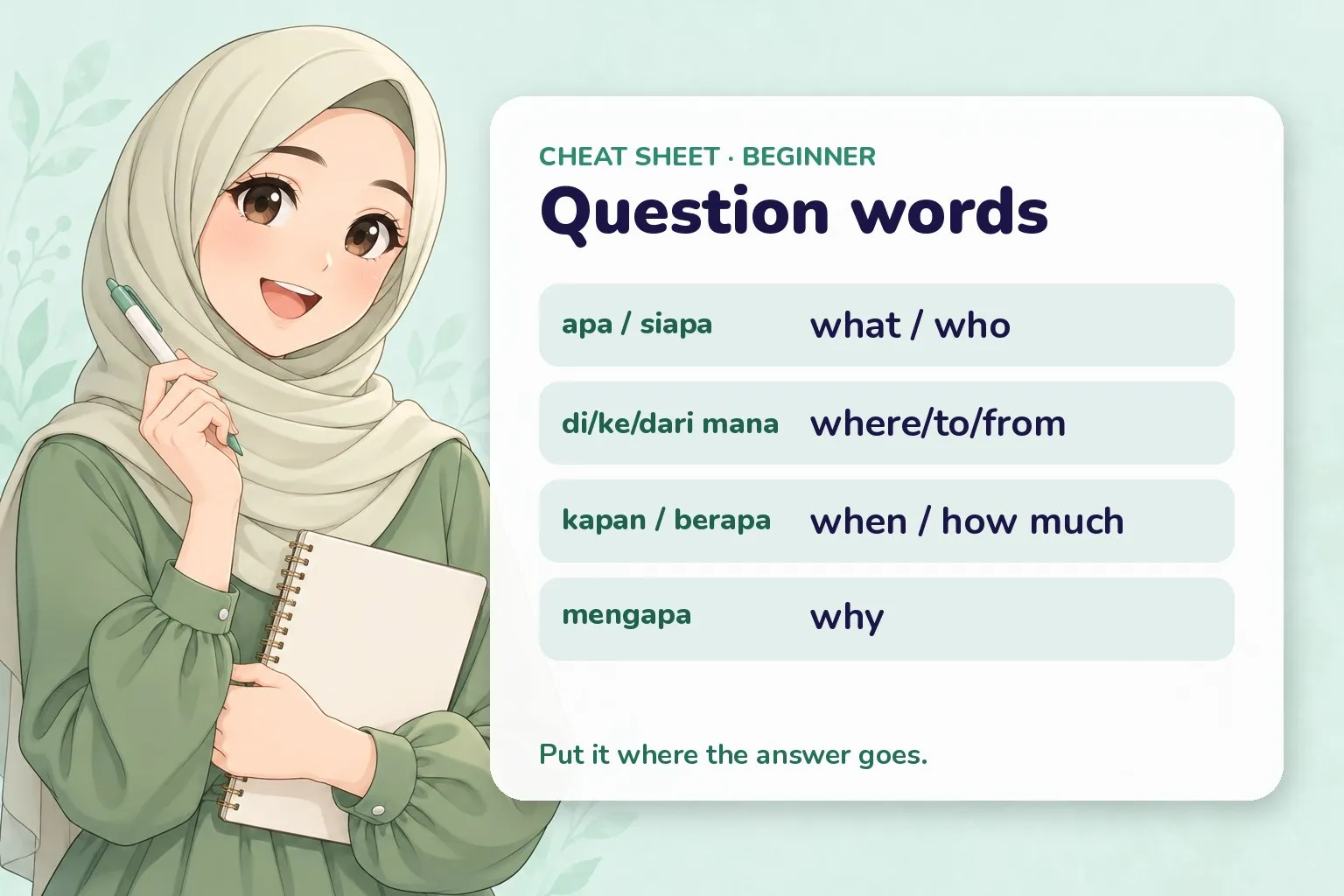
Quick recap before the quiz.
Practice
Question words practice
Try each one, then press Check. No sign-up, nothing is sent anywhere — it all runs in your browser.
Hint: movement = to
Show answer
ke — Movement uses ke: ke mana (to where).
3 Build: 'Where do you live?'
Show answer
Kamu tinggal di mana — The question word takes the answer's slot: Kamu tinggal di mana?
4 Match each question word to what it asks about.
- apa
- siapa
- kapan
- berapa
Show answer
- apa → a thing
- siapa → a person
- kapan → a time
- berapa → an amount
apa things, siapa people, kapan time, berapa amount.
Quiz
Indonesian question words quiz
12 questions · pick an answer and you'll see straight away if it's right.
-
Show answer
apa — apa = what (for things).
-
Show answer
siapa — siapa = who (people and names).
-
Show answer
Kamu dari mana? — Origin uses dari: dari mana (from where).
-
Show answer
kapan — kapan = when.
-
Show answer
Mengapa kamu sedih? — mengapa = why (kenapa is the colloquial version).
-
Show answer
berapa — Age is an amount: Berapa umur kamu?
-
Show answer
Bagaimana kabarmu? — bagaimana = how: Bagaimana kabarmu?
-
Show answer
where the answer would go — It takes the slot of the missing answer; it can also front with yang.
-
Show answer
Kamu tinggal di mana? — Living is a location: di mana.
-
Show answer
berapa — Clock time uses berapa: Jam berapa?
-
Show answer
which one — yang mana = which (one) — a choice between options.
-
Show answer
Siapa — A person: Siapa itu?
Recap cheat-sheet
| Word | Asks about |
|---|---|
| apa | things (what) |
| siapa | people / names (who) |
| di / ke / dari mana | place / direction / origin |
| kapan | time (when) |
| mengapa / kenapa | reason (why) |
| berapa | quantity, price, age, time |
Next
- Back to the Indonesian grammar section
- Practise reading: Indonesian Reading Practice: Intermediate
- New here? Start with Start Learning Indonesian Here
All Indonesian grammar topics
Every grammar point in order, from your first sentence to advanced structures. Pick one and go straight to it. New lessons go live every day, so topics marked Coming soon fill in over the next weeks.
Grammar path
Beginner 18 topics · 12 ready
- 01 Indonesian Personal Pronouns
- 02 Basic Word Order (Subject-Verb-Object)
- 03 Sentences Without 'To Be'
- 04 Noun + Adjective Order
- 05 Possession (Noun + Owner)
- 06 Plurals and Reduplication
- 07 Yes/No Questions (apakah, intonation)
- 08 Question Words (apa, siapa, di mana) You are here
- 09 Negation: tidak vs bukan
- 10 Demonstratives (ini, itu)
- 11 Numbers and Classifiers
- 12 Common Prepositions (di, ke, dari)
- 13 Existence and 'Have' with ada / punya Coming soon
- 14 Manner Deixis (begini, begitu) & sini/situ/sana Coming soon
- 15 Particles -lah, -kah, -pun Coming soon
- 16 Question Tags (kan, ya, bukan) Coming soon
- 17 Adverbs of Frequency (selalu, sering, kadang) Coming soon
- 18 Telling the Time Coming soon
Elementary 24 topics
- 19 The Prefix ber- Coming soon
- 20 The Prefix meN- (Active Transitive) Coming soon
- 21 The Passive with di- Coming soon
- 22 Agent-Focus Passive (Pronoun + Verb) Coming soon
- 23 Aspect Markers (sudah, sedang, akan, belum, masih) Coming soon
- 24 Modal Words (bisa, boleh, harus, mau, ingin) Coming soon
- 25 Comparatives and Superlatives Coming soon
- 26 Ordinal Numbers and Dates Coming soon
- 27 Basic Conjunctions (dan, tetapi, atau, karena) Coming soon
- 28 Imperatives and Requests Coming soon
- 29 Adverbs and Intensifiers (sangat, sekali, agak) Coming soon
- 30 Only / Just (hanya, cuma, saja) Coming soon
- 31 Again / Still / More (lagi, masih, tambah) Coming soon
- 32 Experience (pernah, belum pernah) Coming soon
- 33 Purpose Clauses (untuk, supaya, agar) Coming soon
- 34 Cause Clauses (karena, sebab, gara-gara) Coming soon
- 35 Quantifiers (semua, setiap, beberapa, banyak) Coming soon
- 36 Complement Clauses with bahwa Coming soon
- 37 The Suffix -an (Result Nouns) Coming soon
- 38 The Prefix ke- (ketua, kekasih) Coming soon
- 39 Adverbial -nya (biasanya, sebenarnya) Coming soon
- 40 The Clitic -nya as a Definite Marker Coming soon
- 41 Sequencing (lalu, kemudian, setelah itu) Coming soon
- 42 Before & After (sebelum, setelah, sesudah) Coming soon
Intermediate 21 topics
- 43 The meN-...-kan Construction Coming soon
- 44 The meN-...-i Construction Coming soon
- 45 Nominalising Affixes (pe-, pe-an, per-an, ke-an) Coming soon
- 46 The Prefix ter- (Accidental/Superlative/Stative) Coming soon
- 47 The Prefix se- (One/Same/As) Coming soon
- 48 Relative Clauses with yang Coming soon
- 49 Subordinating Conjunctions (jika, meskipun) Coming soon
- 50 Types of Reduplication Coming soon
- 51 Classifiers and Quantity Expressions Coming soon
- 52 Reciprocal & Stative (ber-an, ber-kan) Coming soon
- 53 Passive Register (di- vs ter- vs ke-an) Coming soon
- 54 Reciprocal (saling, satu sama lain) Coming soon
- 55 Intensive & Reflexive (diri, sendiri) Coming soon
- 56 Correlative Conjunctions (baik...maupun) Coming soon
- 57 Degree (terlalu, cukup, kurang) Coming soon
- 58 The More...The More (makin, semakin) Coming soon
- 59 Simultaneous Actions (sambil, selagi, sementara) Coming soon
- 60 The Prefix memper- (Causative) Coming soon
- 61 ke-...-an Adversative Verbs (kehujanan) Coming soon
- 62 The Frame se-...-nya (sebaiknya, secepatnya) Coming soon
- 63 Compound Words (kata majemuk) Coming soon
Advanced 11 topics
- 64 Advanced Nominalisation & Formal Syntax Coming soon
- 65 Discourse Markers & Cohesion Coming soon
- 66 Formal (baku) vs Colloquial Indonesian Coming soon
- 67 Advanced Passive & Object Preposing Coming soon
- 68 Idiomatic & Layered Affixation Coming soon
- 69 Conditionals & Hypotheticals (seandainya, andai) Coming soon
- 70 Large Numbers, Fractions & Approximation Coming soon
- 71 Compound & Complex Sentences Coming soon
- 72 Topic, Focus & Cleft (yang...itu) Coming soon
- 73 Apposition and Appositive Clauses Coming soon
- 74 Restoring Dropped Affixes (Formal Writing) Coming soon