Sentences Without 'To Be'
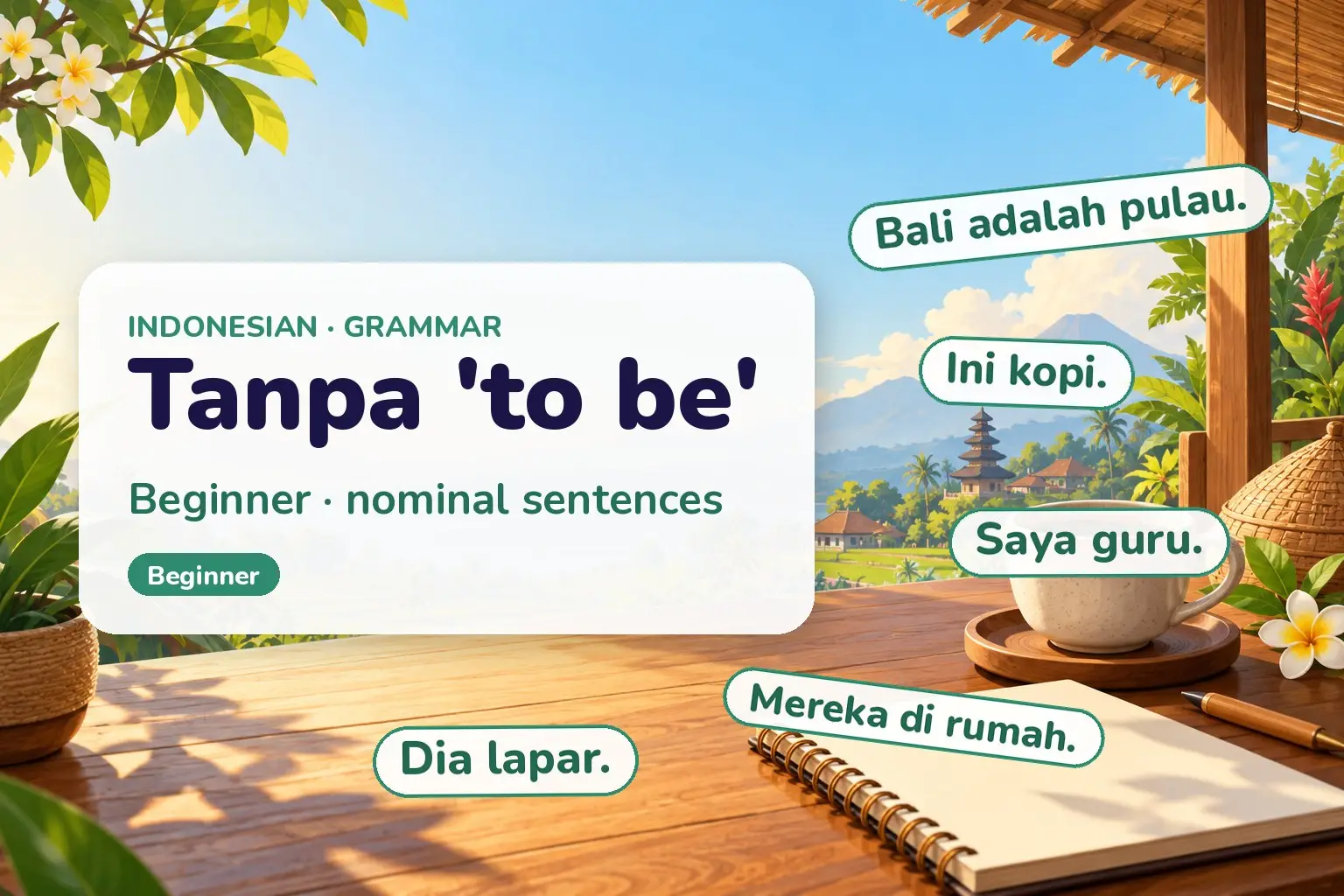
Indonesian normally has no word for 'to be': put the noun or adjective straight after the subject. Saya guru = I am a teacher; Dia lapar = He is hungry. Use adalah only to link two nouns in formal writing.
Level: Beginner. English needs am, is or are in almost every sentence. Indonesian usually needs nothing: you put the noun or adjective straight after the subject. Once you stop looking for a missing verb, these sentences become the easiest in the language.
The rule
A copula is a linking verb like English be that joins a subject to what you say about it. Indonesian mostly does without one. The subject is followed directly by a predicate — the information about the subject — which can be a noun, an adjective, or a place phrase:
- Subject + noun (identity or job): Saya guru. — “I am a teacher.”
- Subject + adjective (quality or state): Dia lapar. — “He/She is hungry.”
- Subject + place (location): Mereka di rumah. — “They are at home.”
Nothing has been left out. Saya guru is a full, correct sentence; there is no Indonesian word that “should” sit in the middle. The predicate also never changes for person or number — the same pattern works for I, she, and they.
The patterns at a glance
| What English uses “be” for | Indonesian pattern | Example |
|---|---|---|
| identity, job, category | subject + noun | Saya guru. |
| quality or condition | subject + adjective | Kamar ini bersih. |
| location | subject + di + place | Mereka di rumah. |
| “this / that is …” | ini / itu + noun | Ini kopi. |
| formal definition | subject + adalah + noun | Paus adalah mamalia. |
When you do use adalah
adalah is a real word, but a narrow one. It links two noun phrases in formal or written Indonesian — definitions, explanations, reports, and careful statements:
- Bali adalah sebuah pulau di Indonesia. — “Bali is an island in Indonesia.”
- Tujuan kami adalah keamanan. — “Our goal is safety.”
In everyday speech the plain pattern is normal: Saya mahasiswa sounds natural, while Saya adalah mahasiswa sounds like a stiff, formal self-description. And adalah does not go before an adjective, even in formal writing: you say Situasi ini sulit (“This situation is difficult”), never Situasi ini adalah sulit.
Saying “is not”: bukan vs tidak
To make these sentences negative, Indonesian picks the negator by what follows:
- bukan negates a noun: Dia bukan dokter. — “He/She is not a doctor.”
- tidak negates an adjective or verb: Saya tidak lapar. — “I am not hungry.”
How to say it
Indonesian spelling is consistent — each letter has one sound. A few to watch in this lesson’s words:
- c is always “ch”: cantik (“beautiful”) sounds like “chan-tik”, not “kan-tik”.
- Vowels are short and pure: the a in adalah is “ah” each time (“ah-dah-lah”).
- ng is one soft sound as in “singer”: orang (“person”) ends like the end of “song”.
- Stress is light and usually on the second-to-last syllable; nothing is drawn out.
Example sentences
- Saya guru.I am a teacher.subject + noun
- Dia dokter.He/She is a doctor.
- Kami mahasiswa.We are university students.
- Rumah ini besar.This house is big.subject + adjective
- Makanan itu enak.That food is delicious.
- Saya lapar.I am hungry.
- Cuaca hari ini panas.The weather today is hot.
- Mereka di rumah.They are at home.subject + place
- Ini kopi.This is coffee.ini + noun
- Itu buku saya.That is my book.
- Ayah saya petani.My father is a farmer.
- Kota ini indah.This city is beautiful.
- Bahasa Indonesia mudah.Indonesian is easy.
- Mereka teman saya.They are my friends.
- Bali adalah sebuah pulau.Bali is an island.formal: adalah + noun
- Paus adalah mamalia.A whale is a mammal.definition
- Tujuan kami adalah keamanan.Our goal is safety.formal
- Dia bukan dokter.He/She is not a doctor.bukan negates a noun
- Saya tidak lapar.I am not hungry.tidak negates an adjective
- Dia sakit hari ini.He/She is sick today.
Common mistakes
- ❌ Saya adalah guru. (casual) → ✅ Saya guru. The plain pattern is normal; adalah sounds overly formal here.
- ❌ Dia adalah cantik. → ✅ Dia cantik. adalah never goes before an adjective.
- ❌ Saya am guru. / Dia is dokter. → ✅ Saya guru. / Dia dokter. There is no English be to import.
- ❌ Dia tidak guru. → ✅ Dia bukan guru. A noun is negated with bukan, not tidak.
- ❌ Dia adalah di rumah. → ✅ Dia ada di rumah. / Dia di rumah. Location uses ada or nothing, not adalah.
A short conversation
Perkenalan (introductions): — Selamat pagi. Saya Budi. Saya mahasiswa. — Halo, Budi. Saya Sari. Saya bukan mahasiswa; saya guru. — Oh, bagus! Sekolah itu dekat? — Ya, sekolahnya dekat.
Usage notes
- Word order is subject–predicate. With no linking verb to anchor the sentence, the order itself carries the meaning: Rumah besar (“The house is big”) vs rumah besar as just a phrase (“a big house”) depends on context and intonation.
- ini / itu (“this / that”) often open an identifying sentence: Ini teh, Itu mobil saya.
- merupakan is a more formal cousin of adalah in writing (“constitutes / is”), but at beginner level adalah or nothing is all you need.
- Formal does not mean always insert adalah. Even a report says Situasi ini sulit, not … adalah sulit.
Compared with…
- Word order carries the load when there is no verb, so a solid grasp of subject-before-predicate helps. See Basic Word Order in Indonesian. To review who the subjects are, see Indonesian Personal Pronouns.
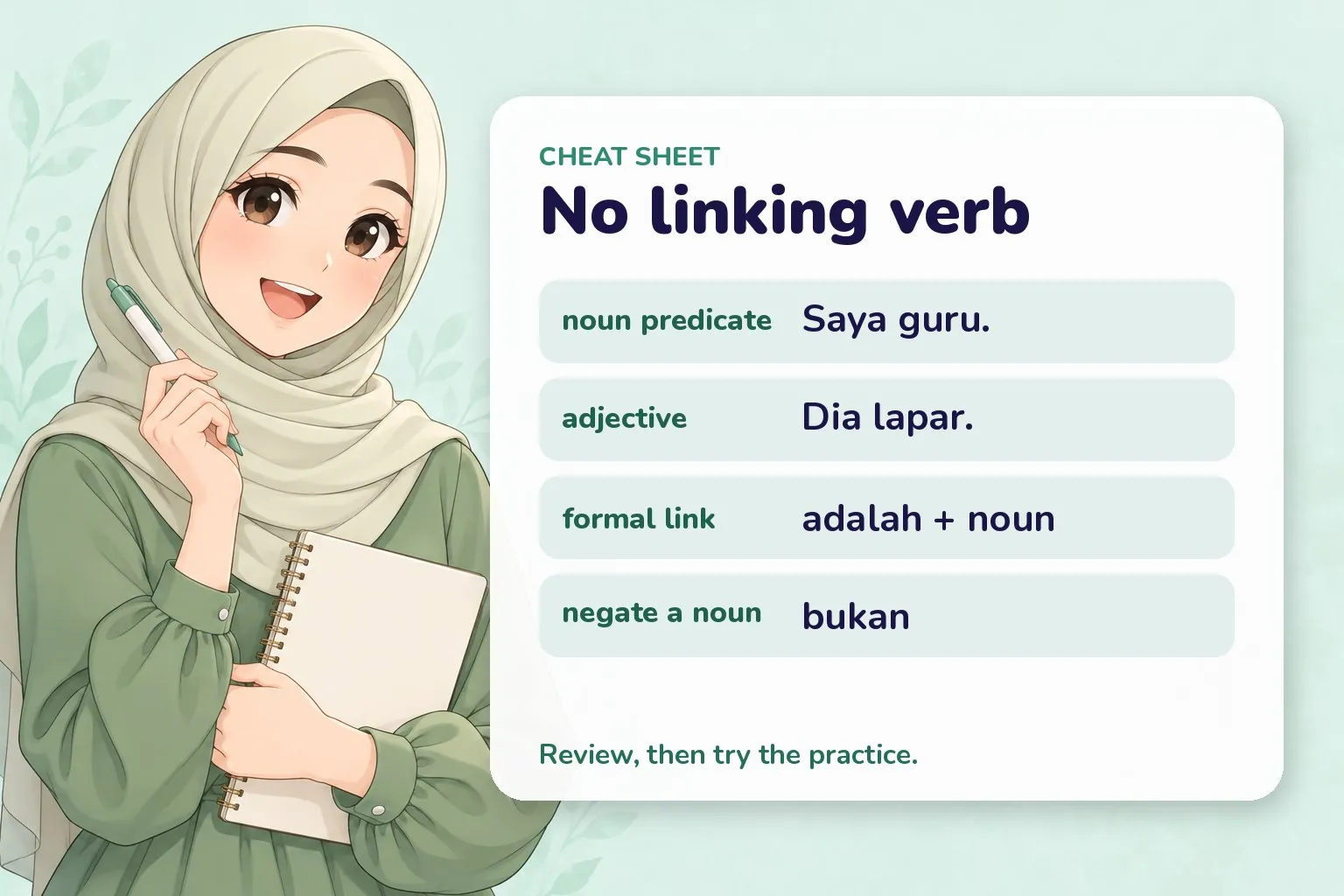
Quick recap before the quiz.
Practice
No to be practice
Try each one, then press Check. No sign-up, nothing is sent anywhere — it all runs in your browser.
Hint: the negator for nouns
Show answer
bukan — A noun is negated with bukan: Dia bukan dokter.
Hint: the negator for adjectives
Show answer
tidak — An adjective is negated with tidak: Saya tidak lapar.
4 Order the words: 'This house is big.'
Show answer
Rumah ini besar — Subject (Rumah ini) + adjective (besar), no linking verb.
5 Match each word to its job.
- adalah
- ada
- bukan
- tidak
Show answer
- adalah → links two nouns (formal)
- ada → there is / located at
- bukan → negates a noun
- tidak → negates an adjective
adalah links nouns; ada marks existence/location; bukan and tidak are the two negators.
Quiz
Indonesian sentences without to be
12 questions · pick an answer and you'll see straight away if it's right.
-
Show answer
Dia lapar. — An adjective follows the subject directly: Dia lapar.
-
Show answer
linking two nouns in formal writing — adalah links two noun phrases, mainly in formal or written Indonesian.
-
Show answer
bukan — A noun is negated with bukan.
-
Show answer
tidak — An adjective (lelah) is negated with tidak.
-
Show answer
Dia adalah cantik. — adalah must not come before an adjective; say Dia cantik.
-
Show answer
Ini — ini ('this') + noun: Ini kopi.
-
Show answer
ada — ada marks existence or location; adalah links nouns.
-
Show answer
di — Location uses di (or ada di), never adalah: Mereka di rumah.
-
Show answer
Indonesian allows a noun predicate with no copula — A noun can be the predicate directly; no linking verb is needed.
-
Show answer
Bali adalah sebuah pulau. — adalah links the two nouns Bali and sebuah pulau in a formal statement.
-
Show answer
enak — Subject (Makanan itu) + adjective (enak), with no linking verb.
-
Show answer
bukan — bukan negates nouns; tidak negates adjectives and verbs.
Recap cheat-sheet
| Pattern | Example | Meaning |
|---|---|---|
| subject + noun | Saya guru. | I am a teacher. |
| subject + adjective | Dia lapar. | He/She is hungry. |
| subject + place | Mereka di rumah. | They are at home. |
| formal: adalah + noun | Paus adalah mamalia. | A whale is a mammal. |
| negate a noun | Dia bukan dokter. | He is not a doctor. |
| negate an adjective | Saya tidak lapar. | I am not hungry. |
Next
- Back to the Indonesian grammar section
- New here? Start with Start Learning Indonesian Here
All Indonesian grammar topics
Every grammar point in order, from your first sentence to advanced structures. Pick one and go straight to it. New lessons go live every day, so topics marked Coming soon fill in over the next weeks.
Grammar path
Beginner 18 topics · 12 ready
- 01 Indonesian Personal Pronouns
- 02 Basic Word Order (Subject-Verb-Object)
- 03 Sentences Without 'To Be' You are here
- 04 Noun + Adjective Order
- 05 Possession (Noun + Owner)
- 06 Plurals and Reduplication
- 07 Yes/No Questions (apakah, intonation)
- 08 Question Words (apa, siapa, di mana)
- 09 Negation: tidak vs bukan
- 10 Demonstratives (ini, itu)
- 11 Numbers and Classifiers
- 12 Common Prepositions (di, ke, dari)
- 13 Existence and 'Have' with ada / punya Coming soon
- 14 Manner Deixis (begini, begitu) & sini/situ/sana Coming soon
- 15 Particles -lah, -kah, -pun Coming soon
- 16 Question Tags (kan, ya, bukan) Coming soon
- 17 Adverbs of Frequency (selalu, sering, kadang) Coming soon
- 18 Telling the Time Coming soon
Elementary 24 topics
- 19 The Prefix ber- Coming soon
- 20 The Prefix meN- (Active Transitive) Coming soon
- 21 The Passive with di- Coming soon
- 22 Agent-Focus Passive (Pronoun + Verb) Coming soon
- 23 Aspect Markers (sudah, sedang, akan, belum, masih) Coming soon
- 24 Modal Words (bisa, boleh, harus, mau, ingin) Coming soon
- 25 Comparatives and Superlatives Coming soon
- 26 Ordinal Numbers and Dates Coming soon
- 27 Basic Conjunctions (dan, tetapi, atau, karena) Coming soon
- 28 Imperatives and Requests Coming soon
- 29 Adverbs and Intensifiers (sangat, sekali, agak) Coming soon
- 30 Only / Just (hanya, cuma, saja) Coming soon
- 31 Again / Still / More (lagi, masih, tambah) Coming soon
- 32 Experience (pernah, belum pernah) Coming soon
- 33 Purpose Clauses (untuk, supaya, agar) Coming soon
- 34 Cause Clauses (karena, sebab, gara-gara) Coming soon
- 35 Quantifiers (semua, setiap, beberapa, banyak) Coming soon
- 36 Complement Clauses with bahwa Coming soon
- 37 The Suffix -an (Result Nouns) Coming soon
- 38 The Prefix ke- (ketua, kekasih) Coming soon
- 39 Adverbial -nya (biasanya, sebenarnya) Coming soon
- 40 The Clitic -nya as a Definite Marker Coming soon
- 41 Sequencing (lalu, kemudian, setelah itu) Coming soon
- 42 Before & After (sebelum, setelah, sesudah) Coming soon
Intermediate 21 topics
- 43 The meN-...-kan Construction Coming soon
- 44 The meN-...-i Construction Coming soon
- 45 Nominalising Affixes (pe-, pe-an, per-an, ke-an) Coming soon
- 46 The Prefix ter- (Accidental/Superlative/Stative) Coming soon
- 47 The Prefix se- (One/Same/As) Coming soon
- 48 Relative Clauses with yang Coming soon
- 49 Subordinating Conjunctions (jika, meskipun) Coming soon
- 50 Types of Reduplication Coming soon
- 51 Classifiers and Quantity Expressions Coming soon
- 52 Reciprocal & Stative (ber-an, ber-kan) Coming soon
- 53 Passive Register (di- vs ter- vs ke-an) Coming soon
- 54 Reciprocal (saling, satu sama lain) Coming soon
- 55 Intensive & Reflexive (diri, sendiri) Coming soon
- 56 Correlative Conjunctions (baik...maupun) Coming soon
- 57 Degree (terlalu, cukup, kurang) Coming soon
- 58 The More...The More (makin, semakin) Coming soon
- 59 Simultaneous Actions (sambil, selagi, sementara) Coming soon
- 60 The Prefix memper- (Causative) Coming soon
- 61 ke-...-an Adversative Verbs (kehujanan) Coming soon
- 62 The Frame se-...-nya (sebaiknya, secepatnya) Coming soon
- 63 Compound Words (kata majemuk) Coming soon
Advanced 11 topics
- 64 Advanced Nominalisation & Formal Syntax Coming soon
- 65 Discourse Markers & Cohesion Coming soon
- 66 Formal (baku) vs Colloquial Indonesian Coming soon
- 67 Advanced Passive & Object Preposing Coming soon
- 68 Idiomatic & Layered Affixation Coming soon
- 69 Conditionals & Hypotheticals (seandainya, andai) Coming soon
- 70 Large Numbers, Fractions & Approximation Coming soon
- 71 Compound & Complex Sentences Coming soon
- 72 Topic, Focus & Cleft (yang...itu) Coming soon
- 73 Apposition and Appositive Clauses Coming soon
- 74 Restoring Dropped Affixes (Formal Writing) Coming soon