Basic Word Order (Subject-Verb-Object)
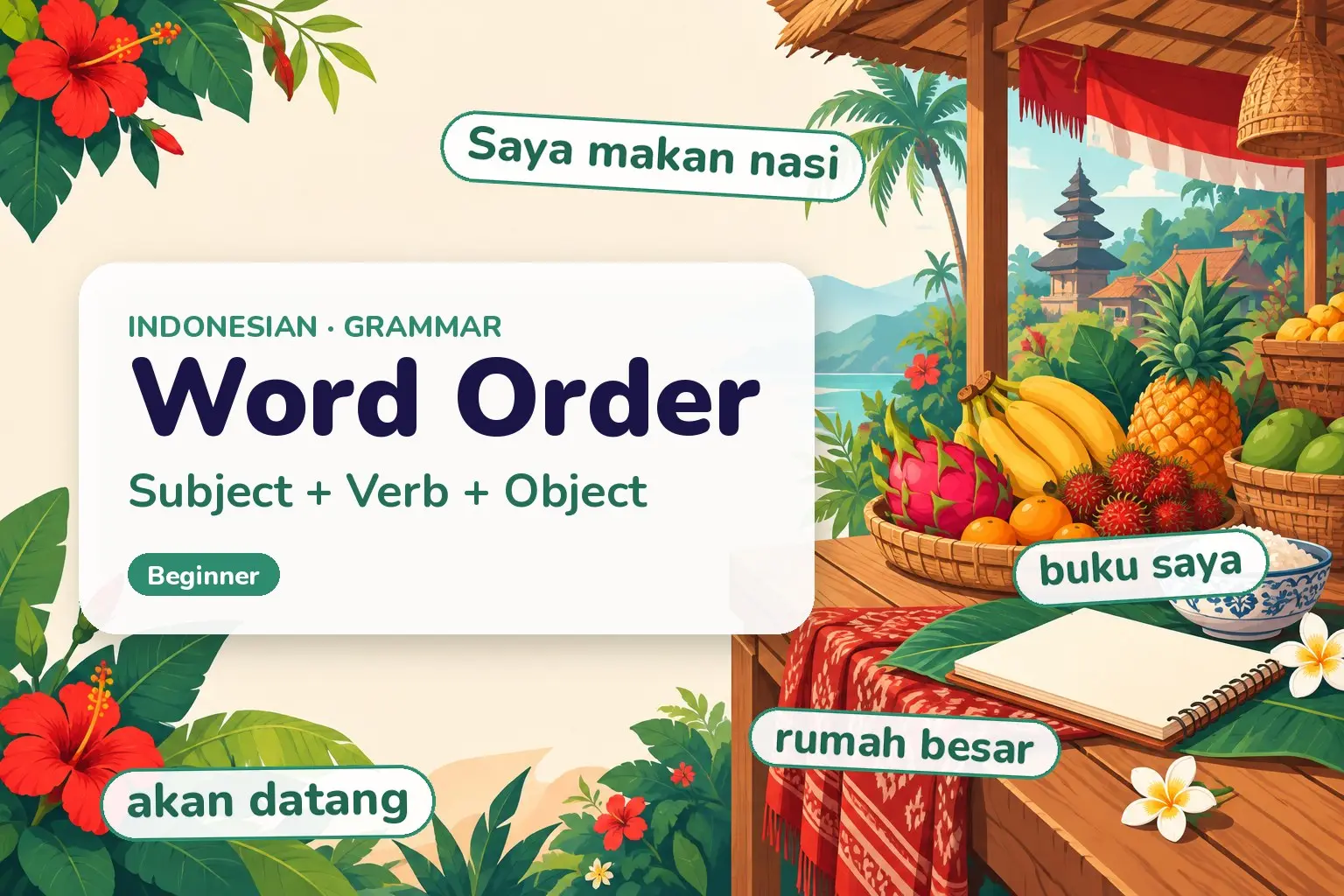
Indonesian follows Subject-Verb-Object order, like English: Saya makan nasi means 'I eat rice'. Verbs never change for person or tense — time words like kemarin (yesterday) or akan (will) do that job instead.
Level: Beginner. Indonesian builds plain sentences in the same order English does — subject, then verb, then object — which makes it a friendly place to start.
The rule
The subject does the action, the verb is the action, and the object receives it. Indonesian keeps them in that order: Subject + Verb + Object.
Saya makan nasi = “I eat rice”: saya (I) is the subject, makan (eat) is the verb, nasi (rice) is the object.
The big relief for beginners: verbs do not change. There is no person agreement (no -s for “he”) and no tense ending (no -ed for the past). One form of the verb covers I eat, she eats and they ate. When you need to show time, you add a small time word or aspect marker instead:
- sudah — already / have done
- sedang — in the middle of (the “-ing” idea)
- akan — will
- plain time words: kemarin (yesterday), sekarang (now), besok (tomorrow)
The pattern
| Subject | Verb | Object | English |
|---|---|---|---|
| Saya | makan | nasi | I eat rice |
| Dia | minum | kopi | He/She drinks coffee |
| Kami | membaca | buku | We read a book |
| Ibu | membeli | sayur | Mother buys vegetables |
To add time, put the marker before the verb or the time word at the front:
| Marker/time word | Example | English |
|---|---|---|
| sudah | Saya sudah makan | I have already eaten |
| sedang | Saya sedang makan | I am eating |
| akan | Saya akan makan | I will eat |
| kemarin | Kemarin saya makan | Yesterday I ate |
Example sentences
- Saya makan nasi.I eat rice.
- Dia minum kopi.He drinks coffee.
- Kami belajar bahasa Indonesia.We study Indonesian.
- Ibu membeli sayur di pasar.Mother buys vegetables at the market.
- Anak itu membaca buku.That child reads a book.
- Kemarin saya pergi ke sekolah.Yesterday I went to school.time word at the front
- Besok dia akan datang.Tomorrow he will come.akan marks the future
- Saya sedang makan sekarang.I am eating now.sedang is the -ing idea
- Mereka sudah pulang.They have already gone home.sudah = already
- Rumah saya besar.My house is big.owner and adjective both come after the noun
- Kucing hitam itu tidur.That black cat is sleeping.
- Ayah tidak suka kopi.Dad doesn't like coffee.tidak negates the verb
- Ini bukan buku saya.This is not my book.bukan negates the noun
- Kami tinggal di Jakarta.We live in Jakarta.
- Guru mengajar murid.The teacher teaches the students.
- Saya membeli buku baru.I am buying a new book.
- Dia menulis surat untuk temannya.She writes a letter to her friend.
- Anjing itu makan tulang.That dog eats a bone.
Common mistakes
- ❌ Saya makans nasi → ✅ Saya makan nasi. Verbs take no -s for the third person and no plural ending.
- ❌ besar rumah → ✅ rumah besar. Adjectives follow the noun they describe.
- ❌ saya buku → ✅ buku saya. The owner comes after the thing owned: “book my”.
- ❌ Ini tidak buku → ✅ Ini bukan buku. Use bukan before a noun; tidak is for verbs and adjectives.
- ❌ Kemarin saya akan pergi → ✅ Kemarin saya pergi. Do not combine a past time word with the future marker akan.
A short conversation
— Kamu sedang apa? (What are you doing?) — Saya sedang membaca buku. (I’m reading a book.) — Sudah makan? (Have you eaten?) — Belum, saya akan makan nanti. (Not yet, I’ll eat later.)
Usage notes
- Fronting for focus. Time words and topics often move to the front for emphasis: Kemarin, saya ke pasar. The core S-V-O stays intact after that.
- Dropping the subject. In a clear context the subject can be left out, as in the dialogue above (Sudah makan?).
- Passive voice. Indonesian also has a di- passive (Buku itu dibaca, “the book is read”), where the object comes first — a later topic, but good to recognise.
Compared with…
- Adjective order is the mirror of English: Indonesian says mobil merah (car red) where English says “red car”. Keep browsing the Indonesian grammar section for noun phrases and the di- passive.
How to say it
Indonesian spelling is close to how it sounds, with a few letters that surprise English speakers:
- c is “ch” as in church: cinta (love) sounds like “cheen-ta”, never “sinta”.
- ng is the soft sound at the end of sing; at the start of a word (nganga) it is the same sound.
- ny is the “ny” of canyon: nyamuk (mosquito).
- e has two values — a clear “eh” (enak, tasty) and a soft “uh” (besar, big). Listening is the quickest way to pick them apart.
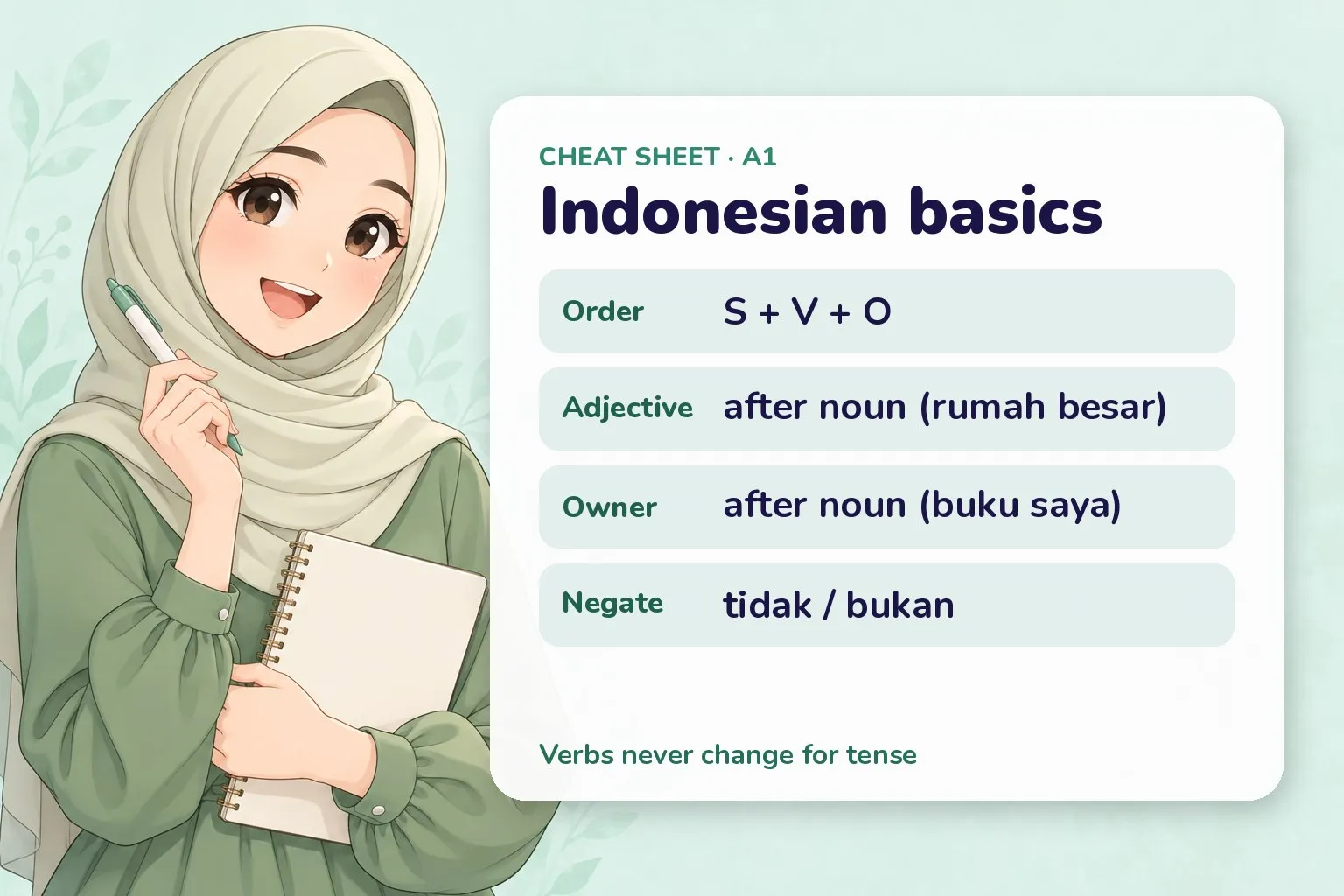
Quick recap before the quiz.
Practice
Word order practice
Try each one, then press Check. No sign-up, nothing is sent anywhere — it all runs in your browser.
1 Put the words in order: 'I eat rice.'
Show answer
Saya makan nasi — Subject (Saya) + Verb (makan) + Object (nasi).
Hint: Not tidak.
Show answer
bukan — bukan negates nouns; tidak negates verbs and adjectives.
4 Match the marker to its meaning.
- sudah
- sedang
- akan
- kemarin
Show answer
- sudah → already
- sedang → -ing (now)
- akan → will
- kemarin → yesterday
These little words carry tense and aspect so the verb can stay fixed.
Quiz
Indonesian word order quiz
12 questions · pick an answer and you'll see straight away if it's right.
-
Show answer
Subject-Verb-Object — Indonesian is S-V-O, like English.
-
Show answer
They don't; time words do the work — Verbs keep one form; markers like sudah/akan show time.
-
Show answer
After the noun — Adjectives follow the noun: rumah besar.
-
Show answer
rumah saya — Owner after the thing owned: rumah saya.
-
Show answer
bukan — bukan is used before nouns; tidak before verbs/adjectives.
-
Show answer
tidak — tidak negates verbs and adjectives: tidak suka.
-
Show answer
in the middle of (-ing) — sedang marks an action in progress.
-
Show answer
the future — akan marks future action: akan datang (will come).
-
Show answer
Saya makan nasi — No -s on the verb, and the order is S-V-O.
-
Show answer
Ayah tidak suka kopi — suka is a verb, so use tidak before it.
-
Show answer
akan — akan marks the future.
-
Show answer
It can move to the front — Time words often front for emphasis, keeping S-V-O after.
Recap cheat-sheet
| Idea | Indonesian | Note |
|---|---|---|
| Order | S + V + O | like English |
| Adjective | rumah besar | after the noun |
| Owner | buku saya | after the noun |
| Negate verb | tidak | tidak suka |
| Negate noun | bukan | bukan guru |
Next
- Back to the Indonesian grammar section
- New here? Start with Start Learning Indonesian Here
All Indonesian grammar topics
Every grammar point in order, from your first sentence to advanced structures. Pick one and go straight to it. New lessons go live every day, so topics marked Coming soon fill in over the next weeks.
Grammar path
Beginner 18 topics · 2 ready
- 01 Indonesian Personal Pronouns
- 02 Basic Word Order (Subject-Verb-Object) You are here
- 03 Sentences Without 'To Be' Coming soon
- 04 Noun + Adjective Order Coming soon
- 05 Possession (Noun + Owner) Coming soon
- 06 Plurals and Reduplication Coming soon
- 07 Yes/No Questions (apakah, intonation) Coming soon
- 08 Question Words (apa, siapa, di mana) Coming soon
- 09 Negation: tidak vs bukan Coming soon
- 10 Demonstratives (ini, itu) Coming soon
- 11 Numbers and Classifiers Coming soon
- 12 Common Prepositions (di, ke, dari) Coming soon
- 13 Existence and 'Have' with ada / punya Coming soon
- 14 Manner Deixis (begini, begitu) & sini/situ/sana Coming soon
- 15 Particles -lah, -kah, -pun Coming soon
- 16 Question Tags (kan, ya, bukan) Coming soon
- 17 Adverbs of Frequency (selalu, sering, kadang) Coming soon
- 18 Telling the Time Coming soon
Elementary 24 topics
- 19 The Prefix ber- Coming soon
- 20 The Prefix meN- (Active Transitive) Coming soon
- 21 The Passive with di- Coming soon
- 22 Agent-Focus Passive (Pronoun + Verb) Coming soon
- 23 Aspect Markers (sudah, sedang, akan, belum, masih) Coming soon
- 24 Modal Words (bisa, boleh, harus, mau, ingin) Coming soon
- 25 Comparatives and Superlatives Coming soon
- 26 Ordinal Numbers and Dates Coming soon
- 27 Basic Conjunctions (dan, tetapi, atau, karena) Coming soon
- 28 Imperatives and Requests Coming soon
- 29 Adverbs and Intensifiers (sangat, sekali, agak) Coming soon
- 30 Only / Just (hanya, cuma, saja) Coming soon
- 31 Again / Still / More (lagi, masih, tambah) Coming soon
- 32 Experience (pernah, belum pernah) Coming soon
- 33 Purpose Clauses (untuk, supaya, agar) Coming soon
- 34 Cause Clauses (karena, sebab, gara-gara) Coming soon
- 35 Quantifiers (semua, setiap, beberapa, banyak) Coming soon
- 36 Complement Clauses with bahwa Coming soon
- 37 The Suffix -an (Result Nouns) Coming soon
- 38 The Prefix ke- (ketua, kekasih) Coming soon
- 39 Adverbial -nya (biasanya, sebenarnya) Coming soon
- 40 The Clitic -nya as a Definite Marker Coming soon
- 41 Sequencing (lalu, kemudian, setelah itu) Coming soon
- 42 Before & After (sebelum, setelah, sesudah) Coming soon
Intermediate 21 topics
- 43 The meN-...-kan Construction Coming soon
- 44 The meN-...-i Construction Coming soon
- 45 Nominalising Affixes (pe-, pe-an, per-an, ke-an) Coming soon
- 46 The Prefix ter- (Accidental/Superlative/Stative) Coming soon
- 47 The Prefix se- (One/Same/As) Coming soon
- 48 Relative Clauses with yang Coming soon
- 49 Subordinating Conjunctions (jika, meskipun) Coming soon
- 50 Types of Reduplication Coming soon
- 51 Classifiers and Quantity Expressions Coming soon
- 52 Reciprocal & Stative (ber-an, ber-kan) Coming soon
- 53 Passive Register (di- vs ter- vs ke-an) Coming soon
- 54 Reciprocal (saling, satu sama lain) Coming soon
- 55 Intensive & Reflexive (diri, sendiri) Coming soon
- 56 Correlative Conjunctions (baik...maupun) Coming soon
- 57 Degree (terlalu, cukup, kurang) Coming soon
- 58 The More...The More (makin, semakin) Coming soon
- 59 Simultaneous Actions (sambil, selagi, sementara) Coming soon
- 60 The Prefix memper- (Causative) Coming soon
- 61 ke-...-an Adversative Verbs (kehujanan) Coming soon
- 62 The Frame se-...-nya (sebaiknya, secepatnya) Coming soon
- 63 Compound Words (kata majemuk) Coming soon
Advanced 11 topics
- 64 Advanced Nominalisation & Formal Syntax Coming soon
- 65 Discourse Markers & Cohesion Coming soon
- 66 Formal (baku) vs Colloquial Indonesian Coming soon
- 67 Advanced Passive & Object Preposing Coming soon
- 68 Idiomatic & Layered Affixation Coming soon
- 69 Conditionals & Hypotheticals (seandainya, andai) Coming soon
- 70 Large Numbers, Fractions & Approximation Coming soon
- 71 Compound & Complex Sentences Coming soon
- 72 Topic, Focus & Cleft (yang...itu) Coming soon
- 73 Apposition and Appositive Clauses Coming soon
- 74 Restoring Dropped Affixes (Formal Writing) Coming soon