Negation: tidak vs bukan
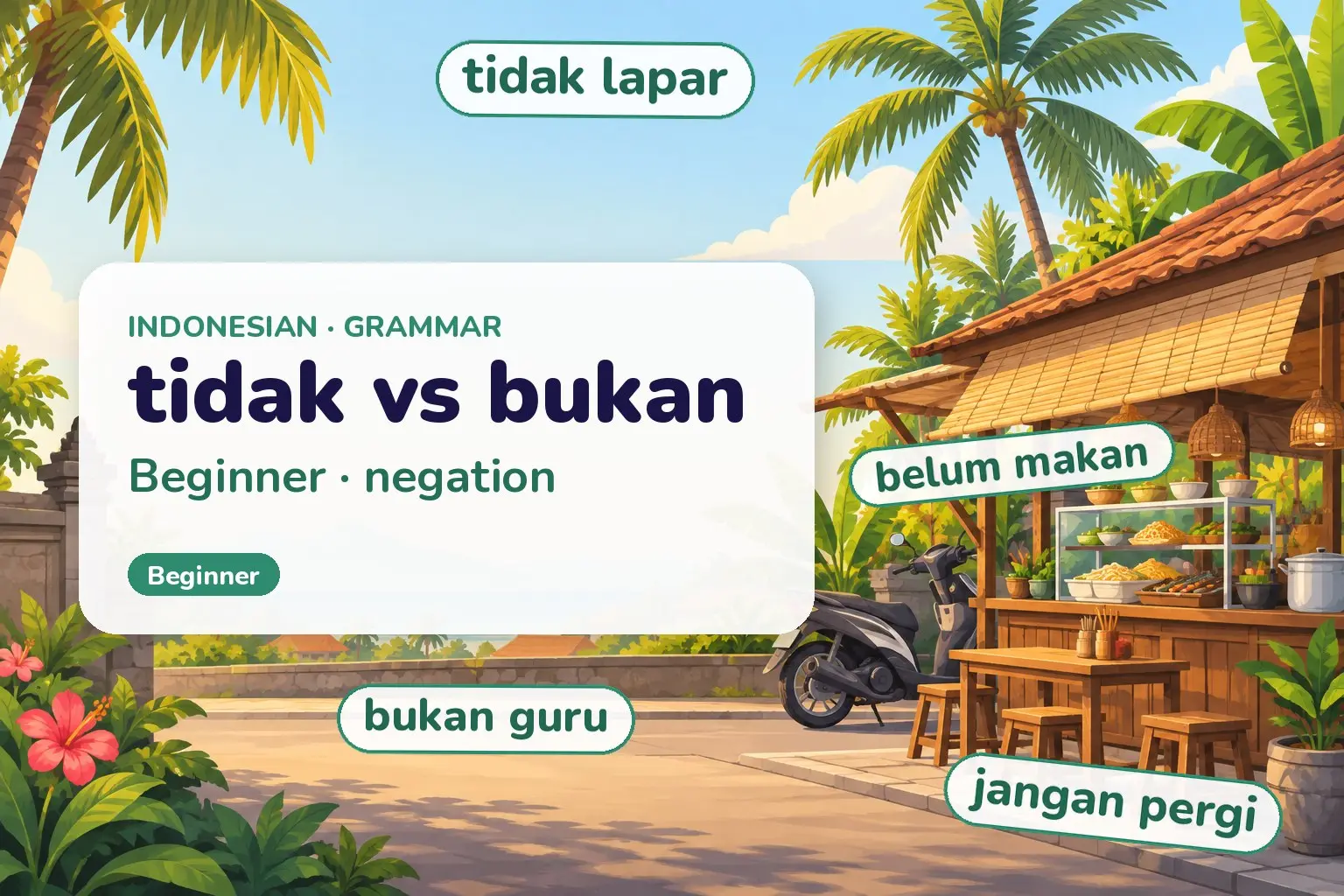
Indonesian chooses its negator by what follows. Use tidak before a verb or adjective (tidak makan, tidak lapar) and bukan before a noun (bukan guru). For 'not yet' use belum, and for 'don't!' use jangan.
Level: Beginner. Indonesian has two everyday words for “not”, and English speakers mix them up because English uses one. The choice is simple once you know it: look at the word right after the negator.
The rule
A negator is a word that makes a sentence negative, like English not. Indonesian picks between two of them by the word class of what comes next — that is, whether the next word is a noun, or a verb or adjective.
- tidak negates a verb or an adjective (an action, state, or quality): Saya tidak makan. — “I do not eat.” Dia tidak lapar. — “He is not hungry.”
- bukan negates a noun (a person or thing): Dia bukan guru. — “He is not a teacher.” Itu bukan mobil saya. — “That is not my car.”
So the test is: Is the next word a noun? If yes, use bukan. If it is a verb or an adjective, use tidak. There is nothing else to decide for a basic sentence.
The negators at a glance
| Negator | Negates | Example | Meaning |
|---|---|---|---|
| tidak | verb or adjective | Saya tidak lapar. | I am not hungry. |
| bukan | noun | Dia bukan dokter. | He/She is not a doctor. |
| belum | verb/adjective (not yet) | Saya belum makan. | I have not eaten yet. |
| jangan | command (don’t) | Jangan pergi! | Don’t go! |
belum: “not yet”
belum is a third negator worth learning now. It means “not yet” and hints that the thing is still expected to happen. It replaces tidak when that “yet” meaning is there:
- Saya belum makan. — “I haven’t eaten yet.” (I still plan to.)
- Dia belum datang. — “He/She hasn’t arrived yet.”
The natural answer to a sudah…? (“already…?”) question is often belum, not tidak: Sudah makan? — Belum. (“Eaten already? — Not yet.”)
jangan: “don’t!”
jangan is the negator for commands — telling someone not to do something. It is not used for plain statements:
- Jangan lupa! — “Don’t forget!”
- Jangan merokok di sini. — “Don’t smoke here.”
For an ordinary negative statement you still use tidak or bukan; jangan only appears when you are forbidding or warning.
How to say it
Indonesian spelling is consistent — one sound per letter. A few points in this lesson’s words:
- c is always “ch”: bukan is easy, but watch kucing (“cat”) ≈ “KOO-ching”.
- Each vowel is short and pure: tidak ≈ “TEE-dak”, bukan ≈ “BOO-kan”.
- Final -k after a vowel is a light, almost swallowed stop: tidak ends softly, not a hard “k”.
- ng is one soft sound as in “singer”: jangan ≈ “JAH-ngan”.
Example sentences
- Saya tidak lapar.I am not hungry.tidak + adjective
- Dia tidak makan daging.He/She does not eat meat.tidak + verb
- Kami tidak sibuk hari ini.We are not busy today.
- Mereka tidak tinggal di sini.They do not live here.
- Rumah ini tidak besar.This house is not big.
- Dia bukan guru.He/She is not a teacher.bukan + noun
- Itu bukan mobil saya.That is not my car.
- Ini bukan kopi, ini teh.This is not coffee, this is tea.bukan for contrast
- Mereka bukan teman saya.They are not my friends.
- Dia bukan orang Indonesia.He/She is not Indonesian.
- Saya belum makan.I haven't eaten yet.belum = not yet
- Dia belum datang.He/She hasn't arrived yet.
- Kami belum siap.We are not ready yet.
- Saya belum pernah ke Bali.I have never been to Bali (yet).
- Jangan lupa!Don't forget!jangan = don't (command)
- Jangan merokok di sini.Don't smoke here.
- Jangan khawatir.Don't worry.
- Maaf, saya tidak tahu.Sorry, I don't know.tidak + verb tahu
- Dia tidak suka kopi.He/She does not like coffee.
- Ini bukan masalah besar.This is not a big problem.bukan + noun phrase
Common mistakes
- ❌ Dia tidak guru. → ✅ Dia bukan guru. A noun (guru) is negated with bukan, not tidak.
- ❌ Saya bukan lapar. → ✅ Saya tidak lapar. An adjective (lapar) takes tidak, not bukan.
- ❌ Saya tidak makan (when you mean “not yet”) → ✅ Saya belum makan. Use belum for “not yet”.
- ❌ Tidak pergi! (as a command) → ✅ Jangan pergi! A “don’t!” command uses jangan.
- ❌ Dia bukan suka kopi. → ✅ Dia tidak suka kopi. suka (“to like”) is a verb, so it takes tidak.
A short conversation
— Kamu bukan mahasiswa, ya? Kamu guru? — Benar, saya bukan mahasiswa. Saya guru. — Sudah makan? — Belum. Saya belum makan. Saya tidak lapar tadi, tapi sekarang lapar. — Ayo makan! Jangan lupa minum juga.
Usage notes
- The next word decides, not the English translation. English says “is not” for both bukan guru and tidak lapar; Indonesian splits them by word class.
- bukan can mark a contrast (“not X, but Y”): Ini bukan teh, tapi kopi.
- In speech tidak shrinks. You will hear tak (written, poetic) and the casual nggak / enggak; bukan keeps its full form, sometimes shortened to kan in questions.
- belum pairs with sudah. The yes/no pair for “already?” is sudah (“yes, already”) vs belum (“not yet”), not tidak.
Compared with…
- belum vs tidak: both can translate as a negative, but belum means “not yet” and keeps the door open. Choose it whenever the thing is still expected.
- jangan vs tidak: jangan forbids an action (a command); tidak simply states that something is not so. To see how negatives attach to verbless sentences, review Sentences Without ‘To Be’, and for the subject–predicate frame around them, Basic Word Order in Indonesian.
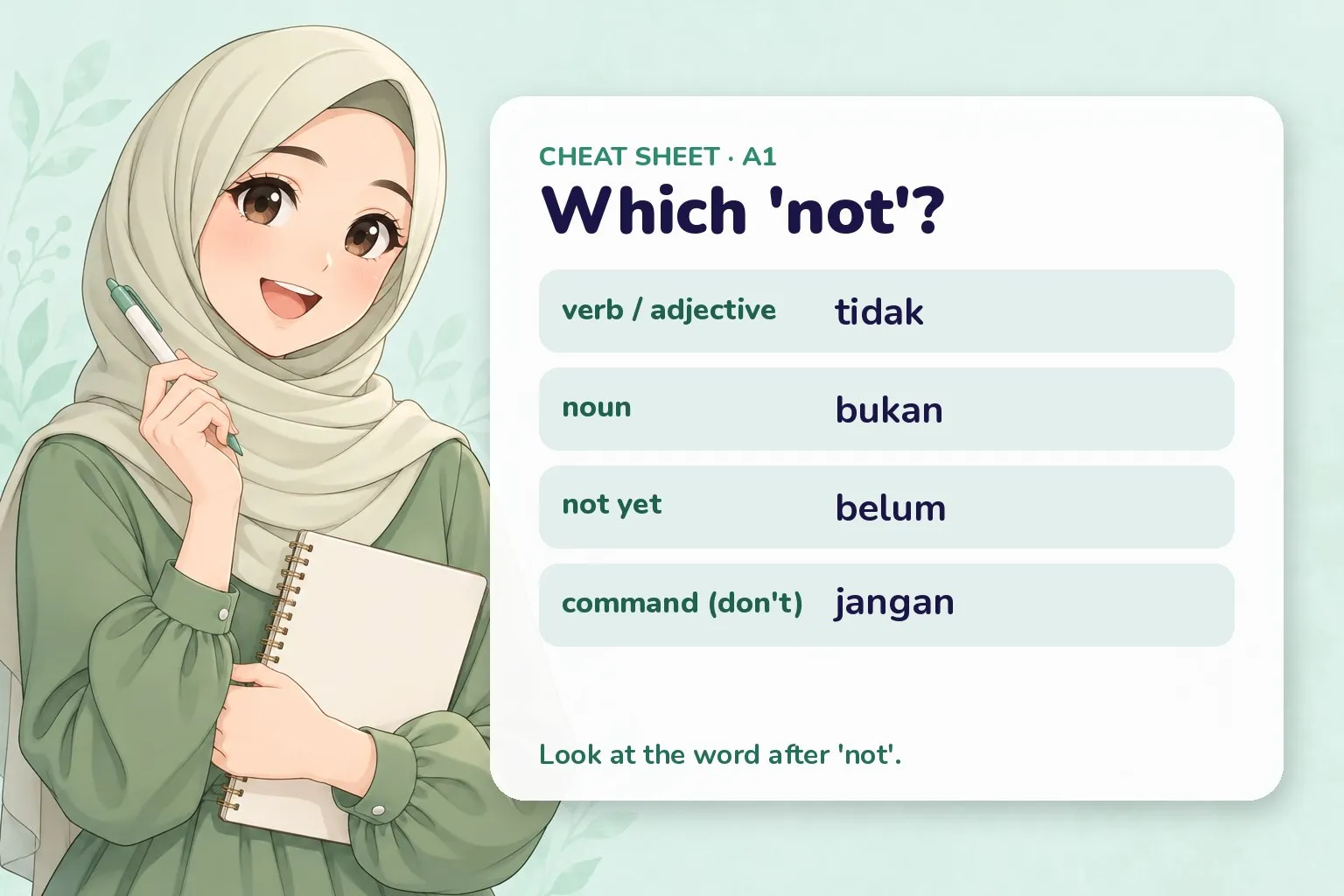
Quick recap before the quiz.
Practice
tidak vs bukan practice
Try each one, then press Check. No sign-up, nothing is sent anywhere — it all runs in your browser.
Hint: lelah is an adjective
Show answer
tidak — An adjective takes tidak: Saya tidak lelah.
Hint: 'not yet'
Show answer
belum — 'Not yet' is belum: Saya belum makan.
4 Order the words: 'That is not my car.'
Show answer
Itu bukan mobil saya — A noun (mobil saya) is negated with bukan: Itu bukan mobil saya.
5 Match each negator to its job.
- tidak
- bukan
- belum
- jangan
Show answer
- tidak → negates a verb/adjective
- bukan → negates a noun
- belum → not yet
- jangan → don't! (command)
tidak for verbs/adjectives, bukan for nouns, belum for 'not yet', jangan for commands.
Quiz
Indonesian negation: tidak vs bukan
12 questions · pick an answer and you'll see straight away if it's right.
-
Show answer
bukan — bukan negates nouns; tidak negates verbs and adjectives.
-
Show answer
tidak — lapar is an adjective, so use tidak.
-
Show answer
bukan — guru is a noun: Dia bukan guru.
-
Show answer
Dia tidak guru. — A noun needs bukan: Dia bukan guru.
-
Show answer
belum — belum means 'not yet': Saya belum sampai.
-
Show answer
Belum. — sudah pairs with belum: 'Not yet.'
-
Show answer
Jangan — A command ('don't') uses jangan.
-
Show answer
lapar is an adjective, so it needs tidak — lapar is an adjective; adjectives take tidak, not bukan.
-
Show answer
the sense of 'not yet / still expected' — belum means 'not yet' and implies the thing may still happen.
-
Show answer
bukan — kopi is a noun, and bukan can mark the contrast: Ini bukan kopi.
-
Show answer
Dia tidak suka kopi. — suka ('to like') is a verb, so it takes tidak.
-
Show answer
jangan — A 'don't' command uses jangan: Jangan lupa!
Recap cheat-sheet
| Say “not” before… | Use | Example |
|---|---|---|
| a verb | tidak | Saya tidak makan. |
| an adjective | tidak | Dia tidak lapar. |
| a noun | bukan | Dia bukan guru. |
| something “not yet” | belum | Saya belum makan. |
| a command (don’t) | jangan | Jangan pergi! |
Next
- Negatives in verbless sentences: Sentences Without ‘To Be’
- The subject–predicate frame: Basic Word Order in Indonesian
- New here? Start with Start Learning Indonesian Here
All Indonesian grammar topics
Every grammar point in order, from your first sentence to advanced structures. Pick one and go straight to it. New lessons go live every day, so topics marked Coming soon fill in over the next weeks.
Grammar path
Beginner 18 topics · 12 ready
- 01 Indonesian Personal Pronouns
- 02 Basic Word Order (Subject-Verb-Object)
- 03 Sentences Without 'To Be'
- 04 Noun + Adjective Order
- 05 Possession (Noun + Owner)
- 06 Plurals and Reduplication
- 07 Yes/No Questions (apakah, intonation)
- 08 Question Words (apa, siapa, di mana)
- 09 Negation: tidak vs bukan You are here
- 10 Demonstratives (ini, itu)
- 11 Numbers and Classifiers
- 12 Common Prepositions (di, ke, dari)
- 13 Existence and 'Have' with ada / punya Coming soon
- 14 Manner Deixis (begini, begitu) & sini/situ/sana Coming soon
- 15 Particles -lah, -kah, -pun Coming soon
- 16 Question Tags (kan, ya, bukan) Coming soon
- 17 Adverbs of Frequency (selalu, sering, kadang) Coming soon
- 18 Telling the Time Coming soon
Elementary 24 topics
- 19 The Prefix ber- Coming soon
- 20 The Prefix meN- (Active Transitive) Coming soon
- 21 The Passive with di- Coming soon
- 22 Agent-Focus Passive (Pronoun + Verb) Coming soon
- 23 Aspect Markers (sudah, sedang, akan, belum, masih) Coming soon
- 24 Modal Words (bisa, boleh, harus, mau, ingin) Coming soon
- 25 Comparatives and Superlatives Coming soon
- 26 Ordinal Numbers and Dates Coming soon
- 27 Basic Conjunctions (dan, tetapi, atau, karena) Coming soon
- 28 Imperatives and Requests Coming soon
- 29 Adverbs and Intensifiers (sangat, sekali, agak) Coming soon
- 30 Only / Just (hanya, cuma, saja) Coming soon
- 31 Again / Still / More (lagi, masih, tambah) Coming soon
- 32 Experience (pernah, belum pernah) Coming soon
- 33 Purpose Clauses (untuk, supaya, agar) Coming soon
- 34 Cause Clauses (karena, sebab, gara-gara) Coming soon
- 35 Quantifiers (semua, setiap, beberapa, banyak) Coming soon
- 36 Complement Clauses with bahwa Coming soon
- 37 The Suffix -an (Result Nouns) Coming soon
- 38 The Prefix ke- (ketua, kekasih) Coming soon
- 39 Adverbial -nya (biasanya, sebenarnya) Coming soon
- 40 The Clitic -nya as a Definite Marker Coming soon
- 41 Sequencing (lalu, kemudian, setelah itu) Coming soon
- 42 Before & After (sebelum, setelah, sesudah) Coming soon
Intermediate 21 topics
- 43 The meN-...-kan Construction Coming soon
- 44 The meN-...-i Construction Coming soon
- 45 Nominalising Affixes (pe-, pe-an, per-an, ke-an) Coming soon
- 46 The Prefix ter- (Accidental/Superlative/Stative) Coming soon
- 47 The Prefix se- (One/Same/As) Coming soon
- 48 Relative Clauses with yang Coming soon
- 49 Subordinating Conjunctions (jika, meskipun) Coming soon
- 50 Types of Reduplication Coming soon
- 51 Classifiers and Quantity Expressions Coming soon
- 52 Reciprocal & Stative (ber-an, ber-kan) Coming soon
- 53 Passive Register (di- vs ter- vs ke-an) Coming soon
- 54 Reciprocal (saling, satu sama lain) Coming soon
- 55 Intensive & Reflexive (diri, sendiri) Coming soon
- 56 Correlative Conjunctions (baik...maupun) Coming soon
- 57 Degree (terlalu, cukup, kurang) Coming soon
- 58 The More...The More (makin, semakin) Coming soon
- 59 Simultaneous Actions (sambil, selagi, sementara) Coming soon
- 60 The Prefix memper- (Causative) Coming soon
- 61 ke-...-an Adversative Verbs (kehujanan) Coming soon
- 62 The Frame se-...-nya (sebaiknya, secepatnya) Coming soon
- 63 Compound Words (kata majemuk) Coming soon
Advanced 11 topics
- 64 Advanced Nominalisation & Formal Syntax Coming soon
- 65 Discourse Markers & Cohesion Coming soon
- 66 Formal (baku) vs Colloquial Indonesian Coming soon
- 67 Advanced Passive & Object Preposing Coming soon
- 68 Idiomatic & Layered Affixation Coming soon
- 69 Conditionals & Hypotheticals (seandainya, andai) Coming soon
- 70 Large Numbers, Fractions & Approximation Coming soon
- 71 Compound & Complex Sentences Coming soon
- 72 Topic, Focus & Cleft (yang...itu) Coming soon
- 73 Apposition and Appositive Clauses Coming soon
- 74 Restoring Dropped Affixes (Formal Writing) Coming soon