Indonesian Numbers and Classifiers
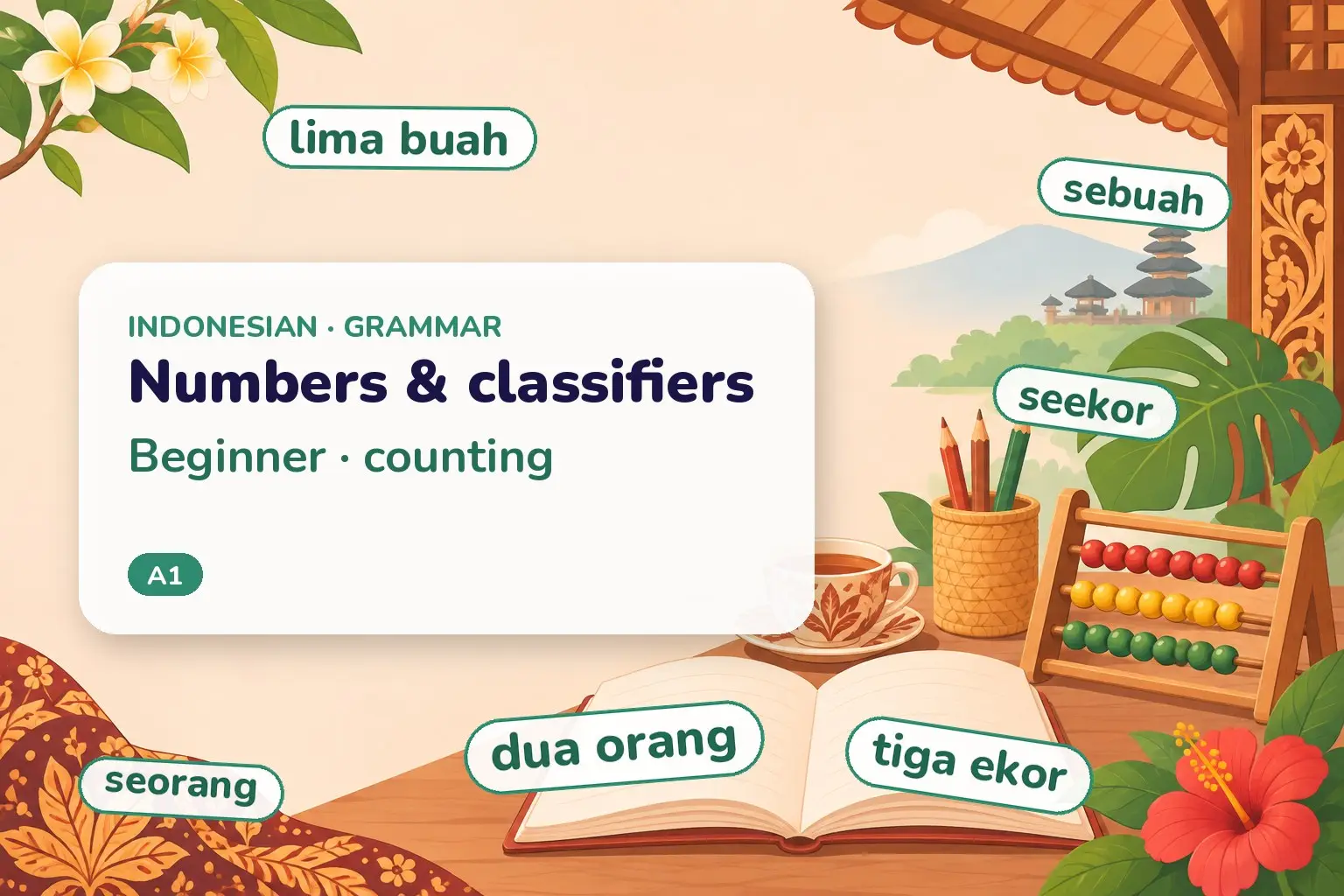
To count things in Indonesian, say number + classifier + noun: dua orang guru (two teachers), tiga ekor kucing (three cats), lima buah buku (five books). Use orang for people, ekor for animals, buah for most objects. The noun stays singular.
Level: Beginner (A1). Counting in Indonesian needs two things: the number words, and a small “counting word” called a classifier that sits between the number and the noun.
The rule
A classifier (Indonesian kata penggolong or kata bantu bilangan) is a word you put between a number and a noun when you count, much like English two head of cattle or three sheets of paper. Indonesian uses one for almost everything.
The order is always number + classifier + noun:
- dua orang guru — two teachers (literally “two person teacher”)
- tiga ekor kucing — three cats (“three tail cat”)
- lima buah buku — five books (“five fruit book”)
Three classifiers cover most beginner needs: orang for people, ekor for animals, and buah for things and objects (the general, catch-all classifier). The noun never changes — it stays in its plain, singular form even though you are talking about several.
For the number one, you do not say satu orang; the satu shrinks to the prefix se- and joins the classifier: seorang (one person), seekor (one animal), sebuah (one object).
Numbers and classifiers at a glance
Core numbers one to ten, plus the building blocks for bigger numbers:
| Number | Indonesian | Number | Indonesian |
|---|---|---|---|
| 1 | satu (se-) | 7 | tujuh |
| 2 | dua | 8 | delapan |
| 3 | tiga | 9 | sembilan |
| 4 | empat | 10 | sepuluh |
| 5 | lima | 11 | sebelas |
| 6 | enam | 20 | dua puluh |
Build bigger numbers with puluh (tens), ratus (hundreds) and ribu (thousands): tiga puluh (30), seratus (100), dua ratus (200), seribu (1,000). Note the same se- = “one”: sepuluh, seratus, seribu.
The three everyday classifiers:
| Classifier | Use for | Example |
|---|---|---|
| orang | people | dua orang anak (two children) |
| ekor | animals | tiga ekor ayam (three chickens) |
| buah | things, objects | empat buah kursi (four chairs) |
How to say it
Indonesian spelling is very regular — one letter, one sound. A few points for this lesson’s words:
- c is English “ch”: tiga is fine, but kucing (cat) = “KOO-ching”.
- ng / ny are single sounds: ng as in “singer” (orang = “OH-rang”), ny as in “canyon”.
- vowels are pure: a = “ah”, e is often a soft “uh” (empat ≈ “uhm-PAT”), u = “oo” (dua = “DOO-ah”).
- stress is light and usually on the next-to-last syllable: se-PU-luh, se-O-rang.
Example sentences
- Ada dua orang guru.There are two teachers.orang for people
- Saya punya tiga ekor kucing.I have three cats.ekor for animals
- Dia membeli lima buah buku.She is buying five books.buah for objects
- Seorang anak bermain di taman.One child is playing in the park.satu + orang → seorang
- Ada seekor anjing di jalan.There is a dog on the street.satu + ekor → seekor
- Saya mau sebuah apel.I want one apple.satu + buah → sebuah
- Empat orang teman datang.Four friends came.
- Kami melihat enam ekor burung.We saw six birds.
- Dia menulis dua buah surat.He wrote two letters.
- Ada sepuluh orang di kelas.There are ten people in the class.sepuluh = se + puluh
- Saya membeli tiga buah mangga.I bought three mangoes.
- Ada dua puluh ekor ikan.There are twenty fish.dua puluh = 20
- Seratus orang hadir.A hundred people attended.seratus = 100
- Dia punya seribu rupiah.He has one thousand rupiah.seribu = 1,000
- Berapa ekor kucing yang kamu punya?How many cats do you have?berapa = how many
- Ada lima orang perempuan dan tiga orang laki-laki.There are five women and three men.
- Saya mau dua buah, bukan satu.I want two, not one.noun can be dropped if clear
- Dua anak itu bermain bola.Those two children are playing ball.classifier often dropped in speech
Common mistakes
- ❌ dua buku-buku → ✅ dua buku. A number already shows plural, so never reduplicate the noun after it.
- ❌ satu orang guru → ✅ seorang guru. For “one”, fuse satu into se- on the classifier.
- ❌ tiga ekor guru → ✅ tiga orang guru. ekor (“tail”) is for animals, not people.
- ❌ dua orang kucing → ✅ dua ekor kucing. Use ekor for animals, not orang.
- ❌ lima buku buah → ✅ lima buah buku. The order is number + classifier + noun, so the classifier comes before the noun.
- ❌ dua puluhan orang → ✅ dua puluh orang. “Twenty” is dua puluh; puluhan means a vague “tens of”.
A short conversation
Di toko hewan (at the pet shop): — Kamu mau berapa ekor ikan? — Saya mau tiga ekor ikan dan seekor kura-kura. — Baik. Dan buku tentang ikan? — Ya, satu — sebuah buku saja.
Usage notes
- Classifiers can be dropped in casual speech. dua guru (two teachers) is common and understood; the full dua orang guru is the standard, careful form and what exams expect.
- Many more classifiers exist. Beyond the big three you will meet batang (long thin things: pens, cigarettes), helai/lembar (flat sheets: paper, cloth) and biji (small round things). Learn these later; orang/ekor/buah carry you a long way first.
- se- is “one” everywhere. The same se- that gives seorang also builds sepuluh, seratus, seribu — and words like sehari (one day).
- Asking “how many”: use berapa + classifier + noun: berapa orang?, berapa ekor?
Compared with…
- Plural by reduplication — without a number, Indonesian doubles the noun to show plural: buku-buku (books). See Plural by Reduplication. With a number, you don’t.
- Noun + adjective order — modifiers follow the noun, and so does the owner: compare the word order in Noun and Adjective Order.
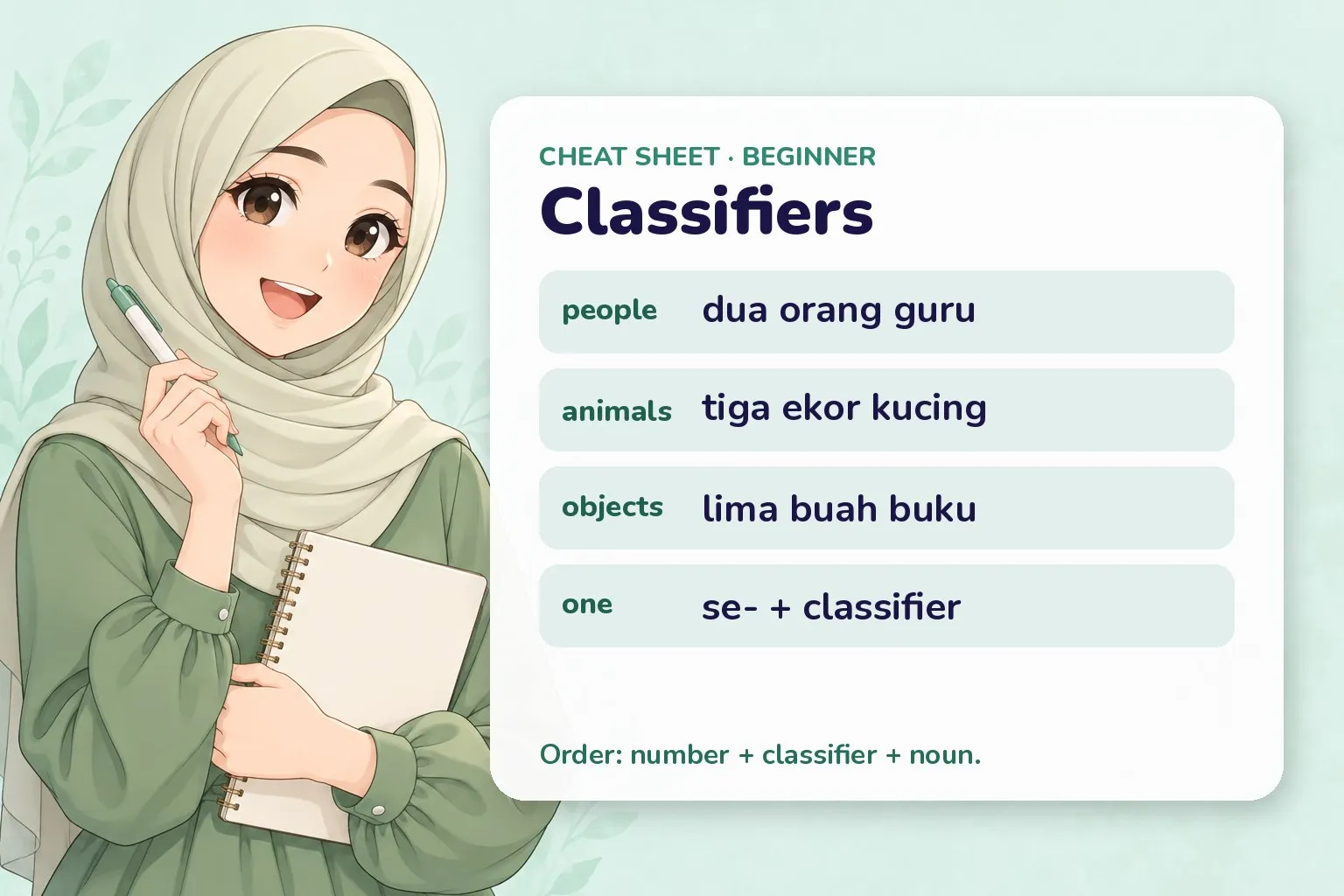
Quick recap before the quiz.
Practice
Numbers and classifiers practice
Try each one, then press Check. No sign-up, nothing is sent anywhere — it all runs in your browser.
Hint: satu + buah
Show answer
sebuah — satu fuses to se- on the classifier buah → sebuah.
Hint: objects
Show answer
buah — Objects take the general classifier buah.
5 Order the words: 'three birds'.
Show answer
tiga ekor burung — number + classifier + noun.
6 Match each noun to its usual classifier.
- guru (teacher)
- kucing (cat)
- buku (book)
- anak (child)
Show answer
- guru (teacher) → orang
- kucing (cat) → ekor
- buku (book) → buah
- anak (child) → orang
orang = people, ekor = animals, buah = objects.
Quiz
Indonesian numbers and classifiers
12 questions · pick an answer and you'll see straight away if it's right.
-
Show answer
orang — People take orang.
-
Show answer
ekor — Animals take ekor.
-
Show answer
buah — Objects take the general classifier buah.
-
Show answer
seorang — satu fuses to se- and joins the classifier: seorang.
-
Show answer
dua buku-buku — Don't reduplicate the noun after a number.
-
Show answer
seekor — satu + ekor → seekor.
-
Show answer
one hundred — se- (one) + ratus (hundred) = 100.
-
Show answer
number + classifier + noun — Always number + classifier + noun.
-
Show answer
dua puluh — Tens are built with puluh: dua puluh.
-
Show answer
the number already marks plural — The number shows plural, so the noun stays in its plain form.
-
Show answer
sebuah — satu + buah → sebuah.
-
Show answer
buah — buah covers most objects when you are unsure.
Recap cheat-sheet
| Pattern | Example | Meaning |
|---|---|---|
| number + orang + noun | dua orang guru | two teachers |
| number + ekor + noun | tiga ekor kucing | three cats |
| number + buah + noun | lima buah buku | five books |
| se- + classifier | seorang, seekor, sebuah | one (person/animal/thing) |
Next
- Back to the Indonesian grammar section
- New here? Start with Start Learning Indonesian Here
All Indonesian grammar topics
Every grammar point in order, from your first sentence to advanced structures. Pick one and go straight to it. New lessons go live every day, so topics marked Coming soon fill in over the next weeks.
Grammar path
Beginner 18 topics · 12 ready
- 01 Indonesian Personal Pronouns
- 02 Basic Word Order (Subject-Verb-Object)
- 03 Sentences Without 'To Be'
- 04 Noun + Adjective Order
- 05 Possession (Noun + Owner)
- 06 Plurals and Reduplication
- 07 Yes/No Questions (apakah, intonation)
- 08 Question Words (apa, siapa, di mana)
- 09 Negation: tidak vs bukan
- 10 Demonstratives (ini, itu)
- 11 Numbers and Classifiers You are here
- 12 Common Prepositions (di, ke, dari)
- 13 Existence and 'Have' with ada / punya Coming soon
- 14 Manner Deixis (begini, begitu) & sini/situ/sana Coming soon
- 15 Particles -lah, -kah, -pun Coming soon
- 16 Question Tags (kan, ya, bukan) Coming soon
- 17 Adverbs of Frequency (selalu, sering, kadang) Coming soon
- 18 Telling the Time Coming soon
Elementary 24 topics
- 19 The Prefix ber- Coming soon
- 20 The Prefix meN- (Active Transitive) Coming soon
- 21 The Passive with di- Coming soon
- 22 Agent-Focus Passive (Pronoun + Verb) Coming soon
- 23 Aspect Markers (sudah, sedang, akan, belum, masih) Coming soon
- 24 Modal Words (bisa, boleh, harus, mau, ingin) Coming soon
- 25 Comparatives and Superlatives Coming soon
- 26 Ordinal Numbers and Dates Coming soon
- 27 Basic Conjunctions (dan, tetapi, atau, karena) Coming soon
- 28 Imperatives and Requests Coming soon
- 29 Adverbs and Intensifiers (sangat, sekali, agak) Coming soon
- 30 Only / Just (hanya, cuma, saja) Coming soon
- 31 Again / Still / More (lagi, masih, tambah) Coming soon
- 32 Experience (pernah, belum pernah) Coming soon
- 33 Purpose Clauses (untuk, supaya, agar) Coming soon
- 34 Cause Clauses (karena, sebab, gara-gara) Coming soon
- 35 Quantifiers (semua, setiap, beberapa, banyak) Coming soon
- 36 Complement Clauses with bahwa Coming soon
- 37 The Suffix -an (Result Nouns) Coming soon
- 38 The Prefix ke- (ketua, kekasih) Coming soon
- 39 Adverbial -nya (biasanya, sebenarnya) Coming soon
- 40 The Clitic -nya as a Definite Marker Coming soon
- 41 Sequencing (lalu, kemudian, setelah itu) Coming soon
- 42 Before & After (sebelum, setelah, sesudah) Coming soon
Intermediate 21 topics
- 43 The meN-...-kan Construction Coming soon
- 44 The meN-...-i Construction Coming soon
- 45 Nominalising Affixes (pe-, pe-an, per-an, ke-an) Coming soon
- 46 The Prefix ter- (Accidental/Superlative/Stative) Coming soon
- 47 The Prefix se- (One/Same/As) Coming soon
- 48 Relative Clauses with yang Coming soon
- 49 Subordinating Conjunctions (jika, meskipun) Coming soon
- 50 Types of Reduplication Coming soon
- 51 Classifiers and Quantity Expressions Coming soon
- 52 Reciprocal & Stative (ber-an, ber-kan) Coming soon
- 53 Passive Register (di- vs ter- vs ke-an) Coming soon
- 54 Reciprocal (saling, satu sama lain) Coming soon
- 55 Intensive & Reflexive (diri, sendiri) Coming soon
- 56 Correlative Conjunctions (baik...maupun) Coming soon
- 57 Degree (terlalu, cukup, kurang) Coming soon
- 58 The More...The More (makin, semakin) Coming soon
- 59 Simultaneous Actions (sambil, selagi, sementara) Coming soon
- 60 The Prefix memper- (Causative) Coming soon
- 61 ke-...-an Adversative Verbs (kehujanan) Coming soon
- 62 The Frame se-...-nya (sebaiknya, secepatnya) Coming soon
- 63 Compound Words (kata majemuk) Coming soon
Advanced 11 topics
- 64 Advanced Nominalisation & Formal Syntax Coming soon
- 65 Discourse Markers & Cohesion Coming soon
- 66 Formal (baku) vs Colloquial Indonesian Coming soon
- 67 Advanced Passive & Object Preposing Coming soon
- 68 Idiomatic & Layered Affixation Coming soon
- 69 Conditionals & Hypotheticals (seandainya, andai) Coming soon
- 70 Large Numbers, Fractions & Approximation Coming soon
- 71 Compound & Complex Sentences Coming soon
- 72 Topic, Focus & Cleft (yang...itu) Coming soon
- 73 Apposition and Appositive Clauses Coming soon
- 74 Restoring Dropped Affixes (Formal Writing) Coming soon