Possession (Noun + Owner)
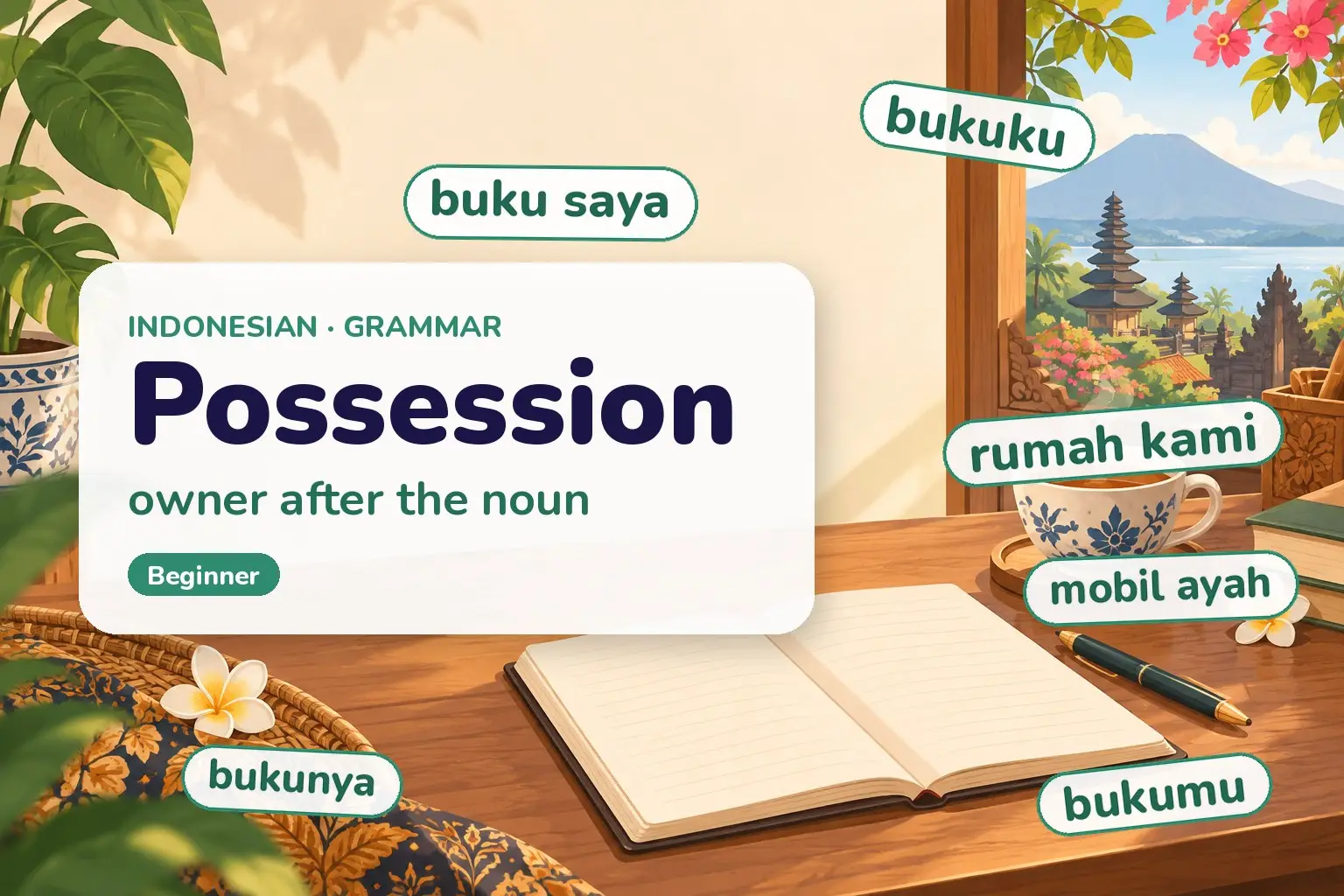
In Indonesian the owner comes after the thing owned: buku saya means my book, rumah kami our house. Short pronouns can attach to the noun as clitics — bukuku (my book), bukumu (your book), bukunya (his/her book) — and nothing changes for gender or number.
Level: Beginner. Saying “my book” or “the teacher’s car” in Indonesian is easy once you accept one thing: the owner comes after the thing owned, the opposite of English. There are no possessive words like English “my” sitting in front — you put the owner (a pronoun, a name or a noun) straight after the item.
The rule
A possessor is whoever owns something; the possessed is the thing. In Indonesian the possessed noun comes first and the possessor follows it:
- buku saya — my book (literally “book my”)
- rumah kami — our house (“house our”)
- mobil ayah — father’s car (“car father”)
- buku Budi — Budi’s book (“book Budi”)
The possessor can be a full pronoun (saya, kami), a name (Budi), or a noun (ayah, guru). Nothing on the noun changes for gender or number: buku stays buku whether it is my book or their books.
Three common pronouns also have a short clitic form that attaches to the end of the noun as a suffix:
- -ku = my (from aku): bukuku = my book
- -mu = your (from kamu): bukumu = your book
- -nya = his / her / its (from dia): bukunya = his/her book
So buku saya and bukuku both mean “my book” — the second just glues the short form on. Note that the polite saya has no clitic; only the informal aku gives -ku.
Forms
| Owner | Full phrase | Clitic form |
|---|---|---|
| saya / aku (my) | buku saya | bukuku |
| kamu (your, informal) | buku kamu | bukumu |
| dia (his / her) | buku dia | bukunya |
| kami / kita (our) | buku kami | — |
| kalian (your, plural) | buku kalian | — |
| mereka (their) | buku mereka | — |
Only -ku, -mu and -nya exist as clitics; the other owners use the full word after the noun.
How to say it
Indonesian spelling is regular and each letter has one sound; a few points help with these words:
- c is always “ch”: cari ≈ “CHAH-ree”, cucu (grandchild) ≈ “CHOO-choo”.
- ny is one sound, like the ni in “onion”: -nya ≈ “nyah”, bukunya ≈ “boo-KOO-nyah”.
- -ya in saya / ayah is a clear “yah”: saya ≈ “SAH-yah”, ayah ≈ “AH-yah”.
- Final -k is a soft catch in the throat (a glottal stop), not a hard English k: anak (child) ≈ “AH-naʔ”.
Example sentences
- Ini buku saya.This is my book.owner after the noun
- Itu rumah kami.That is our house.
- Mobil ayah baru.Father's car is new.noun as owner
- Buku Budi ada di meja.Budi's book is on the table.name as owner
- Namaku Andi.My name is Andi.clitic -ku on nama
- Di mana tasmu?Where is your bag?clitic -mu on tas
- Ini kucingnya.This is his/her cat.clitic -nya
- Rumahnya besar.His/her house is big.
- Anjing saya kecil.My dog is small.
- Sepeda kakak rusak.Older sibling's bike is broken.
- Teman saya tinggal di Jakarta.My friend lives in Jakarta.
- Handphone kamu di mana?Where is your phone?
- Guru kami sangat baik.Our teacher is very kind.
- Ibunya seorang dokter.His/her mother is a doctor.-nya on ibu
- Kamar mereka di lantai dua.Their room is on the second floor.
- Bukuku ada di tasku.My book is in my bag.two clitics
Common mistakes
- ❌ saya buku → ✅ buku saya. The owner follows the noun; saya buku reads as “I book”.
- ❌ ku buku → ✅ bukuku. -ku is a suffix glued to the noun, not a word standing in front.
- ❌ aku rumah (for “my house”) → ✅ rumah saya / rumahku. Use the clitic -ku or the word saya after the noun.
- ❌ buku dia-nya → ✅ buku dia or bukunya. Use the full dia after the noun, or the clitic -nya — not both.
- ❌ mobil baru ayah (for “father’s new car”) → ✅ mobil baru ayah is fine, but “father’s car” alone is mobil ayah, owner right after the noun it owns.
A short conversation
— Ini tas siapa? — Itu tas saya. Dan ini bukuku. — Kalau mobil di luar? — Oh, itu mobil ayah. Rumahnya dekat sini.
Usage notes
- The possessor is always after the noun. Pronoun, name or noun, it takes the same slot: buku saya, buku Budi, buku guru.
- Clitics are only -ku, -mu, -nya. For kami, kita, kalian, mereka and polite Anda, use the full word after the noun (rumah kami, rumah mereka).
- Adjectives come after the noun too, before the owner is less common. The base pattern is noun (+ adjective) + owner: mobil ayah (father’s car), mobil baru ayah (father’s new car).
- -nya doubles as a definite marker. Beyond “his/her”, it can mean “the (one we both know)”: harganya = “its price / the price”.
Compared with…
- Subject pronouns (saya, aku, kamu, dia, kami, mereka). As the subject they come before the verb (Saya membaca — I read); as the owner they come after the noun (buku saya — my book). Same words, opposite position — that switch is the whole trick of possession.
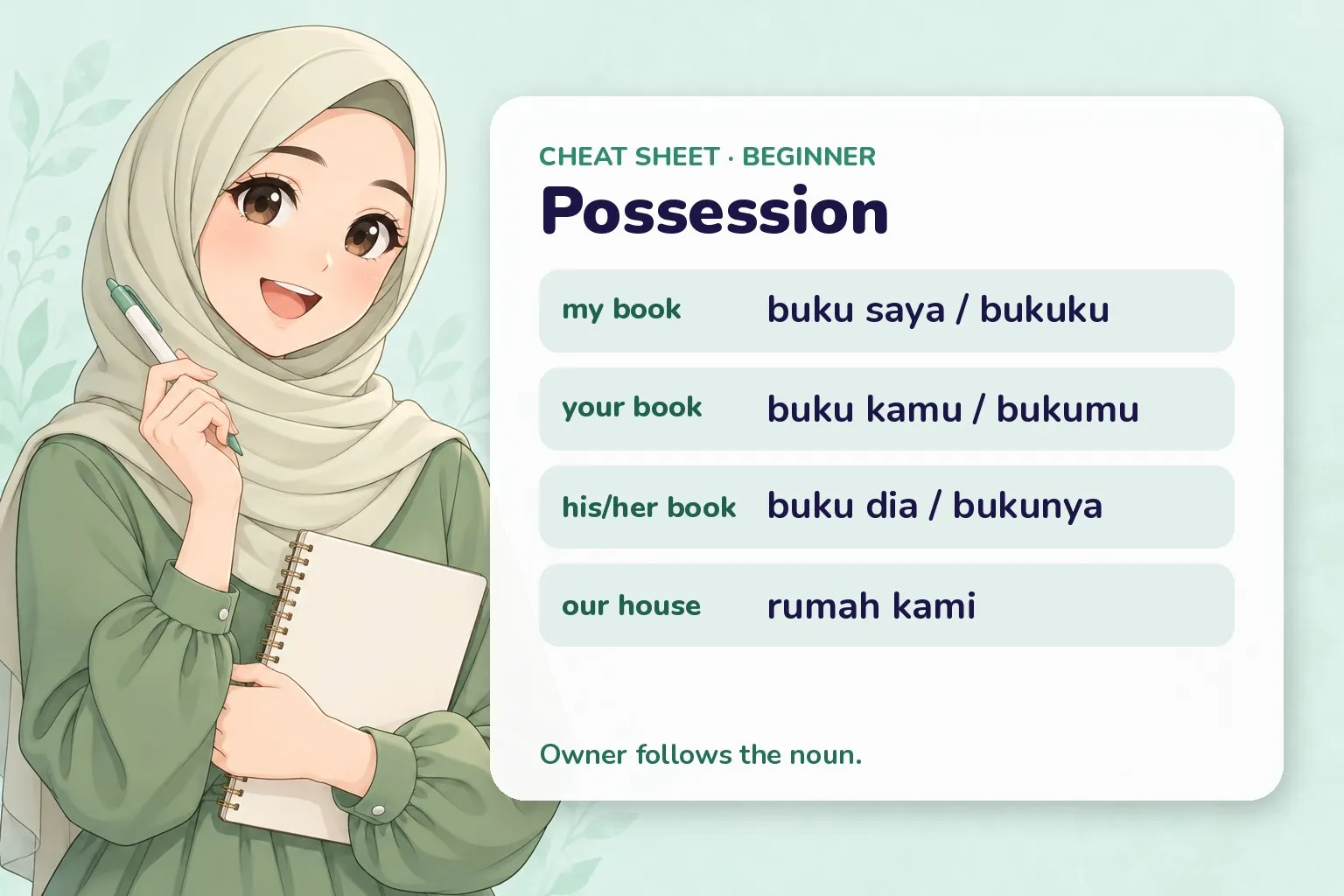
Quick recap before the quiz.
Practice
Possession practice
Try each one, then press Check. No sign-up, nothing is sent anywhere — it all runs in your browser.
Hint: buku + the clitic for aku
Show answer
bukuku — buku + -ku = bukuku, my book.
3 Build: 'our house'.
Show answer
rumah kami — rumah kami — thing first, owner second.
4 Match each clitic to its meaning.
- -ku
- -mu
- -nya
- kami
Show answer
- -ku → my
- -mu → your
- -nya → his/her
- kami → our
-ku my, -mu your, -nya his/her; kami is a full word for our.
Hint: the clitic from dia
Show answer
nya — kucing + -nya = kucingnya, his/her cat.
Quiz
Indonesian possession
10 questions · pick an answer and you'll see straight away if it's right.
-
Show answer
buku saya — Owner after the noun: buku saya.
-
Show answer
aku — -ku is the short form of aku.
-
Show answer
your — -mu = your (from kamu).
-
Show answer
his/her book or the book — -nya marks his/her and can also mean the (known) one.
-
Show answer
rumah kami — rumah kami; kami has no clitic form.
-
Show answer
saya buku — saya buku puts the owner first; it should be buku saya.
-
Show answer
no, the noun stays the same — Indonesian nouns do not change for number here: buku mereka.
-
Show answer
namaku — nama + -ku = namaku, my name.
-
Show answer
saya — Polite saya has no clitic; use the full word after the noun.
-
Show answer
tasmu — tas + -mu = tasmu.
Recap cheat-sheet
| Meaning | Full form | Clitic |
|---|---|---|
| my book | buku saya | bukuku |
| your book | buku kamu | bukumu |
| his/her book | buku dia | bukunya |
| our house | rumah kami | — |
Next
- Back to the Indonesian grammar section
- New here? Start with Start Learning Indonesian Here
All Indonesian grammar topics
Every grammar point in order, from your first sentence to advanced structures. Pick one and go straight to it. New lessons go live every day, so topics marked Coming soon fill in over the next weeks.
Grammar path
Beginner 18 topics · 12 ready
- 01 Indonesian Personal Pronouns
- 02 Basic Word Order (Subject-Verb-Object)
- 03 Sentences Without 'To Be'
- 04 Noun + Adjective Order
- 05 Possession (Noun + Owner) You are here
- 06 Plurals and Reduplication
- 07 Yes/No Questions (apakah, intonation)
- 08 Question Words (apa, siapa, di mana)
- 09 Negation: tidak vs bukan
- 10 Demonstratives (ini, itu)
- 11 Numbers and Classifiers
- 12 Common Prepositions (di, ke, dari)
- 13 Existence and 'Have' with ada / punya Coming soon
- 14 Manner Deixis (begini, begitu) & sini/situ/sana Coming soon
- 15 Particles -lah, -kah, -pun Coming soon
- 16 Question Tags (kan, ya, bukan) Coming soon
- 17 Adverbs of Frequency (selalu, sering, kadang) Coming soon
- 18 Telling the Time Coming soon
Elementary 24 topics
- 19 The Prefix ber- Coming soon
- 20 The Prefix meN- (Active Transitive) Coming soon
- 21 The Passive with di- Coming soon
- 22 Agent-Focus Passive (Pronoun + Verb) Coming soon
- 23 Aspect Markers (sudah, sedang, akan, belum, masih) Coming soon
- 24 Modal Words (bisa, boleh, harus, mau, ingin) Coming soon
- 25 Comparatives and Superlatives Coming soon
- 26 Ordinal Numbers and Dates Coming soon
- 27 Basic Conjunctions (dan, tetapi, atau, karena) Coming soon
- 28 Imperatives and Requests Coming soon
- 29 Adverbs and Intensifiers (sangat, sekali, agak) Coming soon
- 30 Only / Just (hanya, cuma, saja) Coming soon
- 31 Again / Still / More (lagi, masih, tambah) Coming soon
- 32 Experience (pernah, belum pernah) Coming soon
- 33 Purpose Clauses (untuk, supaya, agar) Coming soon
- 34 Cause Clauses (karena, sebab, gara-gara) Coming soon
- 35 Quantifiers (semua, setiap, beberapa, banyak) Coming soon
- 36 Complement Clauses with bahwa Coming soon
- 37 The Suffix -an (Result Nouns) Coming soon
- 38 The Prefix ke- (ketua, kekasih) Coming soon
- 39 Adverbial -nya (biasanya, sebenarnya) Coming soon
- 40 The Clitic -nya as a Definite Marker Coming soon
- 41 Sequencing (lalu, kemudian, setelah itu) Coming soon
- 42 Before & After (sebelum, setelah, sesudah) Coming soon
Intermediate 21 topics
- 43 The meN-...-kan Construction Coming soon
- 44 The meN-...-i Construction Coming soon
- 45 Nominalising Affixes (pe-, pe-an, per-an, ke-an) Coming soon
- 46 The Prefix ter- (Accidental/Superlative/Stative) Coming soon
- 47 The Prefix se- (One/Same/As) Coming soon
- 48 Relative Clauses with yang Coming soon
- 49 Subordinating Conjunctions (jika, meskipun) Coming soon
- 50 Types of Reduplication Coming soon
- 51 Classifiers and Quantity Expressions Coming soon
- 52 Reciprocal & Stative (ber-an, ber-kan) Coming soon
- 53 Passive Register (di- vs ter- vs ke-an) Coming soon
- 54 Reciprocal (saling, satu sama lain) Coming soon
- 55 Intensive & Reflexive (diri, sendiri) Coming soon
- 56 Correlative Conjunctions (baik...maupun) Coming soon
- 57 Degree (terlalu, cukup, kurang) Coming soon
- 58 The More...The More (makin, semakin) Coming soon
- 59 Simultaneous Actions (sambil, selagi, sementara) Coming soon
- 60 The Prefix memper- (Causative) Coming soon
- 61 ke-...-an Adversative Verbs (kehujanan) Coming soon
- 62 The Frame se-...-nya (sebaiknya, secepatnya) Coming soon
- 63 Compound Words (kata majemuk) Coming soon
Advanced 11 topics
- 64 Advanced Nominalisation & Formal Syntax Coming soon
- 65 Discourse Markers & Cohesion Coming soon
- 66 Formal (baku) vs Colloquial Indonesian Coming soon
- 67 Advanced Passive & Object Preposing Coming soon
- 68 Idiomatic & Layered Affixation Coming soon
- 69 Conditionals & Hypotheticals (seandainya, andai) Coming soon
- 70 Large Numbers, Fractions & Approximation Coming soon
- 71 Compound & Complex Sentences Coming soon
- 72 Topic, Focus & Cleft (yang...itu) Coming soon
- 73 Apposition and Appositive Clauses Coming soon
- 74 Restoring Dropped Affixes (Formal Writing) Coming soon