Yes/No Questions (apakah, intonation)
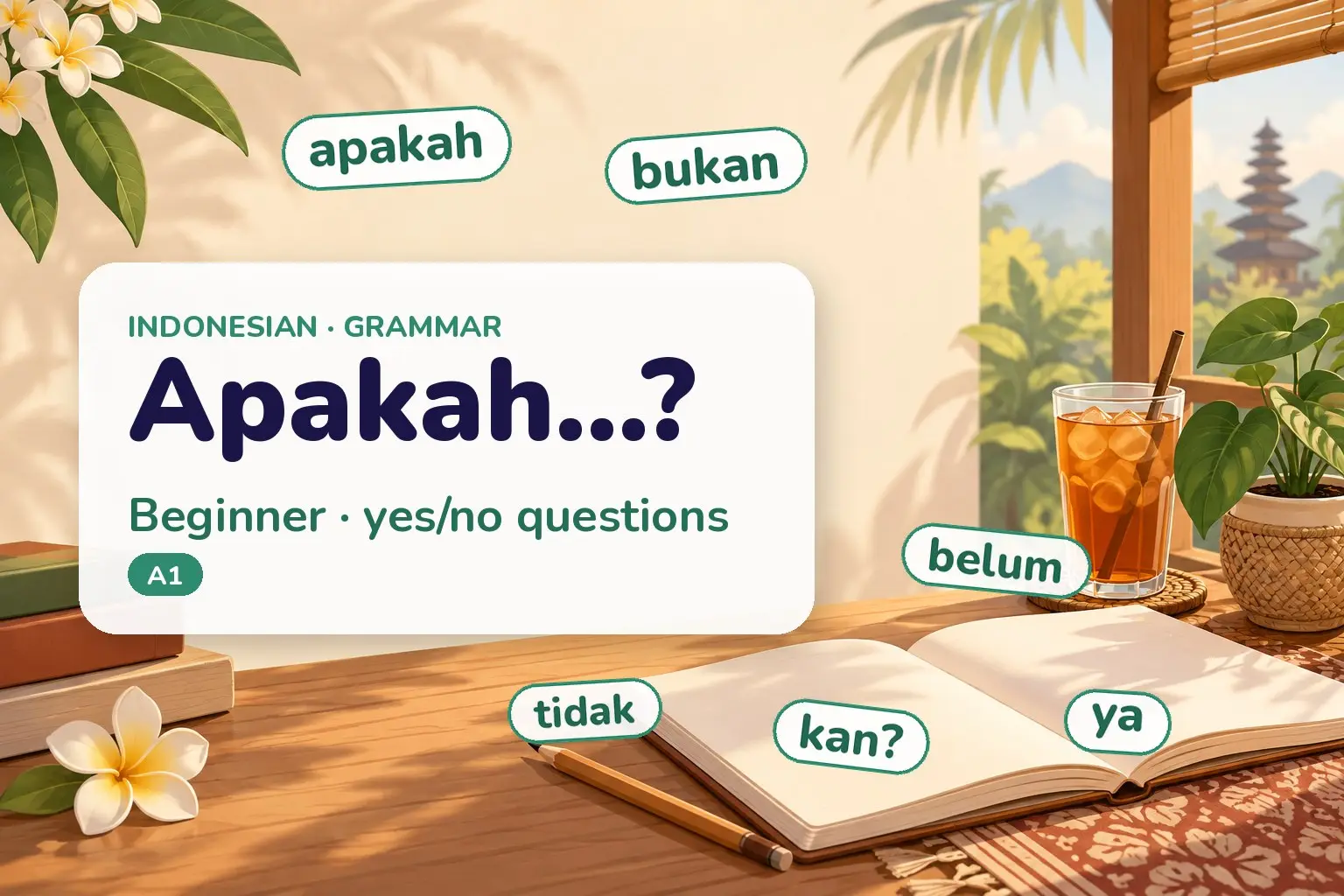
To ask a yes/no question in Indonesian, keep the statement word order and either raise your voice at the end or add apakah at the front: Apakah kamu lapar? Answer ya (yes), tidak (no, for verbs/adjectives) or bukan (no, for nouns).
Level: Beginner. A yes/no question is one you can answer with yes or no. Indonesian makes it the easy way: you keep the sentence exactly as it is and either raise your voice or add one small word.
The rule
A yes/no question (Indonesian pertanyaan ya/tidak) asks the listener to confirm or deny something. Indonesian has two everyday ways to form it, and neither changes the word order:
- Rising intonation. Say the statement and lift your voice at the end. Kamu lapar. (“You are hungry.”) becomes Kamu lapar? (“Are you hungry?”). In writing, the question mark does this job.
- The word apakah at the front. Apakah kamu lapar? means the same thing but sounds more formal or careful. apakah marks the whole sentence as a question.
Unlike English, Indonesian adds no helper verb — there is no equivalent of do in “Do you live here?” — and it does not reorder the words. The subject and predicate stay put; only a tone or apakah is added.
There is also a suffix -kah that can attach to the questioned word for a formal, focused question: Laparkah kamu? (“Are you hungry?”). You will meet it in writing, but apakah or plain intonation is all you need to speak.
The three ways at a glance
| Way to ask | Register | Example | Meaning |
|---|---|---|---|
| rising intonation | everyday speech | Kamu suka kopi? | Do you like coffee? |
| apakah + statement | formal / written | Apakah kamu suka kopi? | Do you like coffee? |
| statement + -kah | formal / focused | Sukakah kamu kopi? | Do you like coffee? |
| statement + kan? | checking a belief | Kamu suka kopi, kan? | You like coffee, right? |
Answering: ya, tidak and bukan
Indonesian picks the “no” word by what is being denied:
- ya (or iya) — yes, to any positive question: Kamu lapar? — Ya.
- tidak — no, when you negate a verb or adjective: Kamu lapar? — Tidak (, saya tidak lapar).
- bukan — no, when you reject a noun or identity: Dia guru? — Bukan (, dia dokter).
- belum — not yet, when something simply has not happened: Sudah makan? — Belum.
A short Ya or Tidak works, but Indonesian often repeats the key word for a natural answer: Toko itu buka? — Tidak, tutup. (“Is that shop open? — No, it’s closed.”)
How to say it
Indonesian spelling is consistent, but a rising tone carries the question:
- The question melody rises or stays high on the last syllable: lapar? ends up, not down.
- apakah is three light syllables, “ah-pah-kah”, with no heavy stress.
- c is always “ch”: cuaca (“weather”) ≈ “chu-AH-cha”.
- ng is one soft sound as in “singer”: dengar (“hear”) ≈ “DUH-ngar”.
Example sentences
- Kamu lapar?Are you hungry?rising intonation
- Apakah kamu lapar?Are you hungry?formal, with apakah
- Apakah ini kopi?Is this coffee?
- Kamu suka kopi?Do you like coffee?
- Apakah dia guru?Is he/she a teacher?
- Mereka di rumah?Are they at home?
- Apakah kamu bisa bahasa Indonesia?Can you speak Indonesian?
- Kamu sudah makan?Have you eaten yet?
- Apakah toko itu buka?Is that shop open?
- Dia datang hari ini?Is he/she coming today?
- Apakah ini tasmu?Is this your bag?
- Kamu tinggal di sini?Do you live here?
- Apakah kamu capek?Are you tired?
- Harga tiketnya naik lagi?Has the ticket price gone up again?
- Kamu dari Prancis, kan?You are from France, right?kan checks a belief
- Apakah Anda punya kartu anggota?Do you have a membership card?formal Anda
- Enak, kan?Tasty, isn't it?
- Kamu tidak lapar?Aren't you hungry?negative question
Common mistakes
- ❌ Apa kamu lapar? used in careful writing for yes/no → ✅ Apakah kamu lapar? In formal yes/no questions use apakah; bare apa also means “what”.
- ❌ Dia guru? — Tidak. → ✅ Bukan. A noun (guru) is rejected with bukan, not tidak.
- ❌ Kamu lapar? — Bukan. → ✅ Tidak. An adjective (lapar) is negated with tidak, not bukan.
- ❌ Apakah kamu suka kopi? in a casual chat → ✅ Kamu suka kopi? In everyday speech, a rising tone is enough; apakah can sound stiff.
- ❌ Do kamu tinggal di sini? / inverting words → ✅ Kamu tinggal di sini? Indonesian adds no do and keeps the statement order.
A short conversation
Di warung (at a food stall): — Apakah kamu lapar? — Ya, sedikit. Nasi goreng enak di sini, kan? — Enak sekali. Kamu mau minum? — Belum, nanti saja.
Usage notes
- apakah is register, not grammar. The question means the same with or without it; apakah just raises formality. Textbooks use it; the street drops it.
- kan is a tag. kan (a short form of bukan) checks something you already believe: Kamu dari Jakarta, kan? (“You’re from Jakarta, right?”).
- Drop obvious pronouns. In context, Mau minum? (“Want a drink?”) is a complete, natural question.
- Answers often repeat the word. Especially after a negative question, repeat the predicate (sudah, belum, tutup) rather than relying on a bare ya.
Compared with question words
A yes/no question expects ya, tidak or bukan. A question-word question asks for information with apa (what), siapa (who), di mana (where), kapan (when), mengapa (why) or bagaimana (how), and cannot be answered with yes or no. Note that apa alone can mean “what”, while apakah marks a yes/no question. For the two “no” words, review Sentences Without ‘To Be’; for the statement order these questions keep, see Basic Word Order in Indonesian.
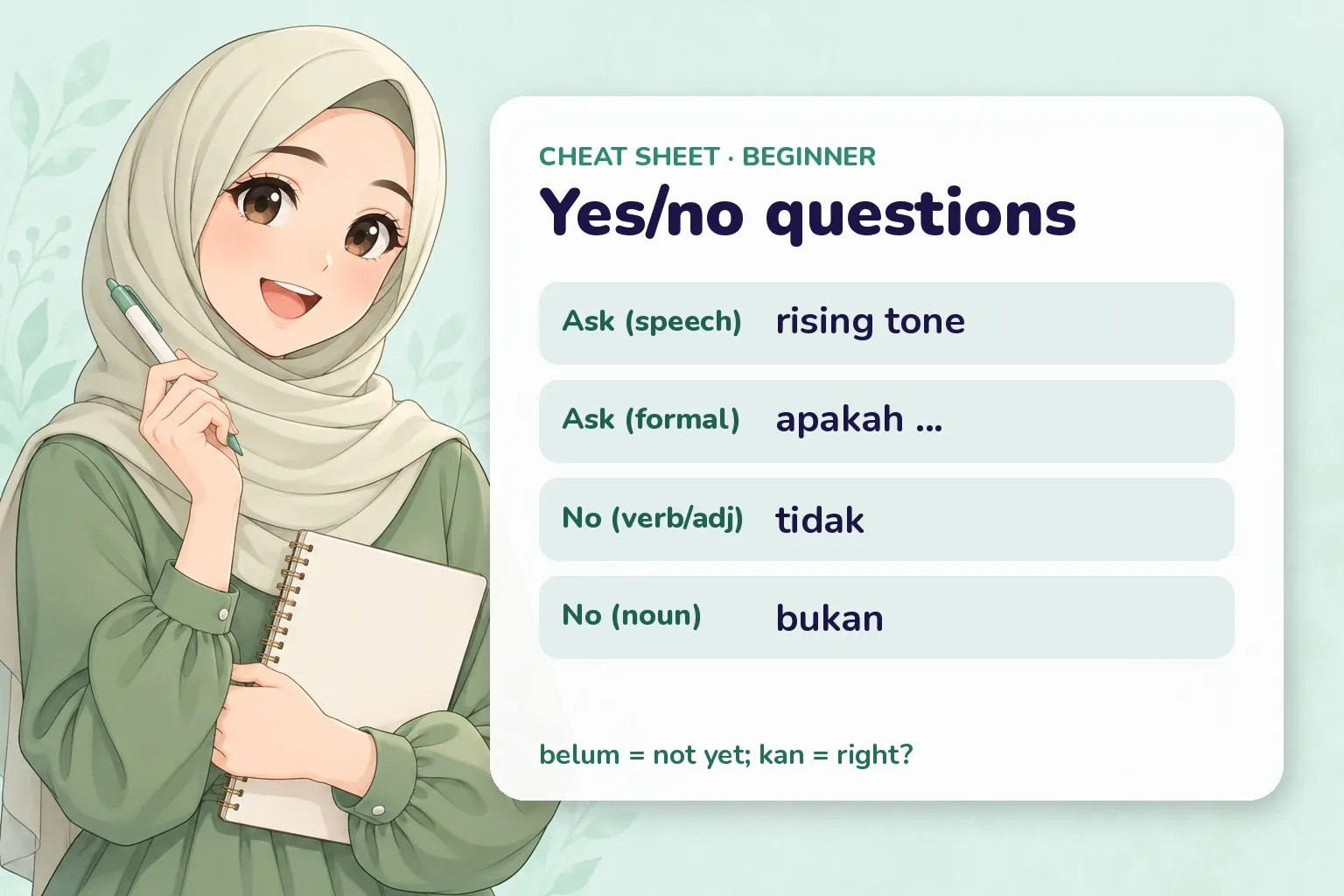
Quick recap before the quiz.
Practice
Yes/no questions practice
Try each one, then press Check. No sign-up, nothing is sent anywhere — it all runs in your browser.
Hint: the front-of-sentence question word
Show answer
Apakah — apakah marks a formal yes/no question: Apakah kamu suka kopi?
3 Match each 'no' word to its job.
- tidak
- bukan
- belum
- ya
Show answer
- tidak → negates a verb or adjective
- bukan → rejects a noun / identity
- belum → not yet
- ya → yes
tidak for verbs/adjectives, bukan for nouns, belum for not-yet, ya for yes.
Hint: it has not happened yet
Show answer
Belum — belum means not yet.
Quiz
Indonesian yes/no questions quiz
12 questions · pick an answer and you'll see straight away if it's right.
-
Show answer
rising intonation / apakah — Either raise your tone or add apakah; nothing moves.
-
Show answer
formality; it marks a yes/no question — apakah marks a formal/written yes/no question.
-
Show answer
Apakah ini kopi? — Apakah + statement: Apakah ini kopi?
-
Show answer
bukan — A noun is rejected with bukan: bukan guru.
-
Show answer
tidak — An adjective is negated with tidak: tidak capek.
-
Show answer
Belum — belum = not yet.
-
Show answer
kan — kan (short for bukan) seeks confirmation: Enak, kan?
-
Show answer
nothing — Nothing is added and nothing moves; only tone or apakah.
-
Show answer
Mau minum? — In speech the pronoun and apakah are often dropped: Mau minum?
-
Show answer
Apakah — Apakah toko itu buka? — is that shop open?
-
Show answer
Bukan, ini tas Rani. — tas is a noun, so use bukan to reject the identity.
-
Show answer
Ya — A positive question takes Ya (or Iya).
Recap cheat-sheet
| Function | Word | Example |
|---|---|---|
| ask (speech) | rising tone | Kamu lapar? |
| ask (formal) | apakah | Apakah kamu lapar? |
| yes | ya / iya | Ya, saya lapar. |
| no (verb/adj) | tidak | Tidak lapar. |
| no (noun) | bukan | Bukan guru. |
| not yet | belum | Belum makan. |
Next
- Learn the information questions: Question Words (apa, siapa, di mana)
- Back to the Indonesian grammar section
- New here? Start with Start Learning Indonesian Here
All Indonesian grammar topics
Every grammar point in order, from your first sentence to advanced structures. Pick one and go straight to it. New lessons go live every day, so topics marked Coming soon fill in over the next weeks.
Grammar path
Beginner 18 topics · 12 ready
- 01 Indonesian Personal Pronouns
- 02 Basic Word Order (Subject-Verb-Object)
- 03 Sentences Without 'To Be'
- 04 Noun + Adjective Order
- 05 Possession (Noun + Owner)
- 06 Plurals and Reduplication
- 07 Yes/No Questions (apakah, intonation) You are here
- 08 Question Words (apa, siapa, di mana)
- 09 Negation: tidak vs bukan
- 10 Demonstratives (ini, itu)
- 11 Numbers and Classifiers
- 12 Common Prepositions (di, ke, dari)
- 13 Existence and 'Have' with ada / punya Coming soon
- 14 Manner Deixis (begini, begitu) & sini/situ/sana Coming soon
- 15 Particles -lah, -kah, -pun Coming soon
- 16 Question Tags (kan, ya, bukan) Coming soon
- 17 Adverbs of Frequency (selalu, sering, kadang) Coming soon
- 18 Telling the Time Coming soon
Elementary 24 topics
- 19 The Prefix ber- Coming soon
- 20 The Prefix meN- (Active Transitive) Coming soon
- 21 The Passive with di- Coming soon
- 22 Agent-Focus Passive (Pronoun + Verb) Coming soon
- 23 Aspect Markers (sudah, sedang, akan, belum, masih) Coming soon
- 24 Modal Words (bisa, boleh, harus, mau, ingin) Coming soon
- 25 Comparatives and Superlatives Coming soon
- 26 Ordinal Numbers and Dates Coming soon
- 27 Basic Conjunctions (dan, tetapi, atau, karena) Coming soon
- 28 Imperatives and Requests Coming soon
- 29 Adverbs and Intensifiers (sangat, sekali, agak) Coming soon
- 30 Only / Just (hanya, cuma, saja) Coming soon
- 31 Again / Still / More (lagi, masih, tambah) Coming soon
- 32 Experience (pernah, belum pernah) Coming soon
- 33 Purpose Clauses (untuk, supaya, agar) Coming soon
- 34 Cause Clauses (karena, sebab, gara-gara) Coming soon
- 35 Quantifiers (semua, setiap, beberapa, banyak) Coming soon
- 36 Complement Clauses with bahwa Coming soon
- 37 The Suffix -an (Result Nouns) Coming soon
- 38 The Prefix ke- (ketua, kekasih) Coming soon
- 39 Adverbial -nya (biasanya, sebenarnya) Coming soon
- 40 The Clitic -nya as a Definite Marker Coming soon
- 41 Sequencing (lalu, kemudian, setelah itu) Coming soon
- 42 Before & After (sebelum, setelah, sesudah) Coming soon
Intermediate 21 topics
- 43 The meN-...-kan Construction Coming soon
- 44 The meN-...-i Construction Coming soon
- 45 Nominalising Affixes (pe-, pe-an, per-an, ke-an) Coming soon
- 46 The Prefix ter- (Accidental/Superlative/Stative) Coming soon
- 47 The Prefix se- (One/Same/As) Coming soon
- 48 Relative Clauses with yang Coming soon
- 49 Subordinating Conjunctions (jika, meskipun) Coming soon
- 50 Types of Reduplication Coming soon
- 51 Classifiers and Quantity Expressions Coming soon
- 52 Reciprocal & Stative (ber-an, ber-kan) Coming soon
- 53 Passive Register (di- vs ter- vs ke-an) Coming soon
- 54 Reciprocal (saling, satu sama lain) Coming soon
- 55 Intensive & Reflexive (diri, sendiri) Coming soon
- 56 Correlative Conjunctions (baik...maupun) Coming soon
- 57 Degree (terlalu, cukup, kurang) Coming soon
- 58 The More...The More (makin, semakin) Coming soon
- 59 Simultaneous Actions (sambil, selagi, sementara) Coming soon
- 60 The Prefix memper- (Causative) Coming soon
- 61 ke-...-an Adversative Verbs (kehujanan) Coming soon
- 62 The Frame se-...-nya (sebaiknya, secepatnya) Coming soon
- 63 Compound Words (kata majemuk) Coming soon
Advanced 11 topics
- 64 Advanced Nominalisation & Formal Syntax Coming soon
- 65 Discourse Markers & Cohesion Coming soon
- 66 Formal (baku) vs Colloquial Indonesian Coming soon
- 67 Advanced Passive & Object Preposing Coming soon
- 68 Idiomatic & Layered Affixation Coming soon
- 69 Conditionals & Hypotheticals (seandainya, andai) Coming soon
- 70 Large Numbers, Fractions & Approximation Coming soon
- 71 Compound & Complex Sentences Coming soon
- 72 Topic, Focus & Cleft (yang...itu) Coming soon
- 73 Apposition and Appositive Clauses Coming soon
- 74 Restoring Dropped Affixes (Formal Writing) Coming soon