Indonesian Frequency Adverbs: selalu, sering, kadang
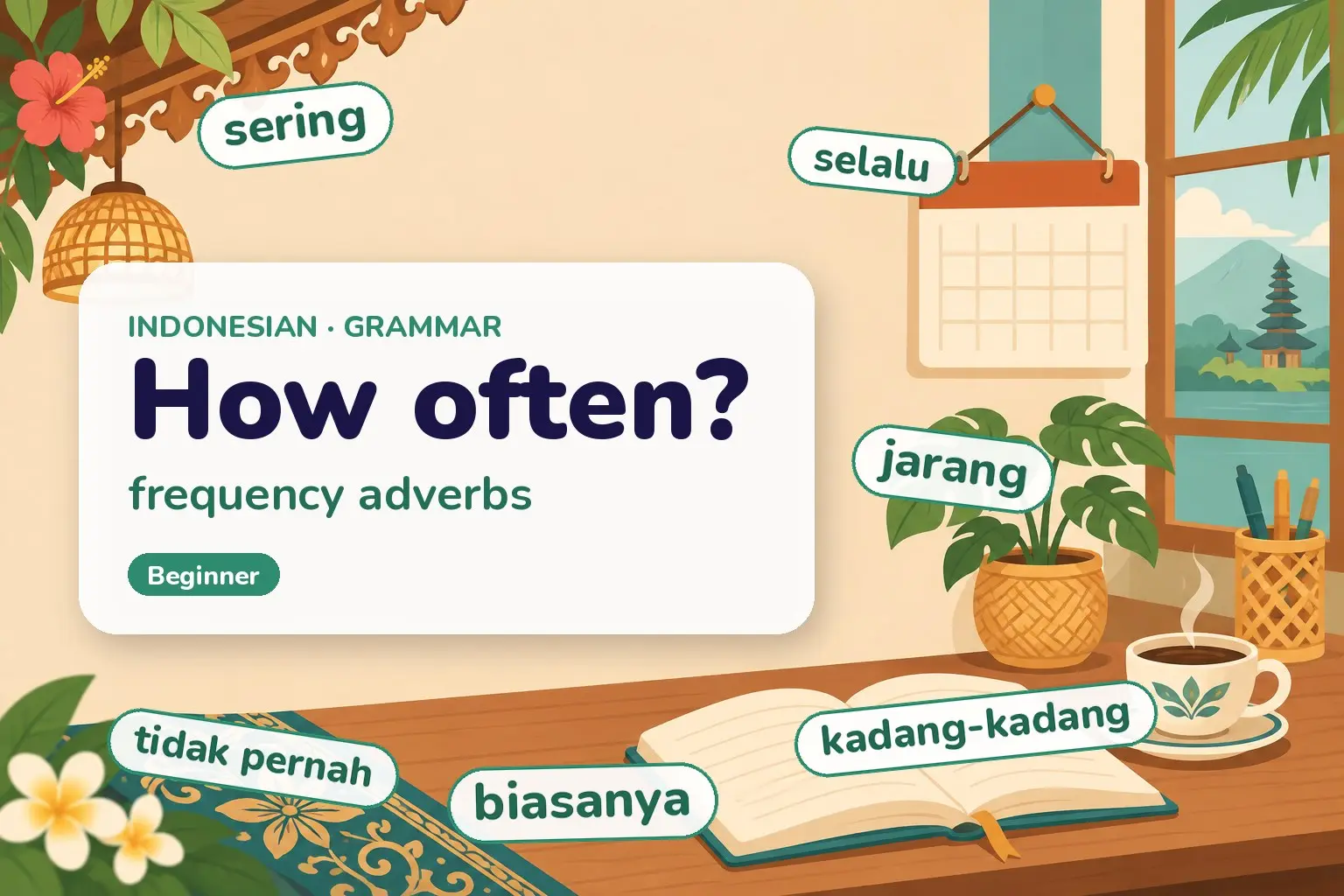
Indonesian frequency adverbs — selalu (always), biasanya (usually), sering (often), kadang-kadang (sometimes), jarang (rarely) and tidak pernah (never) — normally come right before the verb: Saya selalu minum kopi ('I always drink coffee').
On this page10 sections · tap to jump
Level: Beginner. To say how often you do something in Indonesian, you add a frequency word in front of the verb. There is nothing to conjugate — the adverb does all the work. This lesson gives you the six core words and shows exactly where to put them.
The rule
An adverb of frequency tells you how often an action happens — always, usually, often, sometimes, rarely, never. In Indonesian these words normally sit directly before the verb (the action word).
In Saya selalu minum kopi (“I always drink coffee”), selalu (“always”) comes right before the verb minum (“drink”). The subject (saya, “I”) stays in front, the frequency word follows it, then the verb.
This matters because Indonesian verbs do not change for tense: minum is “drink”, “drinks”, “drank” and “will drink” all at once. Often the frequency adverb is the clearest signal that you mean a habit rather than a one-off.
The six core words
Here are the frequency words from most to least often, with a rough percentage to anchor them:
| Indonesian | English | Roughly |
|---|---|---|
| selalu | always | ~100% |
| biasanya | usually | ~80% |
| sering | often | ~70% |
| kadang-kadang | sometimes | ~40% |
| jarang | rarely / seldom | ~15% |
| tidak pernah | never | 0% |
A few close relatives are worth knowing: selalu is sometimes strengthened to selalu saja; sering can appear as sering kali (“many times”); kadang-kadang is often shortened to kadang or replaced by terkadang; and pernah on its own means “ever / have done before”, which is why tidak pernah is literally “not ever” = “never”.
Example sentences
- Saya selalu minum kopi.I always drink coffee.selalu before the verb minum
- Dia selalu bangun pagi.He always wakes up early.selalu = always
- Biasanya saya sarapan di rumah.I usually have breakfast at home.biasanya can start the sentence
- Kami biasanya pulang jam lima.We usually go home at five o'clock.biasanya before the verb
- Dia sering terlambat.He is often late.sering = often
- Saya sering makan di luar.I often eat out.sering before makan
- Mereka kadang-kadang datang.They sometimes come.kadang-kadang = sometimes
- Kadang-kadang saya lupa.Sometimes I forget.fronted for emphasis
- Kadang dia menelepon saya.Sometimes he calls me.kadang = short form
- Saya jarang menonton televisi.I rarely watch television.jarang = rarely (negative meaning)
- Dia jarang makan daging.She rarely eats meat.no tidak with jarang
- Saya tidak pernah merokok.I never smoke.tidak pernah = never
- Mereka tidak pernah terlambat.They are never late.two words before the verb
- Saya pernah ke Bali.I have been to Bali (before).pernah alone = have ever/done before
- Apakah kamu sering ke sini?Do you come here often?frequency word in a question
- Dia biasanya tidak sarapan.He usually doesn't have breakfast.biasanya + negated verb
- Kita selalu bersama.We are always together.selalu before an adjective-like predicate
- Anak itu sering sakit.That child is often ill.sering + sakit (ill)
Common mistakes
- ❌ Saya minum selalu kopi. → ✅ Saya selalu minum kopi. The frequency word comes before the verb, not after it.
- ❌ Saya tidak jarang makan daging. → ✅ Saya jarang makan daging. jarang already means “rarely”; do not add tidak.
- ❌ Saya pernah tidak ke sana. → ✅ Saya tidak pernah ke sana. “Never” is tidak pernah, in that fixed order.
- ❌ Dia selalu terlambat tidak. → ✅ Dia tidak pernah terlambat. To negate a habit, use tidak pernah (“never”), not selalu … tidak.
- ❌ Kadang saya kadang lupa. → ✅ Kadang-kadang saya lupa. Use kadang-kadang (or single kadang) once, before or in front of the clause.
A short conversation
— Kamu sering olahraga? (Do you exercise often?) — Kadang-kadang. Biasanya saya lari di akhir pekan. (Sometimes. I usually run on weekends.) — Saya tidak pernah lari, tapi saya selalu jalan kaki. (I never run, but I always walk.) — Bagus! Saya jarang jalan kaki. (Nice! I rarely walk.)
Each frequency word sits just before its verb — sering olahraga, biasanya … lari, tidak pernah lari, selalu jalan kaki — except kadang-kadang, used alone as a one-word answer.
Usage notes
- Fronting for emphasis. biasanya and kadang-kadang often move to the front of the sentence: Biasanya saya tidur jam sepuluh (“Usually I sleep at ten”). selalu, sering and jarang normally stay just before the verb.
- With negation. You can negate the verb after biasanya: Dia biasanya tidak makan pagi (“He usually doesn’t eat breakfast”). But do not negate selalu, jarang or pernah that way — use tidak pernah for “never”.
- Questions. Keep the adverb in its normal place and add apakah or just a rising tone: Kamu sering ke sini? (“Do you come here often?”).
- pernah on its own. Without tidak, pernah means “have ever / have done before”: Saya pernah coba (“I have tried it before”). belum pernah means “have never … yet”.
Compared with…
- Aspect markers (time words): Indonesian also uses sudah (“already”), belum (“not yet”), sedang (“in the middle of”), masih (“still”) and akan (“will”) in the same slot before the verb. These mark when or how far along an action is, not how often it happens: Saya sudah makan (“I have already eaten”) versus Saya sering makan (“I often eat”). Learn them alongside each other in the Indonesian word order lesson.
- Negation words: to say “not” you use tidak before a verb or adjective and bukan before a noun; “never” combines tidak with pernah. See how they split in negation with tidak and bukan, and build “how often” questions with the words in Indonesian question words. To change the subject in your examples, review Indonesian personal pronouns.
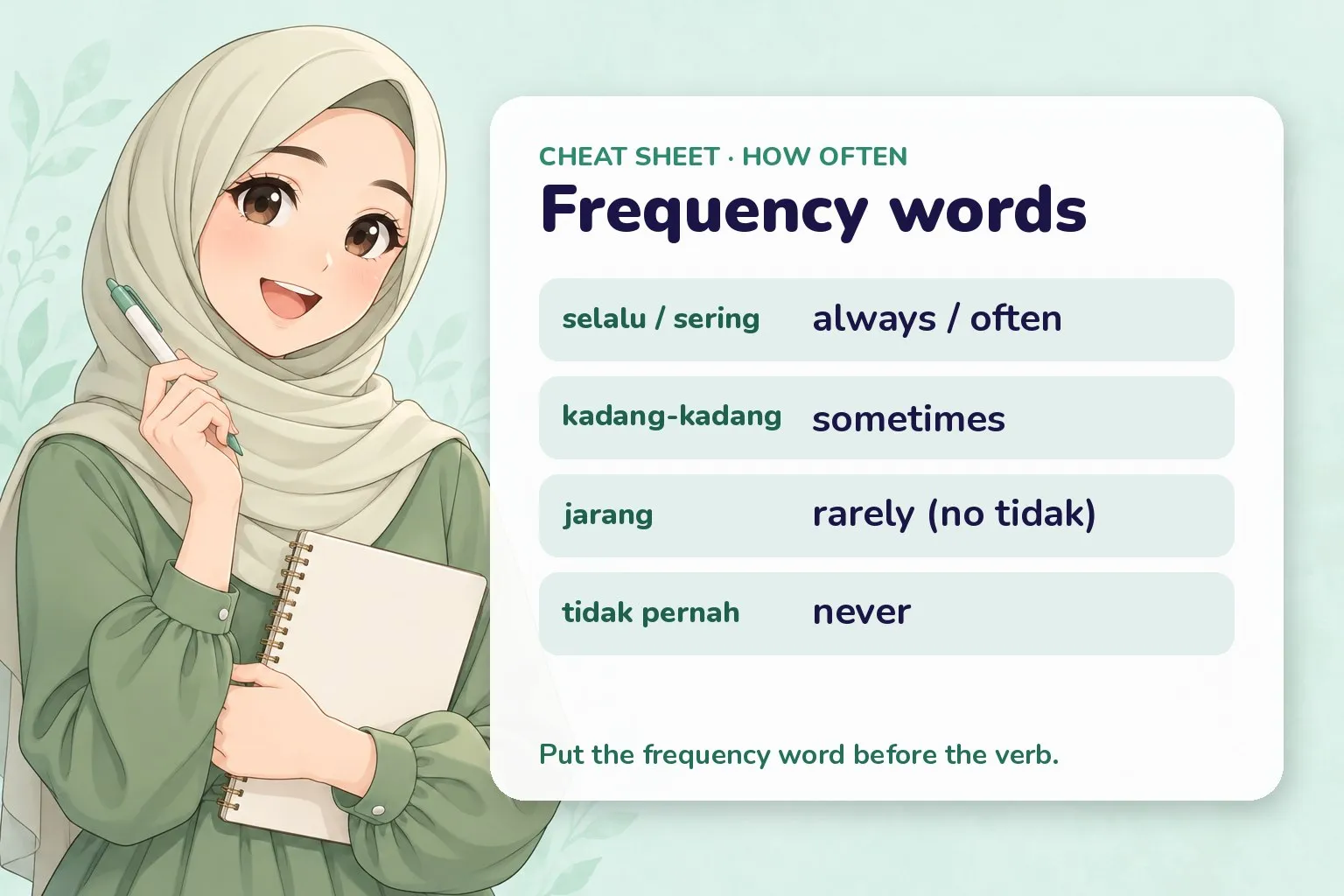
Quick recap before the quiz — the frequency word goes before the verb.
Practice
Indonesian frequency adverbs practice
Try each one, then press Check. No sign-up, nothing is sent anywhere — it all runs in your browser.
Hint: ~100%
Show answer
selalu — selalu = always, placed before the verb minum.
4 Build: 'He is often late.'
Show answer
Dia sering terlambat — Subject (Dia) + frequency (sering) + predicate (terlambat).
5 Match each word to its meaning.
- selalu
- sering
- kadang-kadang
- jarang
Show answer
- selalu → always
- sering → often
- kadang-kadang → sometimes
- jarang → rarely
selalu = always, sering = often, kadang-kadang = sometimes, jarang = rarely.
Quiz
Indonesian frequency adverbs
12 questions · pick an answer and you'll see straight away if it's right.
-
Show answer
always — selalu = always (~100%).
-
Show answer
rarely / seldom — jarang = rarely, and it is already negative in meaning.
-
Show answer
before the verb — It goes before the verb: Saya sering makan di luar.
-
Show answer
tidak pernah — tidak pernah = never; pernah alone means 'have ever/done before'.
-
Show answer
Saya selalu minum kopi. — Subject + frequency + verb + object: Saya selalu minum kopi.
-
Show answer
biasanya and kadang-kadang — biasanya and kadang-kadang commonly front for emphasis.
-
Show answer
I have been to Bali before — pernah on its own means 'have ever / done before'.
-
Show answer
jarang is already negative, so no extra tidak — jarang already means 'rarely'; adding tidak double-negates it.
-
Show answer
sometimes — kadang-kadang (or kadang) = sometimes.
-
Show answer
tidak pernah — tidak pernah is the fixed two-word phrase for 'never'.
-
Show answer
biasanya — biasanya = usually (~80%).
-
Show answer
False — verbs do not change, so frequency words carry the meaning — Verbs are not conjugated for tense, so the frequency adverb often signals the habit.
Recap cheat-sheet
| Word | Meaning | Position |
|---|---|---|
| selalu | always | before the verb |
| biasanya | usually | before the verb or fronted |
| sering | often | before the verb |
| kadang-kadang | sometimes | before the verb or fronted |
| jarang | rarely | before the verb (no tidak) |
| tidak pernah | never | before the verb, one unit |
Next
- Fit them into a sentence: Indonesian word order
- Say “not” and “never”: negation with tidak and bukan
- Ask “how often?”: Indonesian question words
- Back to the Indonesian grammar section
All Indonesian grammar topics
Every grammar point in order, from your first sentence to advanced structures. Pick one and go straight to it. New lessons go live every day, so topics marked Coming soon fill in over the next weeks.
Grammar path
Beginner 18 topics · 18 ready
- 01 Indonesian Personal Pronouns
- 02 Basic Word Order (Subject-Verb-Object)
- 03 Sentences Without 'To Be'
- 04 Noun + Adjective Order
- 05 Possession (Noun + Owner)
- 06 Plurals and Reduplication
- 07 Yes/No Questions (apakah, intonation)
- 08 Question Words (apa, siapa, di mana)
- 09 Negation: tidak vs bukan
- 10 Demonstratives (ini, itu)
- 11 Numbers and Classifiers
- 12 Common Prepositions (di, ke, dari)
- 13 Existence and 'Have' with ada / punya
- 14 Manner Deixis (begini, begitu) & sini/situ/sana
- 15 Particles -lah, -kah, -pun
- 16 Question Tags (kan, ya, bukan)
- 17 Adverbs of Frequency (selalu, sering, kadang) You are here
- 18 Telling the Time
Elementary 24 topics · 3 ready
- 19 The Prefix ber-
- 20 The Prefix meN- (Active Transitive)
- 21 The Passive with di-
- 22 Agent-Focus Passive (Pronoun + Verb) Coming soon
- 23 Aspect Markers (sudah, sedang, akan, belum, masih) Coming soon
- 24 Modal Words (bisa, boleh, harus, mau, ingin) Coming soon
- 25 Comparatives and Superlatives Coming soon
- 26 Ordinal Numbers and Dates Coming soon
- 27 Basic Conjunctions (dan, tetapi, atau, karena) Coming soon
- 28 Imperatives and Requests Coming soon
- 29 Adverbs and Intensifiers (sangat, sekali, agak) Coming soon
- 30 Only / Just (hanya, cuma, saja) Coming soon
- 31 Again / Still / More (lagi, masih, tambah) Coming soon
- 32 Experience (pernah, belum pernah) Coming soon
- 33 Purpose Clauses (untuk, supaya, agar) Coming soon
- 34 Cause Clauses (karena, sebab, gara-gara) Coming soon
- 35 Quantifiers (semua, setiap, beberapa, banyak) Coming soon
- 36 Complement Clauses with bahwa Coming soon
- 37 The Suffix -an (Result Nouns) Coming soon
- 38 The Prefix ke- (ketua, kekasih) Coming soon
- 39 Adverbial -nya (biasanya, sebenarnya) Coming soon
- 40 The Clitic -nya as a Definite Marker Coming soon
- 41 Sequencing (lalu, kemudian, setelah itu) Coming soon
- 42 Before & After (sebelum, setelah, sesudah) Coming soon
Intermediate 20 topics
- 43 The meN-...-kan Construction Coming soon
- 44 The meN-...-i Construction Coming soon
- 45 Nominalising Affixes (pe-, pe-an, per-an, ke-an) Coming soon
- 46 The Prefix ter- (Accidental/Superlative/Stative) Coming soon
- 47 The Prefix se- (One/Same/As) Coming soon
- 48 Relative Clauses with yang Coming soon
- 49 Subordinating Conjunctions (jika, meskipun) Coming soon
- 50 Types of Reduplication Coming soon
- 51 Classifiers and Quantity Expressions Coming soon
- 52 Passive Register (di- vs ter- vs ke-an) Coming soon
- 53 Reciprocal (saling, satu sama lain) Coming soon
- 54 Intensive & Reflexive (diri, sendiri) Coming soon
- 55 Correlative Conjunctions (baik...maupun) Coming soon
- 56 Degree (terlalu, cukup, kurang) Coming soon
- 57 The More...The More (makin, semakin) Coming soon
- 58 Simultaneous Actions (sambil, selagi, sementara) Coming soon
- 59 The Prefix memper- (Causative) Coming soon
- 60 ke-...-an Adversative Verbs (kehujanan) Coming soon
- 61 The Frame se-...-nya (sebaiknya, secepatnya) Coming soon
- 62 Compound Words (kata majemuk) Coming soon
Advanced 11 topics
- 63 Advanced Nominalisation & Formal Syntax Coming soon
- 64 Discourse Markers & Cohesion Coming soon
- 65 Formal (baku) vs Colloquial Indonesian Coming soon
- 66 Advanced Passive & Object Preposing Coming soon
- 67 Idiomatic & Layered Affixation Coming soon
- 68 Conditionals & Hypotheticals (seandainya, andai) Coming soon
- 69 Large Numbers, Fractions & Approximation Coming soon
- 70 Compound & Complex Sentences Coming soon
- 71 Topic, Focus & Cleft (yang...itu) Coming soon
- 72 Apposition and Appositive Clauses Coming soon
- 73 Restoring Dropped Affixes (Formal Writing) Coming soon