Indonesian Passive with di-: dibaca, ditulis
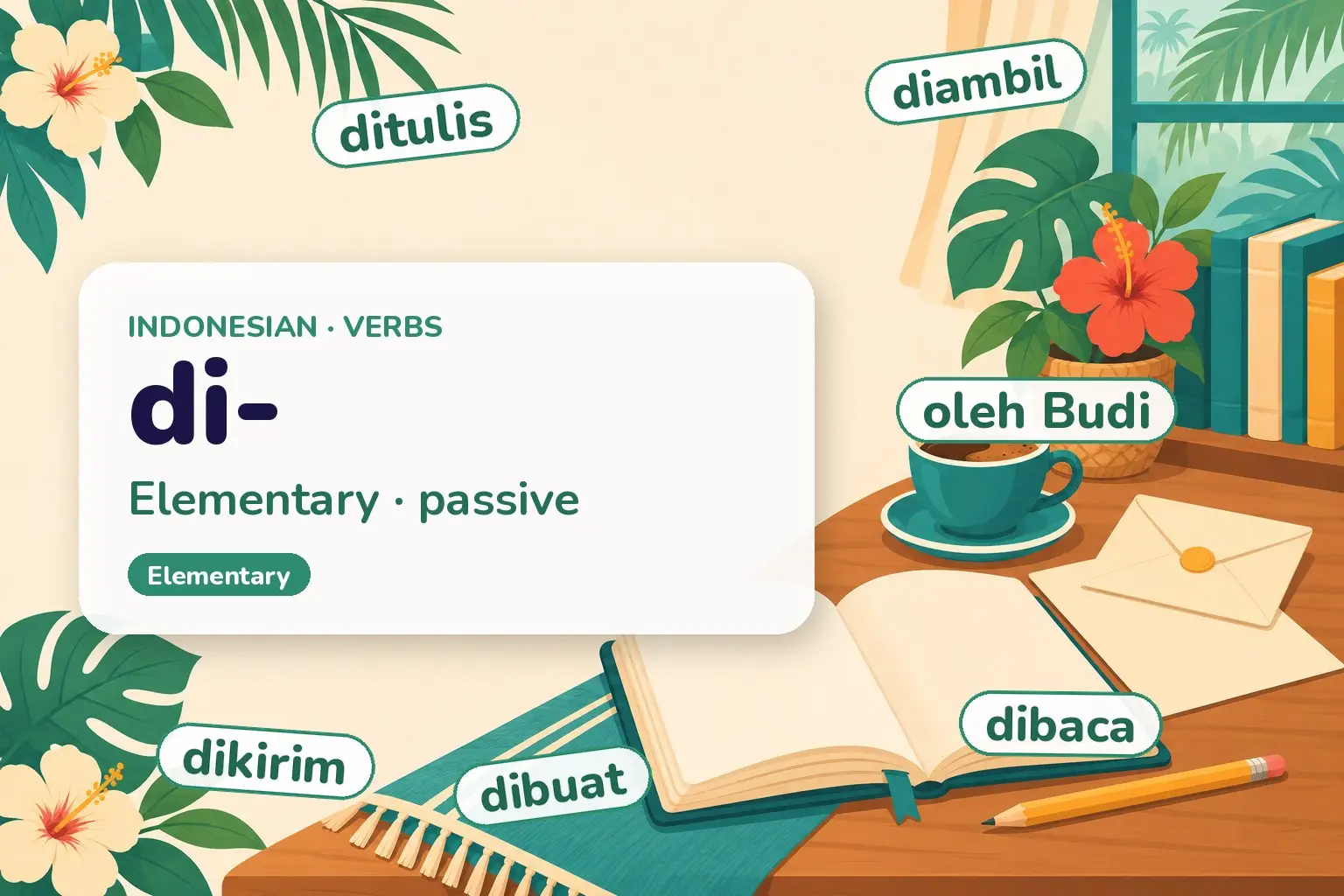
To make an Indonesian verb passive, attach the prefix di- to the base verb and name the doer after oleh (optional): Surat itu ditulis oleh Budi means 'The letter was written by Budi.' The passive puts the thing acted on first and is very common in everyday Indonesian.
Level: Elementary. The passive is not a rare, formal structure in Indonesian — it is everywhere. Attaching one prefix, di-, flips a sentence so the thing being acted on comes first, and Indonesian uses it far more often than English uses “was done by”.
The rule
A verb is active when the subject does the action (Budi writes the letter) and passive when the subject is the thing acted on (The letter is written by Budi). Indonesian builds the passive with the prefix di- attached to the base verb (the bare root with no other prefix).
Take the root tulis (“write”). The active verb is menulis (with the meN- prefix); the passive is ditulis (“is/was written”). The doer — called the agent — is named after the word oleh (“by”): Surat itu ditulis oleh Budi (“The letter was written by Budi”). The oleh phrase is optional and often dropped: Surat itu ditulis Budi is equally correct.
Indonesian has no tense endings, so ditulis can mean “is written”, “was written” or “will be written” — the time comes from context or a time word like sudah (“already”) or akan (“will”). Word order in the passive is thing + di-verb + (oleh) doer.
Active and passive side by side
The root stays the same; only the prefix changes. Active takes meN-, passive takes di-:
| Root | Active (meN-) | Passive (di-) | Meaning of passive |
|---|---|---|---|
| tulis | menulis | ditulis | is/was written |
| baca | membaca | dibaca | is/was read |
| buat | membuat | dibuat | is/was made |
| kirim | mengirim | dikirim | is/was sent |
| makan | memakan / makan | dimakan | is/was eaten |
| ambil | mengambil | diambil | is/was taken |
| panggil | memanggil | dipanggil | is/was called |
And here is a full sentence flipped from active to passive:
| Sentence | Focus | |
|---|---|---|
| Active | Budi menulis surat itu. | Budi (the doer) |
| Passive | Surat itu ditulis oleh Budi. | surat / the letter |
The agent with oleh
The doer is introduced by oleh (“by”), and you have two correct options:
| Form | Example | Note |
|---|---|---|
| with oleh | Buku itu dibaca oleh saya. | fuller, slightly more formal |
| without oleh | Buku itu dibaca saya. | oleh dropped, very common |
| no agent | Buku itu sudah dibaca. | doer unknown or unimportant |
Example sentences
- Surat itu ditulis oleh Budi.The letter was written by Budi.di- + tulis; agent after oleh
- Buku ini dibaca oleh banyak orang.This book is read by many people.di- + baca
- Nasi goreng dibuat oleh ibu.The fried rice is made by mother.di- + buat
- Paket itu sudah dikirim.The parcel has already been sent.agent dropped; sudah = already
- Kue itu dimakan oleh anak-anak.The cake was eaten by the children.di- + makan
- Mobil itu dicuci oleh ayah.The car is washed by father.di- + cuci
- Pintu itu dibuka oleh penjaga.The door was opened by the guard.di- + buka
- Lagu ini dinyanyikan oleh penyanyi terkenal.This song is sung by a famous singer.di- + nyanyikan
- Rumah itu dijual bulan lalu.The house was sold last month.agent dropped; bulan lalu = last month
- Foto itu diambil di pantai.The photo was taken at the beach.diambil (passive) vs di pantai (preposition di)
- Masalah itu akan diselesaikan besok.The problem will be solved tomorrow.akan = will; future from context
- Dia dipanggil oleh guru.He was called by the teacher.di- + panggil
- Uang itu disimpan di bank.The money is kept in the bank.disimpan (passive) + di bank (preposition)
- Buku itu saya baca kemarin.I read the book yesterday.pronoun passive: saya baca, no di-
- Surat ini harus ditandatangani.This letter must be signed.harus = must; agent not named
- Jendela itu dipecahkan oleh bola.The window was broken by a ball.di- + pecahkan
- Makanan itu sudah dihabiskan oleh mereka.The food has been finished by them.mereka = them; sudah = already
- Tugas itu dikerjakan dengan cepat.The task was done quickly.dengan cepat = quickly
Common mistakes
- ❌ Surat itu menulis oleh Budi. → ✅ Surat itu ditulis oleh Budi. If the subject is the thing acted on, use the passive di-, not the active meN-.
- ❌ Buku itu di baca. (two words) → ✅ Buku itu dibaca. The passive di- is a prefix, written joined to the verb.
- ❌ Saya dibaca buku itu. → ✅ Buku itu saya baca / Buku itu dibaca oleh saya. With a pronoun doer, either put the pronoun before the bare verb (saya baca) or use di- + oleh saya; you cannot make saya the subject of dibaca.
- ❌ Foto itu diambil pantai. → ✅ Foto itu diambil di pantai. Here di is the separate preposition “at/in”; keep it apart from the verb and from any oleh agent.
- ❌ ditulis oleh dengan Budi → ✅ ditulis oleh Budi. The agent takes oleh alone — never add dengan (“with”).
A short conversation
— Siapa yang membuat kue ini? (Who made this cake?) — Kue ini dibuat oleh nenek. (This cake was made by grandma.) — passive, focus on the cake — Dan surat tadi? (And the letter earlier?) — Sudah saya kirim pagi ini. (I already sent it this morning.) — pronoun passive, saya kirim
The cake answer uses di- with a named doer (dibuat oleh nenek); the letter answer uses the pronoun passive saya kirim because the doer is saya.
Usage notes
- Indonesian prefers the passive more than English. In notices, instructions and news, the passive is the normal, neutral voice: Dilarang merokok (“Smoking is forbidden”), Harap dibaca (“Please read”). Do not force every sentence into the active.
- Word order is fixed: the thing acted on comes first, then the di- verb, then the optional oleh agent. You cannot move the agent in front.
- Suffixes stay on the verb. If the active verb has -kan or -i (menyelesaikan, menandatangani), the passive keeps them: diselesaikan, ditandatangani.
- Tense comes from context. Add sudah (already), sedang (in progress) or akan (will) to pin the time: sudah dibaca, sedang dibaca, akan dibaca.
Compared with…
- Active meN- verbs: the active counterpart uses the meN- prefix and puts the doer first: Budi menulis surat versus Surat ditulis oleh Budi. The root is the same; only the prefix and word order change. See Indonesian meN- verbs.
- Pronoun passive: with a pronoun doer, Indonesian drops di- and puts the pronoun before the bare verb — buku itu saya baca — instead of dibaca oleh saya. See Indonesian word order.
How to say it
These are the sounds English speakers get wrong in this lesson’s words:
| Sound | How to say it |
|---|---|
| c in cuci, baca | always “ch”: cuci ≈ “CHOO-chee”, baca ≈ “BAH-cha”. |
| di- prefix | a short “dee”: dibaca ≈ “dee-BAH-cha”. |
| ny in dinyanyikan | like “ny” in “canyon”: ≈ “dee-nya-NYEE-kan”. |
| final -k in paket | a clipped, unreleased “k”. |
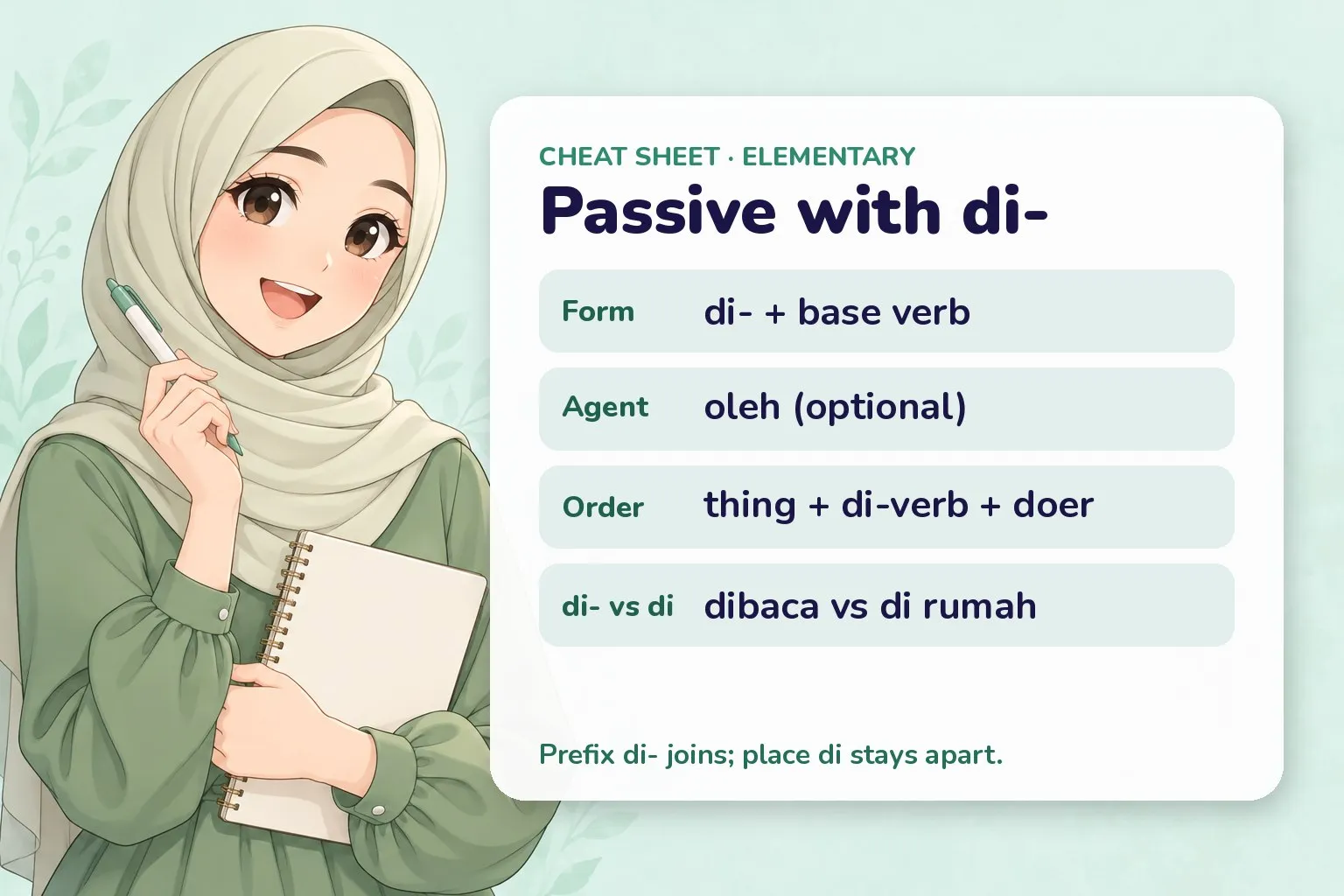
Quick recap before the quiz.
Practice
di- passive practice
Try each one, then press Check. No sign-up, nothing is sent anywhere — it all runs in your browser.
Hint: di- + buat
Show answer
dibuat — The passive of membuat is dibuat.
4 Match each active verb to its passive form.
- menulis
- membaca
- mengirim
- mengambil
Show answer
- menulis → ditulis
- membaca → dibaca
- mengirim → dikirim
- mengambil → diambil
Drop meN-, attach di- to the base verb.
Hint: pronoun before the bare verb
Show answer
saya — With a pronoun doer: Buku itu saya baca.
Quiz
Indonesian di- passive
10 questions · pick an answer and you'll see straight away if it's right.
-
Show answer
di- — di- + base verb makes the passive: dibaca, ditulis.
-
Show answer
dikirim — di- + kirim = dikirim.
-
Show answer
oleh — oleh means 'by': ditulis oleh Budi.
-
Show answer
joined to the verb (dibaca) — The prefix di- is always joined: dibaca, ditulis.
-
Show answer
di rumah — di rumah (at home) is the separate preposition; the others are passive prefixes.
-
Show answer
Kue itu dimakan oleh anak-anak. — Thing + di-verb + oleh doer: Kue itu dimakan oleh anak-anak.
-
Show answer
Yes — 'Surat itu ditulis Budi' is also correct — oleh is optional: ditulis Budi is equally correct.
-
Show answer
the pattern 'buku itu saya baca' (no di-) — Pronoun passive puts the pronoun before the bare verb: saya baca.
-
Show answer
with a time word like sudah or akan — Indonesian has no tense endings; sudah (already), akan (will) mark the time.
-
Show answer
diambil — di- + ambil = diambil; di pantai stays separate as the preposition.
Recap cheat-sheet
| Point | Form |
|---|---|
| Passive prefix | di- + base verb (dibaca) |
| Word order | thing + di-verb + (oleh) doer |
| Agent word | oleh (optional) |
| Pronoun doer | buku itu saya baca (no di-) |
| di- vs di | dibaca (joined) vs di rumah (separate) |
| Tense | sudah / sedang / akan + verb |
Next
- The active counterpart: Indonesian meN- verbs
- Pick out the doer and object: Indonesian word order
- Build base verbs with ber-: Indonesian ber- verbs
- Back to the Indonesian grammar section
All Indonesian grammar topics
Every grammar point in order, from your first sentence to advanced structures. Pick one and go straight to it. New lessons go live every day, so topics marked Coming soon fill in over the next weeks.
Grammar path
Beginner 18 topics · 18 ready
- 01 Indonesian Personal Pronouns
- 02 Basic Word Order (Subject-Verb-Object)
- 03 Sentences Without 'To Be'
- 04 Noun + Adjective Order
- 05 Possession (Noun + Owner)
- 06 Plurals and Reduplication
- 07 Yes/No Questions (apakah, intonation)
- 08 Question Words (apa, siapa, di mana)
- 09 Negation: tidak vs bukan
- 10 Demonstratives (ini, itu)
- 11 Numbers and Classifiers
- 12 Common Prepositions (di, ke, dari)
- 13 Existence and 'Have' with ada / punya
- 14 Manner Deixis (begini, begitu) & sini/situ/sana
- 15 Particles -lah, -kah, -pun
- 16 Question Tags (kan, ya, bukan)
- 17 Adverbs of Frequency (selalu, sering, kadang)
- 18 Telling the Time
Elementary 24 topics · 3 ready
- 19 The Prefix ber-
- 20 The Prefix meN- (Active Transitive)
- 21 The Passive with di- You are here
- 22 Agent-Focus Passive (Pronoun + Verb) Coming soon
- 23 Aspect Markers (sudah, sedang, akan, belum, masih) Coming soon
- 24 Modal Words (bisa, boleh, harus, mau, ingin) Coming soon
- 25 Comparatives and Superlatives Coming soon
- 26 Ordinal Numbers and Dates Coming soon
- 27 Basic Conjunctions (dan, tetapi, atau, karena) Coming soon
- 28 Imperatives and Requests Coming soon
- 29 Adverbs and Intensifiers (sangat, sekali, agak) Coming soon
- 30 Only / Just (hanya, cuma, saja) Coming soon
- 31 Again / Still / More (lagi, masih, tambah) Coming soon
- 32 Experience (pernah, belum pernah) Coming soon
- 33 Purpose Clauses (untuk, supaya, agar) Coming soon
- 34 Cause Clauses (karena, sebab, gara-gara) Coming soon
- 35 Quantifiers (semua, setiap, beberapa, banyak) Coming soon
- 36 Complement Clauses with bahwa Coming soon
- 37 The Suffix -an (Result Nouns) Coming soon
- 38 The Prefix ke- (ketua, kekasih) Coming soon
- 39 Adverbial -nya (biasanya, sebenarnya) Coming soon
- 40 The Clitic -nya as a Definite Marker Coming soon
- 41 Sequencing (lalu, kemudian, setelah itu) Coming soon
- 42 Before & After (sebelum, setelah, sesudah) Coming soon
Intermediate 20 topics
- 43 The meN-...-kan Construction Coming soon
- 44 The meN-...-i Construction Coming soon
- 45 Nominalising Affixes (pe-, pe-an, per-an, ke-an) Coming soon
- 46 The Prefix ter- (Accidental/Superlative/Stative) Coming soon
- 47 The Prefix se- (One/Same/As) Coming soon
- 48 Relative Clauses with yang Coming soon
- 49 Subordinating Conjunctions (jika, meskipun) Coming soon
- 50 Types of Reduplication Coming soon
- 51 Classifiers and Quantity Expressions Coming soon
- 52 Passive Register (di- vs ter- vs ke-an) Coming soon
- 53 Reciprocal (saling, satu sama lain) Coming soon
- 54 Intensive & Reflexive (diri, sendiri) Coming soon
- 55 Correlative Conjunctions (baik...maupun) Coming soon
- 56 Degree (terlalu, cukup, kurang) Coming soon
- 57 The More...The More (makin, semakin) Coming soon
- 58 Simultaneous Actions (sambil, selagi, sementara) Coming soon
- 59 The Prefix memper- (Causative) Coming soon
- 60 ke-...-an Adversative Verbs (kehujanan) Coming soon
- 61 The Frame se-...-nya (sebaiknya, secepatnya) Coming soon
- 62 Compound Words (kata majemuk) Coming soon
Advanced 11 topics
- 63 Advanced Nominalisation & Formal Syntax Coming soon
- 64 Discourse Markers & Cohesion Coming soon
- 65 Formal (baku) vs Colloquial Indonesian Coming soon
- 66 Advanced Passive & Object Preposing Coming soon
- 67 Idiomatic & Layered Affixation Coming soon
- 68 Conditionals & Hypotheticals (seandainya, andai) Coming soon
- 69 Large Numbers, Fractions & Approximation Coming soon
- 70 Compound & Complex Sentences Coming soon
- 71 Topic, Focus & Cleft (yang...itu) Coming soon
- 72 Apposition and Appositive Clauses Coming soon
- 73 Restoring Dropped Affixes (Formal Writing) Coming soon