Existence and 'Have' with ada / punya
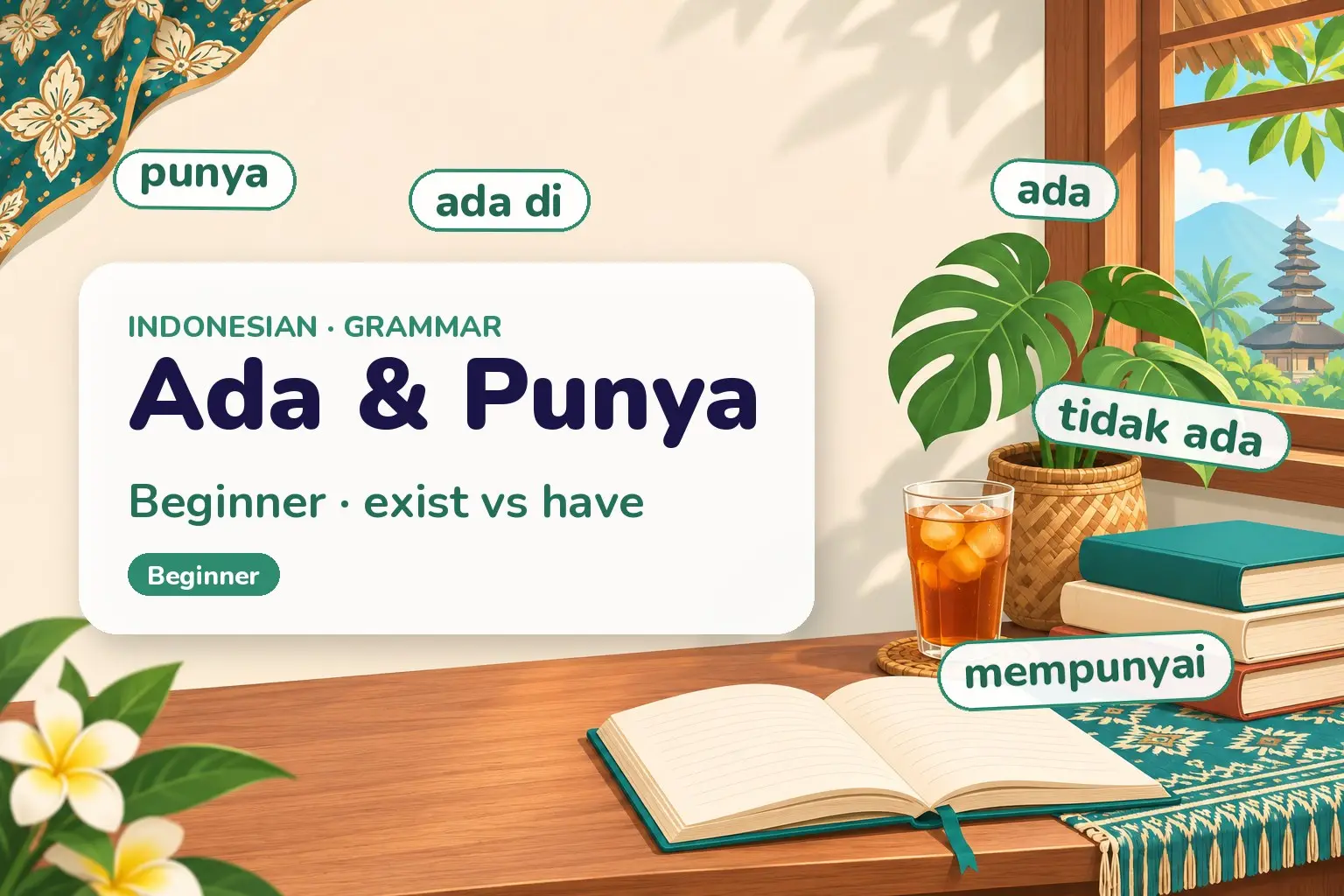
Use ada for existence — 'there is / there are': Ada buku di meja (There is a book on the table). Use punya (informal) or mempunyai (formal) for possession — 'to have': Saya punya mobil (I have a car). Keep the two apart.
Level: Beginner. Two small words do a lot of work in Indonesian: ada (there is / exist) and punya (have). English blurs them — “I have a book” and “there is a book” both feel like “have / be”. Indonesian keeps them separate, and mixing them up is the most common beginner slip.
The rule
ada means “there is / there are” or “to exist / be present”. It introduces something into a scene: Ada masalah (“There is a problem”). It does not need a subject in front of it.
punya means “to have / own”. It links an owner to a thing: Saya punya mobil (“I have a car”). The owner comes first, then punya, then what they own.
So the test is simple: are you saying something exists (use ada), or that someone owns it (use punya)?
- Existence: Ada air di gelas. — There is water in the glass.
- Possession: Dia punya adik. — She has a younger sibling.
Indonesian also uses ada + di to say where someone or something is located: Buku itu ada di meja (“That book is on the table”), Saya ada di kantor (“I’m at the office”). Here ada is close to English “to be (somewhere)”.
The forms
| Word | Register | Meaning | Example |
|---|---|---|---|
| ada | neutral | there is / exist / be present | Ada tamu. (There’s a guest.) |
| ada di | neutral | to be located at | Dia ada di rumah. (He’s at home.) |
| punya | informal | to have / own | Saya punya rumah. (I have a house.) |
| mempunyai | formal | to have / possess | Dia mempunyai rumah. |
| memiliki | formal | to own / possess | Mereka memiliki tanah. (They own land.) |
| tidak ada | neutral | there isn’t / none | Tidak ada waktu. (There’s no time.) |
| tidak punya | informal | don’t have | Saya tidak punya uang. (I have no money.) |
punya, mempunyai and memiliki all express ownership. punya is what you say and hear every day; mempunyai and memiliki appear in writing, news and formal speech.
How to say it
Indonesian spelling is close to how it sounds, but a few letters surprise English speakers:
- ny in punya: one sound like the “ny” in “canyon” — punya ≈ “POO-nya”.
- c elsewhere in Indonesian is “ch” (as in cari = “CHA-ree”); it does not appear in these words, but note it for the rest of your study.
- Vowels are short and clear: ada = “AH-da”, di = “dee”. No long drawl.
- Stress is light, usually on the second-to-last syllable: meMIliki, memPUnyai.
Example sentences
- Ada buku di meja.There is a book on the table.existence, no subject
- Ada tamu di depan.There's a guest out front.
- Apakah ada masalah?Is there a problem?question with apakah
- Tidak ada air di gelas.There's no water in the glass.tidak ada = there isn't
- Di sini ada banyak restoran.There are many restaurants here.
- Saya ada di rumah sekarang.I'm at home now.ada + di = located at
- Dia ada di kantor.He is at the office.
- Bukunya ada di tas.The book is in the bag.
- Saya punya mobil.I have a car.possession: owner + punya
- Dia punya adik.She has a younger sibling.
- Kami punya rumah di Bandung.We have a house in Bandung.
- Kamu punya waktu besok?Do you have time tomorrow?
- Saya tidak punya uang.I don't have any money.tidak punya = don't have
- Mereka memiliki tanah yang luas.They own a large piece of land.memiliki = formal 'own'
- Perusahaan itu mempunyai banyak karyawan.That company has many employees.mempunyai = formal 'have'
- Belum ada kabar dari dia.There's no news from him yet.belum ada = not yet
- Di kota ini ada stasiun kereta.In this city there is a train station.
- Apakah kamu punya kakak?Do you have an older sibling?
- Ada yang bisa saya bantu?Is there something I can help with?shop/service phrase
- Hari ini saya tidak ada acara.I don't have any plans today.common 'ada acara' = have an event/plan
Common mistakes
- ❌ Saya ada mobil. → ✅ Saya punya mobil. For “I have a car”, use punya; ada alone is existence, not ownership.
- ❌ Ada saya di rumah. → ✅ Saya ada di rumah. For location the subject comes first: Saya ada di…
- ❌ Tidak punya air di gelas. → ✅ Tidak ada air di gelas. No owner here — it’s existence, so tidak ada.
- ❌ Dia punya di kantor. → ✅ Dia ada di kantor. Being somewhere is ada di, not punya.
- ❌ Saya mempunya rumah. → ✅ Saya mempunyai rumah (or everyday Saya punya rumah). The formal verb is mempunyai, with the full ending.
A short conversation
— Kamu punya payung? — Tidak, aku tidak punya. Tapi di kelas ada beberapa. — Oke. Payungnya ada di mana? — Ada di lemari dekat pintu.
Usage notes
- ada for availability / service. Shops and offices use ada for “we have / it’s available”: Ada kamar kosong? (“Are there any free rooms?”). The reply is Ada (“Yes, there is”) or Tidak ada (“No, there isn’t”).
- punya can drop to show relationship. Teman saya already means “my friend” without punya; use punya mainly for the verb “to have”, not for every “my”.
- ber- verbs sometimes replace punya. beranak (“to have children”), beruang (“to have money”) exist, but beginners should rely on punya and mempunyai.
- ada as “yes, there is”. On its own, Ada answers “is there…?”: Ada telur? — Ada. This short answer is very common.
- Word order for possession is fixed: owner + punya + thing. There is no change for tense; context or a time word (kemarin, besok) shows when.
Compared with other building blocks
Indonesian has no verb “to be” for simple statements like Saya guru (“I am a teacher”), so ada fills a different gap — it is the word for existence and location, not for linking a subject to a noun. For ownership, this lesson’s punya works together with the possession patterns (like rumah saya = “my house”). And because location uses ada di, it leans on the prepositions di, ke and dari — ada di (at), not ada ke.
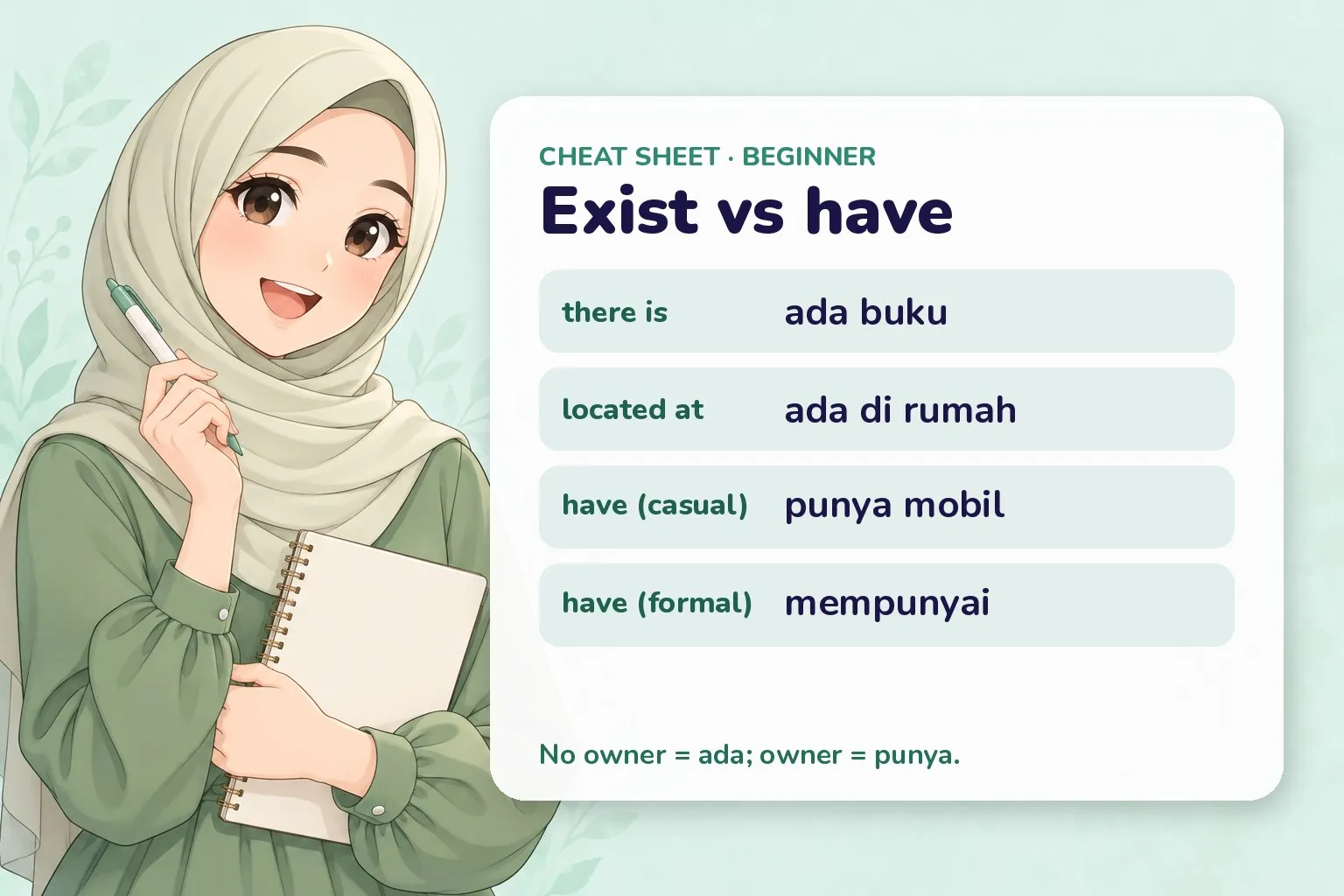
Quick recap before the quiz.
Practice
ada and punya practice
Try each one, then press Check. No sign-up, nothing is sent anywhere — it all runs in your browser.
Hint: existence, no owner
Show answer
Ada — Existence uses ada with no subject in front.
3 Build: 'I'm at home now.'
Show answer
Saya ada di rumah sekarang — Location: subject + ada di + place.
4 Match each phrase to its meaning.
- ada
- punya
- mempunyai
- tidak ada
Show answer
- ada → there is / exist
- punya → to have (informal)
- mempunyai → to have (formal)
- tidak ada → there isn't
ada = existence, punya/mempunyai = possession.
Hint: to be located at
Show answer
ada — Location uses ada di.
Quiz
Indonesian ada and punya
12 questions · pick an answer and you'll see straight away if it's right.
-
Show answer
ada — ada introduces existence.
-
Show answer
punya — punya links an owner to a thing.
-
Show answer
punya — Ownership uses punya, not ada.
-
Show answer
Ada — Existence with no owner uses ada.
-
Show answer
Saya ada di rumah. — Location is subject + ada di + place.
-
Show answer
mempunyai — mempunyai is the formal form of punya.
-
Show answer
tidak punya — Possession negates with tidak punya.
-
Show answer
There's no news yet — belum = not yet, so belum ada = there isn't one yet.
-
Show answer
ada — Existence negated: tidak ada.
-
Show answer
ada is existence/location, not ownership; use punya — Standard Indonesian uses punya for possession; ada mobil is colloquial.
-
Show answer
Ada kamar kosong? — Availability uses ada: Ada kamar kosong?
-
Show answer
ada — Location uses ada di.
Recap cheat-sheet
| Idea | Word | Example |
|---|---|---|
| there is / exists | ada | Ada tamu. |
| is located at | ada di | Saya ada di rumah. |
| have (informal) | punya | Saya punya mobil. |
| have (formal) | mempunyai / memiliki | Dia memiliki tanah. |
| there isn’t / don’t have | tidak ada / tidak punya | Tidak ada waktu. |
Next
- Back to the Indonesian grammar section
- See why there is no verb “to be”: No verb “to be”
- New here? Start with Start Learning Indonesian Here
All Indonesian grammar topics
Every grammar point in order, from your first sentence to advanced structures. Pick one and go straight to it. New lessons go live every day, so topics marked Coming soon fill in over the next weeks.
Grammar path
Beginner 18 topics · 13 ready
- 01 Indonesian Personal Pronouns
- 02 Basic Word Order (Subject-Verb-Object)
- 03 Sentences Without 'To Be'
- 04 Noun + Adjective Order
- 05 Possession (Noun + Owner)
- 06 Plurals and Reduplication
- 07 Yes/No Questions (apakah, intonation)
- 08 Question Words (apa, siapa, di mana)
- 09 Negation: tidak vs bukan
- 10 Demonstratives (ini, itu)
- 11 Numbers and Classifiers
- 12 Common Prepositions (di, ke, dari)
- 13 Existence and 'Have' with ada / punya You are here
- 14 Manner Deixis (begini, begitu) & sini/situ/sana Coming soon
- 15 Particles -lah, -kah, -pun Coming soon
- 16 Question Tags (kan, ya, bukan) Coming soon
- 17 Adverbs of Frequency (selalu, sering, kadang) Coming soon
- 18 Telling the Time Coming soon
Elementary 24 topics
- 19 The Prefix ber- Coming soon
- 20 The Prefix meN- (Active Transitive) Coming soon
- 21 The Passive with di- Coming soon
- 22 Agent-Focus Passive (Pronoun + Verb) Coming soon
- 23 Aspect Markers (sudah, sedang, akan, belum, masih) Coming soon
- 24 Modal Words (bisa, boleh, harus, mau, ingin) Coming soon
- 25 Comparatives and Superlatives Coming soon
- 26 Ordinal Numbers and Dates Coming soon
- 27 Basic Conjunctions (dan, tetapi, atau, karena) Coming soon
- 28 Imperatives and Requests Coming soon
- 29 Adverbs and Intensifiers (sangat, sekali, agak) Coming soon
- 30 Only / Just (hanya, cuma, saja) Coming soon
- 31 Again / Still / More (lagi, masih, tambah) Coming soon
- 32 Experience (pernah, belum pernah) Coming soon
- 33 Purpose Clauses (untuk, supaya, agar) Coming soon
- 34 Cause Clauses (karena, sebab, gara-gara) Coming soon
- 35 Quantifiers (semua, setiap, beberapa, banyak) Coming soon
- 36 Complement Clauses with bahwa Coming soon
- 37 The Suffix -an (Result Nouns) Coming soon
- 38 The Prefix ke- (ketua, kekasih) Coming soon
- 39 Adverbial -nya (biasanya, sebenarnya) Coming soon
- 40 The Clitic -nya as a Definite Marker Coming soon
- 41 Sequencing (lalu, kemudian, setelah itu) Coming soon
- 42 Before & After (sebelum, setelah, sesudah) Coming soon
Intermediate 21 topics
- 43 The meN-...-kan Construction Coming soon
- 44 The meN-...-i Construction Coming soon
- 45 Nominalising Affixes (pe-, pe-an, per-an, ke-an) Coming soon
- 46 The Prefix ter- (Accidental/Superlative/Stative) Coming soon
- 47 The Prefix se- (One/Same/As) Coming soon
- 48 Relative Clauses with yang Coming soon
- 49 Subordinating Conjunctions (jika, meskipun) Coming soon
- 50 Types of Reduplication Coming soon
- 51 Classifiers and Quantity Expressions Coming soon
- 52 Reciprocal & Stative (ber-an, ber-kan) Coming soon
- 53 Passive Register (di- vs ter- vs ke-an) Coming soon
- 54 Reciprocal (saling, satu sama lain) Coming soon
- 55 Intensive & Reflexive (diri, sendiri) Coming soon
- 56 Correlative Conjunctions (baik...maupun) Coming soon
- 57 Degree (terlalu, cukup, kurang) Coming soon
- 58 The More...The More (makin, semakin) Coming soon
- 59 Simultaneous Actions (sambil, selagi, sementara) Coming soon
- 60 The Prefix memper- (Causative) Coming soon
- 61 ke-...-an Adversative Verbs (kehujanan) Coming soon
- 62 The Frame se-...-nya (sebaiknya, secepatnya) Coming soon
- 63 Compound Words (kata majemuk) Coming soon
Advanced 11 topics
- 64 Advanced Nominalisation & Formal Syntax Coming soon
- 65 Discourse Markers & Cohesion Coming soon
- 66 Formal (baku) vs Colloquial Indonesian Coming soon
- 67 Advanced Passive & Object Preposing Coming soon
- 68 Idiomatic & Layered Affixation Coming soon
- 69 Conditionals & Hypotheticals (seandainya, andai) Coming soon
- 70 Large Numbers, Fractions & Approximation Coming soon
- 71 Compound & Complex Sentences Coming soon
- 72 Topic, Focus & Cleft (yang...itu) Coming soon
- 73 Apposition and Appositive Clauses Coming soon
- 74 Restoring Dropped Affixes (Formal Writing) Coming soon