Indonesian begini, begitu and sini, situ, sana
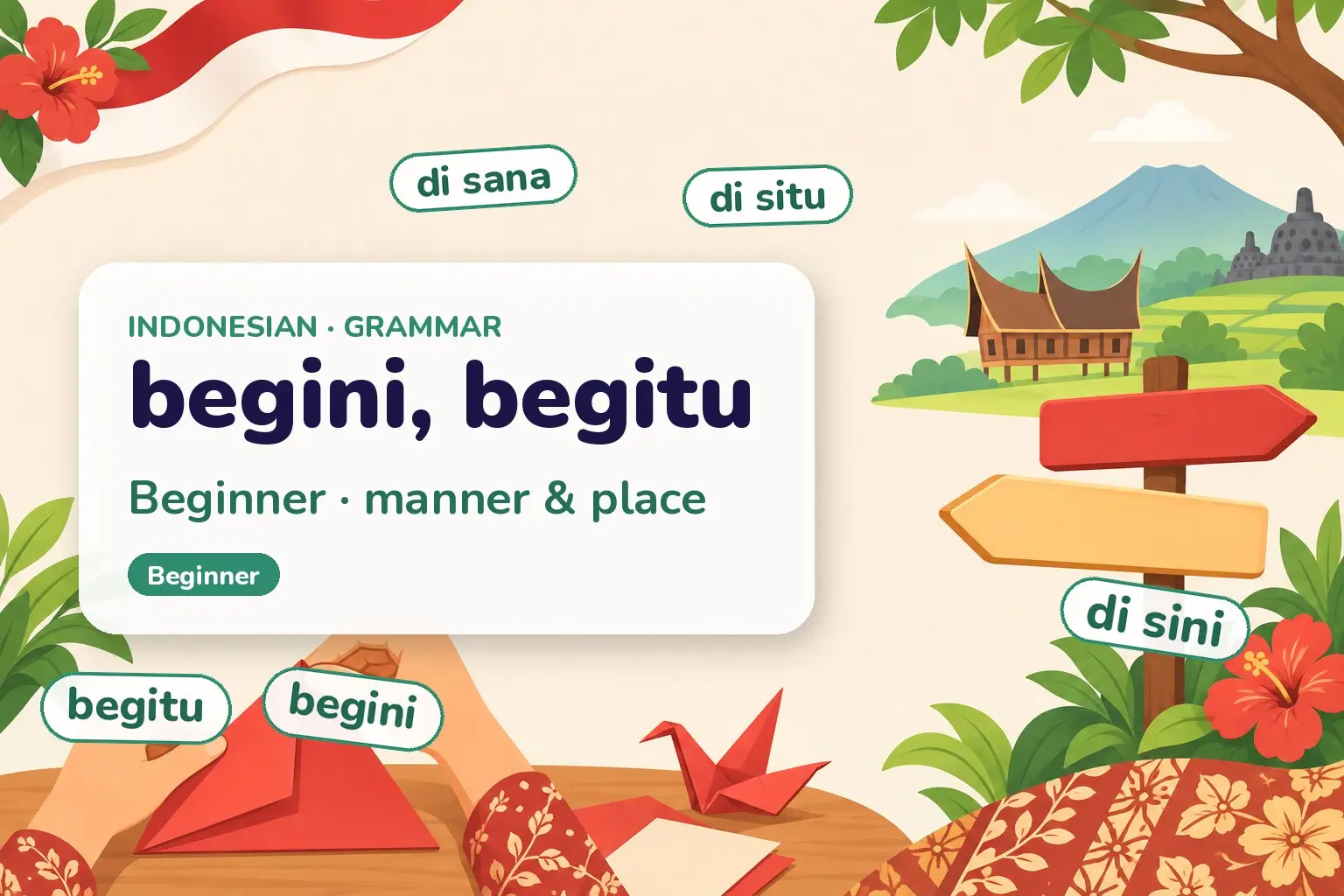
begini means 'like this / this way' and begitu means 'like that / that way', pointing to a manner, not a thing. The place words sini (here), situ (there, near you) and sana (over there) take di, ke or dari: di sini, ke sana.
Level: Beginner. Besides ini (this) and itu (that) for objects, Indonesian has a second pointing set for how something is done and where it is. begini and begitu point to a manner; sini, situ and sana point to a place. Learn these and you can say “like this”, “like that” and “over there” without a dictionary.
The rule
Deixis is the grammar of pointing words — words whose meaning depends on where the speaker and listener are. You already know the object pair in Indonesian demonstratives ini and itu. This lesson adds two more kinds of pointing:
- Manner — begini (like this / this way) and begitu (like that / that way). They come from bagai + ini/itu and mean the same as seperti ini and seperti itu.
- Place — sini (here), situ (there, near you or just mentioned) and sana (over there, far from both).
The big difference from ini / itu is that begini, begitu and the place words replace a whole phrase, so they stand on their own. begitu is a complete answer to “how?”; sana is a complete answer to “where?”. You never put a noun after them the way you do with ini and itu.
Forms
| Word | Points to | Meaning |
|---|---|---|
| begini | manner (near) | like this, this way |
| begitu | manner (far / mentioned) | like that, that way; so |
| sini | place (near me) | here |
| situ | place (near you) | there |
| sana | place (far from both) | over there |
The three place words combine with a preposition to show position, destination or origin:
| Preposition | Here | There (near you) | Over there |
|---|---|---|---|
| di (at / in) | di sini | di situ | di sana |
| ke (to) | ke sini | ke situ | ke sana |
| dari (from) | dari sini | dari situ | dari sana |
begini and begitu: pointing to a manner
Use begini when you are showing or about to show the way yourself — it points to what is close to you right now:
- Lipat kertasnya begini. — Fold the paper like this.
- Begini caranya. — This is how it’s done.
Use begitu for a way that is further off, already mentioned, or one you are commenting on:
- Jangan begitu. — Don’t (do it) like that.
- Dia selalu bicara begitu. — He always talks like that.
For formal writing and speeches there is a third, careful word, demikian (thus, in that way): Demikian ketentuan yang berlaku (Such are the rules that apply). In everyday speech begitu is the natural choice.
sini, situ, sana: pointing to a place
The three place words map to the same near–mid–far scale as the pronouns:
- di sini — here, by me.
- di situ — there, by you, or at a spot just pointed out.
- di sana — over there, far from both of us.
Keep the preposition separate: di sini, not disini. Swap di for ke to show movement toward, and dari to show movement from: Saya datang ke sini (I came here), Dia pulang dari sana (She went home from over there).
How to say it
Indonesian spelling is regular — one steady sound per letter. For this lesson:
| Sound | How to say it |
|---|---|
| Pure vowels | i = “ee”, u = “oo”, a = “ah”: begini = “buh-GEE-nee”, situ = “SEE-too”, sana = “SAH-nah”. |
| e (two kinds) | The e in begini / begitu is the weak “uh” (pepet): “buh-”. |
| g | Always hard, as in “go”: begitu = “buh-GEE-too”, never a soft “j”. |
| Stress | Light, usually on the next-to-last syllable: be-GI-ni, be-GI-tu, SA-na. |
Example sentences
- Lakukan begini.Do it like this.begini = this way, speaker shows it
- Begini caranya.This is how it's done.begini opening an explanation
- Jangan begitu.Don't do it like that.begitu stands alone as 'that way'
- Dia selalu bicara begitu.He always talks like that.begitu = in that manner
- Mengapa kamu begitu sedih?Why are you so sad?begitu = so / very before an adjective
- Kue ini begitu enak.This cake is so delicious.begitu as intensifier
- Kalau begitu, kita pergi sekarang.In that case, let's go now.kalau begitu = in that case
- Saya tinggal di sini.I live here.di sini = here, near me
- Tasmu ada di situ.Your bag is there.di situ = there, near you
- Mereka bekerja di sana.They work over there.di sana = far from both
- Ayo ke sini!Come here!ke sini = to here
- Jangan taruh di situ.Don't put it there.di situ = that spot by you
- Dia baru pulang dari sana.She just got back from over there.dari sana = from far away
- Dari sini ke stasiun dekat.From here to the station is close.dari sini = from here
- Tolong jelaskan begini saja.Please just explain it like this.begini saja = just like this
- Begitu juga adik saya.My younger sibling too / likewise.begitu juga = likewise
- Rumahnya begitu besar.His house is so big.begitu = so, intensifying besar
- Taruh buku ini di sana.Put this book over there.ini for the thing, di sana for the place
Common mistakes
- ❌ buku begini (for “this book”) → ✅ buku ini. begini is a manner, not a thing; a book is buku ini.
- ❌ di ini (for “here”) → ✅ di sini. “Here” is the place word sini, not ini.
- ❌ Jangan ini (for “Don’t do it like this”) → ✅ Jangan begini / Jangan begitu. A manner needs begini / begitu.
- ❌ disini, disana → ✅ di sini, di sana. Keep di a separate word in place phrases.
- ❌ ke sana ke sini used for “this and that thing” → ✅ keep sana / sini for places; use ini / itu for objects.
- ❌ begitu buku → ✅ buku itu for “that book”; begitu never modifies a noun.
A short conversation
— Permisi, bagaimana cara melipatnya? (Excuse me, how do I fold it?) — Begini. Lipat sudutnya, lalu tekan. (Like this. Fold the corner, then press.) — Oh, begitu! Terima kasih. (Oh, like that! Thank you.) — Sama-sama. Buku panduannya ada di situ, dekat kamu. (You’re welcome. The manual is there, near you.)
Usage notes
- Standalone answers. begini, begitu, sini, situ and sana can each be a full reply: “How?” → Begini. “Where?” → Di sana. You do not need a noun after them.
- kalau begitu / begitu juga. Two very common set phrases: kalau begitu (in that case, so then) and begitu juga (likewise, the same goes for).
- situ for “you”. In casual speech some speakers use situ to mean “you” at a slight distance; as a beginner, keep situ for “there” and use kamu / Anda for “you”.
- Distance is flexible. The near–mid–far line is about focus, not metres. di situ often just means “at that spot”, even when it is not literally beside the listener.
- Movement words. Remember the trio: di for position, ke for going toward, dari for coming from — di sini / ke sini / dari sini.
Compared with ini and itu
ini and itu point to things and sit after the noun (buku ini = this book); begini and begitu point to a manner and stand alone (Lakukan begitu = do it that way); sini, situ and sana point to a place and take a preposition (di sana = over there). They share the same near-and-far feeling but never swap jobs. For the object pair and the full ini / itu rules, see Indonesian demonstratives ini and itu, and for where these words sit in a sentence, see Indonesian word order.
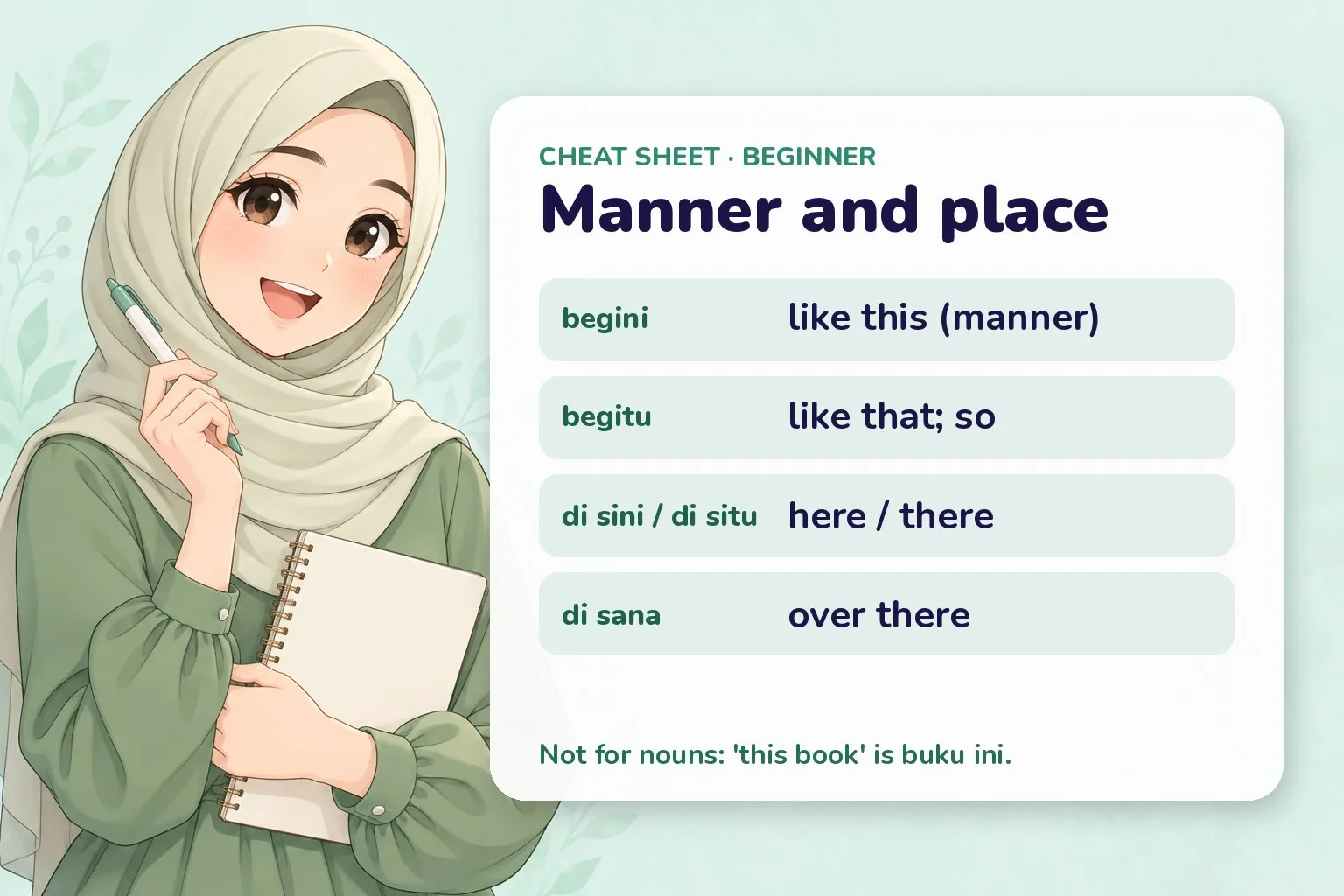
Quick recap before the quiz.
Practice
begini, begitu, sini, situ, sana practice
Try each one, then press Check. No sign-up, nothing is sent anywhere — it all runs in your browser.
Hint: place near me
Show answer
sini — di sini = here, near the speaker.
3 Build: 'Come here!'
Show answer
Ayo ke sini — ke sini = to here: Ayo ke sini!
4 Match each word to its job.
- begini
- di sana
- buku ini
- begitu baik
Show answer
- begini → like this (manner)
- di sana → over there (place)
- buku ini → this book (thing)
- begitu baik → so kind (intensifier)
begini = manner, sana = place, ini = thing, begitu = so/very.
Hint: set phrase 'in that case'
Show answer
begitu — kalau begitu = in that case.
Quiz
Indonesian begini, begitu, sini, situ, sana
12 questions · pick an answer and you'll see straight away if it's right.
-
Show answer
like this (manner) — begini = like this / this way.
-
Show answer
like that / that way — begitu = like that / that way (also 'so').
-
Show answer
sana — sana (over there) is a place word.
-
Show answer
di sini — di sini = here.
-
Show answer
di situ — di situ = there, by the listener.
-
Show answer
buku ini — A thing takes ini/itu: buku ini. begini/sini are not for nouns.
-
Show answer
so / very — Before an adjective, begitu = so/very: so big.
-
Show answer
Ayo ke sini! — ke sini = to here: Ayo ke sini!
-
Show answer
begitu — Jangan begitu = don't (do it) like that.
-
Show answer
'here' is the place word sini: di sini — Place = sini; ini is 'this'. So 'here' is di sini.
-
Show answer
dari sana — dari = from: dari sana.
-
Show answer
demikian — demikian is the formal manner word; begitu is the everyday one.
Recap cheat-sheet
| Word | Job | Example |
|---|---|---|
| begini | like this (manner) | Begini caranya. |
| begitu | like that; so | Jangan begitu. |
| di sini | here | Saya di sini. |
| di situ | there (by you) | Tasmu di situ. |
| di sana | over there | Mereka di sana. |
Next
- Back to the Indonesian grammar section
- Related: Indonesian demonstratives ini and itu and Indonesian word order
- New here? Start with Start Learning Indonesian Here
All Indonesian grammar topics
Every grammar point in order, from your first sentence to advanced structures. Pick one and go straight to it. New lessons go live every day, so topics marked Coming soon fill in over the next weeks.
Grammar path
Beginner 18 topics · 14 ready
- 01 Indonesian Personal Pronouns
- 02 Basic Word Order (Subject-Verb-Object)
- 03 Sentences Without 'To Be'
- 04 Noun + Adjective Order
- 05 Possession (Noun + Owner)
- 06 Plurals and Reduplication
- 07 Yes/No Questions (apakah, intonation)
- 08 Question Words (apa, siapa, di mana)
- 09 Negation: tidak vs bukan
- 10 Demonstratives (ini, itu)
- 11 Numbers and Classifiers
- 12 Common Prepositions (di, ke, dari)
- 13 Existence and 'Have' with ada / punya
- 14 Manner Deixis (begini, begitu) & sini/situ/sana You are here
- 15 Particles -lah, -kah, -pun Coming soon
- 16 Question Tags (kan, ya, bukan) Coming soon
- 17 Adverbs of Frequency (selalu, sering, kadang) Coming soon
- 18 Telling the Time Coming soon
Elementary 24 topics
- 19 The Prefix ber- Coming soon
- 20 The Prefix meN- (Active Transitive) Coming soon
- 21 The Passive with di- Coming soon
- 22 Agent-Focus Passive (Pronoun + Verb) Coming soon
- 23 Aspect Markers (sudah, sedang, akan, belum, masih) Coming soon
- 24 Modal Words (bisa, boleh, harus, mau, ingin) Coming soon
- 25 Comparatives and Superlatives Coming soon
- 26 Ordinal Numbers and Dates Coming soon
- 27 Basic Conjunctions (dan, tetapi, atau, karena) Coming soon
- 28 Imperatives and Requests Coming soon
- 29 Adverbs and Intensifiers (sangat, sekali, agak) Coming soon
- 30 Only / Just (hanya, cuma, saja) Coming soon
- 31 Again / Still / More (lagi, masih, tambah) Coming soon
- 32 Experience (pernah, belum pernah) Coming soon
- 33 Purpose Clauses (untuk, supaya, agar) Coming soon
- 34 Cause Clauses (karena, sebab, gara-gara) Coming soon
- 35 Quantifiers (semua, setiap, beberapa, banyak) Coming soon
- 36 Complement Clauses with bahwa Coming soon
- 37 The Suffix -an (Result Nouns) Coming soon
- 38 The Prefix ke- (ketua, kekasih) Coming soon
- 39 Adverbial -nya (biasanya, sebenarnya) Coming soon
- 40 The Clitic -nya as a Definite Marker Coming soon
- 41 Sequencing (lalu, kemudian, setelah itu) Coming soon
- 42 Before & After (sebelum, setelah, sesudah) Coming soon
Intermediate 21 topics
- 43 The meN-...-kan Construction Coming soon
- 44 The meN-...-i Construction Coming soon
- 45 Nominalising Affixes (pe-, pe-an, per-an, ke-an) Coming soon
- 46 The Prefix ter- (Accidental/Superlative/Stative) Coming soon
- 47 The Prefix se- (One/Same/As) Coming soon
- 48 Relative Clauses with yang Coming soon
- 49 Subordinating Conjunctions (jika, meskipun) Coming soon
- 50 Types of Reduplication Coming soon
- 51 Classifiers and Quantity Expressions Coming soon
- 52 Reciprocal & Stative (ber-an, ber-kan) Coming soon
- 53 Passive Register (di- vs ter- vs ke-an) Coming soon
- 54 Reciprocal (saling, satu sama lain) Coming soon
- 55 Intensive & Reflexive (diri, sendiri) Coming soon
- 56 Correlative Conjunctions (baik...maupun) Coming soon
- 57 Degree (terlalu, cukup, kurang) Coming soon
- 58 The More...The More (makin, semakin) Coming soon
- 59 Simultaneous Actions (sambil, selagi, sementara) Coming soon
- 60 The Prefix memper- (Causative) Coming soon
- 61 ke-...-an Adversative Verbs (kehujanan) Coming soon
- 62 The Frame se-...-nya (sebaiknya, secepatnya) Coming soon
- 63 Compound Words (kata majemuk) Coming soon
Advanced 11 topics
- 64 Advanced Nominalisation & Formal Syntax Coming soon
- 65 Discourse Markers & Cohesion Coming soon
- 66 Formal (baku) vs Colloquial Indonesian Coming soon
- 67 Advanced Passive & Object Preposing Coming soon
- 68 Idiomatic & Layered Affixation Coming soon
- 69 Conditionals & Hypotheticals (seandainya, andai) Coming soon
- 70 Large Numbers, Fractions & Approximation Coming soon
- 71 Compound & Complex Sentences Coming soon
- 72 Topic, Focus & Cleft (yang...itu) Coming soon
- 73 Apposition and Appositive Clauses Coming soon
- 74 Restoring Dropped Affixes (Formal Writing) Coming soon