Indonesian Particles: -lah, -kah, -pun
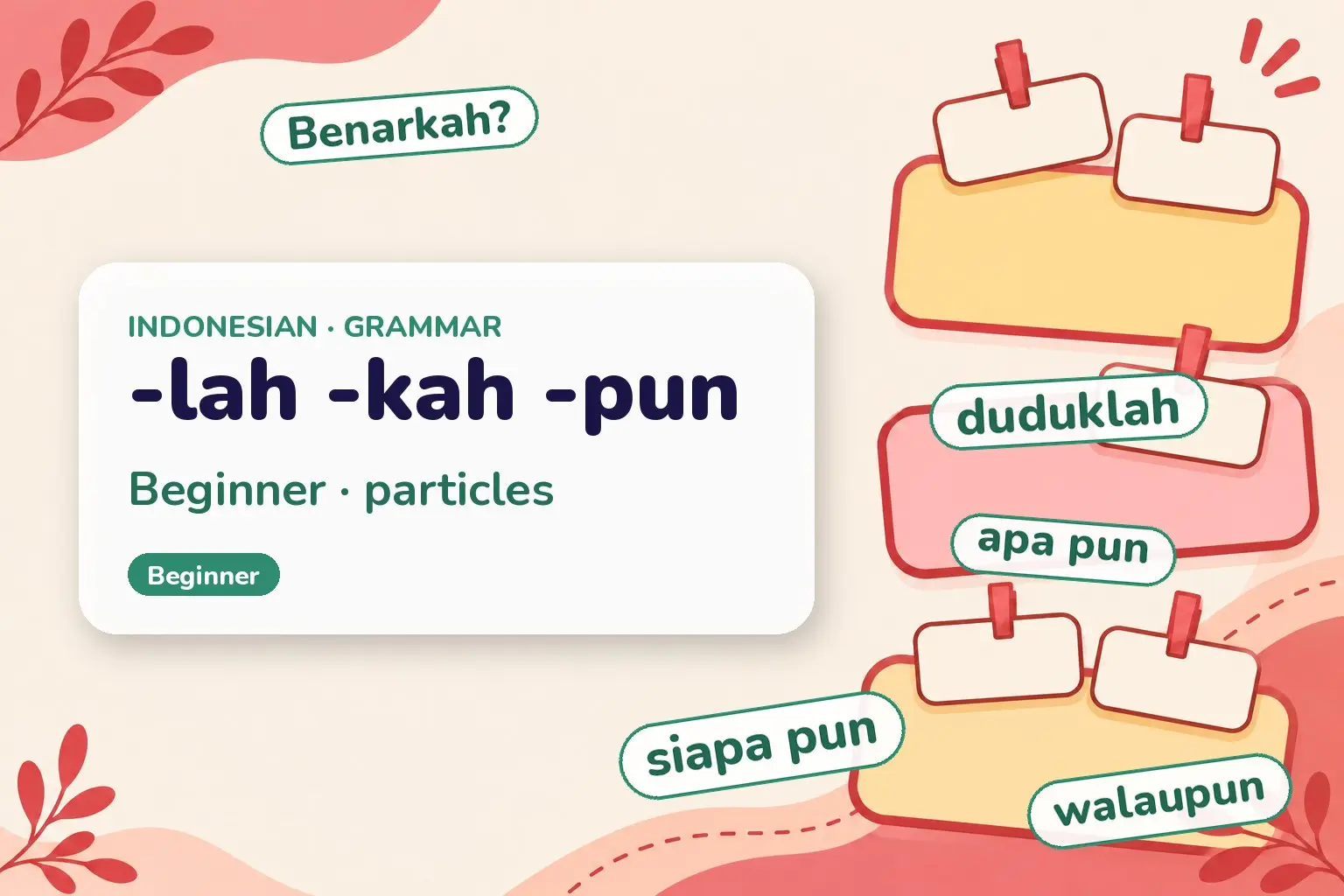
Indonesian -lah emphasises or softens (duduklah, do sit down), -kah turns a statement into a question (Benarkah? Is it true?), and -pun means even or too (siapa pun, anyone). -lah and -kah always join the word; -pun joins only in a fixed set like walaupun.
On this page14 sections · tap to jump
Level: Beginner. Indonesian has three little particles that attach to the end of a word to add colour: -lah (emphasis or a gentle command), -kah (a question marker) and -pun (even, too). They never change the meaning of the base word — they adjust its tone or turn it into a question.
The rule
A particle here is a short element with no meaning on its own that clings to another word (a clitic). All three attach to the end of the word you want to highlight. That highlighted word is often pulled to the front of the sentence.
- -lah adds emphasis or softens a command. On a statement it stresses the word it joins (Dialah yang benar — He is the one who’s right). On a verb it makes a polite imperative (duduk “sit” → duduklah “do sit / please sit”).
- -kah turns a statement into a yes/no question, mainly in formal or written Indonesian (Benarkah? — Is it true?). It attaches to the word being questioned.
- -pun means even / too / also (siapa pun — anyone at all; sedikit pun — even a little).
The three particles at a glance
| Particle | Job | Attaches to | Example |
|---|---|---|---|
| -lah | emphasis; soften a command | the stressed word / a verb | duduklah (do sit down) |
| -kah | yes/no question (formal) | the questioned word | Benarkah? (Is it true?) |
| -pun | even / too / also | the word it scopes over | apa pun (anything at all) |
-lah: emphasis and polite commands
On a command, -lah takes the edge off a bare verb. Duduk! is a blunt “Sit!”; Duduklah is “Do sit down / please have a seat”. On a statement, it emphasises the fronted word and often pairs with yang (the one that/who): Dialah yang memecahkan gelas — “It was he who broke the glass.”
-kah: the question particle
-kah marks a yes/no question in careful or written Indonesian. You attach it to whatever you are questioning and usually move that word to the front:
- Benar. (It’s true.) → Benarkah? (Is it true?)
- Dia datang. (He is coming.) → Diakah yang datang? (Is it he who is coming?)
It can also sit on a question word for a more formal flavour: apa → apakah, siapa → siapakah. In everyday conversation people usually drop -kah and just raise their intonation.
-pun: even, too, also
-pun gives the sense “even” or “too”. With a question word it builds “any-”: siapa pun (anyone), apa pun (anything), ke mana pun (anywhere), kapan pun (any time). With a quantity it stresses the smallest amount: Dia tidak makan sedikit pun — “He didn’t eat even a little.”
Here is the spelling catch. By the EYD spelling rules, -pun is written as a separate word in these “even/too” meanings (apa pun, siapa pun, satu pun). But a fixed, closed set of conjunctions is written joined: adapun, andaipun, ataupun, bagaimanapun, biarpun, kalaupun, maupun, meskipun, sekalipun, sungguhpun, walaupun.
How to say it
These particles are unstressed tails; the stress stays on the base word:
- -lah — “lah”, a light, quick syllable: duduklah = “DOO-dook-lah”.
- -kah — “kah”: benarkah = “buh-NAR-kah”.
- -pun — “poon”: apa pun = “AH-pa poon”.
- Remember Indonesian c is “ch” and the vowels are pure, so sedikit = “suh-DEE-kit”.
Example sentences
- Duduklah.Do sit down. / Please have a seat.-lah softens the command duduk
- Masuklah, pintunya terbuka.Come in, the door is open.polite imperative with -lah
- Dialah yang benar.He is the one who is right.-lah emphasises the fronted dia
- Inilah rumah saya.This is my house.ini + -lah: 'this is the very one'
- Ambillah satu.Go ahead and take one.offering with -lah
- Benarkah?Is it true?-kah makes a yes/no question
- Apakah kamu lapar?Are you hungry?formal question with apakah
- Siapakah dia?Who is he?-kah on a question word, formal
- Diakah yang datang?Is it he who is coming?questioned word fronted + -kah
- Maukah Anda membantu saya?Would you like to help me?polite request with -kah
- Siapa pun boleh ikut.Anyone may come along.siapa pun = anyone (two words)
- Apa pun bisa terjadi.Anything can happen.apa pun = anything (two words)
- Dia tidak makan sedikit pun.He didn't eat even a little.sedikit pun = even a little
- Ke mana pun kamu pergi, aku ikut.Wherever you go, I'll come.ke mana pun = anywhere
- Walaupun hujan, kami tetap pergi.Although it was raining, we still went.walaupun = one word (conjunction)
- Saya mau teh atau kopi, mana pun boleh.I'd like tea or coffee, either is fine.mana pun = whichever
- Meskipun lelah, dia terus bekerja.Even though tired, he kept working.meskipun = one word
- Satu pun tidak tersisa.Not even one is left.satu pun = not even one
Common mistakes
- ❌ Duduk-lah with a hyphen → ✅ duduklah. Clitics join the word directly, no hyphen.
- ❌ Apa kamu lapar? as careful writing → ✅ Apakah kamu lapar? Formal yes/no questions take -kah.
- ❌ apapun, siapapun → ✅ apa pun, siapa pun. The “even/any” particle is two words.
- ❌ walau pun, meski pun → ✅ walaupun, meskipun. These conjunctions are one word.
- ❌ Stacking -lah on every verb → ✅ use it only for real emphasis or a polite command; otherwise it sounds stiff.
- ❌ Benar-kah kamu? meaning “are you right” → ✅ Benarkah? attaches to the questioned word, which usually fronts.
A short conversation
— Permisi, inikah toko Pak Budi? (Excuse me, is this Mr Budi’s shop?) — Ya. Masuklah, silakan. (Yes. Do come in, please.) — Apa pun boleh saya lihat? (May I look at anything?) — Tentu. Ambillah waktu Anda. (Of course. Take your time.)
Usage notes
- Register. -kah belongs to formal/written Indonesian; -lah is common in both but easy to overdo; -pun is neutral.
- One particle at a time on a word. You normally add just one of these to a given word, not two.
- -lah with question words = emphasis, not a question. Di manalah dia sekarang? adds a wondering, rhetorical tone (“wherever is he now?”).
- pun as a connector. A separate pun can also mean “as for / then” at the start of a clause: Dia pun pergi — “He, too, left / So he left.”
- Pronouns. These particles attach to many word types; for the forms of dia, kamu, Anda see the pronoun lesson linked below.
Compared with imperatives
A plain Indonesian imperative is just the bare verb: Duduk! (Sit!), Lihat! (Look!). Adding -lah turns the order into an invitation or a softened request: Duduklah (do sit down), Lihatlah (take a look). So the contrast is tone, not grammar: the verb is the same, and -lah only makes it polite. You can see the bare command pattern in Indonesian word order, and build full questions in Indonesian yes/no questions.
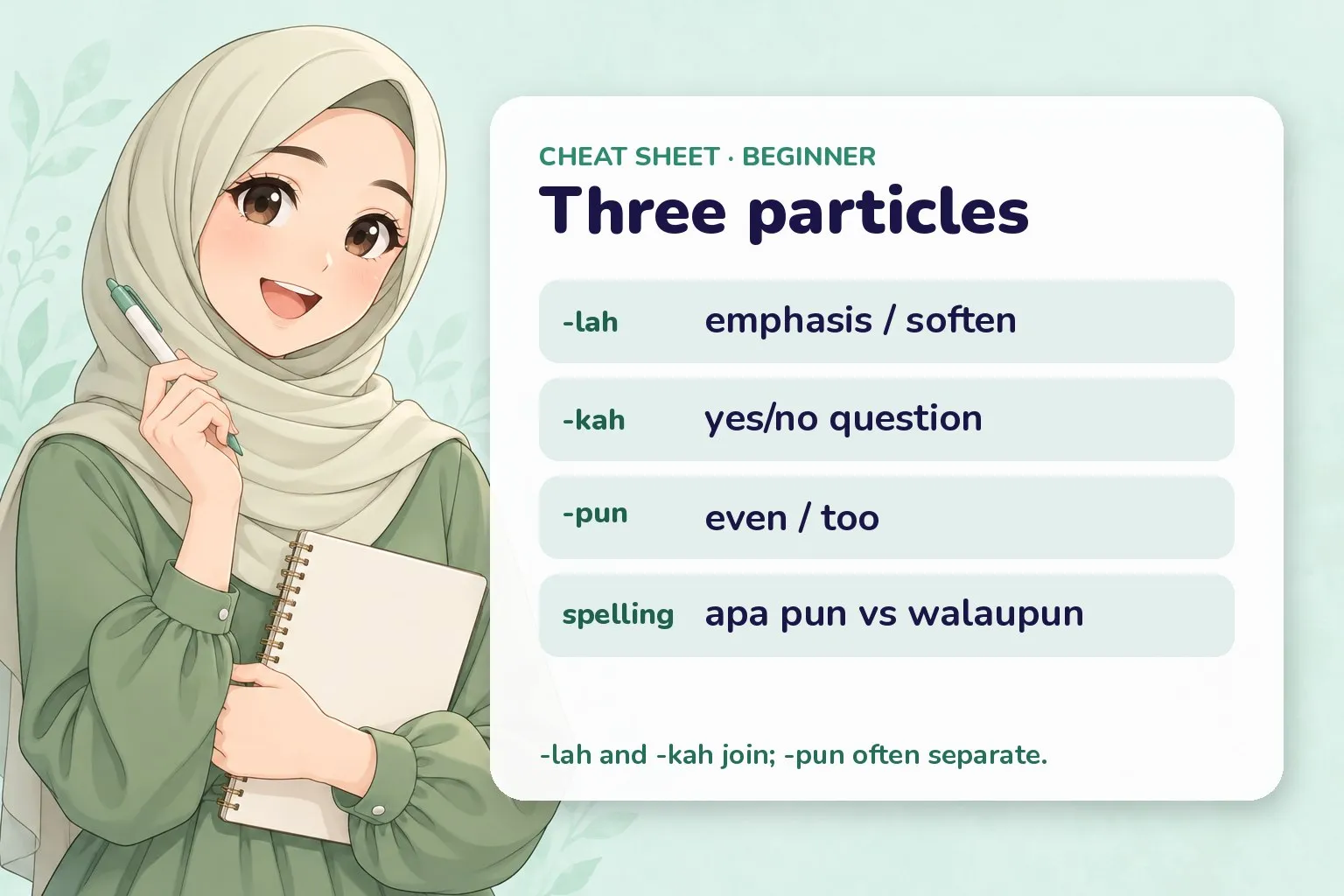
Quick recap before the quiz.
Practice
Indonesian particles practice
Try each one, then press Check. No sign-up, nothing is sent anywhere — it all runs in your browser.
Hint: add the emphasis/softening particle
Show answer
duduklah — duduk + -lah = duduklah, 'do sit down'.
3 Build 'Anyone may come along.'
Show answer
Siapa pun boleh ikut — siapa pun (two words) = anyone; Siapa pun boleh ikut.
4 Match each particle to its job.
- -lah
- -kah
- -pun
Show answer
- -lah → emphasis / soften a command
- -kah → yes/no question
- -pun → even / too / also
Three tone tags: emphasis, question, 'even'.
Quiz
Indonesian particles -lah, -kah, -pun
12 questions · pick an answer and you'll see straight away if it's right.
-
Show answer
a softer / more polite command — duduklah = 'do sit down', a softened command.
-
Show answer
mark a yes/no question — -kah signals a question: Benarkah?
-
Show answer
even / too — siapa pun = anyone, sedikit pun = even a little.
-
Show answer
replaced by rising intonation — Everyday questions use intonation; -kah is formal/written.
-
Show answer
siapa pun — siapa pun (anyone) is two words; walaupun/meskipun are one.
-
Show answer
meskipun — meskipun (even though) is in the joined conjunction set.
-
Show answer
He is the one who is right. — -lah emphasises the fronted dia: 'HE is the one who's right'.
-
Show answer
Apakah kamu lapar? — Formal yes/no question: Apakah kamu lapar?
-
Show answer
Satu pun tidak tersisa — satu pun = not even one.
-
Show answer
overusing it so speech sounds stiff — Keep -lah for real emphasis or polite commands.
-
Show answer
Benarkah — Benar + -kah = Benarkah? (Is it true?).
-
Show answer
the end of a word — They are enclitics: they attach to the end of the word.
Recap cheat-sheet
| Particle | Meaning | Spelling | Example |
|---|---|---|---|
| -lah | emphasis / soften command | always joined | duduklah |
| -kah | yes/no question (formal) | always joined | Benarkah? |
| -pun (even/too) | even, too, any- | two words | apa pun |
| -pun (conjunction) | although / or / however | joined (fixed set) | walaupun |
Next
- Back to the Indonesian grammar section
- Related: Indonesian yes/no questions and Indonesian question words
- New here? Start with Start Learning Indonesian Here
All Indonesian grammar topics
Every grammar point in order, from your first sentence to advanced structures. Pick one and go straight to it. New lessons go live every day, so topics marked Coming soon fill in over the next weeks.
Grammar path
Beginner 18 topics · 18 ready
- 01 Indonesian Personal Pronouns
- 02 Basic Word Order (Subject-Verb-Object)
- 03 Sentences Without 'To Be'
- 04 Noun + Adjective Order
- 05 Possession (Noun + Owner)
- 06 Plurals and Reduplication
- 07 Yes/No Questions (apakah, intonation)
- 08 Question Words (apa, siapa, di mana)
- 09 Negation: tidak vs bukan
- 10 Demonstratives (ini, itu)
- 11 Numbers and Classifiers
- 12 Common Prepositions (di, ke, dari)
- 13 Existence and 'Have' with ada / punya
- 14 Manner Deixis (begini, begitu) & sini/situ/sana
- 15 Particles -lah, -kah, -pun You are here
- 16 Question Tags (kan, ya, bukan)
- 17 Adverbs of Frequency (selalu, sering, kadang)
- 18 Telling the Time
Elementary 24 topics · 3 ready
- 19 The Prefix ber-
- 20 The Prefix meN- (Active Transitive)
- 21 The Passive with di-
- 22 Agent-Focus Passive (Pronoun + Verb) Coming soon
- 23 Aspect Markers (sudah, sedang, akan, belum, masih) Coming soon
- 24 Modal Words (bisa, boleh, harus, mau, ingin) Coming soon
- 25 Comparatives and Superlatives Coming soon
- 26 Ordinal Numbers and Dates Coming soon
- 27 Basic Conjunctions (dan, tetapi, atau, karena) Coming soon
- 28 Imperatives and Requests Coming soon
- 29 Adverbs and Intensifiers (sangat, sekali, agak) Coming soon
- 30 Only / Just (hanya, cuma, saja) Coming soon
- 31 Again / Still / More (lagi, masih, tambah) Coming soon
- 32 Experience (pernah, belum pernah) Coming soon
- 33 Purpose Clauses (untuk, supaya, agar) Coming soon
- 34 Cause Clauses (karena, sebab, gara-gara) Coming soon
- 35 Quantifiers (semua, setiap, beberapa, banyak) Coming soon
- 36 Complement Clauses with bahwa Coming soon
- 37 The Suffix -an (Result Nouns) Coming soon
- 38 The Prefix ke- (ketua, kekasih) Coming soon
- 39 Adverbial -nya (biasanya, sebenarnya) Coming soon
- 40 The Clitic -nya as a Definite Marker Coming soon
- 41 Sequencing (lalu, kemudian, setelah itu) Coming soon
- 42 Before & After (sebelum, setelah, sesudah) Coming soon
Intermediate 20 topics
- 43 The meN-...-kan Construction Coming soon
- 44 The meN-...-i Construction Coming soon
- 45 Nominalising Affixes (pe-, pe-an, per-an, ke-an) Coming soon
- 46 The Prefix ter- (Accidental/Superlative/Stative) Coming soon
- 47 The Prefix se- (One/Same/As) Coming soon
- 48 Relative Clauses with yang Coming soon
- 49 Subordinating Conjunctions (jika, meskipun) Coming soon
- 50 Types of Reduplication Coming soon
- 51 Classifiers and Quantity Expressions Coming soon
- 52 Passive Register (di- vs ter- vs ke-an) Coming soon
- 53 Reciprocal (saling, satu sama lain) Coming soon
- 54 Intensive & Reflexive (diri, sendiri) Coming soon
- 55 Correlative Conjunctions (baik...maupun) Coming soon
- 56 Degree (terlalu, cukup, kurang) Coming soon
- 57 The More...The More (makin, semakin) Coming soon
- 58 Simultaneous Actions (sambil, selagi, sementara) Coming soon
- 59 The Prefix memper- (Causative) Coming soon
- 60 ke-...-an Adversative Verbs (kehujanan) Coming soon
- 61 The Frame se-...-nya (sebaiknya, secepatnya) Coming soon
- 62 Compound Words (kata majemuk) Coming soon
Advanced 11 topics
- 63 Advanced Nominalisation & Formal Syntax Coming soon
- 64 Discourse Markers & Cohesion Coming soon
- 65 Formal (baku) vs Colloquial Indonesian Coming soon
- 66 Advanced Passive & Object Preposing Coming soon
- 67 Idiomatic & Layered Affixation Coming soon
- 68 Conditionals & Hypotheticals (seandainya, andai) Coming soon
- 69 Large Numbers, Fractions & Approximation Coming soon
- 70 Compound & Complex Sentences Coming soon
- 71 Topic, Focus & Cleft (yang...itu) Coming soon
- 72 Apposition and Appositive Clauses Coming soon
- 73 Restoring Dropped Affixes (Formal Writing) Coming soon