The Indonesian Prefix ber-: Intransitive Verbs
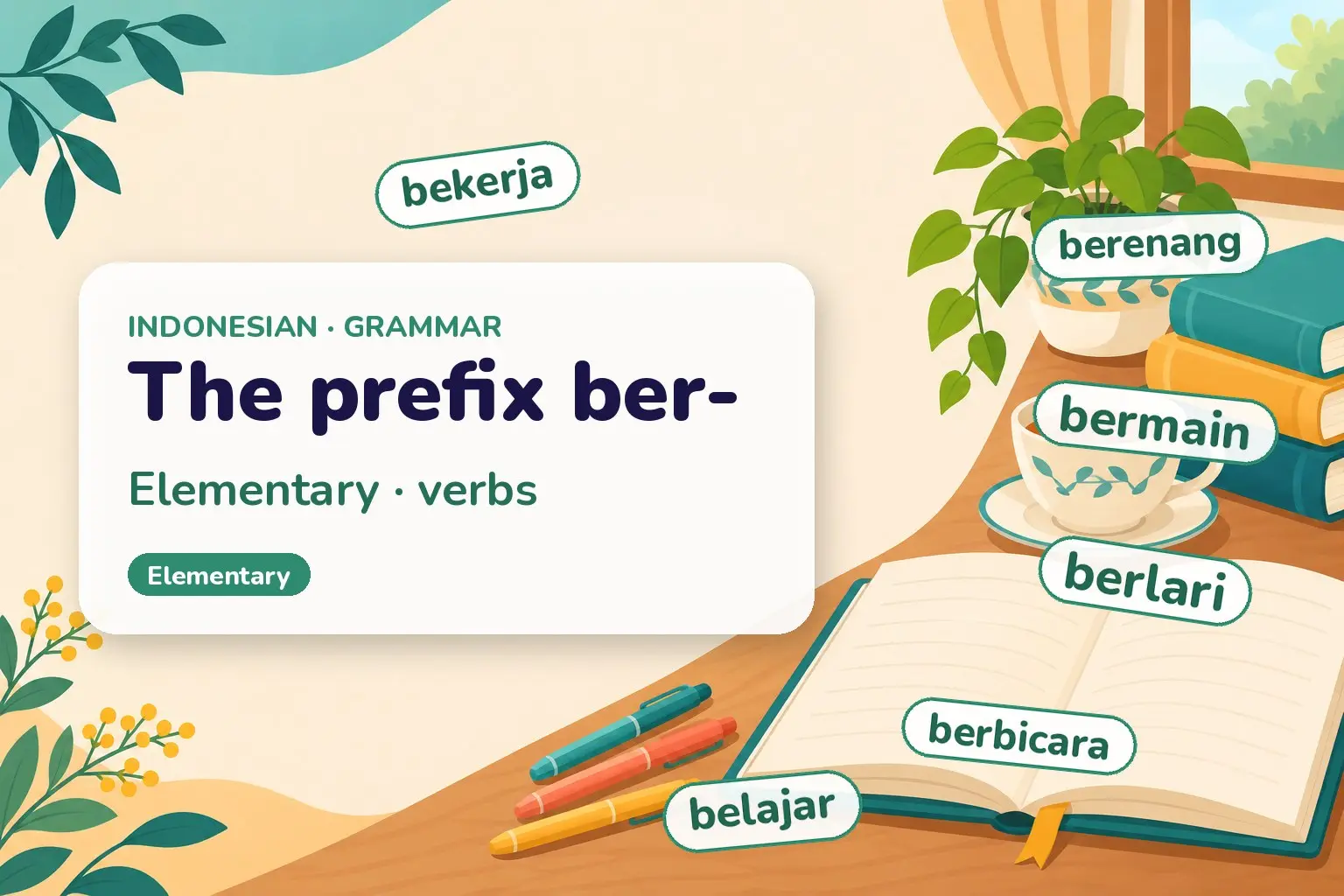
The prefix ber- turns a root into a mostly intransitive verb — one with no direct object — often meaning to have, do or wear: berbicara (to speak), bekerja (to work). The r shifts in a few words: ber- + ajar = belajar, ber- + renang = berenang.
Level: Elementary. Indonesian builds most of its verbs by adding a prefix to a root. The prefix ber- is the one for actions you do by yourself — speaking, working, swimming, travelling — and it is wonderfully regular.
The rule
A root is the bare word before any prefix, such as bicara (“speech / talk”). A prefix is a piece added to the front. Ber- attaches to a root and makes a verb that is almost always intransitive — a verb that does not take a direct object (you do not do it to something).
Bicara on its own is just the idea of “talk”; berbicara is the verb “to speak / to talk”. Dia berbicara (“He speaks”) is complete as it stands — no object is needed.
Ber- verbs carry a few related meanings, and the root usually tells you which:
- To do an activity: berolahraga (to exercise), berenang (to swim), berbelanja (to go shopping).
- To have / possess: beruang (to have money, from uang “money”), berkeluarga (to have a family).
- To wear: bertopi (to wear a hat, from topi), berbaju (to wear a shirt, from baju).
Forms — the three spellings of ber-
In the great majority of cases, ber- attaches with no change at all: just add it to the front. Three small adjustments cover the exceptions.
| Rule | When | Example |
|---|---|---|
| ber- (no change) | most roots | ber- + jalan → berjalan (to walk) |
| ber- (no change) | most roots | ber- + main → bermain (to play) |
| bel- | only the root ajar | ber- + ajar → belajar (to study) |
| be- (r dropped) | root begins with r | ber- + renang → berenang (to swim) |
| be- (r dropped) | r in the root’s first syllable | ber- + kerja → bekerja (to work) |
So the r changes to l in just one everyday word, belajar, and the r simply disappears when keeping it would give an awkward double r or a stutter of r-sounds, as in berenang and bekerja.
Example sentences
- Saya berbicara bahasa Inggris.I speak English.berbicara, no object needed
- Dia bekerja di kantor.She works in an office.ber- + kerja → bekerja (r dropped)
- Kami belajar bahasa Indonesia.We study Indonesian.ber- + ajar → belajar (r → l)
- Anak-anak berenang di kolam.The children swim in the pool.ber- + renang → berenang (r dropped)
- Mereka bermain sepak bola.They play football.ber- + main → bermain
- Saya berjalan ke sekolah.I walk to school.berjalan, intransitive
- Dia berlari setiap pagi.He runs every morning.berlari (to run, oneself)
- Kita beristirahat sebentar.We rest for a moment.beristirahat (to rest)
- Ibu berbelanja di pasar.Mum is shopping at the market.berbelanja (to shop)
- Mereka bertemu di kafe.They meet at the cafe.bertemu (to meet)
- Saya berolahraga tiga kali seminggu.I exercise three times a week.berolahraga (to do sport)
- Dia bertopi merah.He is wearing a red hat.ber- + topi → bertopi (to wear)
- Keluarga kami berlibur di Bali.Our family is on holiday in Bali.berlibur (to holiday)
- Anak itu berbahasa Jawa.That child speaks Javanese.berbahasa (to speak a language)
- Mereka bernyanyi bersama.They sing together.bernyanyi (to sing)
- Saya berpikir tentang masa depan.I think about the future.berpikir (to think)
- Dia berangkat jam tujuh.She departs at seven o'clock.berangkat (to depart)
- Kucing itu berbulu putih.That cat has white fur.ber- + bulu → berbulu (to have)
- Kami berdiskusi tentang rencana.We discuss the plan.berdiskusi (to have a discussion)
- Dia berhenti di depan rumah.He stops in front of the house.berhenti (to stop)
Common mistakes
- ❌ Saya berajar bahasa Indonesia. → ✅ Saya belajar bahasa Indonesia. With the root ajar, ber- becomes bel-: belajar.
- ❌ Dia berkerja di kantor. → ✅ Dia bekerja di kantor. The root kerja has r in its first syllable, so the prefix drops its r: bekerja.
- ❌ Anak-anak berrenang. → ✅ Anak-anak berenang. A double r is avoided; ber- + renang gives berenang.
- ❌ Saya berbicara dia. → ✅ Saya berbicara dengan dia. Ber- verbs take no direct object; add a preposition like dengan (“with”).
- ❌ Dia membekerja. → ✅ Dia bekerja. Do not stack prefixes; a root takes ber- OR me-, not both.
A short conversation
— Apa kabar? Kamu sedang apa? (How are you? What are you doing?) — Saya sedang belajar bahasa Indonesia. (I’m studying Indonesian.) — Bagus! Saya bekerja di pagi hari dan berolahraga sore ini. (Great! I work in the morning and exercise this afternoon.) — Mau berenang bersama nanti? (Want to swim together later?)
Spot the three tricky spellings in action: belajar, bekerja and berenang.
Usage notes
- sedang + ber- verb = right now. To say an action is in progress, put sedang (“in the middle of”) before the verb: Saya sedang berbicara (“I’m speaking right now”).
- Many ber- verbs come from nouns. topi (hat) → bertopi (to wear a hat); uang (money) → beruang (to have money); keluarga (family) → berkeluarga (to have a family). The meaning is “to have / wear / be equipped with” the noun.
- In casual speech the prefix is sometimes dropped. You may hear Saya kerja instead of Saya bekerja. This is informal; in careful or written Indonesian, keep the prefix.
- A tiny third-spelling note: with a very small number of roots beginning with the same pattern, the rule stays the same — when in doubt, the official dictionary (KBBI) lists the standard form.
Compared with…
- The prefix me- (transitive verbs): me- (and its spelling variants mem-, men-, meng-, meny-, menge-) builds verbs that do take a direct object. Compare berbicara (“to speak”, intransitive) with membicarakan sesuatu (“to discuss something”, transitive). If the English verb needs an object, reach for a me- verb. The me- family is covered in the Indonesian grammar section.
- The bare root alone: some roots are already complete verbs in casual use (makan “to eat”, minum “to drink”, pergi “to go”) and take no prefix at all. Ber- adds the “do-it-yourself / have / wear” flavour to roots that need it.
How to say it
Indonesian spelling is phonetic — say every letter — but a few sounds differ from English:
- c is always “ch”: berbicara ≈ “ber-bee-CHA-ra”, bercakap ≈ “ber-CHA-kap”.
- e has two values: a clear “eh” (bekerja ≈ “be-KER-ja”) and a weak “uh” (the first e in berenang is the “uh” schwa).
- r is lightly rolled or tapped, as in Spanish: let it flap once in berlari.
- ng is the “-ng” of “singer”, never “n-g”: berenang ends “-nang”, bernyanyi has the “ny” of “canyon”.
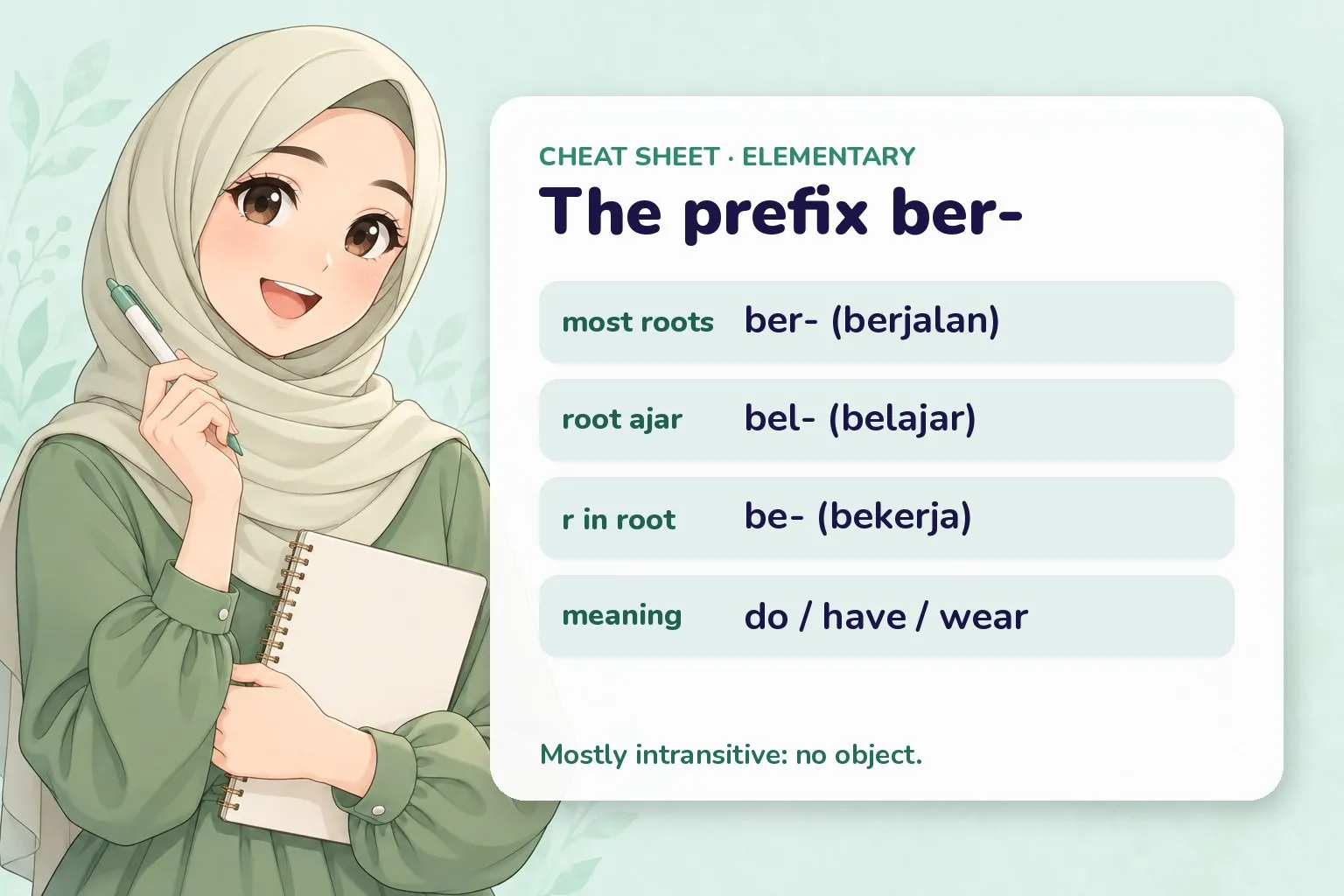
Quick recap before the quiz.
Practice
Prefix ber- practice
Try each one, then press Check. No sign-up, nothing is sent anywhere — it all runs in your browser.
Hint: avoid the double r
Show answer
berenang — ber- + renang drops one r: berenang.
Hint: root: bicara
Show answer
berbicara — berbicara is the intransitive 'to speak'.
5 Build: 'The children swim in the pool.'
Show answer
Anak-anak berenang di kolam — Subject, verb, then the place phrase di kolam.
6 Match each ber- verb to its meaning.
- berjalan
- bekerja
- belajar
- bermain
Show answer
- berjalan → to walk
- bekerja → to work
- belajar → to study
- bermain → to play
Four everyday ber- verbs, two of them with the dropped/changed r.
Quiz
Indonesian prefix ber-
12 questions · pick an answer and you'll see straight away if it's right.
-
Show answer
intransitive (no object) — ber- builds mostly intransitive verbs.
-
Show answer
belajar — Only with ajar does the r turn into l: belajar.
-
Show answer
bekerja — The r drops before a root with r in the first syllable: bekerja.
-
Show answer
berenang — One r is dropped to avoid a double r: berenang.
-
Show answer
Saya berbicara dengan dia. — ber- verbs need a preposition before a person: berbicara dengan dia.
-
Show answer
to play — ber- + main (play) → bermain.
-
Show answer
to have money — ber- + uang = to have money; the activity/have meaning of ber-.
-
Show answer
me- — me- builds transitive verbs; ber- is intransitive.
-
Show answer
to wear a hat — ber- + topi (hat) = to wear a hat; the 'wear' meaning.
-
Show answer
bekerja — ber- + kerja drops the r: bekerja.
-
Show answer
Saya kerja — Informally the prefix may drop: Saya kerja; keep it in careful Indonesian.
-
Show answer
sedang — sedang marks an action in progress: sedang berbicara.
Recap cheat-sheet
| Form | When | Example |
|---|---|---|
| ber- | most roots | berjalan, bermain |
| bel- | root = ajar | belajar |
| be- (r dropped) | root starts with r | berenang |
| be- (r dropped) | r in first syllable | bekerja |
| meaning | do / have / wear | berlari, beruang, bertopi |
Next
- The verbs that take an object: the me- prefix in the Indonesian grammar section
- Build sentences: Indonesian word order
- The pronouns you use with these verbs: Indonesian personal pronouns
- New here? Start Learning Indonesian Here
All Indonesian grammar topics
Every grammar point in order, from your first sentence to advanced structures. Pick one and go straight to it. New lessons go live every day, so topics marked Coming soon fill in over the next weeks.
Grammar path
Beginner 18 topics · 18 ready
- 01 Indonesian Personal Pronouns
- 02 Basic Word Order (Subject-Verb-Object)
- 03 Sentences Without 'To Be'
- 04 Noun + Adjective Order
- 05 Possession (Noun + Owner)
- 06 Plurals and Reduplication
- 07 Yes/No Questions (apakah, intonation)
- 08 Question Words (apa, siapa, di mana)
- 09 Negation: tidak vs bukan
- 10 Demonstratives (ini, itu)
- 11 Numbers and Classifiers
- 12 Common Prepositions (di, ke, dari)
- 13 Existence and 'Have' with ada / punya
- 14 Manner Deixis (begini, begitu) & sini/situ/sana
- 15 Particles -lah, -kah, -pun
- 16 Question Tags (kan, ya, bukan)
- 17 Adverbs of Frequency (selalu, sering, kadang)
- 18 Telling the Time
Elementary 24 topics · 3 ready
- 19 The Prefix ber- You are here
- 20 The Prefix meN- (Active Transitive)
- 21 The Passive with di-
- 22 Agent-Focus Passive (Pronoun + Verb) Coming soon
- 23 Aspect Markers (sudah, sedang, akan, belum, masih) Coming soon
- 24 Modal Words (bisa, boleh, harus, mau, ingin) Coming soon
- 25 Comparatives and Superlatives Coming soon
- 26 Ordinal Numbers and Dates Coming soon
- 27 Basic Conjunctions (dan, tetapi, atau, karena) Coming soon
- 28 Imperatives and Requests Coming soon
- 29 Adverbs and Intensifiers (sangat, sekali, agak) Coming soon
- 30 Only / Just (hanya, cuma, saja) Coming soon
- 31 Again / Still / More (lagi, masih, tambah) Coming soon
- 32 Experience (pernah, belum pernah) Coming soon
- 33 Purpose Clauses (untuk, supaya, agar) Coming soon
- 34 Cause Clauses (karena, sebab, gara-gara) Coming soon
- 35 Quantifiers (semua, setiap, beberapa, banyak) Coming soon
- 36 Complement Clauses with bahwa Coming soon
- 37 The Suffix -an (Result Nouns) Coming soon
- 38 The Prefix ke- (ketua, kekasih) Coming soon
- 39 Adverbial -nya (biasanya, sebenarnya) Coming soon
- 40 The Clitic -nya as a Definite Marker Coming soon
- 41 Sequencing (lalu, kemudian, setelah itu) Coming soon
- 42 Before & After (sebelum, setelah, sesudah) Coming soon
Intermediate 20 topics
- 43 The meN-...-kan Construction Coming soon
- 44 The meN-...-i Construction Coming soon
- 45 Nominalising Affixes (pe-, pe-an, per-an, ke-an) Coming soon
- 46 The Prefix ter- (Accidental/Superlative/Stative) Coming soon
- 47 The Prefix se- (One/Same/As) Coming soon
- 48 Relative Clauses with yang Coming soon
- 49 Subordinating Conjunctions (jika, meskipun) Coming soon
- 50 Types of Reduplication Coming soon
- 51 Classifiers and Quantity Expressions Coming soon
- 52 Passive Register (di- vs ter- vs ke-an) Coming soon
- 53 Reciprocal (saling, satu sama lain) Coming soon
- 54 Intensive & Reflexive (diri, sendiri) Coming soon
- 55 Correlative Conjunctions (baik...maupun) Coming soon
- 56 Degree (terlalu, cukup, kurang) Coming soon
- 57 The More...The More (makin, semakin) Coming soon
- 58 Simultaneous Actions (sambil, selagi, sementara) Coming soon
- 59 The Prefix memper- (Causative) Coming soon
- 60 ke-...-an Adversative Verbs (kehujanan) Coming soon
- 61 The Frame se-...-nya (sebaiknya, secepatnya) Coming soon
- 62 Compound Words (kata majemuk) Coming soon
Advanced 11 topics
- 63 Advanced Nominalisation & Formal Syntax Coming soon
- 64 Discourse Markers & Cohesion Coming soon
- 65 Formal (baku) vs Colloquial Indonesian Coming soon
- 66 Advanced Passive & Object Preposing Coming soon
- 67 Idiomatic & Layered Affixation Coming soon
- 68 Conditionals & Hypotheticals (seandainya, andai) Coming soon
- 69 Large Numbers, Fractions & Approximation Coming soon
- 70 Compound & Complex Sentences Coming soon
- 71 Topic, Focus & Cleft (yang...itu) Coming soon
- 72 Apposition and Appositive Clauses Coming soon
- 73 Restoring Dropped Affixes (Formal Writing) Coming soon