The Indonesian Prefix meN-: Active Transitive Verbs
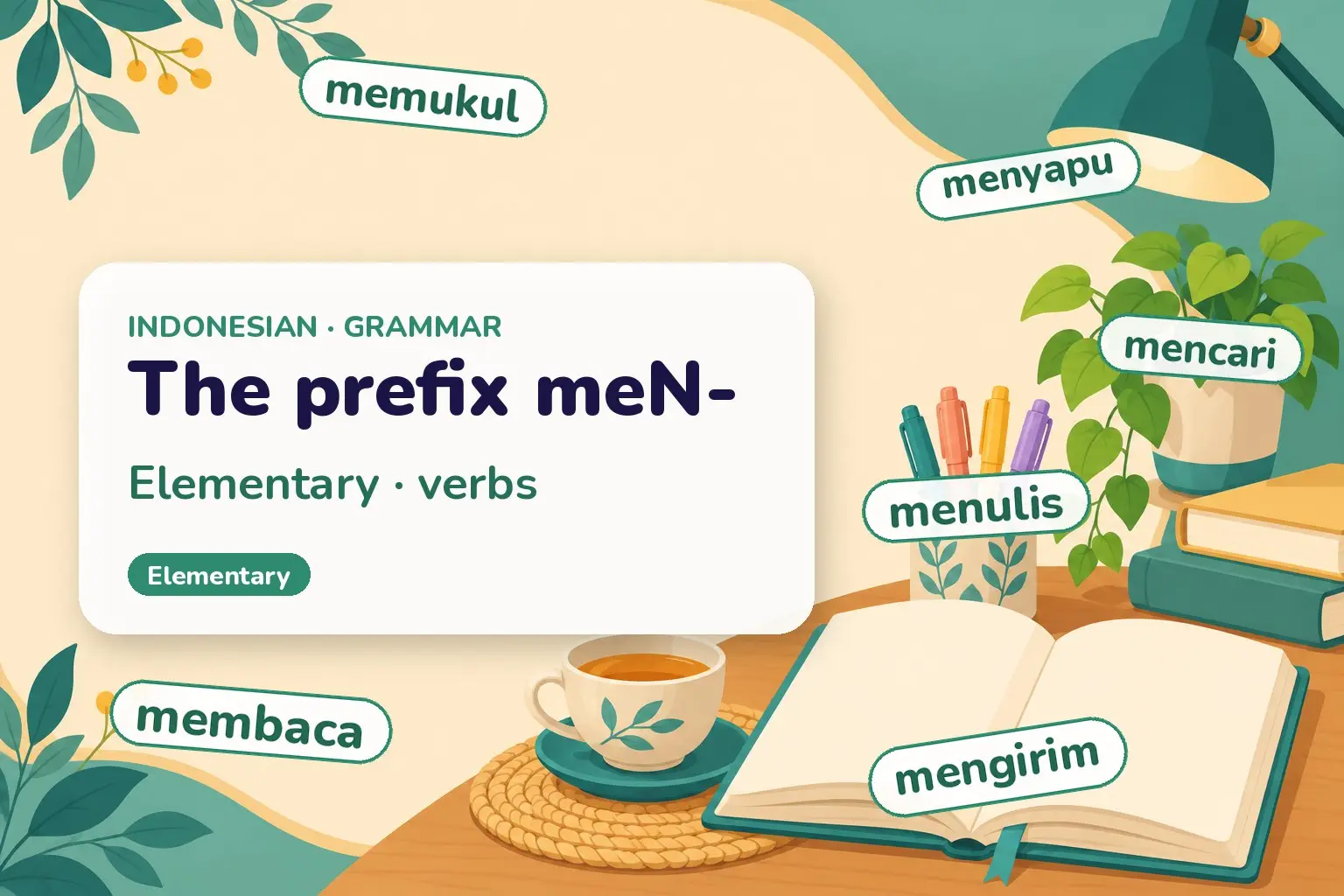
The prefix meN- builds active transitive verbs — ones that take an object: membaca buku (to read a book), menulis surat (to write a letter). Its nasal sound adapts to the root's first letter (mem-, men-, meny-, meng-, menge-), and an initial p, t, k or s is usually dropped.
Level: Elementary. The prefix meN- is the other half of Indonesian verb-building. Where ber- makes verbs you do by yourself, meN- makes verbs you do to something — and its one small complication is that it changes shape to fit the root.
The rule
A root is the bare word before any prefix, such as baca (“read”). A verb is transitive when it takes a direct object — something the action lands on: you read a book, write a letter, open a door. The prefix meN- turns a root into exactly that kind of active, transitive verb.
The capital N in meN- is a reminder that the prefix ends in a nasal sound that assimilates — it reshapes itself to match the first sound of the root. That gives five written forms: me-, mem-, men-, meny-, meng- and, for very short roots, menge-.
On top of that, four root-initial letters — p, t, k, s — are dropped (they “dissolve” into the nasal). This is the rule learners find trickiest, so it is worth meeting head-on: pukul → memukul, tulis → menulis, kirim → mengirim, sapu → menyapu.
Forms — how meN- changes shape
Pick the form from the root’s first sound. The dropped letters are shown in brackets.
| Form | Root begins with | Example |
|---|---|---|
| me- | l, m, n, r, w, y, ng, ny | me + lihat → melihat (to see) |
| mem- | b, f, v | mem + baca → membaca (to read) |
| mem- (p drops) | p | mem + (p)ukul → memukul (to hit) |
| men- | c, d, j, z | men + cari → mencari (to look for) |
| men- (t drops) | t | men + (t)ulis → menulis (to write) |
| meny- (s drops) | s | meny + (s)apu → menyapu (to sweep) |
| meng- | a, e, i, o, u, g, h | meng + ambil → mengambil (to take) |
| meng- (k drops) | k | meng + (k)irim → mengirim (to send) |
| menge- | one-syllable roots | menge + bom → mengebom (to bomb) |
So membaca keeps its b, but memukul has lost the p of pukul. Mencari keeps its c, but menulis has lost the t of tulis. The nasal always matches the place in the mouth where the root sound is made.
Example sentences
- Saya membaca buku setiap malam.I read a book every night.mem + baca → membaca; object buku
- Dia menulis surat untuk ibunya.She writes a letter to her mother.men + tulis → menulis (t drops)
- Kami mengirim paket ke Jakarta.We send a parcel to Jakarta.meng + kirim → mengirim (k drops)
- Ibu menyapu lantai.Mum sweeps the floor.meny + sapu → menyapu (s drops)
- Anak itu memukul bola.That child hits the ball.mem + pukul → memukul (p drops)
- Saya melihat gunung dari jendela.I see the mountain from the window.me + lihat → melihat (no change)
- Mereka mencari kunci yang hilang.They look for the lost key.men + cari → mencari
- Dia membeli sayur di pasar.He buys vegetables at the market.mem + beli → membeli (b stays)
- Kita mendengar musik bersama.We listen to music together.men + dengar → mendengar (d stays)
- Guru menggambar peta di papan.The teacher draws a map on the board.meng + gambar → menggambar (g stays)
- Saya mengambil air dari dapur.I take water from the kitchen.meng + ambil → mengambil (vowel)
- Ayah memotong rumput pagi ini.Dad cuts the grass this morning.mem + potong → memotong (p drops)
- Dia menanya alamat rumah saya.She asks for my home address.men + tanya → menanya (t drops)
- Kami menyewa mobil untuk liburan.We rent a car for the holiday.meny + sewa → menyewa (s drops)
- Anak-anak menonton film kartun.The children watch a cartoon.men + tonton → menonton (t drops)
- Saya menjual sepeda lama saya.I sell my old bicycle.men + jual → menjual (j stays)
- Dia menghitung uang di meja.He counts the money on the table.meng + hitung → menghitung (h stays)
- Mereka mengecat pagar rumah.They paint the house fence.menge + cat → mengecat (one-syllable root)
- Kami memasak nasi goreng.We cook fried rice.me + masak → memasak (m stays)
- Ibu menerima tamu di ruang tamu.Mum receives guests in the living room.men + terima → menerima (t drops)
Common mistakes
- ❌ Saya metulis surat. → ✅ Saya menulis surat. With a root starting in t, the prefix becomes men- and the t drops: menulis.
- ❌ Dia mekirim paket. → ✅ Dia mengirim paket. A k-root takes meng- and loses the k: mengirim.
- ❌ Ibu mesapu lantai. → ✅ Ibu menyapu lantai. An s-root takes meny- and drops the s: menyapu.
- ❌ Anak itu mempukul bola. → ✅ Anak itu memukul bola. The p of pukul dissolves; it is memukul, not mempukul.
- ❌ Saya membaca. (with nothing after it, meaning “I read it”) → ✅ Saya membacanya. or Saya membaca buku. A meN- verb normally needs an object; add one, or the suffix -nya (“it”).
- ❌ Saya menggambar peta written as mengambar peta → ✅ menggambar. A g-root keeps its g, so meng- + gambar has a double g: menggambar.
A short conversation
— Kamu sedang apa? (What are you doing?) — Saya sedang menulis surat dan membaca email. (I’m writing a letter and reading emails.) — Nanti bisa mengirim paket ini ke kantor pos? (Can you send this parcel to the post office later?) — Bisa. Saya juga mau membeli perangko di sana. (Sure. I also want to buy stamps there.)
Each verb has an object: menulis surat, membaca email, mengirim paket, membeli perangko — that is what makes them transitive.
Usage notes
- The object can be a noun or the suffix -nya. If the thing is already known, attach -nya (“it/them”) to the verb: Saya sudah membacanya (“I have already read it”). Otherwise name it: membaca koran.
- sedang + meN- verb = right now. Put sedang before the verb for an action in progress: Dia sedang menulis (“She is writing right now”).
- Many meN- verbs add -kan or -i for a fuller object. Membaca (“read”) vs membacakan (“read aloud to someone”); menulis (“write”) vs menuliskan (“write down for someone”). These suffixes fine-tune who or what the action is aimed at — a later topic once the base meN- is solid.
- In casual speech the prefix is often dropped. You may hear Saya baca koran instead of Saya membaca koran. This is informal; careful and written Indonesian keeps the full meN- form.
Compared with…
- The prefix ber- (intransitive): ber- builds verbs with no object — actions the subject does alone: berjalan (“to walk”), berenang (“to swim”). Compare berbicara (“to speak”, intransitive) with membicarakan sesuatu (“to discuss something”, transitive). If the English verb needs an object, reach for meN-. See the Indonesian prefix ber-.
- The passive prefix di-: the same transitive verb flips to passive by swapping meN- for di-: Saya menulis surat (“I write a letter”) becomes Surat ditulis (oleh) saya (“The letter is written by me”). The object of the active sentence becomes the subject of the passive one. The di- passive is a separate lesson in the Indonesian grammar section.
How to say it
Indonesian spelling is phonetic, but these points matter for meN- verbs:
- ng is the “-ng” of “singer”, one sound: mengirim ≈ “me-NGEE-rim”, menggambar has a hard g after it (“meng-GAM-bar”).
- ny is the “ny” of “canyon”: menyapu ≈ “me-NYA-poo”.
- c is always “ch”: mencari ≈ “men-CHA-ri”.
- e has two values: a weak “uh” schwa in the prefix me- and menge-, and a clearer “eh” in many roots: menerima ≈ “muh-nuh-REE-ma”.
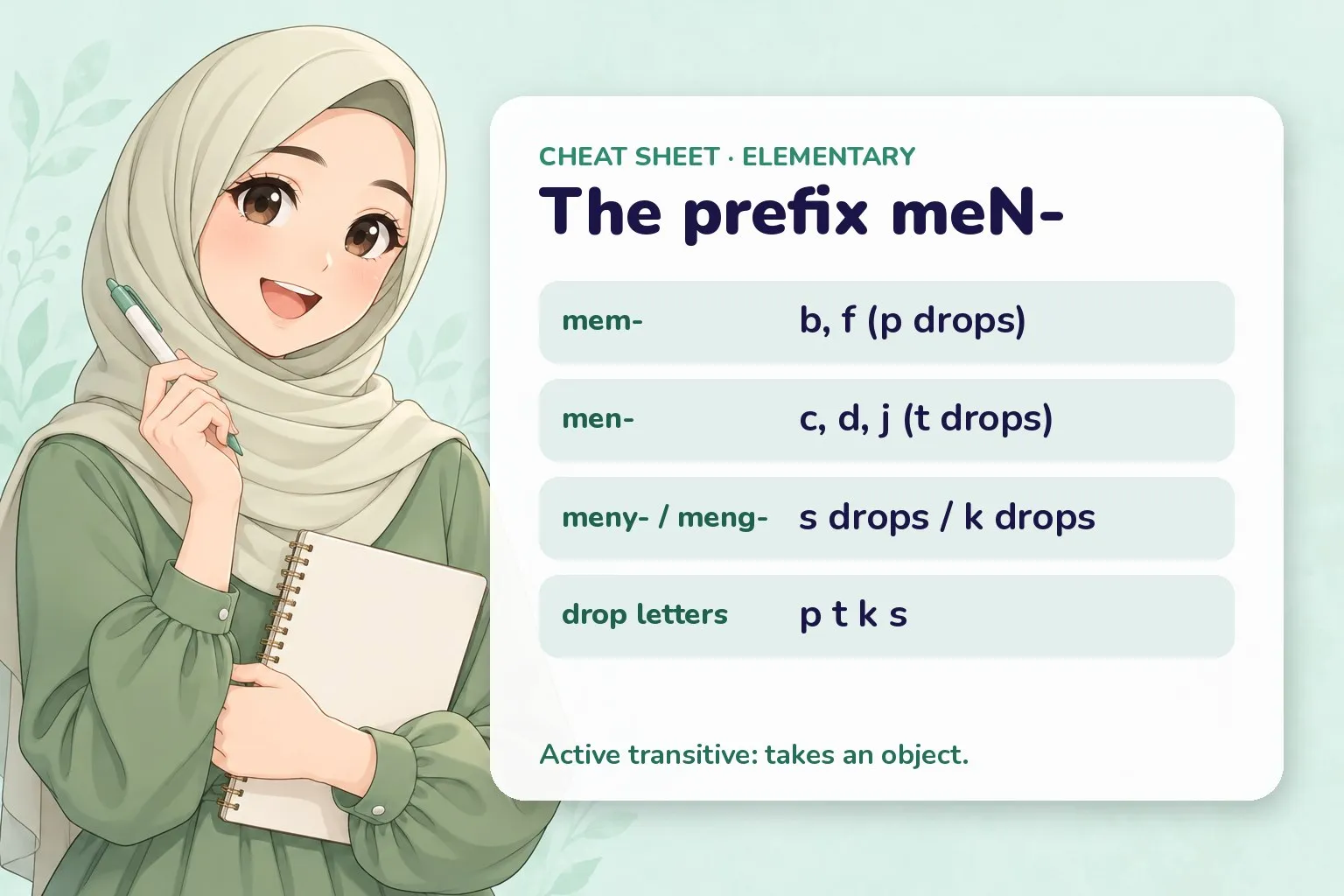
Quick recap before the quiz.
Practice
Prefix meN- practice
Try each one, then press Check. No sign-up, nothing is sent anywhere — it all runs in your browser.
Hint: s takes meny- and drops
Show answer
menyapu — meny- + sapu loses the s: menyapu.
Hint: b stays
Show answer
membaca — mem- + baca keeps the b: membaca.
5 Build: 'We send a parcel to Jakarta.'
Show answer
Kami mengirim paket ke Jakarta — Subject, meN- verb, object, then the place phrase.
6 Match each root to its meN- verb.
- baca
- tulis
- kirim
- sapu
Show answer
- baca → membaca
- tulis → menulis
- kirim → mengirim
- sapu → menyapu
Note which keep their first letter and which drop it.
Quiz
Indonesian prefix meN-
12 questions · pick an answer and you'll see straight away if it's right.
-
Show answer
transitive (take an object) — meN- builds active transitive verbs, which take a direct object.
-
Show answer
p, t, k, s — p, t, k and s dissolve into the nasal.
-
Show answer
memukul — The p of pukul drops: memukul.
-
Show answer
mencari — A c-root takes men- and the c stays: mencari.
-
Show answer
mengambil — A vowel-initial root takes meng-: mengambil.
-
Show answer
membeli (beli) — beli starts with b, which stays: membeli. The others start with t/s/k, which drop.
-
Show answer
to read — mem- + baca = to read.
-
Show answer
ber- — ber- builds intransitive verbs; meN- is transitive.
-
Show answer
di- — The passive swaps meN- for di-: Surat ditulis.
-
Show answer
menyapu — s-root → meny- and the s drops: menyapu.
-
Show answer
menge- — Monosyllabic roots take menge-: mengebom, mengecat.
-
Show answer
menggambar — A g-root takes meng- and the g stays, giving a double g: menggambar.
Recap cheat-sheet
| Form | Root starts with | Example |
|---|---|---|
| me- | l, m, n, r, w, y, ng, ny | melihat |
| mem- | b, f, v (p drops) | membaca, memukul |
| men- | c, d, j, z (t drops) | mencari, menulis |
| meny- | s (drops) | menyapu |
| meng- | vowels, g, h (k drops) | mengambil, mengirim |
| menge- | one-syllable roots | mengebom |
Next
- The intransitive partner: the Indonesian prefix ber-
- Build sentences: Indonesian word order
- The pronouns you use with these verbs: Indonesian personal pronouns
- New here? Start Learning Indonesian Here
All Indonesian grammar topics
Every grammar point in order, from your first sentence to advanced structures. Pick one and go straight to it. New lessons go live every day, so topics marked Coming soon fill in over the next weeks.
Grammar path
Beginner 18 topics · 18 ready
- 01 Indonesian Personal Pronouns
- 02 Basic Word Order (Subject-Verb-Object)
- 03 Sentences Without 'To Be'
- 04 Noun + Adjective Order
- 05 Possession (Noun + Owner)
- 06 Plurals and Reduplication
- 07 Yes/No Questions (apakah, intonation)
- 08 Question Words (apa, siapa, di mana)
- 09 Negation: tidak vs bukan
- 10 Demonstratives (ini, itu)
- 11 Numbers and Classifiers
- 12 Common Prepositions (di, ke, dari)
- 13 Existence and 'Have' with ada / punya
- 14 Manner Deixis (begini, begitu) & sini/situ/sana
- 15 Particles -lah, -kah, -pun
- 16 Question Tags (kan, ya, bukan)
- 17 Adverbs of Frequency (selalu, sering, kadang)
- 18 Telling the Time
Elementary 24 topics · 3 ready
- 19 The Prefix ber-
- 20 The Prefix meN- (Active Transitive) You are here
- 21 The Passive with di-
- 22 Agent-Focus Passive (Pronoun + Verb) Coming soon
- 23 Aspect Markers (sudah, sedang, akan, belum, masih) Coming soon
- 24 Modal Words (bisa, boleh, harus, mau, ingin) Coming soon
- 25 Comparatives and Superlatives Coming soon
- 26 Ordinal Numbers and Dates Coming soon
- 27 Basic Conjunctions (dan, tetapi, atau, karena) Coming soon
- 28 Imperatives and Requests Coming soon
- 29 Adverbs and Intensifiers (sangat, sekali, agak) Coming soon
- 30 Only / Just (hanya, cuma, saja) Coming soon
- 31 Again / Still / More (lagi, masih, tambah) Coming soon
- 32 Experience (pernah, belum pernah) Coming soon
- 33 Purpose Clauses (untuk, supaya, agar) Coming soon
- 34 Cause Clauses (karena, sebab, gara-gara) Coming soon
- 35 Quantifiers (semua, setiap, beberapa, banyak) Coming soon
- 36 Complement Clauses with bahwa Coming soon
- 37 The Suffix -an (Result Nouns) Coming soon
- 38 The Prefix ke- (ketua, kekasih) Coming soon
- 39 Adverbial -nya (biasanya, sebenarnya) Coming soon
- 40 The Clitic -nya as a Definite Marker Coming soon
- 41 Sequencing (lalu, kemudian, setelah itu) Coming soon
- 42 Before & After (sebelum, setelah, sesudah) Coming soon
Intermediate 20 topics
- 43 The meN-...-kan Construction Coming soon
- 44 The meN-...-i Construction Coming soon
- 45 Nominalising Affixes (pe-, pe-an, per-an, ke-an) Coming soon
- 46 The Prefix ter- (Accidental/Superlative/Stative) Coming soon
- 47 The Prefix se- (One/Same/As) Coming soon
- 48 Relative Clauses with yang Coming soon
- 49 Subordinating Conjunctions (jika, meskipun) Coming soon
- 50 Types of Reduplication Coming soon
- 51 Classifiers and Quantity Expressions Coming soon
- 52 Passive Register (di- vs ter- vs ke-an) Coming soon
- 53 Reciprocal (saling, satu sama lain) Coming soon
- 54 Intensive & Reflexive (diri, sendiri) Coming soon
- 55 Correlative Conjunctions (baik...maupun) Coming soon
- 56 Degree (terlalu, cukup, kurang) Coming soon
- 57 The More...The More (makin, semakin) Coming soon
- 58 Simultaneous Actions (sambil, selagi, sementara) Coming soon
- 59 The Prefix memper- (Causative) Coming soon
- 60 ke-...-an Adversative Verbs (kehujanan) Coming soon
- 61 The Frame se-...-nya (sebaiknya, secepatnya) Coming soon
- 62 Compound Words (kata majemuk) Coming soon
Advanced 11 topics
- 63 Advanced Nominalisation & Formal Syntax Coming soon
- 64 Discourse Markers & Cohesion Coming soon
- 65 Formal (baku) vs Colloquial Indonesian Coming soon
- 66 Advanced Passive & Object Preposing Coming soon
- 67 Idiomatic & Layered Affixation Coming soon
- 68 Conditionals & Hypotheticals (seandainya, andai) Coming soon
- 69 Large Numbers, Fractions & Approximation Coming soon
- 70 Compound & Complex Sentences Coming soon
- 71 Topic, Focus & Cleft (yang...itu) Coming soon
- 72 Apposition and Appositive Clauses Coming soon
- 73 Restoring Dropped Affixes (Formal Writing) Coming soon