Indonesian Question Tags: kan, ya, bukan
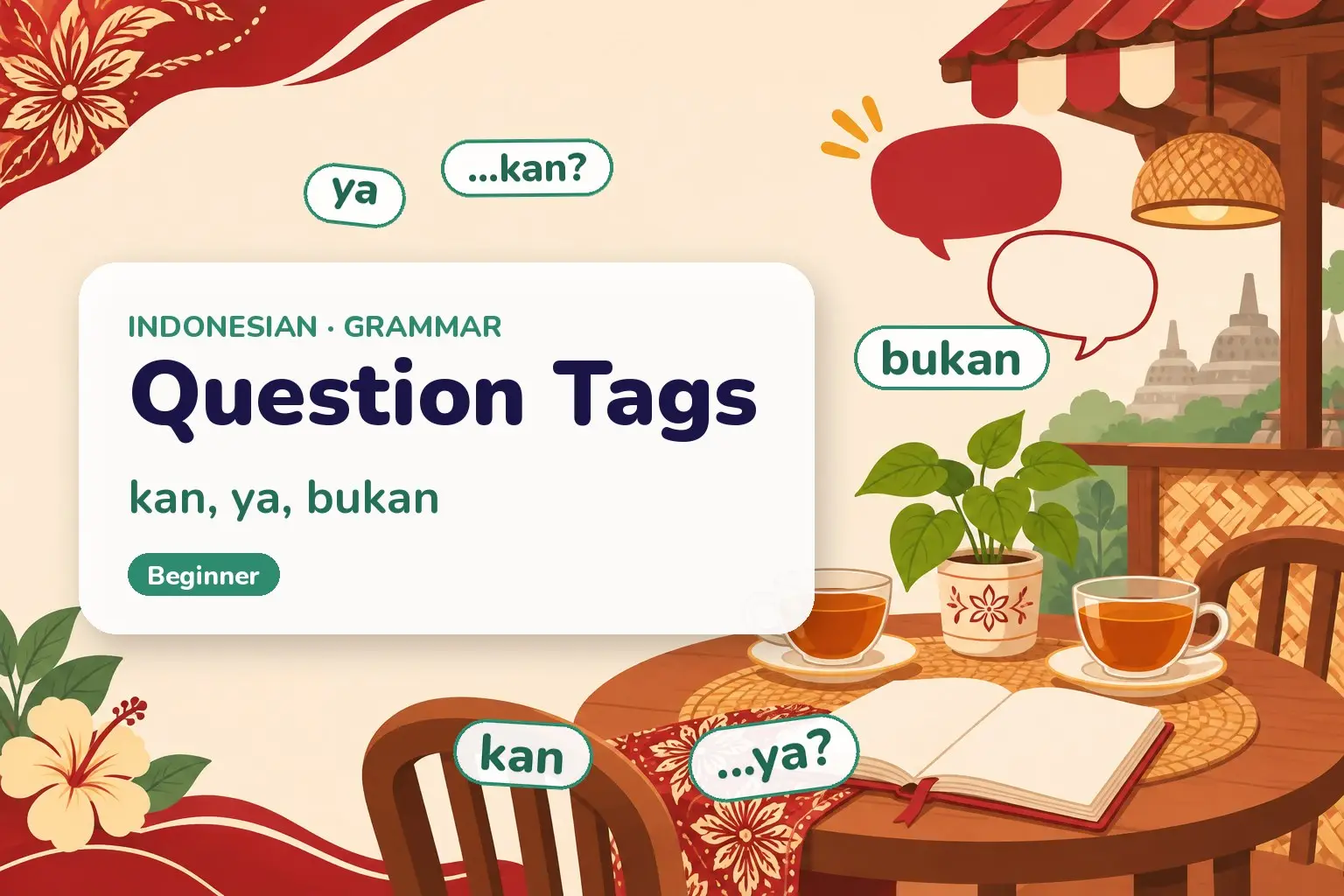
Indonesian turns a statement into a check with a short tag at the end: kan (right? / isn't it?), ya (okay? / yeah?) and bukan (isn't it?). They all ask the listener to agree, just like the English tag isn't it?
Level: Beginner. English checks a fact by tacking on a tag: “You’re coming, aren’t you?” Indonesian does the same thing, only far more simply — it adds one short, unchanging word to the end of a statement: kan, ya or bukan. There is no complicated matching to the verb; the same tag works for every sentence.
The rule
A question tag is a small word added to a statement to invite the listener to agree or confirm. English changes the tag to match the verb (is it, aren’t you, didn’t he). Indonesian keeps one fixed word, dropped onto the end of the sentence, usually after a comma:
- kan — “right? / isn’t it?”, the everyday tag. It assumes the listener already agrees. Kamu tahu, kan? (You know, right?)
- ya — “okay? / yeah?”, softer and warmer. It seeks gentle agreement or checks that something is fine. Besok kita pergi, ya? (We’ll go tomorrow, okay?)
- bukan — “isn’t it?”, the full, slightly more formal confirmation tag. Dia guru, bukan? (He’s a teacher, isn’t he?)
All three expect the answer yes. You are not opening a genuine question so much as asking the listener to nod along.
The three tags at a glance
| Tag | Rough English | Register | Example |
|---|---|---|---|
| kan | right? / isn’t it? | casual, everyday | Enak, kan? (Tasty, right?) |
| ya | okay? / yeah? | soft, friendly | Kita mulai, ya? (We’ll start, okay?) |
| bukan | isn’t it? | neutral, a bit formal | Ini rumahmu, bukan? (This is your house, isn’t it?) |
kan is simply a shortened form of bukan, which is why their meaning overlaps. In speech you will hear kan far more often; bukan? as a tag sounds more careful or polite.
bukan has two jobs — don’t mix them
The single biggest trap is that bukan is also the word for “not” in front of a noun. Same spelling, two completely different roles:
- Negator: Dia bukan guru. — He is not a teacher. (bukan sits before the noun)
- Tag: Dia guru, bukan? — He is a teacher, isn’t he? (bukan sits at the very end, after a comma, with a rising tone)
Position and intonation tell them apart: a negator comes before the noun; a tag comes last and rises.
Examples
- Kamu tahu, kan?You know, right?kan: assumes you agree
- Enak, kan?Tasty, isn't it?kan on an adjective
- Kita sudah bayar, kan?We already paid, didn't we?checking a shared fact
- Dia teman kamu, kan?She's your friend, right?kan after a noun phrase
- Besok libur, kan?Tomorrow is a holiday, right?confirming a plan
- Besok kita pergi, ya?We'll go tomorrow, okay?ya: soft, friendly
- Kita mulai sekarang, ya?We'll start now, okay?ya seeks gentle agreement
- Tunggu di sini, ya.Wait here, okay?ya softens an instruction
- Jangan lupa, ya.Don't forget, okay?ya warms a reminder
- Dia guru, bukan?He's a teacher, isn't he?bukan: formal tag
- Ini rumahmu, bukan?This is your house, isn't it?bukan after a noun
- Kamu orang Jakarta, bukan?You're from Jakarta, aren't you?polite confirmation
- Dia bukan guru.He is not a teacher.bukan as negator, before the noun
- Itu bukan punyaku.That is not mine.negator bukan, not a tag
- Kan sudah kubilang.I did tell you, didn't I?kan at the front for emphasis
- Mahal, ya?Expensive, huh?ya as a soft reaction
- Kamu capek, kan?You're tired, aren't you?guessing and checking
- Kita ketemu jam tujuh, ya?We'll meet at seven, okay?fixing a time gently
Common mistakes
- ❌ Dia bukan, guru? → ✅ Dia guru, bukan? As a tag, bukan goes at the very end, after the noun.
- ❌ Using bukan to tag an adjective’s truth, e.g. Enak, bukan? feels stiff → ✅ Enak, kan? For everyday adjectives and verbs, kan is the natural tag.
- ❌ Ya kamu tahu? meaning “you know, right?” → ✅ Kamu tahu, ya? The tag follows the statement; it does not lead it (except front-shifted kan).
A short conversation
— Kita ketemu besok, ya? — Iya. Di kafe yang kemarin, kan? — Betul. Kamu masih ingat tempatnya, bukan?
Each line adds a tag — ya to float the plan, kan to confirm the place, bukan? to double-check politely — and every reply is a simple yes.
Usage notes
- Register. kan and ya are the casual, spoken choices; bukan? sounds a little more formal or careful, good with people you do not know well.
- ya beyond questions. ya softens commands and requests into something friendlier: Pelan-pelan, ya (Take it slow, okay?). This is why it feels warm.
- Front-shifted kan. kan can move to the front to mean “but I already said / as you know”: Kan kamu yang minta (But you’re the one who asked).
- Punctuation. In writing, set the tag off with a comma and close with a question mark when it is a real check: Kamu ikut, kan?
Compared with…
- A full yes/no question uses apakah or just a rising tone on the whole sentence, and it is genuinely open: see Indonesian yes/no questions. A tag question, by contrast, already expects “yes”.
- bukan versus tidak as negators. When you actually want to say “not”, the choice between bukan (for nouns) and tidak (for verbs and adjectives) is a separate rule — review negation with tidak and bukan.
- To ask who, what, where and when instead of checking a fact, use the Indonesian question words.
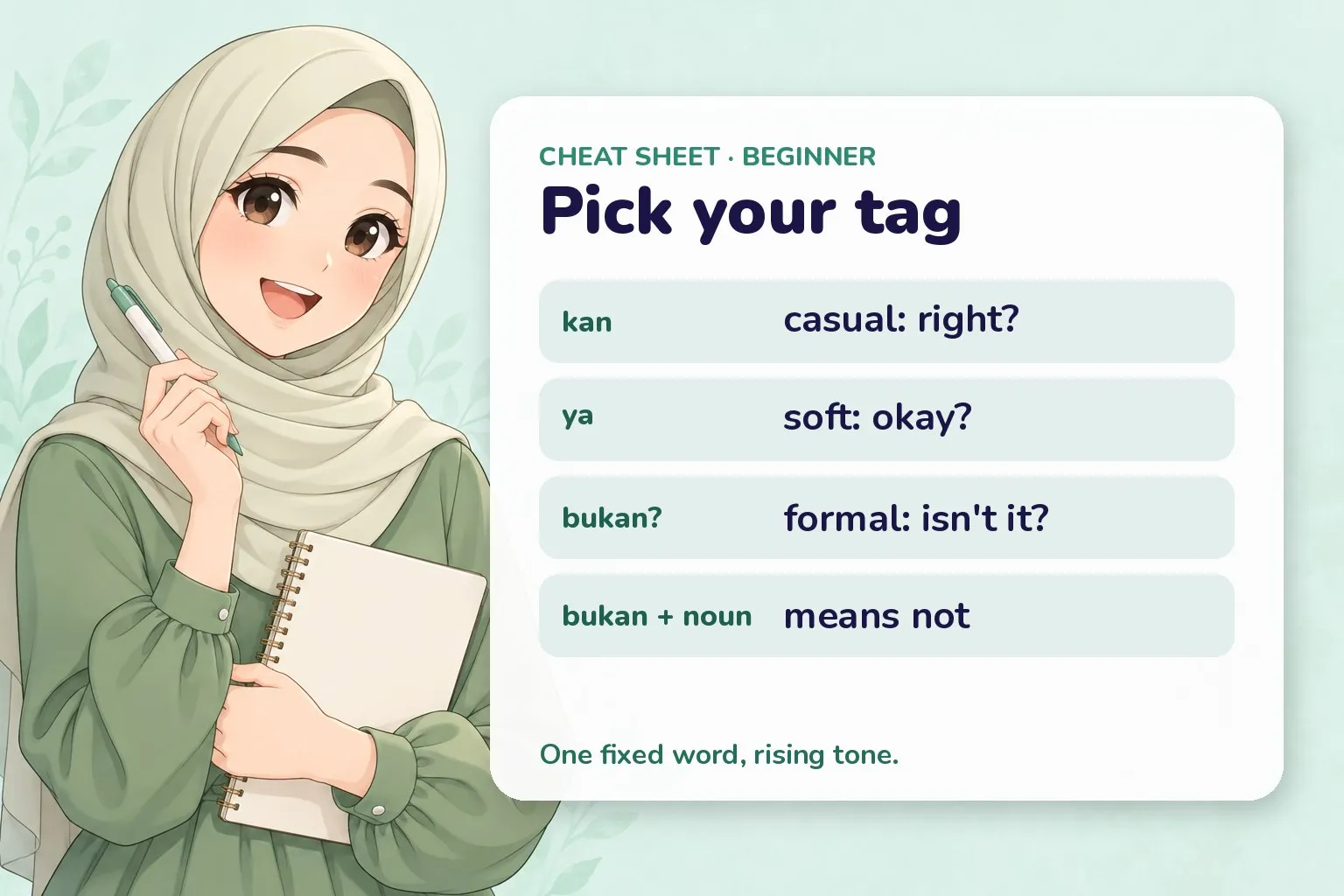
Quick recap before the quiz.
Practice
Question tags practice
Try each one, then press Check. No sign-up, nothing is sent anywhere — it all runs in your browser.
Hint: okay? / yeah?
Show answer
ya — ya is the soft, warm tag: Besok kita pergi, ya?
3 Match each tag to its feel.
- kan
- ya
- bukan
- tidak
Show answer
- kan → casual, right?
- ya → soft, okay?
- bukan → formal, isn't it?
- tidak → not a tag (means 'not')
kan casual, ya soft, bukan formal; tidak is a negator, never a tag.
5 Build the tag question: 'He's a teacher, isn't he?'
Show answer
Dia guru, bukan? — The tag bukan goes at the very end: Dia guru, bukan?
Quiz
Indonesian question tags
12 questions · pick an answer and you'll see straight away if it's right.
-
Show answer
ask the listener to agree — A tag invites confirmation — it expects 'yes'.
-
Show answer
kan — kan is the everyday spoken tag.
-
Show answer
bukan — kan comes from bukan, which is why they overlap in meaning.
-
Show answer
soft and friendly — ya is the soft, warm confirmation tag.
-
Show answer
the negator 'not' before a noun — Before a noun, bukan means 'not': 'He is not a teacher'.
-
Show answer
the tag 'isn't he?' — At the end, after a comma, bukan is the confirmation tag.
-
Show answer
tidak — tidak means 'not' for verbs/adjectives; it is not a tag.
-
Show answer
a bit formal / polite — bukan? sounds slightly more formal than kan.
-
Show answer
Wait here, okay? — ya softens the instruction: 'Wait here, okay?'.
-
Show answer
rising / questioning — A rising tone turns the tag into a real check.
-
Show answer
kan — kan (or bukan) checks a fact you both know: 'We already paid, right?'.
-
Show answer
I did tell you, didn't I? — Front-shifted kan means 'but I already said / as you know'.
Recap cheat-sheet
| Tag | Use it for | Feel |
|---|---|---|
| kan | checking a fact you both know | casual, everyday |
| ya | floating a plan, softening a request | warm, friendly |
| bukan? | polite confirmation at the end | a bit formal |
| bukan (before a noun) | saying “not” | negator, not a tag |
Next
- Ask real open questions: Indonesian yes/no questions
- Say “not” correctly: negation with tidak and bukan
- Back to the Indonesian grammar section
- New here? Start Learning Indonesian Here
All Indonesian grammar topics
Every grammar point in order, from your first sentence to advanced structures. Pick one and go straight to it. New lessons go live every day, so topics marked Coming soon fill in over the next weeks.
Grammar path
Beginner 18 topics · 18 ready
- 01 Indonesian Personal Pronouns
- 02 Basic Word Order (Subject-Verb-Object)
- 03 Sentences Without 'To Be'
- 04 Noun + Adjective Order
- 05 Possession (Noun + Owner)
- 06 Plurals and Reduplication
- 07 Yes/No Questions (apakah, intonation)
- 08 Question Words (apa, siapa, di mana)
- 09 Negation: tidak vs bukan
- 10 Demonstratives (ini, itu)
- 11 Numbers and Classifiers
- 12 Common Prepositions (di, ke, dari)
- 13 Existence and 'Have' with ada / punya
- 14 Manner Deixis (begini, begitu) & sini/situ/sana
- 15 Particles -lah, -kah, -pun
- 16 Question Tags (kan, ya, bukan) You are here
- 17 Adverbs of Frequency (selalu, sering, kadang)
- 18 Telling the Time
Elementary 24 topics · 3 ready
- 19 The Prefix ber-
- 20 The Prefix meN- (Active Transitive)
- 21 The Passive with di-
- 22 Agent-Focus Passive (Pronoun + Verb) Coming soon
- 23 Aspect Markers (sudah, sedang, akan, belum, masih) Coming soon
- 24 Modal Words (bisa, boleh, harus, mau, ingin) Coming soon
- 25 Comparatives and Superlatives Coming soon
- 26 Ordinal Numbers and Dates Coming soon
- 27 Basic Conjunctions (dan, tetapi, atau, karena) Coming soon
- 28 Imperatives and Requests Coming soon
- 29 Adverbs and Intensifiers (sangat, sekali, agak) Coming soon
- 30 Only / Just (hanya, cuma, saja) Coming soon
- 31 Again / Still / More (lagi, masih, tambah) Coming soon
- 32 Experience (pernah, belum pernah) Coming soon
- 33 Purpose Clauses (untuk, supaya, agar) Coming soon
- 34 Cause Clauses (karena, sebab, gara-gara) Coming soon
- 35 Quantifiers (semua, setiap, beberapa, banyak) Coming soon
- 36 Complement Clauses with bahwa Coming soon
- 37 The Suffix -an (Result Nouns) Coming soon
- 38 The Prefix ke- (ketua, kekasih) Coming soon
- 39 Adverbial -nya (biasanya, sebenarnya) Coming soon
- 40 The Clitic -nya as a Definite Marker Coming soon
- 41 Sequencing (lalu, kemudian, setelah itu) Coming soon
- 42 Before & After (sebelum, setelah, sesudah) Coming soon
Intermediate 20 topics
- 43 The meN-...-kan Construction Coming soon
- 44 The meN-...-i Construction Coming soon
- 45 Nominalising Affixes (pe-, pe-an, per-an, ke-an) Coming soon
- 46 The Prefix ter- (Accidental/Superlative/Stative) Coming soon
- 47 The Prefix se- (One/Same/As) Coming soon
- 48 Relative Clauses with yang Coming soon
- 49 Subordinating Conjunctions (jika, meskipun) Coming soon
- 50 Types of Reduplication Coming soon
- 51 Classifiers and Quantity Expressions Coming soon
- 52 Passive Register (di- vs ter- vs ke-an) Coming soon
- 53 Reciprocal (saling, satu sama lain) Coming soon
- 54 Intensive & Reflexive (diri, sendiri) Coming soon
- 55 Correlative Conjunctions (baik...maupun) Coming soon
- 56 Degree (terlalu, cukup, kurang) Coming soon
- 57 The More...The More (makin, semakin) Coming soon
- 58 Simultaneous Actions (sambil, selagi, sementara) Coming soon
- 59 The Prefix memper- (Causative) Coming soon
- 60 ke-...-an Adversative Verbs (kehujanan) Coming soon
- 61 The Frame se-...-nya (sebaiknya, secepatnya) Coming soon
- 62 Compound Words (kata majemuk) Coming soon
Advanced 11 topics
- 63 Advanced Nominalisation & Formal Syntax Coming soon
- 64 Discourse Markers & Cohesion Coming soon
- 65 Formal (baku) vs Colloquial Indonesian Coming soon
- 66 Advanced Passive & Object Preposing Coming soon
- 67 Idiomatic & Layered Affixation Coming soon
- 68 Conditionals & Hypotheticals (seandainya, andai) Coming soon
- 69 Large Numbers, Fractions & Approximation Coming soon
- 70 Compound & Complex Sentences Coming soon
- 71 Topic, Focus & Cleft (yang...itu) Coming soon
- 72 Apposition and Appositive Clauses Coming soon
- 73 Restoring Dropped Affixes (Formal Writing) Coming soon