Telling the Time in Indonesian
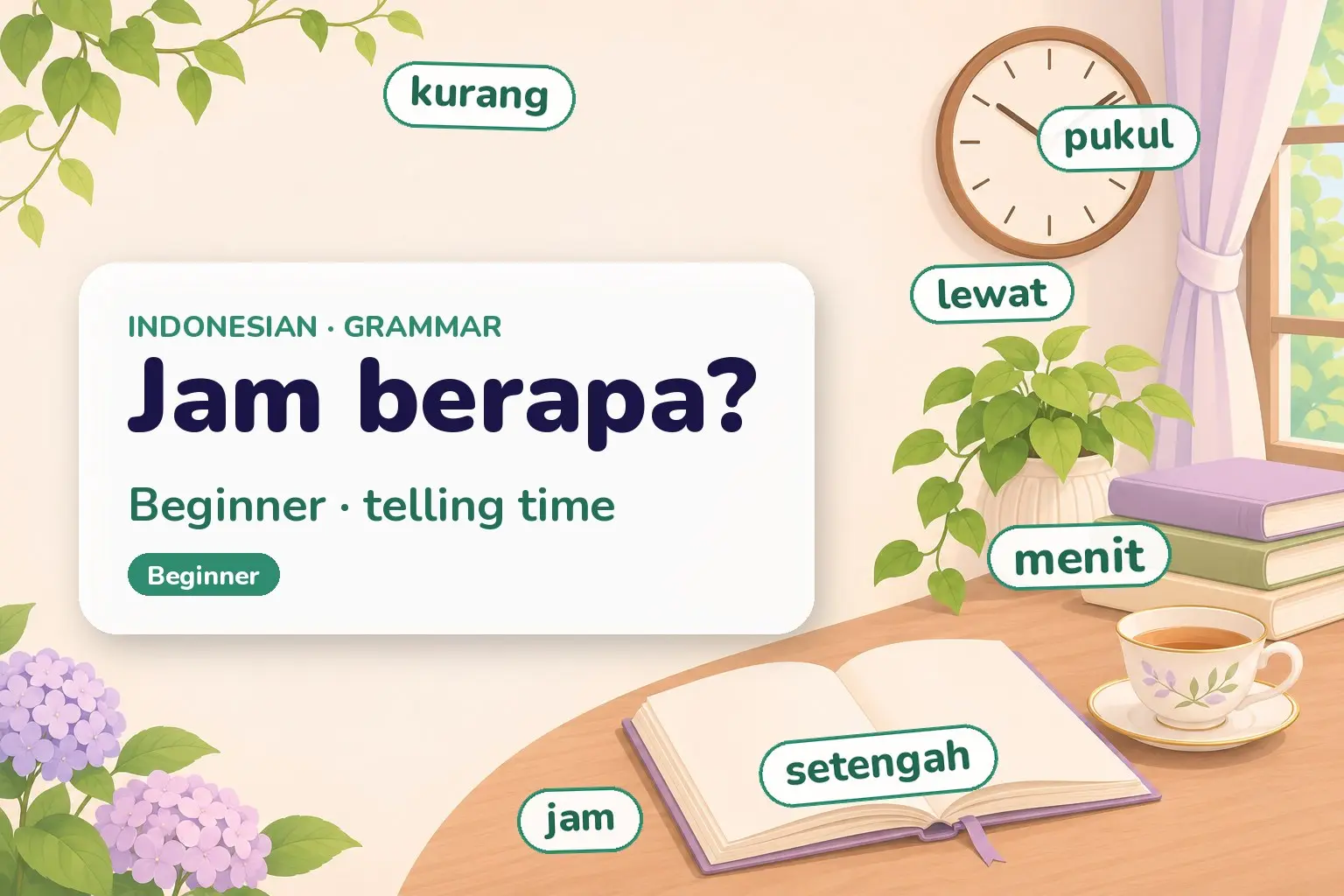
To tell the time in Indonesian, use jam or the more formal pukul plus a number: jam tiga is 3 o'clock. Add lewat for minutes past and kurang for minutes to the hour, and add pagi, siang, sore or malam to show the part of the day.
Level: Beginner. Telling the time in Indonesian needs just a few building blocks: a word for “o’clock”, your numbers, and three little words for past, to and half. The only real surprise is how setengah (“half”) works — so we meet it head-on.
The rule
There are two words for the clock. jam is the everyday word; pukul is a little more formal and is used in announcements, schedules and polite speech. Both are followed by a number: jam tiga and pukul tiga both mean “3 o’clock”.
To ask the time, use berapa (“how many / what”): Jam berapa? or Pukul berapa? (“What time is it?”). To answer, give the hour, then add minutes if you need them:
- lewat means “past”: jam tiga lewat sepuluh = “ten past three” (3:10).
- kurang means “to / less”: jam empat kurang sepuluh = “ten to four” (3:50).
- setengah means “half”: setengah empat = “half to four” = 3:30.
The unit word menit (“minute”) is often added for clarity: jam tiga lewat sepuluh menit.
The pieces in a table
| Indonesian | Meaning | Example | Time |
|---|---|---|---|
| jam / pukul | o’clock | jam lima | 5:00 |
| lewat | past | jam lima lewat lima | 5:05 |
| kurang | to (before) | jam lima kurang lima | 4:55 |
| setengah | half (to the next hour) | setengah enam | 5:30 |
| menit | minute | lewat dua puluh menit | twenty past |
| seperempat | quarter | jam lima lewat seperempat | 5:15 |
The setengah trap
This is the one point everyone gets wrong at first. setengah points at the hour that is coming, not the one that has passed. setengah tiga is “half of the way to three”, which is 2:30 — not 3:30.
So:
- setengah dua = 1:30 (halfway to two)
- setengah tiga = 2:30 (halfway to three)
- setengah tujuh = 6:30 (halfway to seven)
Parts of the day
Indonesian has no a.m. or p.m. Instead you name the stretch of day after the time:
- pagi — morning (roughly from dawn to about 11)
- siang — midday / early afternoon (about 11 to 15)
- sore — late afternoon (about 15 to 18)
- malam — evening / night (after about 18)
So jam tujuh pagi is 7 a.m. and jam tujuh malam is 7 p.m. For timetables and official notices, Indonesian also uses the 24-hour clock with pukul and digits: pukul 07.00, pukul 19.00 (note the dot, not a colon).
Example sentences
- Jam berapa sekarang?What time is it now?jam berapa = what time
- Sekarang jam tiga.It's three o'clock now.jam + number
- Pukul sembilan pagi.Nine in the morning.pukul = formal 'o'clock'
- Jam lima lewat sepuluh.Ten past five (5:10).lewat = past
- Jam enam kurang lima.Five to six (5:55).kurang = to
- Setengah empat.Half past three (3:30).setengah = halfway to four
- Setengah dua.Half past one (1:30).the classic trap: toward two
- Jam tujuh pagi.Seven in the morning (7 a.m.).pagi = morning
- Jam satu siang.One in the afternoon (1 p.m.).siang = midday
- Jam empat sore.Four in the afternoon (4 p.m.).sore = late afternoon
- Jam delapan malam.Eight at night (8 p.m.).malam = night
- Kereta berangkat pukul 07.00.The train leaves at 07:00.24-hour clock with pukul
- Film mulai jam setengah sembilan.The film starts at 8:30.setengah sembilan = toward nine
- Saya bangun jam enam.I get up at six.jam + number after a verb
- Dia tidur selama delapan jam.She slept for eight hours.delapan jam = eight hours
- Jam makan siang pukul dua belas.Lunchtime is at twelve.dua belas = twelve
- Jam tiga lewat seperempat.Quarter past three (3:15).seperempat = quarter
- Sampai jumpa jam sepuluh.See you at ten.jam sepuluh = ten o'clock
- Rapat dimulai pukul 14.30.The meeting starts at 14:30.formal 24-hour time
- Sekarang jam berapa di Jakarta?What time is it in Jakarta now?asking elsewhere's time
Common mistakes
- ❌ setengah dua = 2:30 → ✅ setengah dua = 1:30. The half counts toward dua (two), so it is one-thirty.
- ❌ jam dua for “two hours” → ✅ dua jam. The number comes first for a duration: dua jam = two hours; jam dua = two o’clock.
- ❌ jam tiga kurang sepuluh meaning 3:10 → ✅ use lewat: jam tiga lewat sepuluh = 3:10. kurang means “to”, so jam tiga kurang sepuluh is 2:50.
- ❌ jam tujuh AM → ✅ jam tujuh pagi. There is no “AM/PM”; name the part of the day instead.
- ❌ pukul 7:00 with a colon → ✅ pukul 07.00. Indonesian writes 24-hour times with a dot.
A short conversation
— Jam berapa kita bertemu? (What time shall we meet?) — Setengah tujuh, ya? (Six-thirty, okay?) — Pagi atau malam? (Morning or evening?) — Malam. Jam setengah tujuh malam, di depan bioskop. (Evening. Six-thirty p.m., in front of the cinema.)
Notice setengah tujuh = 6:30 (toward seven) and how malam fixes it as the evening, not the morning.
Usage notes
- Numbers you need. Time uses your basic numbers: satu, dua, tiga, empat, lima, enam, tujuh, delapan, sembilan, sepuluh, sebelas, dua belas. If these are shaky, review the counting page before drilling times.
- lebih is an informal “lewat”. In casual speech some speakers say jam tiga lebih (“a bit past three”); lewat is the clearer, standard choice.
- Round first, then refine. Native speakers often give the nearest convenient point — jam tiga, setengah empat — and only add lewat/kurang when precision matters.
- tepat means “exactly”. jam tiga tepat = “three o’clock sharp”.
Compared with…
- Plain counting: every time expression rides on the cardinal numbers and the quantity word jam. If setengah or seperempat feel odd, they are just the fraction words sitting in front of a number — see how counting and measure words behave in Indonesian numbers and classifiers.
- Asking and placing: questions about time use berapa (“how many/what”), and appointments usually pair with a place or a preposition. Review the question words in Indonesian question words and location words such as di, ke, dari in Indonesian prepositions.
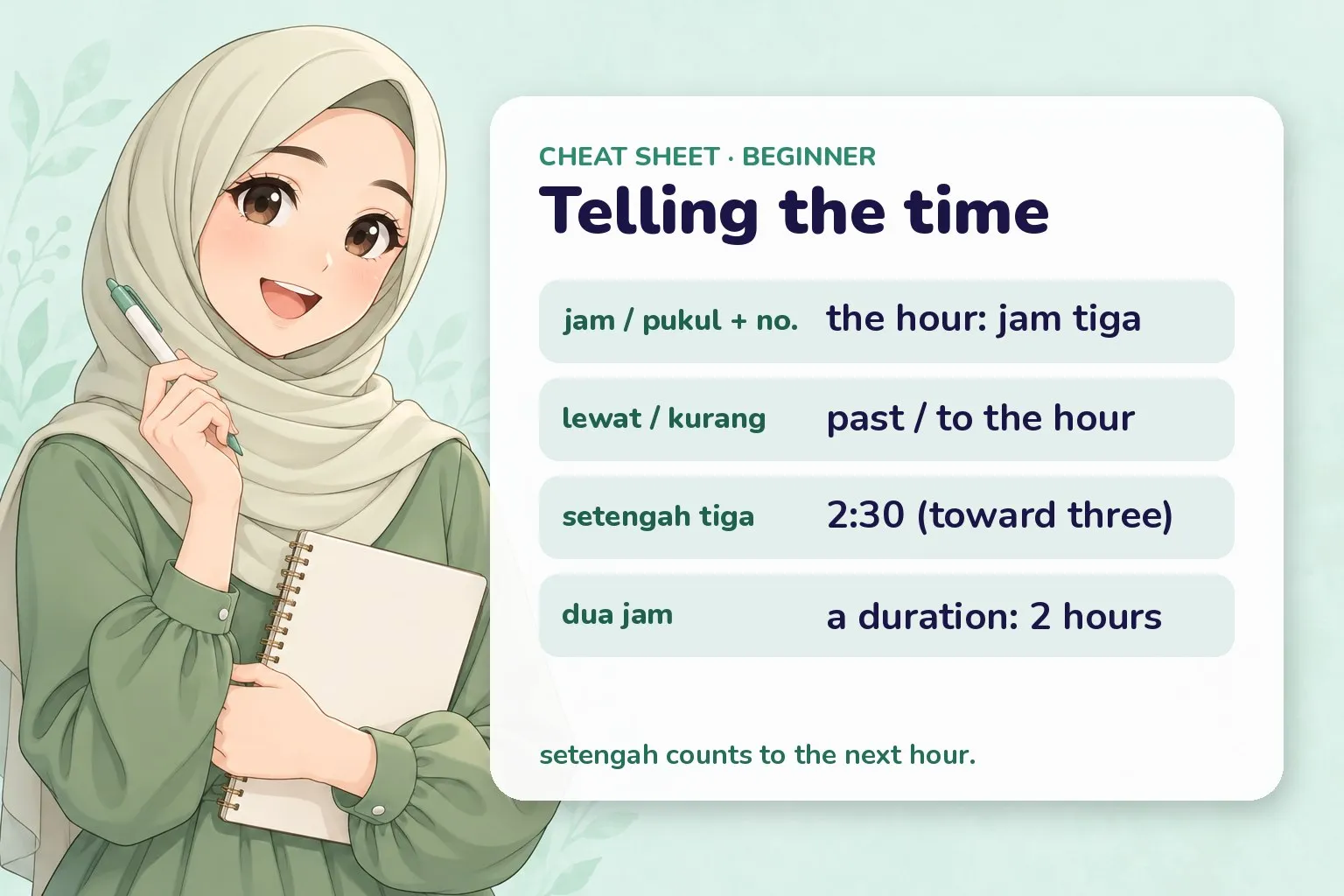
Quick recap before the quiz — remember setengah counts toward the next hour.
Practice
Telling the time practice
Try each one, then press Check. No sign-up, nothing is sent anywhere — it all runs in your browser.
Hint: number first for a duration
Show answer
dua — dua jam = two hours (duration puts the number first).
Hint: evening/night
Show answer
malam — malam marks the evening, so jam tujuh malam = 7 p.m.
5 Build: 'ten past five' (5:10).
Show answer
jam lima lewat sepuluh — jam lima lewat sepuluh = 5:10.
6 Match each word to its meaning.
- lewat
- kurang
- setengah
- pukul
Show answer
- lewat → past
- kurang → to
- setengah → half
- pukul → o'clock (formal)
These four words build almost every time expression.
Quiz
Telling the time in Indonesian
12 questions · pick an answer and you'll see straight away if it's right.
-
Show answer
What time is it? — Jam berapa? = 'What time is it?'
-
Show answer
pukul — pukul is the formal word used in schedules and announcements.
-
Show answer
1:30 — The half counts toward dua (two), so it is 1:30.
-
Show answer
past — lewat = past; e.g. jam tiga lewat sepuluh = 3:10.
-
Show answer
to / before — kurang = to: jam lima kurang lima = 4:55.
-
Show answer
two hours — Number before jam = a duration: two hours.
-
Show answer
jam tujuh pagi — pagi = morning, so jam tujuh pagi = 7 a.m.
-
Show answer
late afternoon — sore is the late afternoon, roughly 15:00–18:00.
-
Show answer
pukul 19.00 — The 24-hour clock uses a dot: pukul 19.00.
-
Show answer
3:15 — seperempat = quarter, lewat = past: quarter past three = 3:15.
-
Show answer
setengah — setengah empat = halfway to four = 3:30.
-
Show answer
delapan jam — A duration puts the number first: delapan jam = eight hours.
Recap cheat-sheet
| You want | Say | Example |
|---|---|---|
| the hour | jam / pukul + number | jam tiga = 3:00 |
| minutes past | lewat | jam tiga lewat sepuluh = 3:10 |
| minutes to | kurang | jam tiga kurang sepuluh = 2:50 |
| half | setengah (toward next hour) | setengah tiga = 2:30 |
| a duration | number + jam | dua jam = two hours |
Next
- The numbers behind every time: Indonesian numbers and classifiers
- Ask about time and place: Indonesian question words
- Back to the Indonesian grammar section
All Indonesian grammar topics
Every grammar point in order, from your first sentence to advanced structures. Pick one and go straight to it. New lessons go live every day, so topics marked Coming soon fill in over the next weeks.
Grammar path
Beginner 18 topics · 18 ready
- 01 Indonesian Personal Pronouns
- 02 Basic Word Order (Subject-Verb-Object)
- 03 Sentences Without 'To Be'
- 04 Noun + Adjective Order
- 05 Possession (Noun + Owner)
- 06 Plurals and Reduplication
- 07 Yes/No Questions (apakah, intonation)
- 08 Question Words (apa, siapa, di mana)
- 09 Negation: tidak vs bukan
- 10 Demonstratives (ini, itu)
- 11 Numbers and Classifiers
- 12 Common Prepositions (di, ke, dari)
- 13 Existence and 'Have' with ada / punya
- 14 Manner Deixis (begini, begitu) & sini/situ/sana
- 15 Particles -lah, -kah, -pun
- 16 Question Tags (kan, ya, bukan)
- 17 Adverbs of Frequency (selalu, sering, kadang)
- 18 Telling the Time You are here
Elementary 24 topics · 3 ready
- 19 The Prefix ber-
- 20 The Prefix meN- (Active Transitive)
- 21 The Passive with di-
- 22 Agent-Focus Passive (Pronoun + Verb) Coming soon
- 23 Aspect Markers (sudah, sedang, akan, belum, masih) Coming soon
- 24 Modal Words (bisa, boleh, harus, mau, ingin) Coming soon
- 25 Comparatives and Superlatives Coming soon
- 26 Ordinal Numbers and Dates Coming soon
- 27 Basic Conjunctions (dan, tetapi, atau, karena) Coming soon
- 28 Imperatives and Requests Coming soon
- 29 Adverbs and Intensifiers (sangat, sekali, agak) Coming soon
- 30 Only / Just (hanya, cuma, saja) Coming soon
- 31 Again / Still / More (lagi, masih, tambah) Coming soon
- 32 Experience (pernah, belum pernah) Coming soon
- 33 Purpose Clauses (untuk, supaya, agar) Coming soon
- 34 Cause Clauses (karena, sebab, gara-gara) Coming soon
- 35 Quantifiers (semua, setiap, beberapa, banyak) Coming soon
- 36 Complement Clauses with bahwa Coming soon
- 37 The Suffix -an (Result Nouns) Coming soon
- 38 The Prefix ke- (ketua, kekasih) Coming soon
- 39 Adverbial -nya (biasanya, sebenarnya) Coming soon
- 40 The Clitic -nya as a Definite Marker Coming soon
- 41 Sequencing (lalu, kemudian, setelah itu) Coming soon
- 42 Before & After (sebelum, setelah, sesudah) Coming soon
Intermediate 20 topics
- 43 The meN-...-kan Construction Coming soon
- 44 The meN-...-i Construction Coming soon
- 45 Nominalising Affixes (pe-, pe-an, per-an, ke-an) Coming soon
- 46 The Prefix ter- (Accidental/Superlative/Stative) Coming soon
- 47 The Prefix se- (One/Same/As) Coming soon
- 48 Relative Clauses with yang Coming soon
- 49 Subordinating Conjunctions (jika, meskipun) Coming soon
- 50 Types of Reduplication Coming soon
- 51 Classifiers and Quantity Expressions Coming soon
- 52 Passive Register (di- vs ter- vs ke-an) Coming soon
- 53 Reciprocal (saling, satu sama lain) Coming soon
- 54 Intensive & Reflexive (diri, sendiri) Coming soon
- 55 Correlative Conjunctions (baik...maupun) Coming soon
- 56 Degree (terlalu, cukup, kurang) Coming soon
- 57 The More...The More (makin, semakin) Coming soon
- 58 Simultaneous Actions (sambil, selagi, sementara) Coming soon
- 59 The Prefix memper- (Causative) Coming soon
- 60 ke-...-an Adversative Verbs (kehujanan) Coming soon
- 61 The Frame se-...-nya (sebaiknya, secepatnya) Coming soon
- 62 Compound Words (kata majemuk) Coming soon
Advanced 11 topics
- 63 Advanced Nominalisation & Formal Syntax Coming soon
- 64 Discourse Markers & Cohesion Coming soon
- 65 Formal (baku) vs Colloquial Indonesian Coming soon
- 66 Advanced Passive & Object Preposing Coming soon
- 67 Idiomatic & Layered Affixation Coming soon
- 68 Conditionals & Hypotheticals (seandainya, andai) Coming soon
- 69 Large Numbers, Fractions & Approximation Coming soon
- 70 Compound & Complex Sentences Coming soon
- 71 Topic, Focus & Cleft (yang...itu) Coming soon
- 72 Apposition and Appositive Clauses Coming soon
- 73 Restoring Dropped Affixes (Formal Writing) Coming soon