The German Perfect Tense (Perfekt)
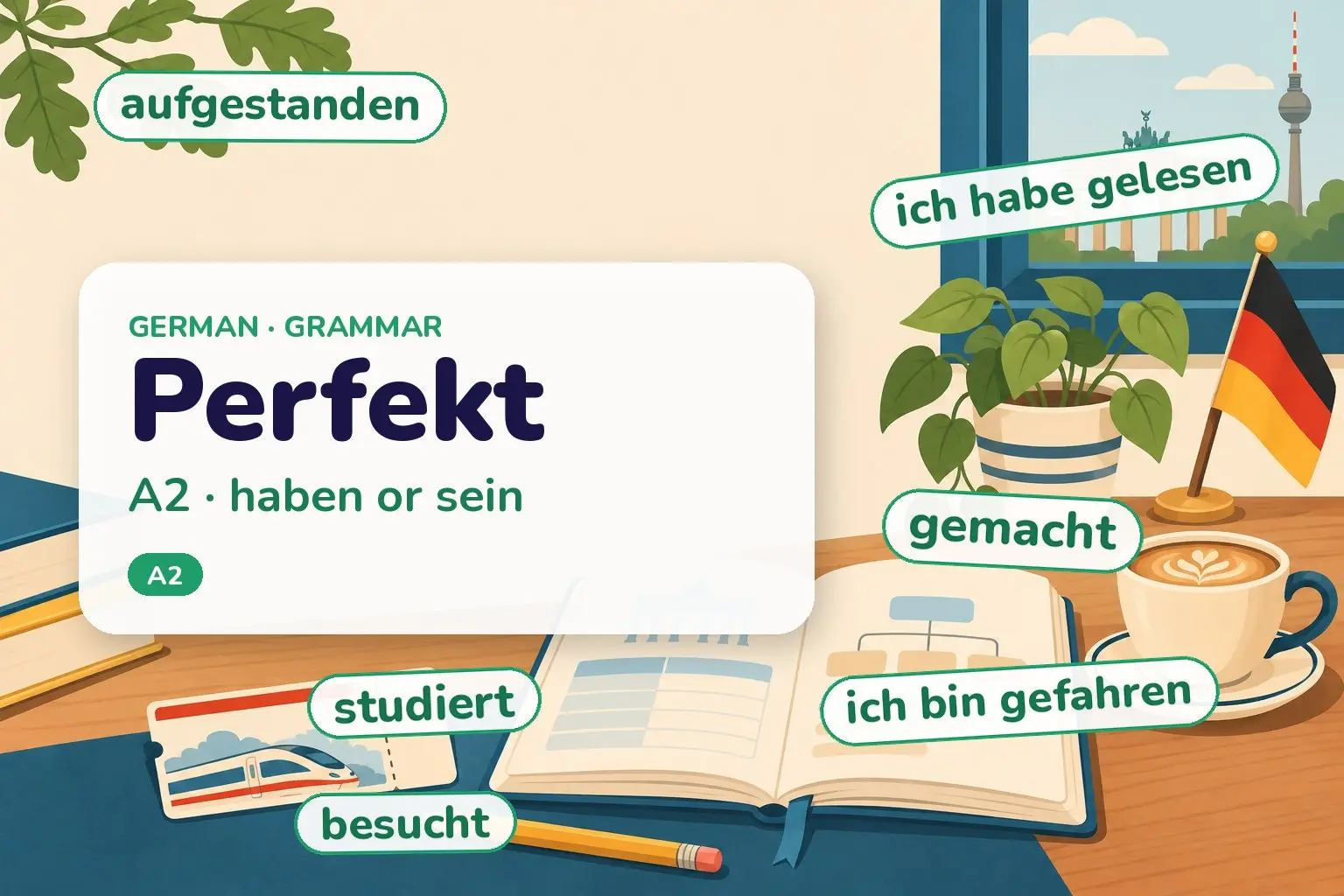
The German perfect tense is a helping verb plus a past participle: Ich habe das Buch gelesen, Ich bin nach Berlin gefahren. Most verbs take haben; sein belongs to intransitive verbs of movement with a destination or of change of state, and the participle goes to the end.
Level: A2. The perfect tense is the past you will hear all day in Germany: Ich habe geschlafen, Wir sind gefahren. It has only two moving parts — a helping verb and a past participle — but the helping verb is a choice, and the choice is where most learners lose marks.
The rule
The perfect tense (Perfekt) is a compound past: a form of haben or sein carries the person and the tense, and the past participle (Partizip II) carries the meaning. Duden describes it as a past seen from the speaker’s point of view, kept in touch with the present by the present-tense form of the helping verb — which is why German also calls it the vollendete Gegenwart, the completed present.
Word order is fixed. The helping verb takes the second position that every German main-clause verb takes, and the participle goes to the end: Ich habe gestern einen Film gesehen. That split is the verb bracket (Satzklammer) — the two halves hold everything else between them, and nothing may follow the participle.
The real decision is the auxiliary. Duden’s rule of thumb is that haben is the normal case, and sein belongs to a narrow, describable group: intransitive verbs that mark a transition into a new state, plus movement verbs when a destination or direction is given. Transitive verbs — verbs with a direct object — take haben without exception.
So the sentence is built in three steps: choose the auxiliary, build the participle, and place the participle at the end. Get those right and the tense is correct; the rest is vocabulary.
Building the participle
grammis gives the general shape as (ge) + participle stem + (e)n / (e)t. The bracket around ge- is the whole story: weak verbs end in -t, strong verbs end in -en and often change their vowel.
| Verb type | Pattern | Example |
|---|---|---|
| weak | ge- + stem + -t | machen → gemacht, kaufen → gekauft |
| weak, stem ends in -t/-d | ge- + stem + -et | arbeiten → gearbeitet, warten → gewartet |
| strong | ge- + changed stem + -en | lesen → gelesen, fahren → gefahren, sprechen → gesprochen |
| inseparable prefix | no ge- | besuchen → besucht, verstehen → verstanden, erzählen → erzählt |
| verb in -ieren | no ge- | studieren → studiert, telefonieren → telefoniert |
| separable prefix | prefix + ge- + stem | aufstehen → aufgestanden, einkaufen → eingekauft, ankommen → angekommen |
grammis notes that the ge- is decided mainly by stress: verbs with the stress on the first syllable take it, which is why the separable prefix keeps the stress and the ge- slides after it, while the unstressed inseparable prefixes be-, ge-, er-, ver-, zer-, ent-, emp- and the -ieren verbs block it.
Choosing haben or sein
| Verb group | Auxiliary | Example |
|---|---|---|
| transitive verbs (with an object) | haben | Ich habe einen Kaffee getrunken. |
| most other verbs | haben | Wir haben lange gewartet. |
| intransitive, change of state | sein | Die Rosen sind aufgeblüht. |
| movement + destination or direction | sein | Sie ist nach Mannheim gefahren. |
| movement without a destination | either | Ich habe/bin geschwommen. |
| gehen, reisen, bleiben, passieren, werden | sein | Wir sind zu Hause geblieben. |
Duden is precise about the movement group: many movement verbs can take either auxiliary, but once a direction or a place is attached, only sein is possible — Sie ist gestern nach Mannheim gefahren, not hat gefahren. gehen and reisen are given as exclusively sein verbs today.
Twelve participles worth knowing by heart
These come up in almost every conversation about a day, a trip or a week. The auxiliary column is the part to learn with the participle, not separately.
| Verb | Participle | Auxiliary | Mini-example |
|---|---|---|---|
| gehen | gegangen | sein | Ich bin nach Hause gegangen. |
| kommen | gekommen | sein | Er ist spät gekommen. |
| fahren | gefahren | sein | Wir sind ans Meer gefahren. |
| bleiben | geblieben | sein | Sie ist zwei Tage geblieben. |
| werden | geworden | sein | Es ist kalt geworden. |
| sein | gewesen | sein | Ich bin dort gewesen. |
| haben | gehabt | haben | Wir haben Glück gehabt. |
| sehen | gesehen | haben | Ich habe ihn gesehen. |
| essen | gegessen | haben | Hast du schon gegessen? |
| trinken | getrunken | haben | Wir haben Tee getrunken. |
| schreiben | geschrieben | haben | Sie hat eine Mail geschrieben. |
| nehmen | genommen | haben | Ich habe den Bus genommen. |
sein is the awkward one twice over: its participle is gewesen, and it is a sein verb itself — Ich bin in Berlin gewesen.
Example sentences
- Ich habe einen Kaffee getrunken.I drank a coffee.transitive → haben
- Wir haben gestern einen Film gesehen.We watched a film yesterday.strong participle: gesehen
- Sie hat lange gewartet.She waited a long time.stem in -t → gewartet
- Ich habe in Berlin studiert.I studied in Berlin.no ge- with -ieren
- Er hat seine Tante besucht.He visited his aunt.inseparable prefix → no ge-
- Hast du das verstanden?Did you understand that?verstanden, participle at the end
- Ich bin um sechs aufgestanden.I got up at six.separable prefix: aufgestanden
- Wir sind um sieben angekommen.We arrived at seven.movement with a goal → sein
- Sie ist nach Mannheim gefahren.She drove to Mannheim.direction given → sein
- Ich bin gestern zu Hause geblieben.I stayed at home yesterday.bleiben takes sein
- Die Blumen sind aufgeblüht.The flowers have blossomed.change of state → sein
- Ich habe früher viel geschwommen.I used to swim a lot.no destination → haben is fine
- Wir haben den ganzen Tag gearbeitet.We worked all day.gearbeitet with the extra -e-
- Er hat mir die Wahrheit erzählt.He told me the truth.erzählt, no ge-
- Ich habe das Buch nicht gelesen.I haven't read the book.nicht sits before the participle
- Sie hat eingekauft und dann gekocht.She shopped and then cooked.two participles, one auxiliary
- Wir sind letztes Jahr nach Italien gereist.We travelled to Italy last year.reisen is always sein
- Ich habe noch nie Sushi gegessen.I have never eaten sushi.past linked to now
- Er ist krank geworden.He got sick.werden → geworden with sein
- Ich weiß, dass sie angekommen ist.I know that she has arrived.subordinate clause: auxiliary last
Common mistakes
- ❌ Ich habe nach Berlin gefahren. → ✅ Ich bin nach Berlin gefahren. A direction is named, so the movement verb takes sein.
- ❌ Ich bin das Buch gelesen. → ✅ Ich habe das Buch gelesen. Transitive verbs take haben, whatever the participle looks like.
- ❌ Ich habe gestudiert. → ✅ Ich habe studiert. Verbs in -ieren never take ge-.
- ❌ Ich habe gebesucht. → ✅ Ich habe besucht. The inseparable prefix be- blocks ge- and stays unstressed.
- ❌ Ich habe um sechs aufgestanden. → ✅ Ich bin um sechs aufgestanden. Getting up is a change of state, so sein.
- ❌ Ich habe gelesen das Buch. → ✅ Ich habe das Buch gelesen. The participle closes the bracket; nothing follows it.
A short conversation
Montag im Büro: — Wie war dein Wochenende? (How was your weekend?) — Super! Ich bin am Samstag nach Hamburg gefahren und habe meine Schwester besucht. (Great — I went to Hamburg on Saturday and visited my sister.) — Und was hast du dort gemacht? (And what did you do there?) — Wir sind lange durch die Stadt gelaufen und haben abends gekocht. (We walked around the city for ages and cooked in the evening.) — Klingt gut. Ich bin leider zu Hause geblieben. (Sounds good. I unfortunately stayed at home.)
Usage notes
- Where the Perfekt lives. Duden puts it plainly: written standard German narrates in the Präteritum, spoken German narrates mostly in the Perfekt. In a letter, a report or a novel you will read Wir verbrachten den Sommer in der Stadt; in a conversation you will hear Wir haben den Sommer in der Stadt verbracht.
- When the Präteritum wins anyway. If the predicate is already multi-part — a modal verb plus an infinitive, for instance — a Perfekt would make it three parts, and speakers fall back on the Präteritum: weil ich nicht abschätzen konnte, wie lange ich brauchen würde. Duden calls the Perfekt version cumbersome.
- A past with consequences. Where a past event still bears on the present, the Perfekt is the tense that carries it: Ich habe meinen Schlüssel verloren (and that is why I am standing here). A Präteritum would report the event without the consequence.
- Subordinate clauses. In a weil-, dass- or wenn- clause the finite verb goes last, so the auxiliary follows the participle: weil ich das Buch gelesen habe. More on that frame in German sentence word order.
- Regional variation. Duden records that the north says ich habe gelegen / gestanden / gesessen, while the south, Austria and Switzerland say ich bin gelegen / gestanden / gesessen. Both are standard in their region; pick one and stay consistent.
- schon, noch nicht, noch nie. These adverbs place an event on a line that reaches the present, which is exactly what the Perfekt does: Ich habe schon gefrühstückt, Ich habe noch nicht gefrühstückt, Ich habe noch nie Muscheln probiert. Reported as finished facts without that line, they would take the Präteritum.
Compared with the Präteritum
The Präteritum is a single word (ich las, ich ging) and needs no auxiliary, which makes it shorter and more formal. The Perfekt is two words and dominates speech. Where both are possible, the difference is register rather than meaning — Duden gives Kolumbus entdeckte Amerika and Kolumbus hat Amerika entdeckt as interchangeable.
| Präteritum | Perfekt | |
|---|---|---|
| Form | one word: ich las | auxiliary + participle: ich habe gelesen |
| Typical use | written narrative, reports | spoken German, letters, messages |
| Modal verb + infinitive | preferred: ich konnte nicht kommen | avoided: ich habe nicht kommen können |
How to say it
| Point | How to say it |
|---|---|
| ge- | a quick “guh”: gemacht = “guh-MAKHT”, gelesen = “guh-LAY-zen”. |
| participle -en | the e nearly vanishes: gesehen = “guh-ZAY-en”, gefahren = “guh-FAH-ren”. |
| -iert | “eert”: studiert = “shtoo-DEERT”, telefoniert = “tay-lay-fo-NEERT”. |
| spoken habe | often shortened to “hahb”: Ich hab’ das gemacht is normal in speech, not sloppy. |
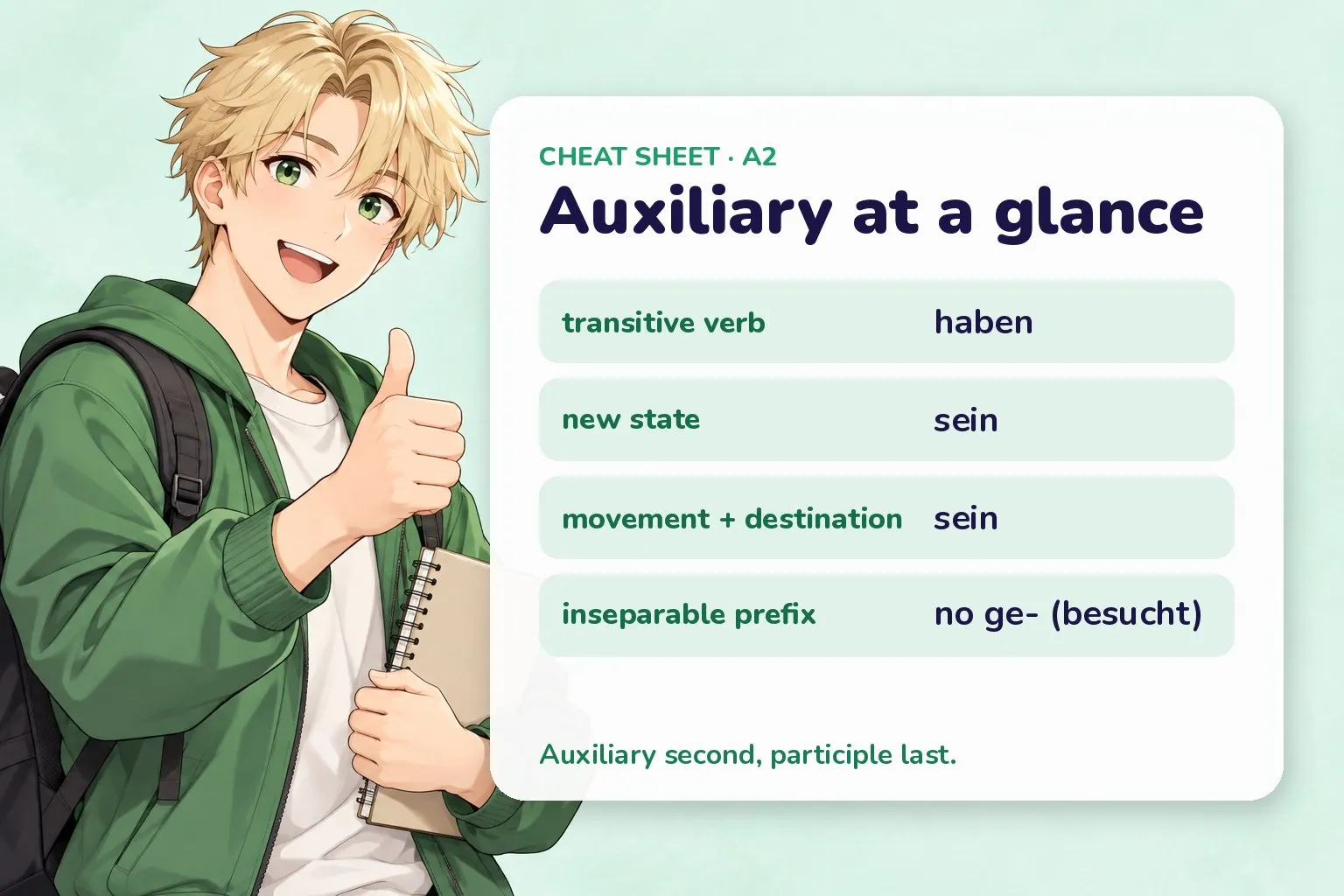
Quick recap before the quiz.
Practice
German Perfekt practice
Try each one, then press Check. No sign-up, nothing is sent anywhere — it all runs in your browser.
Hint: no ge- with -ieren
Show answer
studiert — Verbs in -ieren take no ge-: studiert.
Hint: ge- goes after the separable prefix
Show answer
aufgestanden — Separable prefix + ge- + stem: aufgestanden.
5 Build the sentence: 'I watched a film yesterday.'
Show answer
Ich habe gestern einen Film gesehen — Auxiliary in position two, participle last: Ich habe gestern einen Film gesehen.
6 Match each verb to its correct participle.
- machen
- verstehen
- telefonieren
- einkaufen
Show answer
- machen → gemacht
- verstehen → verstanden
- telefonieren → telefoniert
- einkaufen → eingekauft
Weak -t, no ge- after inseparable prefixes, no ge- in -ieren, ge- inside separable prefixes.
Quiz
German perfect tense
12 questions · pick an answer and you'll see straight away if it's right.
-
Show answer
haben or sein plus a past participle — Auxiliary carries person and tense, the participle carries meaning.
-
Show answer
haben — Duden: the haben-perfect is the normal case.
-
Show answer
ist — Movement with a destination → sein; sie is singular → ist.
-
Show answer
besucht — The inseparable prefix be- blocks ge-.
-
Show answer
studiert — Verbs in -ieren never take ge-.
-
Show answer
aufgestanden — ge- sits between the separable prefix and the stem.
-
Show answer
habe — Without a destination, haben is normal for schwimmen.
-
Show answer
sind — bleiben takes sein: wir sind geblieben.
-
Show answer
at the end — Auxiliary second, participle last: the verb bracket.
-
Show answer
comes last — Subordinate clauses put the finite verb last: weil ich das Buch gelesen habe.
-
Show answer
the Präteritum — Duden: the Präteritum is the basic tense of written narration; speech prefers the Perfekt.
-
Show answer
gegessen — essen → gegessen, with haben.
Recap cheat-sheet
| Part | Rule | Example |
|---|---|---|
| Auxiliary | haben normally; sein for change of state and movement with a destination | ich habe gelesen / ich bin gefahren |
| Weak participle | ge- + stem + -t | gemacht, gearbeitet |
| Strong participle | ge- + stem + -en | gelesen, gesprochen |
| No ge- | inseparable prefix, -ieren | besucht, studiert |
| Separable prefix | prefix + ge- + stem | aufgestanden |
| Position | auxiliary second, participle last | Ich habe das Buch gelesen. |
| Subordinate clause | auxiliary last | weil ich es gelesen habe |
Next
- The two auxiliaries on their own: sein and haben
- Negating a perfect-tense sentence: nicht vs kein
- Where the verb bracket comes from: German sentence word order
- Modal verbs, which prefer the Präteritum: German modal verbs
- Back to the German grammar section, or start at Start Learning German Here
All German grammar topics
Every grammar point in order, from your first sentence to advanced structures. Pick one and go straight to it. New lessons go live every day, so topics marked Coming soon fill in over the next weeks.
Grammar path
A1 16 topics · 16 ready
- 01 German Articles: Der, Die, Das
- 02 Indefinite Articles: ein / eine / ein
- 03 German Personal Pronouns (ich, du, er...)
- 04 Present Tense: Regular Verbs
- 05 The Verbs sein and haben
- 06 W-Questions (wer, was, wo, wie)
- 07 Yes/No Questions (Verb First)
- 08 Stem-Changing Verbs (fahren, essen, lesen)
- 09 Basic Word Order (Verb Second)
- 10 The Accusative Case (Direct Object)
- 11 Negation: nicht vs kein
- 12 Possessive Articles (mein, dein, sein)
- 13 Modal Verbs (können, müssen, wollen)
- 14 The Imperative (Commands)
- 15 Numbers, Time and Dates
- 16 Common Prepositions (basic)
A2 19 topics · 6 ready
- 17 The Dative Case (Indirect Object)
- 18 Verbs with the Dative (helfen, danken)
- 19 Accusative Prepositions (durch, für, ohne)
- 20 Dative Prepositions (mit, nach, bei, von, zu)
- 21 Two-Way Prepositions (Wechselpräpositionen)
- 22 The Perfect Tense (Perfekt) You are here
- 23 Perfekt: Choosing haben or sein Coming soon
- 24 Past Participles (Partizip II) Coming soon
- 25 Simple Past (Präteritum): sein, haben, modals Coming soon
- 26 Separable-Prefix Verbs Coming soon
- 27 Inseparable-Prefix Verbs Coming soon
- 28 Comparative and Superlative Coming soon
- 29 Coordinating Conjunctions (und, aber, denn) Coming soon
- 30 Subordinate Clauses (weil, dass) Coming soon
- 31 Reflexive Verbs (sich freuen) Coming soon
- 32 Ein-Words in Accusative and Dative Coming soon
- 33 Pronouns in Accusative and Dative Coming soon
- 34 Requests with möchten and würden Coming soon
- 35 Ordinal Numbers and Dates Coming soon
B1 20 topics
- 36 Adjective Endings after Definite Articles Coming soon
- 37 Adjective Endings after Indefinite Articles Coming soon
- 38 Adjective Endings with No Article Coming soon
- 39 Simple Past (Präteritum): All Verbs Coming soon
- 40 Past Perfect (Plusquamperfekt) Coming soon
- 41 Future Tense (Futur I) Coming soon
- 42 The Genitive Case (Possession) Coming soon
- 43 Genitive Prepositions (wegen, trotz) Coming soon
- 44 Subordinating Conjunctions (als, wenn, obwohl) Coming soon
- 45 als vs wenn (Past vs Repeated) Coming soon
- 46 Infinitive Clauses with zu Coming soon
- 47 Purpose: um...zu vs damit Coming soon
- 48 Relative Clauses (der, die, das) Coming soon
- 49 Dative Reflexive Verbs Coming soon
- 50 Konjunktiv II: würde and Polite/Hypothetical Coming soon
- 51 Conditional Sentences (wenn-Sätze) Coming soon
- 52 Passive Voice: Present (werden) Coming soon
- 53 Verbs with Fixed Prepositions Coming soon
- 54 da- and wo- Compounds (darauf, worauf) Coming soon
- 55 Weak Nouns (N-Declension) Coming soon
B2 18 topics
- 56 Passive in All Tenses and with Modals Coming soon
- 57 Stative Passive (Zustandspassiv) Coming soon
- 58 Passive Alternatives (man, sich lassen) Coming soon
- 59 Konjunktiv II in the Past (hätte gemacht) Coming soon
- 60 Konjunktiv I and Reported Speech Coming soon
- 61 Advanced Relative Clauses (was, wo, Präposition+Pronomen) Coming soon
- 62 Nominalised Adjectives and Participles Coming soon
- 63 Participles as Adjectives (Partizip I/II) Coming soon
- 64 Extended Participle Attributes Coming soon
- 65 Two-Part Connectors (entweder...oder) Coming soon
- 66 Adverbial Connectors (deshalb, trotzdem) Coming soon
- 67 Temporal Clauses (bevor, nachdem, seitdem) Coming soon
- 68 Concessive & Conditional Clauses (obwohl, falls) Coming soon
- 69 Subjective Use of Modal Verbs Coming soon
- 70 Future Perfect (Futur II) Coming soon
- 71 Verb Valency and Objects Coming soon
- 72 Mid-Field Order: Te-Ka-Mo-Lo Coming soon
- 73 Nominal Style (Nominalisierung) Coming soon
C1 11 topics
- 74 Light-Verb Constructions (Funktionsverbgefüge) Coming soon
- 75 Advanced & Impersonal Passive Coming soon
- 76 Advanced Konjunktiv (als ob, Wunschsätze) Coming soon
- 77 Participial & Abbreviated Clauses Coming soon
- 78 Nominalisation vs Verbalisation (Umformung) Coming soon
- 79 Modal Particles (doch, ja, mal, eben, halt) Coming soon
- 80 Formal Connectors & Text Cohesion Coming soon
- 81 Advanced Genitive & Nominal Attributes Coming soon
- 82 Word Formation (Komposita & Derivation) Coming soon
- 83 Reported Speech in Extended Text Coming soon
- 84 Emphasis, Fronting and Inversion Coming soon