German Articles: Der, Die, Das
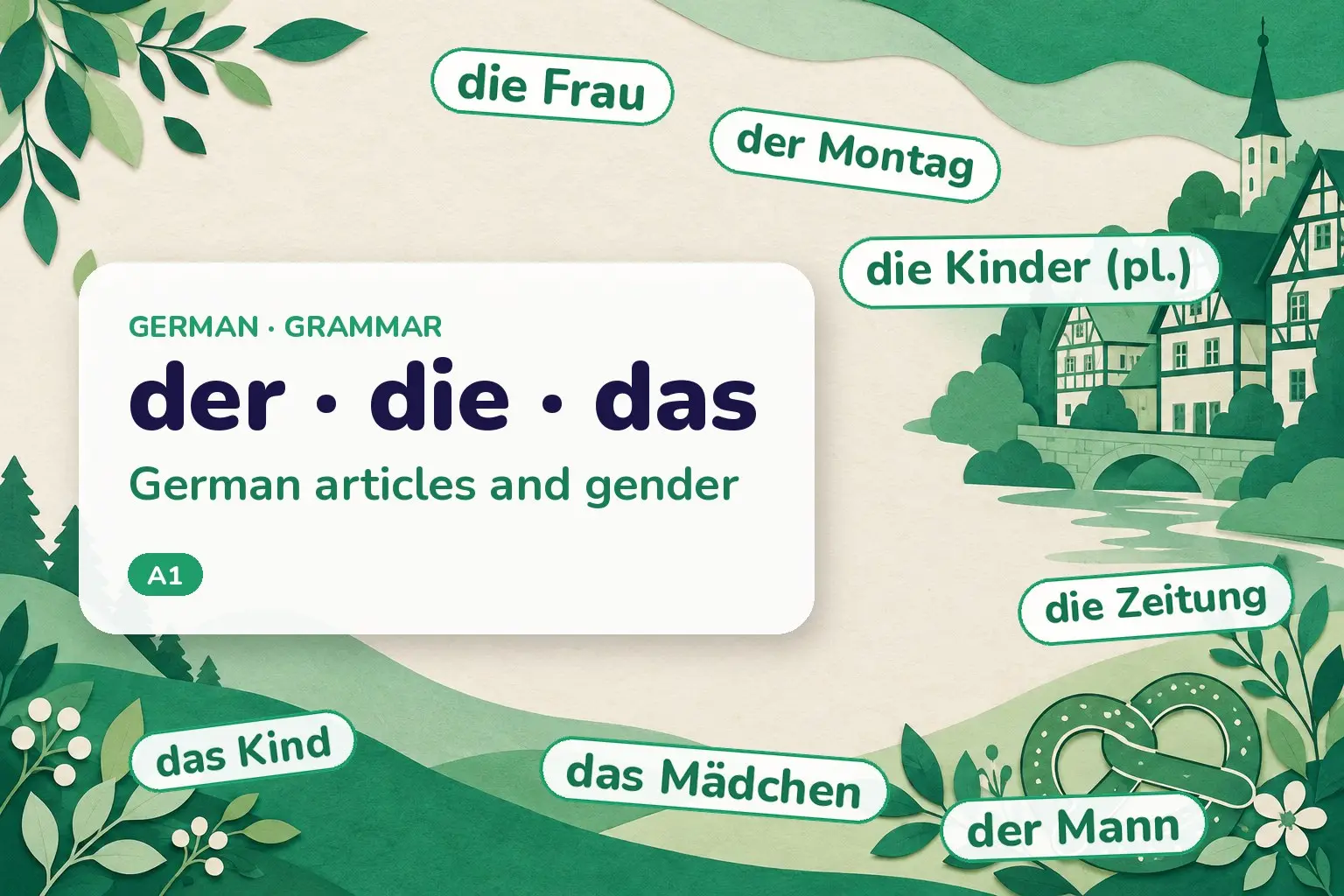
German has three genders, each with its own word for 'the': der (masculine), die (feminine) and das (neuter). All plurals use die. Gender is often not logical — das Mädchen ('the girl') is neuter — but some endings help: -ung, -heit, -keit are feminine and -chen is neuter. Learn every noun with its article.
Level: A1. In German, every noun has a grammatical gender: masculine, feminine or neuter. You can see it in the word for “the” — der, die or das. This page covers the basic (nominative) forms; the articles change in other cases, which come later.
The rule
- der — masculine: der Mann (the man), der Tisch (the table)
- die — feminine: die Frau (the woman), die Lampe (the lamp)
- das — neuter: das Kind (the child), das Buch (the book)
- die — all plurals, whatever the gender: die Tische, die Lampen, die Bücher
Gender is a grammatical label, not a fact about the thing. Learn every noun with its article, and write all German nouns with a capital letter.
Patterns that help
| Pattern | Usually | Examples |
|---|---|---|
| -ung, -heit, -keit, -schaft, -ion, -tät | die (feminine) | die Zeitung, die Freiheit, die Information, die Universität |
| -chen, -lein (small things) | das (neuter) | das Mädchen, das Brötchen, das Büchlein |
| Days, months, seasons | der (masculine) | der Montag, der Mai, der Sommer |
| -er for people who do something (male / dictionary form) | der (masculine) | der Lehrer, der Fahrer — but die Lehrerin for a woman |
| Infinitives used as nouns | das (neuter) | das Essen, das Lernen |
The suffixes -ung, -heit, -keit, -schaft, -ion, -tät, -chen and -lein are reliable when they are real suffixes; the other rows are tendencies. Many common nouns (der Tisch, die Tür, das Haus) simply have to be learned.
Example sentences
- Der Mann ist groß. — The man is tall.
- Die Frau ist Lehrerin. — The woman is a teacher.
- Das Kind spielt. — The child is playing.
- Das Mädchen liest. — The girl is reading. (-chen → neuter)
- Die Zeitung ist neu. — The newspaper is new. (-ung → feminine)
- Der Montag ist lang. — Monday is long.
- Die Bücher sind teuer. — The books are expensive. (plural → die)
- Das Haus ist alt. — The house is old.
- Der Lehrer ist nett. — The teacher is nice.
- Die Tür ist offen. — The door is open.
Common mistakes
- ❌ die Mädchen ist hier → ✅ das Mädchen ist hier. Singular Mädchen is neuter; die Mädchen is the plural (“the girls”).
- ❌ der Haus → ✅ das Haus. Learn the article with the noun.
- ❌ das Bücher → ✅ die Bücher. Every plural takes die.
- ❌ die tisch → ✅ der Tisch. Nouns are capitalised.
Compared with…
- English “the” — one form for everything; German has three singular forms plus die for plurals.
- Cases — der/die/das change with the role of the noun in the sentence (den Mann, dem Kind); this comes in a later lesson in the German grammar section.
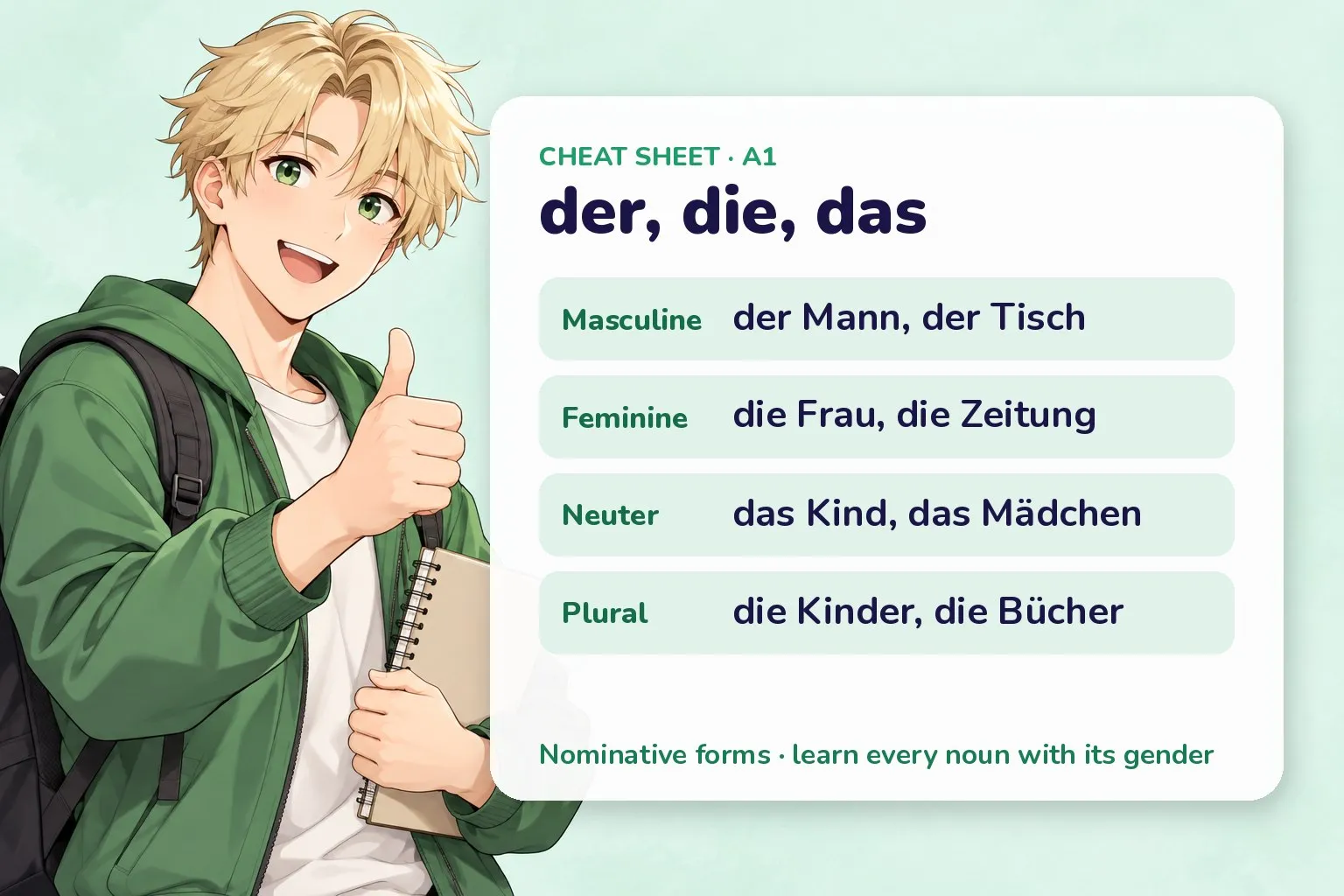
Quick recap before the quiz.
Mini quiz
- ___ Zeitung (the newspaper)
- ___ Brötchen (the bread roll)
- ___ Mann (the man)
- ___ Kinder (the children)
- ___ Freiheit (the freedom)
Answers
- die — -ung is feminine.
- das — -chen is neuter.
- der — masculine.
- die — all plurals take die.
- die — -heit is feminine.
Sources
- Rules and forms checked against Duden and the IDS grammis grammar.
- This topic sits at beginner level (A1) in common course sequencing; the CEFR is used as a general reference, not as a topic-level ruling.
- Example sentences were written for this lesson; no third-party sentences were copied.
Next
- Back to the German grammar section
- New here? Start with Start Learning German Here
Sources
- Duden Sprachwissen (grammar) — Duden
- grammis — German grammar — Leibniz-Institut für Deutsche Sprache
- CEFR level descriptions — Council of Europe