German Negation: nicht vs kein
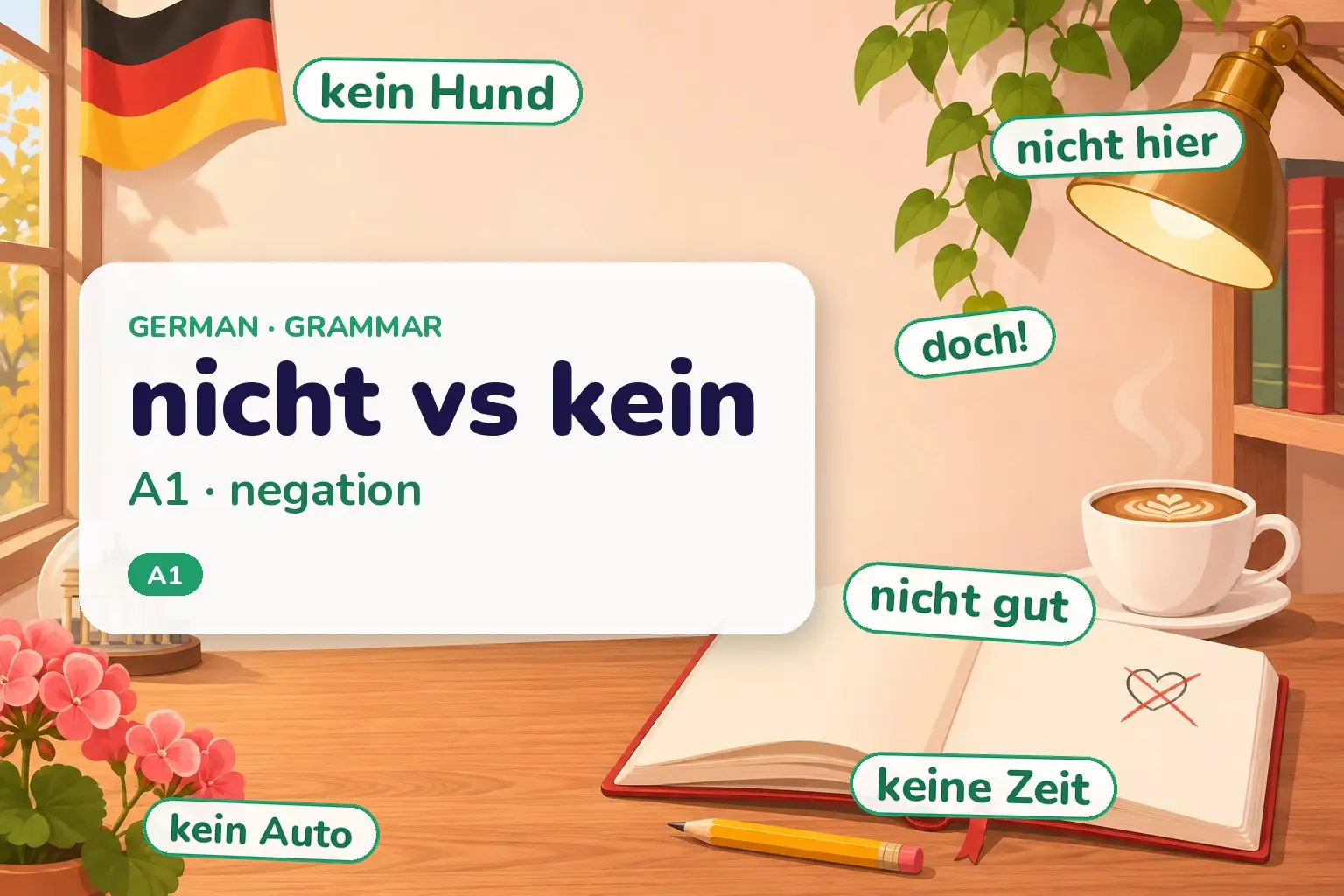
Use kein to negate a noun that would otherwise take ein/eine or no article (kein Auto, keine Zeit). Use nicht for everything else — verbs, adjectives, adverbs, and nouns with a definite article (nicht das Auto).
Level: A1. German has two ways to say “not”: kein negates a noun, and nicht negates everything else. Pick the right one and your sentence sounds natural straight away.
The rule
To negate means to say something is not the case. German splits the job between two words.
Use kein when you negate a noun that would otherwise appear with the indefinite article ein/eine or with no article at all (most plurals and uncountable nouns). kein means “not a / no / not any”. It behaves like ein and takes the same endings — plus a plural form that ein never had.
Use nicht for everything else: verbs (Ich arbeite nicht), adjectives (nicht schön), adverbs (nicht hier), and nouns that already carry a definite article or are a name or pronoun (nicht das Auto, nicht Berlin). A quick test: if the positive sentence uses ein/eine or no article, negate it with kein; if it uses der/die/das or a specific word, use nicht.
The position of nicht matters. For whole-sentence negation it usually sits near the end of the clause (Ich kenne den Mann nicht). For partial negation — contradicting just one element — nicht stands directly in front of that element (Ich komme nicht heute = not today, but another day).
The kein forms
kein declines exactly like ein, and it adds a plural that ein lacks. At A1 you mainly need the nominative (subject) and accusative (direct object):
| Case | masculine | feminine | neuter | plural |
|---|---|---|---|---|
| nominative | kein | keine | kein | keine |
| accusative | keinen | keine | kein | keine |
So ein Hund → kein Hund (nom.), einen Hund → keinen Hund (acc.), and a bare plural Hunde → keine Hunde.
How to say it
German spelling is regular once you know a few sounds that turn up in these words:
| Sound | How to say it |
|---|---|
| ei | like English “eye”: kein = “kine”, keine = “KINE-uh”, nein = “nine”. |
| ei vs ie | ei = “eye”, but ie = “ee”: nicht keeps a short “i” (≈ “nisht”), nie = “nee”. |
| ch | after i/e it is soft, like a hissed “h”: nicht ends “…isht/iHHt”, not an English “ch”. |
| ö / ü | round your lips: schön = “shern” (rounded), für = “fewr” (rounded “ee”). |
Example sentences
- Ich habe kein Auto.I don't have a car.ein Auto → kein Auto
- Ich habe keine Zeit.I have no time.feminine → keine
- Das ist kein Problem.That's not a problem.neuter → kein
- Wir haben keinen Hund.We don't have a dog.accusative masculine → keinen
- Ich habe keine Geschwister.I have no siblings.plural → keine
- Er trinkt keinen Kaffee.He doesn't drink coffee.no-article noun → kein
- Das ist keine gute Idee.That's not a good idea.
- Ich arbeite heute nicht.I'm not working today.negating the verb → nicht
- Der Film ist nicht gut.The film is not good.adjective → nicht
- Sie wohnt nicht hier.She doesn't live here.adverb of place → nicht
- Ich kenne den Mann nicht.I don't know the man.definite article → nicht, at the end
- Das ist nicht mein Auto.That's not my car.possessive → nicht
- Wir fahren nicht nach Berlin.We're not going to Berlin.place name → nicht
- Ich kann heute nicht kommen.I can't come today.nicht before the second verb
- Er ist nicht groß.He is not tall.
- Ich komme nicht heute, sondern morgen.I'm coming not today, but tomorrow.partial negation: nicht before 'heute'
- Hast du kein Geld? — Doch, ich habe Geld.Don't you have any money? — Yes, I do have money.doch answers a negative question
- Ich verstehe das nicht.I don't understand that.
Common mistakes
- ❌ Ich habe nicht ein Auto. → ✅ Ich habe kein Auto. Negate an ein-noun with kein, never nicht ein.
- ❌ Ich habe nicht Zeit. → ✅ Ich habe keine Zeit. A no-article noun still takes kein-, not nicht.
- ❌ Das ist kein das Auto. → ✅ Das ist nicht das Auto. A noun with a definite article is negated with nicht.
- ❌ Ich kenne nicht den Mann. → ✅ Ich kenne den Mann nicht. For whole-sentence negation, nicht goes to the end.
- ❌ Er ist groß nicht. → ✅ Er ist nicht groß. nicht stands before the adjective it negates.
- ❌ Hast du kein Geld? — Ja. → ✅ …— Doch. To contradict a negative question, answer doch, not ja.
A short conversation
Im Café: — Möchtest du einen Kaffee? — Nein danke, ich trinke keinen Kaffee. Ich mag Kaffee nicht. — Hast du keine Zeit für einen Tee? — Doch! Einen Tee nehme ich gern.
Usage notes
- Whole vs partial negation. At the end of the clause, nicht negates the whole sentence (Ich arbeite nicht). Placed directly before one word, it negates only that word (Ich arbeite nicht heute = not today), usually with a contrast: …, sondern morgen.
- nicht and the verb bracket. When a clause has a second verb part — an infinitive, a past participle, or a separable prefix — nicht comes just before it: Ich kann nicht kommen, Ich habe nicht geschlafen, Ich rufe nicht an.
- doch. German uses doch to say “yes, actually” against a negative statement or question: Du kommst nicht? — Doch!
- kein is stronger than “not a”. Ich habe kein Auto can mean “I don’t have a car” or “I have no car at all”; context decides.
Compared with…
- ein / eine — the indefinite article. kein is simply ein with a k- and a plural: compare Indefinite Articles: ein / eine / ein.
- der / die / das — a noun with a definite article is negated with nicht, not kein: see German Articles: Der, Die, Das.
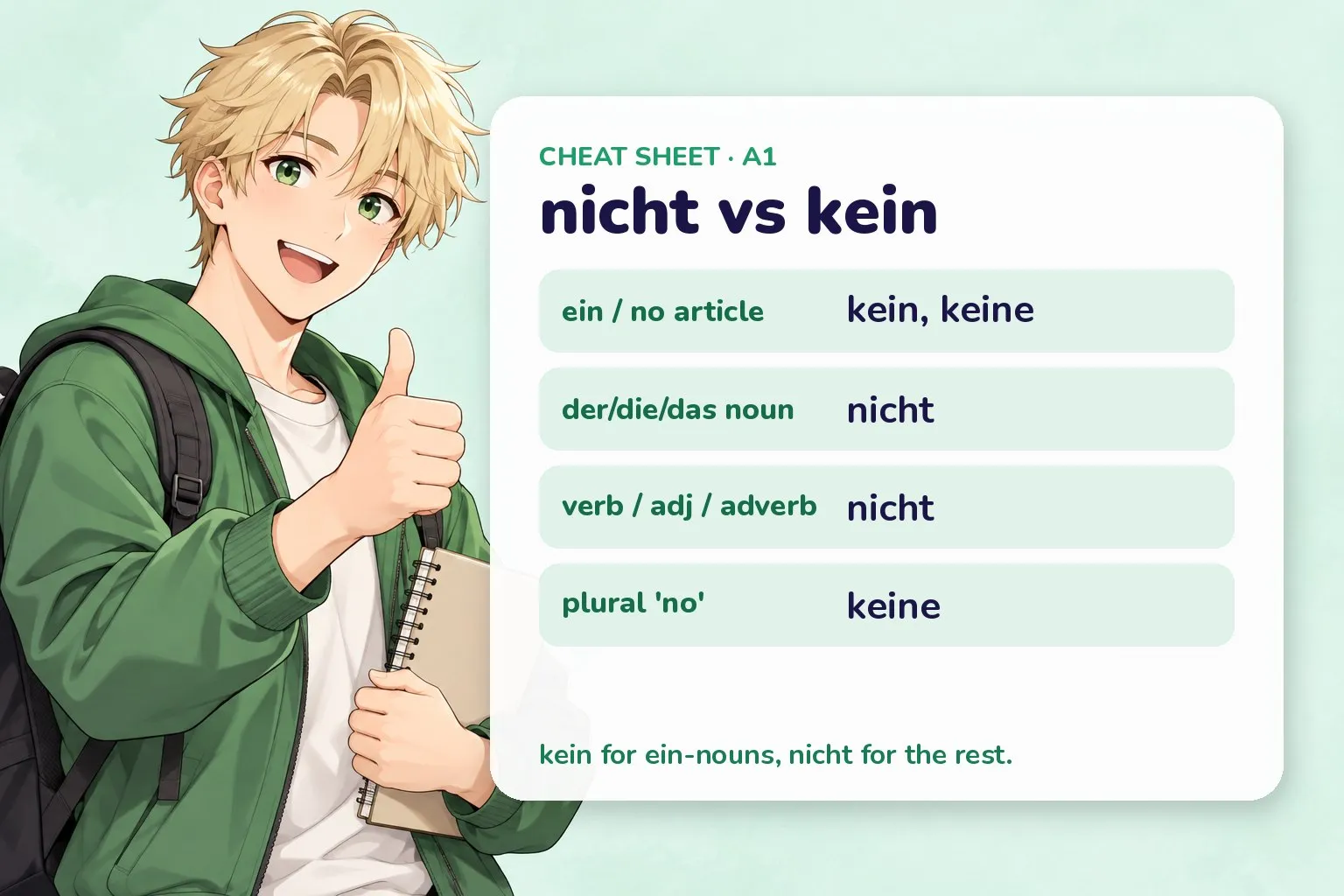
Quick recap before the quiz.
Practice
nicht vs kein practice
Try each one, then press Check. No sign-up, nothing is sent anywhere — it all runs in your browser.
Hint: Zeit is feminine and has no article here
Show answer
keine — No-article noun → kein-; Zeit is feminine → keine.
Hint: direct object, masculine
Show answer
keinen — Masculine accusative of kein is keinen.
5 Order the words: 'I don't know the man.'
Show answer
Ich kenne den Mann nicht — Whole-sentence nicht goes to the end of the clause.
6 Match each sentence to its negator.
- Ich habe ein Auto.
- Ich kenne das Auto.
- Ich habe Zeit.
- Der Film ist gut.
Show answer
- Ich habe ein Auto. → kein Auto
- Ich kenne das Auto. → das Auto nicht
- Ich habe Zeit. → keine Zeit
- Der Film ist gut. → nicht gut
ein / no-article nouns → kein; definite nouns, verbs and adjectives → nicht.
Quiz
German nicht vs kein
12 questions · pick an answer and you'll see straight away if it's right.
-
Show answer
kein — ein Auto → kein Auto.
-
Show answer
keine — Zeit is feminine with no article → keine.
-
Show answer
nicht — An adjective is negated with nicht.
-
Show answer
nicht — A definite-article noun → nicht, at the end of the clause.
-
Show answer
keinen — Direct object, masculine → keinen.
-
Show answer
nicht — An adverb of place is negated with nicht.
-
Show answer
nicht — A noun with a possessive (mein) → nicht.
-
Show answer
keine — Plural noun → keine.
-
Show answer
Das ist kein Problem. — Problem is neuter, ein Problem → kein Problem.
-
Show answer
Doch — Use doch to contradict a negative question.
-
Show answer
nicht — nicht comes just before the second verb part (kommen).
-
Show answer
plural form (keine) — There is no plural ein, but there is keine.
Recap cheat-sheet
| Negate a… | Use | Example |
|---|---|---|
| noun with ein/eine | kein/keine | kein Auto |
| noun with no article | kein/keine | keine Zeit |
| noun with der/die/das | nicht | das Auto nicht |
| verb / adjective / adverb | nicht | nicht gut |
Next
- Back to the German grammar section
- New here? Start with Start Learning German Here
All German grammar topics
Every grammar point in order, from your first sentence to advanced structures. Pick one and go straight to it. New lessons go live every day, so topics marked Coming soon fill in over the next weeks.
Grammar path
A1 16 topics · 12 ready
- 01 German Articles: Der, Die, Das
- 02 Indefinite Articles: ein / eine / ein
- 03 German Personal Pronouns (ich, du, er...)
- 04 Present Tense: Regular Verbs
- 05 The Verbs sein and haben
- 06 W-Questions (wer, was, wo, wie)
- 07 Yes/No Questions (Verb First)
- 08 Stem-Changing Verbs (fahren, essen, lesen)
- 09 Basic Word Order (Verb Second)
- 10 The Accusative Case (Direct Object)
- 11 Negation: nicht vs kein You are here
- 12 Possessive Articles (mein, dein, sein)
- 13 Modal Verbs (können, müssen, wollen) Coming soon
- 14 The Imperative (Commands) Coming soon
- 15 Numbers, Time and Dates Coming soon
- 16 Common Prepositions (basic) Coming soon
A2 19 topics
- 17 The Dative Case (Indirect Object) Coming soon
- 18 Verbs with the Dative (helfen, danken) Coming soon
- 19 Accusative Prepositions (durch, für, ohne) Coming soon
- 20 Dative Prepositions (mit, nach, bei, von, zu) Coming soon
- 21 Two-Way Prepositions (Wechselpräpositionen) Coming soon
- 22 The Perfect Tense (Perfekt) Coming soon
- 23 Perfekt: Choosing haben or sein Coming soon
- 24 Past Participles (Partizip II) Coming soon
- 25 Simple Past (Präteritum): sein, haben, modals Coming soon
- 26 Separable-Prefix Verbs Coming soon
- 27 Inseparable-Prefix Verbs Coming soon
- 28 Comparative and Superlative Coming soon
- 29 Coordinating Conjunctions (und, aber, denn) Coming soon
- 30 Subordinate Clauses (weil, dass) Coming soon
- 31 Reflexive Verbs (sich freuen) Coming soon
- 32 Ein-Words in Accusative and Dative Coming soon
- 33 Pronouns in Accusative and Dative Coming soon
- 34 Requests with möchten and würden Coming soon
- 35 Ordinal Numbers and Dates Coming soon
B1 20 topics
- 36 Adjective Endings after Definite Articles Coming soon
- 37 Adjective Endings after Indefinite Articles Coming soon
- 38 Adjective Endings with No Article Coming soon
- 39 Simple Past (Präteritum): All Verbs Coming soon
- 40 Past Perfect (Plusquamperfekt) Coming soon
- 41 Future Tense (Futur I) Coming soon
- 42 The Genitive Case (Possession) Coming soon
- 43 Genitive Prepositions (wegen, trotz) Coming soon
- 44 Subordinating Conjunctions (als, wenn, obwohl) Coming soon
- 45 als vs wenn (Past vs Repeated) Coming soon
- 46 Infinitive Clauses with zu Coming soon
- 47 Purpose: um...zu vs damit Coming soon
- 48 Relative Clauses (der, die, das) Coming soon
- 49 Dative Reflexive Verbs Coming soon
- 50 Konjunktiv II: würde and Polite/Hypothetical Coming soon
- 51 Conditional Sentences (wenn-Sätze) Coming soon
- 52 Passive Voice: Present (werden) Coming soon
- 53 Verbs with Fixed Prepositions Coming soon
- 54 da- and wo- Compounds (darauf, worauf) Coming soon
- 55 Weak Nouns (N-Declension) Coming soon
B2 18 topics
- 56 Passive in All Tenses and with Modals Coming soon
- 57 Stative Passive (Zustandspassiv) Coming soon
- 58 Passive Alternatives (man, sich lassen) Coming soon
- 59 Konjunktiv II in the Past (hätte gemacht) Coming soon
- 60 Konjunktiv I and Reported Speech Coming soon
- 61 Advanced Relative Clauses (was, wo, Präposition+Pronomen) Coming soon
- 62 Nominalised Adjectives and Participles Coming soon
- 63 Participles as Adjectives (Partizip I/II) Coming soon
- 64 Extended Participle Attributes Coming soon
- 65 Two-Part Connectors (entweder...oder) Coming soon
- 66 Adverbial Connectors (deshalb, trotzdem) Coming soon
- 67 Temporal Clauses (bevor, nachdem, seitdem) Coming soon
- 68 Concessive & Conditional Clauses (obwohl, falls) Coming soon
- 69 Subjective Use of Modal Verbs Coming soon
- 70 Future Perfect (Futur II) Coming soon
- 71 Verb Valency and Objects Coming soon
- 72 Mid-Field Order: Te-Ka-Mo-Lo Coming soon
- 73 Nominal Style (Nominalisierung) Coming soon
C1 11 topics
- 74 Light-Verb Constructions (Funktionsverbgefüge) Coming soon
- 75 Advanced & Impersonal Passive Coming soon
- 76 Advanced Konjunktiv (als ob, Wunschsätze) Coming soon
- 77 Participial & Abbreviated Clauses Coming soon
- 78 Nominalisation vs Verbalisation (Umformung) Coming soon
- 79 Modal Particles (doch, ja, mal, eben, halt) Coming soon
- 80 Formal Connectors & Text Cohesion Coming soon
- 81 Advanced Genitive & Nominal Attributes Coming soon
- 82 Word Formation (Komposita & Derivation) Coming soon
- 83 Reported Speech in Extended Text Coming soon
- 84 Emphasis, Fronting and Inversion Coming soon