German Personal Pronouns (ich, du, er...)
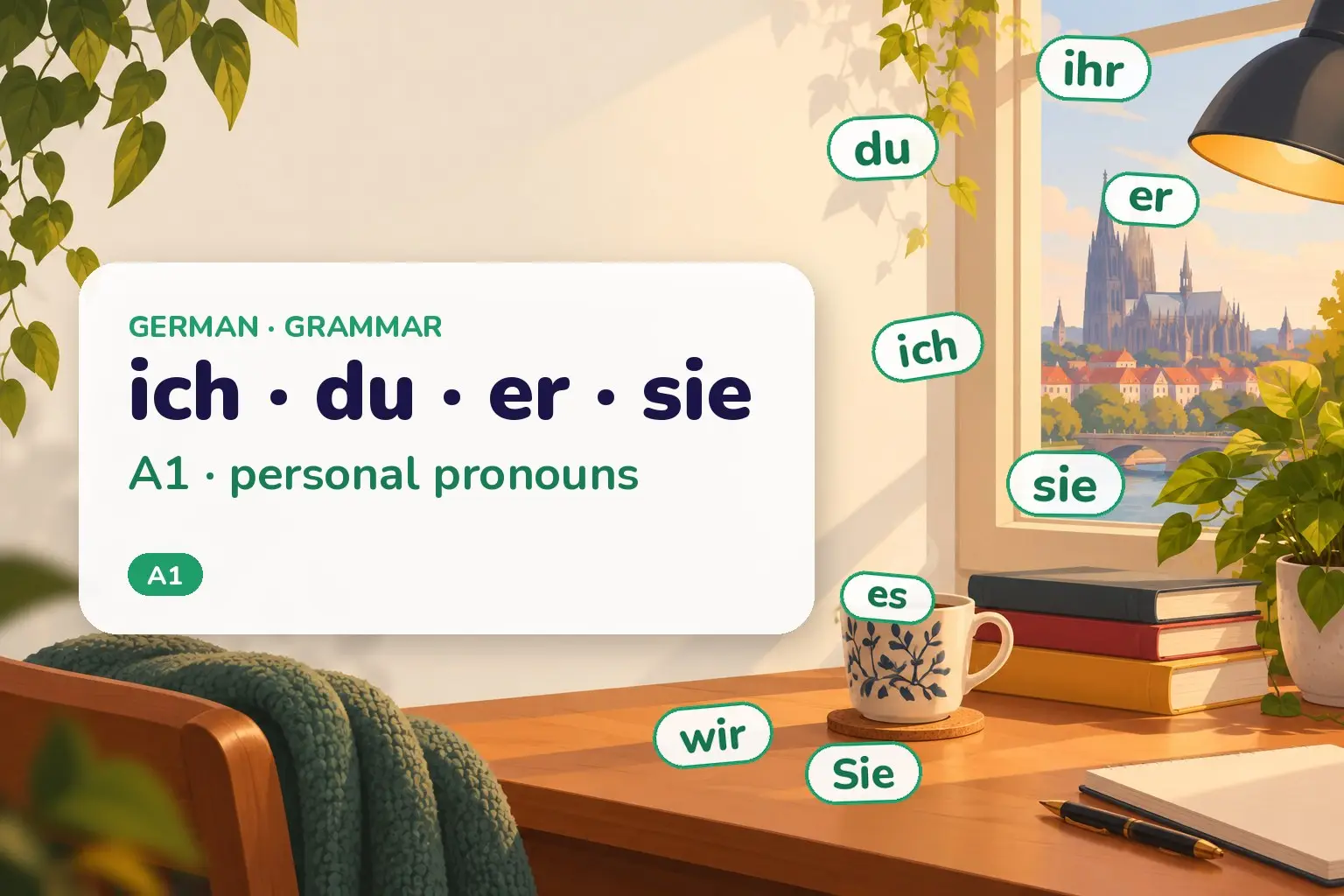
German's subject pronouns are ich (I), du (you), er (he), sie (she), es (it), wir (we), ihr (you all), sie (they) and the formal Sie (you). Sie is always capitalised; du is informal.
Level: A1. Personal pronouns are the small words that stand in for a person or thing as the subject of a sentence — I, you, he, she, it, we, they. German has nine of them in the subject form, and two small puzzles: the du / Sie politeness choice, and the fact that sie does triple duty.
The rule
A personal pronoun replaces a noun so you do not repeat it: instead of Anna again, you say sie (she). These are the nominative (subject) forms — the pronoun doing the action of the verb.
German sorts them by person (who is speaking) and number (one or many), plus a formal register:
- ich (I), du (you, one person, informal), er (he), sie (she), es (it).
- wir (we), ihr (you, several people, informal), sie (they).
- Sie (you, formal) — singular or plural, always written with a capital S.
Two things trip up English speakers. First, er / sie / es follow the noun’s grammatical gender, not its real-world sex or type: der Tisch (the table) is er, die Lampe (the lamp) is sie, das Buch (the book) is es. Second, sie means she, they, and (capitalised) formal you — you tell them apart by the capital letter and the verb ending.
The pronoun forms
| Person | Pronoun | Meaning | Verb “to be” |
|---|---|---|---|
| 1st singular | ich | I | ich bin |
| 2nd singular (informal) | du | you | du bist |
| 3rd singular | er / sie / es | he / she / it | er ist |
| 1st plural | wir | we | wir sind |
| 2nd plural (informal) | ihr | you (all) | ihr seid |
| 3rd plural | sie | they | sie sind |
| formal (sg & pl) | Sie | you | Sie sind |
du, ihr or Sie?
German makes you choose how formally to address someone:
- du — one person you are close to: family, friends, children, classmates, pets, and online in many communities.
- ihr — more than one such person (the plural of du): Kommt ihr mit? (“Are you all coming?”).
- Sie — anyone you would not address by first name: strangers, officials, shop staff, a new colleague, your doctor. It is the same word for one person or many.
How to say it
German spelling is regular, but a few sounds need care here:
| Letter / word | How to say it |
|---|---|
| ich | The -ch after i is a soft hiss, like the start of “huge” — not “k”. ich ≈ “ikh”. |
| sie / Sie | Both sound the same: “zee”. Only the capital and the verb show which one you mean. |
| du | A pure “oo”, like English “do”: du ≈ “doo”. |
| er / wir / ihr | The final -r is soft, almost “ah”: er ≈ “air”, wir ≈ “veer”, ihr ≈ “eer”. The w sounds like English “v”. |
Example sentences
- Ich bin müde.I am tired.
- Du bist mein Freund.You are my friend.du = informal you
- Er kommt aus Berlin.He comes from Berlin.
- Sie wohnt in Hamburg.She lives in Hamburg.sie + singular verb = she
- Es regnet heute.It is raining today.
- Wir lernen Deutsch.We are learning German.
- Ihr seid sehr nett.You (all) are very kind.ihr = informal plural you
- Sie sind Studenten.They are students.sie + plural verb = they
- Sind Sie Herr Müller?Are you Mr Müller?capital Sie = formal you
- Wo wohnen Sie?Where do you live?formal you, in a question
- Der Tisch ist alt. Er ist aus Holz.The table is old. It is made of wood.der → er
- Die Lampe ist neu. Sie ist schön.The lamp is new. It is beautiful.die → sie
- Das Buch ist gut. Es ist spannend.The book is good. It is exciting.das → es
- Wir sind Freunde.We are friends.
- Habt ihr Zeit?Do you (all) have time?
- Sie arbeiten zusammen.They work together.
- Ich heiße Anna, und du?My name is Anna, and you?
- Das Mädchen ist jung. Es geht zur Schule.The girl is young. She goes to school.das Mädchen is neuter → es
Common mistakes
- ❌ Sie bist nett. → ✅ Du bist nett. The verb bist goes with du, not with Sie (which takes sind).
- ❌ Die Tisch… sie ist alt (for a table) → ✅ Der Tisch… er ist alt. Tisch is masculine, so the pronoun is er.
- ❌ Das Mädchen… sie ist jung → ✅ Das Mädchen… es ist jung. Grammatical gender wins: Mädchen is neuter → es.
- ❌ writing sie for formal “you” → ✅ Sie with a capital, everywhere in the sentence.
- ❌ du to a stranger at an office → ✅ Sie until you are invited to switch.
A short conversation
Im Büro: — Guten Tag. Sind Sie Frau Klein? — Ja, das bin ich. Und Sie? — Ich heiße Tom. Wir arbeiten ab heute zusammen.
Usage notes
- The verb always agrees. Learn the pronoun and its verb ending as a pair: ich habe, du hast, er hat, wir haben, ihr habt, sie/Sie haben.
- Capital Sie never relaxes. Even mid-sentence it keeps its capital: Können Sie mir helfen?
- Dropping the pronoun is rare. Unlike Spanish or Italian, German normally keeps the subject pronoun: say ich bin, not just bin.
- Next step: these are the subject (nominative) forms. When the pronoun is an object, the forms change (mich, dich, ihn, uns…) — a separate topic once these are solid.
Compared with…
- Grammatical gender decides whether an object is er, sie or es. If you are unsure which article a noun takes, revisit der, die, das: German Gender and the pronoun follows automatically.
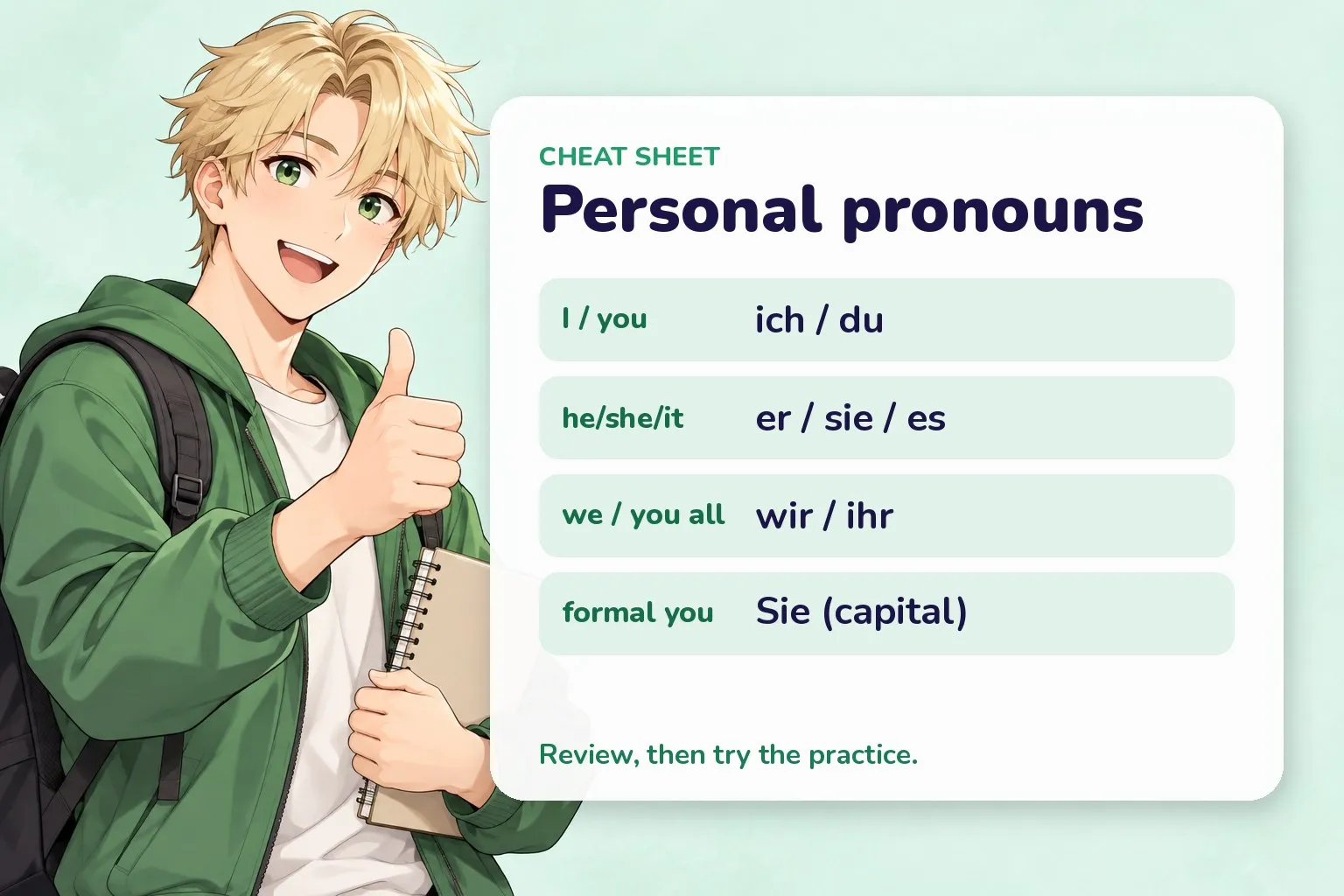
Quick recap before the quiz.
Practice
Personal pronouns practice
Try each one, then press Check. No sign-up, nothing is sent anywhere — it all runs in your browser.
Hint: capital letter, formal you
Show answer
Sie — Formal you is Sie, always capitalised.
3 Order the words: 'We are learning German.'
Show answer
Wir lernen Deutsch — Subject wir + verb lernen + object Deutsch.
4 Match each pronoun to its meaning.
- ich
- ihr
- es
- wir
Show answer
- ich → I
- ihr → you (all, informal)
- es → it
- wir → we
ich = I, ihr = informal plural you, es = it, wir = we.
Quiz
German personal pronouns
12 questions · pick an answer and you'll see straight away if it's right.
-
Show answer
ich — ich = I.
-
Show answer
du — du is the singular informal 'you'.
-
Show answer
Sie — Lampe is feminine (die), so the pronoun is sie.
-
Show answer
Sie (capital S) — Formal Sie always keeps a capital S.
-
Show answer
you (several, informal) — ihr is the plural of du: 'you all', informally.
-
Show answer
bist — du bist — the -st ending marks du.
-
Show answer
Es — Mädchen is grammatically neuter (das), so the pronoun is es.
-
Show answer
Sie — Use the formal Sie with people you do not know.
-
Show answer
they are — Lower-case sie + plural verb sind = they are.
-
Show answer
er — Hund is masculine (der), so er — grammatical gender, not animal sex.
-
Show answer
bin — ich bin — first person singular of sein.
-
Show answer
Ihr seid nett. — ihr seid is the right pronoun–verb pair; the others mismatch.
Recap cheat-sheet
| Pronoun | Meaning | Note |
|---|---|---|
| ich / du | I / you (informal) | du for friends, family |
| er / sie / es | he / she / it | matches der / die / das |
| wir / ihr | we / you (all, informal) | ihr = plural of du |
| sie | they | lower-case, plural verb |
| Sie | you (formal) | always capitalised |
Next
- Back to the German grammar section
- New here? Start with Start Learning German Here
All German grammar topics
Every grammar point in order, from your first sentence to advanced structures. Pick one and go straight to it. New lessons go live every day, so topics marked Coming soon fill in over the next weeks.
Grammar path
A1 16 topics · 12 ready
- 01 German Articles: Der, Die, Das
- 02 Indefinite Articles: ein / eine / ein
- 03 German Personal Pronouns (ich, du, er...) You are here
- 04 Present Tense: Regular Verbs
- 05 The Verbs sein and haben
- 06 W-Questions (wer, was, wo, wie)
- 07 Yes/No Questions (Verb First)
- 08 Stem-Changing Verbs (fahren, essen, lesen)
- 09 Basic Word Order (Verb Second)
- 10 The Accusative Case (Direct Object)
- 11 Negation: nicht vs kein
- 12 Possessive Articles (mein, dein, sein)
- 13 Modal Verbs (können, müssen, wollen) Coming soon
- 14 The Imperative (Commands) Coming soon
- 15 Numbers, Time and Dates Coming soon
- 16 Common Prepositions (basic) Coming soon
A2 19 topics
- 17 The Dative Case (Indirect Object) Coming soon
- 18 Verbs with the Dative (helfen, danken) Coming soon
- 19 Accusative Prepositions (durch, für, ohne) Coming soon
- 20 Dative Prepositions (mit, nach, bei, von, zu) Coming soon
- 21 Two-Way Prepositions (Wechselpräpositionen) Coming soon
- 22 The Perfect Tense (Perfekt) Coming soon
- 23 Perfekt: Choosing haben or sein Coming soon
- 24 Past Participles (Partizip II) Coming soon
- 25 Simple Past (Präteritum): sein, haben, modals Coming soon
- 26 Separable-Prefix Verbs Coming soon
- 27 Inseparable-Prefix Verbs Coming soon
- 28 Comparative and Superlative Coming soon
- 29 Coordinating Conjunctions (und, aber, denn) Coming soon
- 30 Subordinate Clauses (weil, dass) Coming soon
- 31 Reflexive Verbs (sich freuen) Coming soon
- 32 Ein-Words in Accusative and Dative Coming soon
- 33 Pronouns in Accusative and Dative Coming soon
- 34 Requests with möchten and würden Coming soon
- 35 Ordinal Numbers and Dates Coming soon
B1 20 topics
- 36 Adjective Endings after Definite Articles Coming soon
- 37 Adjective Endings after Indefinite Articles Coming soon
- 38 Adjective Endings with No Article Coming soon
- 39 Simple Past (Präteritum): All Verbs Coming soon
- 40 Past Perfect (Plusquamperfekt) Coming soon
- 41 Future Tense (Futur I) Coming soon
- 42 The Genitive Case (Possession) Coming soon
- 43 Genitive Prepositions (wegen, trotz) Coming soon
- 44 Subordinating Conjunctions (als, wenn, obwohl) Coming soon
- 45 als vs wenn (Past vs Repeated) Coming soon
- 46 Infinitive Clauses with zu Coming soon
- 47 Purpose: um...zu vs damit Coming soon
- 48 Relative Clauses (der, die, das) Coming soon
- 49 Dative Reflexive Verbs Coming soon
- 50 Konjunktiv II: würde and Polite/Hypothetical Coming soon
- 51 Conditional Sentences (wenn-Sätze) Coming soon
- 52 Passive Voice: Present (werden) Coming soon
- 53 Verbs with Fixed Prepositions Coming soon
- 54 da- and wo- Compounds (darauf, worauf) Coming soon
- 55 Weak Nouns (N-Declension) Coming soon
B2 18 topics
- 56 Passive in All Tenses and with Modals Coming soon
- 57 Stative Passive (Zustandspassiv) Coming soon
- 58 Passive Alternatives (man, sich lassen) Coming soon
- 59 Konjunktiv II in the Past (hätte gemacht) Coming soon
- 60 Konjunktiv I and Reported Speech Coming soon
- 61 Advanced Relative Clauses (was, wo, Präposition+Pronomen) Coming soon
- 62 Nominalised Adjectives and Participles Coming soon
- 63 Participles as Adjectives (Partizip I/II) Coming soon
- 64 Extended Participle Attributes Coming soon
- 65 Two-Part Connectors (entweder...oder) Coming soon
- 66 Adverbial Connectors (deshalb, trotzdem) Coming soon
- 67 Temporal Clauses (bevor, nachdem, seitdem) Coming soon
- 68 Concessive & Conditional Clauses (obwohl, falls) Coming soon
- 69 Subjective Use of Modal Verbs Coming soon
- 70 Future Perfect (Futur II) Coming soon
- 71 Verb Valency and Objects Coming soon
- 72 Mid-Field Order: Te-Ka-Mo-Lo Coming soon
- 73 Nominal Style (Nominalisierung) Coming soon
C1 11 topics
- 74 Light-Verb Constructions (Funktionsverbgefüge) Coming soon
- 75 Advanced & Impersonal Passive Coming soon
- 76 Advanced Konjunktiv (als ob, Wunschsätze) Coming soon
- 77 Participial & Abbreviated Clauses Coming soon
- 78 Nominalisation vs Verbalisation (Umformung) Coming soon
- 79 Modal Particles (doch, ja, mal, eben, halt) Coming soon
- 80 Formal Connectors & Text Cohesion Coming soon
- 81 Advanced Genitive & Nominal Attributes Coming soon
- 82 Word Formation (Komposita & Derivation) Coming soon
- 83 Reported Speech in Extended Text Coming soon
- 84 Emphasis, Fronting and Inversion Coming soon