Possessive Articles: mein, dein, sein
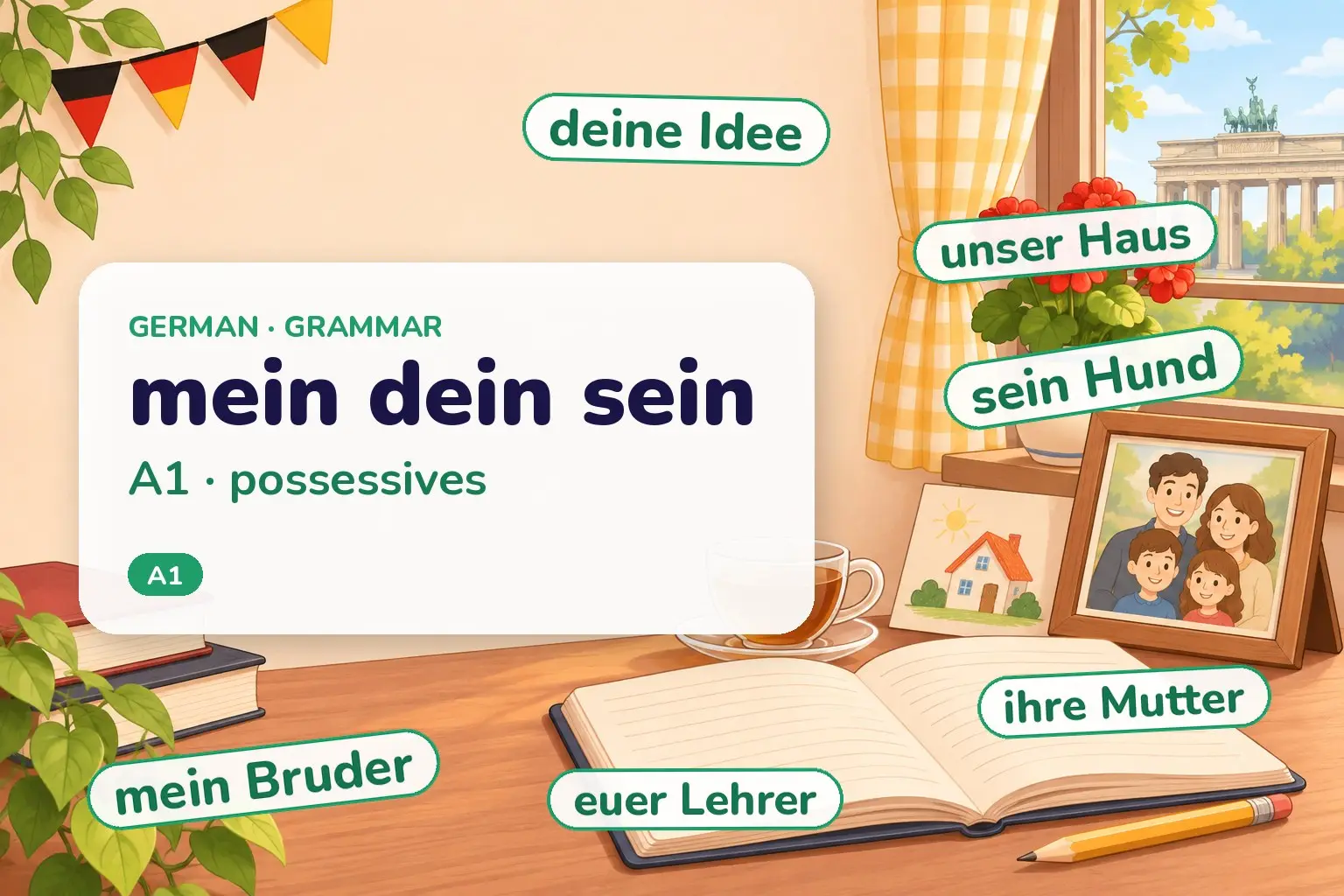
German possessive articles (mein, dein, sein, ihr, unser, euer, Ihr) mean my, your, his, her and so on. They take the same endings as ein and kein, matching the gender and case of the noun that follows.
Level: A1. Possessive articles say who something belongs to — my, your, his, her. In German they behave exactly like the indefinite article ein, so if you already know ein/eine, most of the work is done.
The rule
A possessive article (German Possessivartikel) stands in front of a noun and shows the owner: mein Auto (my car), deine Idee (your idea). Each person has its own base word:
- mein — my
- dein — your (one person you know well)
- sein — his / its
- ihr — her / their
- unser — our
- euer — your (several people you know well)
- Ihr — your (polite, always capitalised)
The base word then takes an ending that copies ein/kein. The ending matches the gender, number and case of the noun that comes after it — not the owner. So mein becomes meine before a feminine noun (meine Mutter) and stays mein before a masculine or neuter one (mein Vater, mein Kind).
The possessive base words
| Person (pronoun) | Possessive | Meaning |
|---|---|---|
| ich | mein | my |
| du | dein | your (informal, one person) |
| er / es | sein | his / its |
| sie (she) | ihr | her |
| wir | unser | our |
| ihr (you all) | euer | your (informal, plural) |
| sie (they) | ihr | their |
| Sie (polite) | Ihr | your (formal) |
The endings (nominative and accusative)
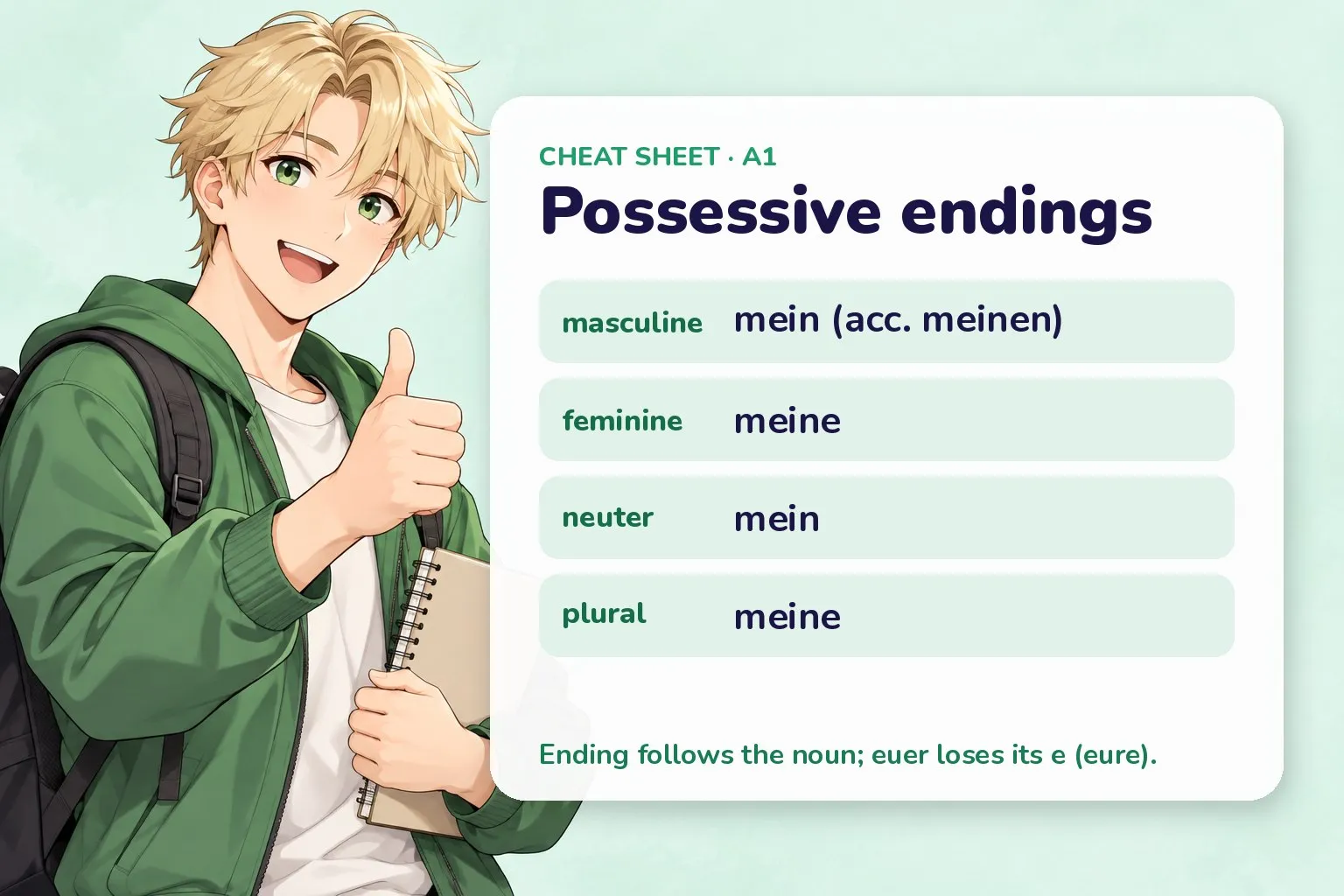
The endings are identical to ein/kein. In the nominative (subject) and accusative (direct object), only the masculine accusative changes:
| Gender / number | Nominative | Accusative | Example (mein) |
|---|---|---|---|
| masculine | mein | meinen | mein Bruder → meinen Bruder |
| feminine | meine | meine | meine Schwester |
| neuter | mein | mein | mein Kind |
| plural | meine | meine | meine Eltern |
Example sentences
- Das ist mein Bruder.That is my brother.masculine, nominative → mein
- Das ist meine Schwester.That is my sister.feminine → meine
- Das ist mein Kind.That is my child.neuter → mein
- Das sind meine Eltern.Those are my parents.plural → meine
- Ist das dein Auto?Is that your car?
- Wo ist deine Tasche?Where is your bag?
- Sein Hund heißt Rex.His dog is called Rex.sein = his
- Ihr Bruder wohnt in Berlin.Her brother lives in Berlin.ihr = her, masculine noun
- Ihre Mutter ist Ärztin.Her mother is a doctor.feminine noun → ihre
- Unser Haus ist klein.Our house is small.
- Unsere Stadt ist schön.Our city is beautiful.
- Wie heißt euer Lehrer?What is your teacher's name?euer, plural you
- Ich liebe meine Arbeit.I love my work.
- Ich sehe deinen Vater.I see your father.masculine accusative → deinen
- Er sucht seinen Schlüssel.He is looking for his key.masculine accusative → seinen
- Wir besuchen unsere Großeltern.We are visiting our grandparents.plural object → unsere
- Hast du meine Nummer?Do you have my number?feminine object stays meine
- Ihr Zug kommt um acht.Their train arrives at eight.ihr = their
- Haben Sie Ihren Ausweis?Do you have your ID?polite Ihr, masculine accusative → Ihren
- Das ist nicht mein Problem.That is not my problem.
Common mistakes
- ❌ meine Bruder → ✅ mein Bruder. Bruder is masculine, so no -e in the nominative.
- ❌ mein Schwester → ✅ meine Schwester. Schwester is feminine, so add -e.
- ❌ Ich sehe mein Vater → ✅ Ich sehe meinen Vater. A masculine direct object takes -en in the accusative.
- ❌ ihre Bruder (for “her brother”) → ✅ ihr Bruder. The ending follows Bruder (masculine), not the female owner.
- ❌ euers Auto → ✅ euer Auto. euer keeps its base form before a neuter noun; it does not add -s.
A short conversation
Am Telefon: — Hallo, ist das dein Handy? Ich finde meine Nummer nicht. — Ja, einen Moment. Wie heißt deine Freundin? — Ihre Mutter hat angerufen. Hast du ihre Nummer?
Usage notes
- Case keeps going: beyond the accusative, the dative adds -em/-er/-em/-en (mit meinem Bruder, mit meiner Schwester). At A1 you mainly need the nominative and accusative above.
- sein vs ihr: sein is “his/its” (owner = er/es); ihr is “her/their” (owner = sie). Decide by looking at who owns the thing, then add the ending for the noun.
- Ihr with a capital letter is the polite “your” and is written with a capital I everywhere in the sentence, which is how you tell it apart from lowercase ihr (her/their).
Compared with…
- ein / eine / ein — the indefinite article, whose endings the possessives copy exactly. See Indefinite Articles: ein / eine / ein.
- kein / keine — the negative “no / not a”, another ein-word with the same endings. It appears in the negation lesson.
- der / die / das — the definite articles, whose gender decides every ending here. See German Articles: Der, Die, Das, and note the accusative case for the masculine -en.
Quick recap before the quiz.
Practice
Possessive article practice
Try each one, then press Check. No sign-up, nothing is sent anywhere — it all runs in your browser.
Show answer
mein — Bruder is masculine, nominative → mein (no ending).
Show answer
deinen — Masculine direct object → accusative -en: deinen.
4 Order the words: 'Her mother is a doctor.'
Show answer
Ihre Mutter ist Ärztin — Mutter is feminine → ihre; here ihr means 'her'.
5 Match each pronoun to its possessive.
- ich
- du
- er
- wir
Show answer
- ich → mein
- du → dein
- er → sein
- wir → unser
Each person has one base possessive word.
Quiz
German possessive articles
12 questions · pick an answer and you'll see straight away if it's right.
-
Show answer
mein — Bruder is masculine, nominative → mein.
-
Show answer
meine — Schwester is feminine → meine.
-
Show answer
sein — sein = his (owner er/es).
-
Show answer
ihr — ihr = her (owner sie).
-
Show answer
meinen — Masculine direct object → accusative meinen.
-
Show answer
Bruder is masculine, so no -e — The ending follows the noun (masculine Bruder), not the owner.
-
Show answer
the noun that follows — Gender, number and case of the following noun decide the ending.
-
Show answer
ein and kein — They are 'ein-words' and decline like ein/kein.
-
Show answer
unsere — Stadt is feminine → unsere.
-
Show answer
Ihr (capital I) — Polite Ihr always keeps a capital I.
-
Show answer
seinen — Masculine accusative → seinen.
-
Show answer
euer Haus — euer keeps its base form before the neuter Haus.
Recap cheat-sheet
| Owner | Possessive | +feminine / plural |
|---|---|---|
| ich / du | mein / dein | meine / deine |
| er, es / sie | sein / ihr | seine / ihre |
| wir / ihr (pl) | unser / euer | unsere / eure |
| Sie (polite) | Ihr | Ihre |
Next
- Previous topic: the negation words nicht and kein
- Back to the German grammar section
- New here? Start with Start Learning German Here
All German grammar topics
Every grammar point in order, from your first sentence to advanced structures. Pick one and go straight to it. New lessons go live every day, so topics marked Coming soon fill in over the next weeks.
Grammar path
A1 16 topics · 12 ready
- 01 German Articles: Der, Die, Das
- 02 Indefinite Articles: ein / eine / ein
- 03 German Personal Pronouns (ich, du, er...)
- 04 Present Tense: Regular Verbs
- 05 The Verbs sein and haben
- 06 W-Questions (wer, was, wo, wie)
- 07 Yes/No Questions (Verb First)
- 08 Stem-Changing Verbs (fahren, essen, lesen)
- 09 Basic Word Order (Verb Second)
- 10 The Accusative Case (Direct Object)
- 11 Negation: nicht vs kein
- 12 Possessive Articles (mein, dein, sein) You are here
- 13 Modal Verbs (können, müssen, wollen) Coming soon
- 14 The Imperative (Commands) Coming soon
- 15 Numbers, Time and Dates Coming soon
- 16 Common Prepositions (basic) Coming soon
A2 19 topics
- 17 The Dative Case (Indirect Object) Coming soon
- 18 Verbs with the Dative (helfen, danken) Coming soon
- 19 Accusative Prepositions (durch, für, ohne) Coming soon
- 20 Dative Prepositions (mit, nach, bei, von, zu) Coming soon
- 21 Two-Way Prepositions (Wechselpräpositionen) Coming soon
- 22 The Perfect Tense (Perfekt) Coming soon
- 23 Perfekt: Choosing haben or sein Coming soon
- 24 Past Participles (Partizip II) Coming soon
- 25 Simple Past (Präteritum): sein, haben, modals Coming soon
- 26 Separable-Prefix Verbs Coming soon
- 27 Inseparable-Prefix Verbs Coming soon
- 28 Comparative and Superlative Coming soon
- 29 Coordinating Conjunctions (und, aber, denn) Coming soon
- 30 Subordinate Clauses (weil, dass) Coming soon
- 31 Reflexive Verbs (sich freuen) Coming soon
- 32 Ein-Words in Accusative and Dative Coming soon
- 33 Pronouns in Accusative and Dative Coming soon
- 34 Requests with möchten and würden Coming soon
- 35 Ordinal Numbers and Dates Coming soon
B1 20 topics
- 36 Adjective Endings after Definite Articles Coming soon
- 37 Adjective Endings after Indefinite Articles Coming soon
- 38 Adjective Endings with No Article Coming soon
- 39 Simple Past (Präteritum): All Verbs Coming soon
- 40 Past Perfect (Plusquamperfekt) Coming soon
- 41 Future Tense (Futur I) Coming soon
- 42 The Genitive Case (Possession) Coming soon
- 43 Genitive Prepositions (wegen, trotz) Coming soon
- 44 Subordinating Conjunctions (als, wenn, obwohl) Coming soon
- 45 als vs wenn (Past vs Repeated) Coming soon
- 46 Infinitive Clauses with zu Coming soon
- 47 Purpose: um...zu vs damit Coming soon
- 48 Relative Clauses (der, die, das) Coming soon
- 49 Dative Reflexive Verbs Coming soon
- 50 Konjunktiv II: würde and Polite/Hypothetical Coming soon
- 51 Conditional Sentences (wenn-Sätze) Coming soon
- 52 Passive Voice: Present (werden) Coming soon
- 53 Verbs with Fixed Prepositions Coming soon
- 54 da- and wo- Compounds (darauf, worauf) Coming soon
- 55 Weak Nouns (N-Declension) Coming soon
B2 18 topics
- 56 Passive in All Tenses and with Modals Coming soon
- 57 Stative Passive (Zustandspassiv) Coming soon
- 58 Passive Alternatives (man, sich lassen) Coming soon
- 59 Konjunktiv II in the Past (hätte gemacht) Coming soon
- 60 Konjunktiv I and Reported Speech Coming soon
- 61 Advanced Relative Clauses (was, wo, Präposition+Pronomen) Coming soon
- 62 Nominalised Adjectives and Participles Coming soon
- 63 Participles as Adjectives (Partizip I/II) Coming soon
- 64 Extended Participle Attributes Coming soon
- 65 Two-Part Connectors (entweder...oder) Coming soon
- 66 Adverbial Connectors (deshalb, trotzdem) Coming soon
- 67 Temporal Clauses (bevor, nachdem, seitdem) Coming soon
- 68 Concessive & Conditional Clauses (obwohl, falls) Coming soon
- 69 Subjective Use of Modal Verbs Coming soon
- 70 Future Perfect (Futur II) Coming soon
- 71 Verb Valency and Objects Coming soon
- 72 Mid-Field Order: Te-Ka-Mo-Lo Coming soon
- 73 Nominal Style (Nominalisierung) Coming soon
C1 11 topics
- 74 Light-Verb Constructions (Funktionsverbgefüge) Coming soon
- 75 Advanced & Impersonal Passive Coming soon
- 76 Advanced Konjunktiv (als ob, Wunschsätze) Coming soon
- 77 Participial & Abbreviated Clauses Coming soon
- 78 Nominalisation vs Verbalisation (Umformung) Coming soon
- 79 Modal Particles (doch, ja, mal, eben, halt) Coming soon
- 80 Formal Connectors & Text Cohesion Coming soon
- 81 Advanced Genitive & Nominal Attributes Coming soon
- 82 Word Formation (Komposita & Derivation) Coming soon
- 83 Reported Speech in Extended Text Coming soon
- 84 Emphasis, Fronting and Inversion Coming soon