Stem-Changing Verbs (fahren, essen, lesen)
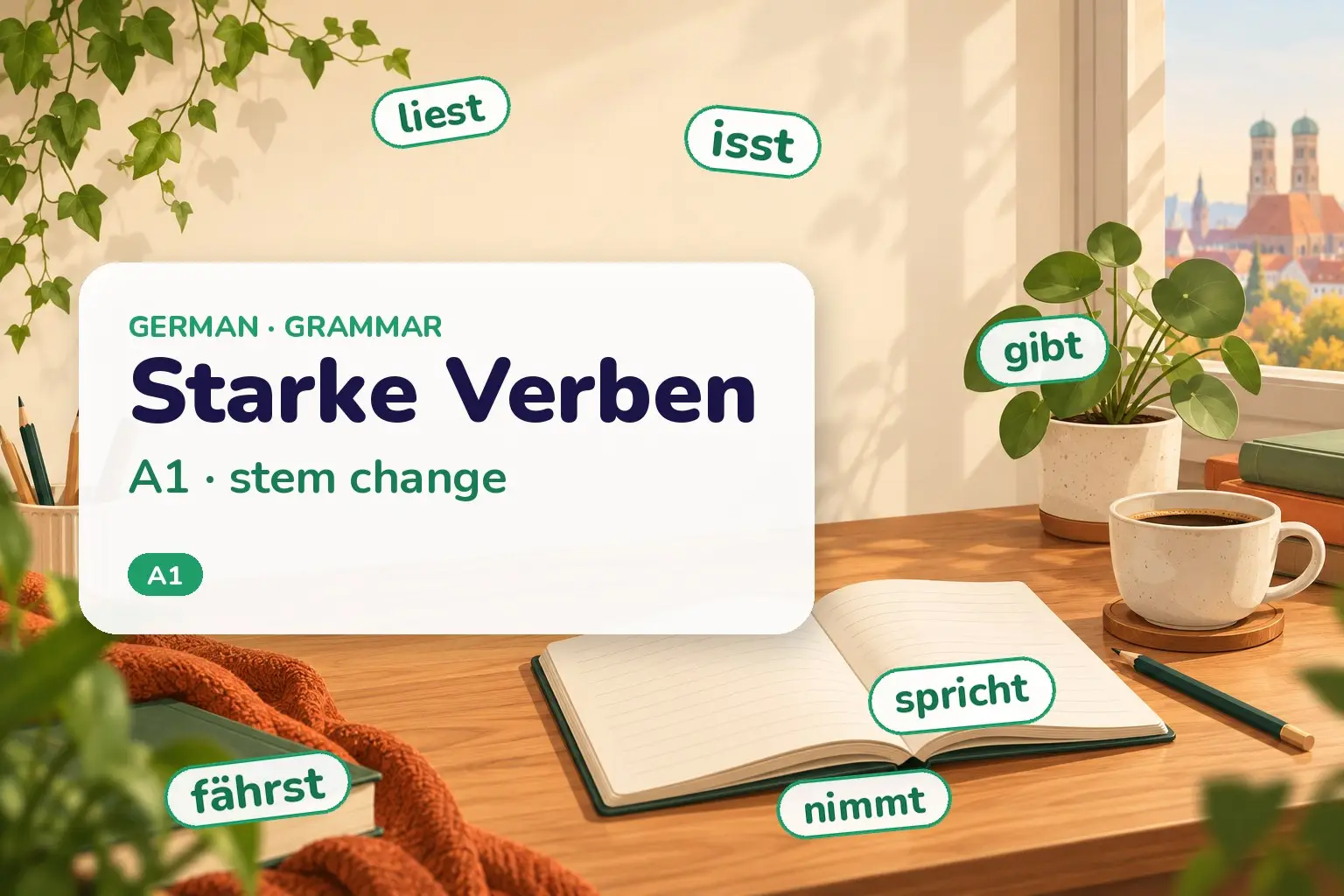
A group of common German verbs are stem-changing: they switch their stem vowel in the du and er/sie/es forms only — a→ä (du fährst), e→i (du isst), e→ie (du liest). Every other form and all the endings stay regular.
Level: A1. You have met the regular present tense. A small but very common group of verbs breaks one part of it: they change their stem vowel in two forms. The endings do not change, so once you spot the pattern these verbs are easy.
The rule
The stem is the part of the verb left after you remove the infinitive -en (fahren → fahr-). For regular verbs that stem never changes; you just add the ending. Stem-changing verbs (also called strong verbs) swap the vowel of the stem — but only in the du and er/sie/es forms. The ich, wir, ihr and sie/Sie forms keep the plain stem.
There are three main switches:
- a → ä: fahren (to drive) → du fährst, er fährt. Also schlafen, tragen, waschen, fallen.
- e → i: essen (to eat) → du isst, er isst. Also geben, sprechen, helfen, treffen, nehmen.
- e → ie: lesen (to read) → du liest, er liest. Also sehen, empfehlen, stehlen.
The endings are exactly the ones you already know: -e, -st, -t, -en, -t, -en. Only the vowel inside the stem moves.
The present-tense forms
| Person | fahren (a→ä) | essen (e→i) | lesen (e→ie) |
|---|---|---|---|
| ich | fahre | esse | lese |
| du | fährst | isst | liest |
| er/sie/es | fährt | isst | liest |
| wir | fahren | essen | lesen |
| ihr | fahrt | esst | lest |
| sie/Sie | fahren | essen | lesen |
Notice how ich, wir, ihr and sie/Sie all keep the original vowel (fahre, fahren, fahrt). The change sits only in the middle two rows.
A few verbs also shift a consonant
| Person | nehmen (to take) | geben (to give) | sprechen (to speak) |
|---|---|---|---|
| ich | nehme | gebe | spreche |
| du | nimmst | gibst | sprichst |
| er/sie/es | nimmt | gibt | spricht |
| wir | nehmen | geben | sprechen |
| ihr | nehmt | gebt | sprecht |
| sie/Sie | nehmen | geben | sprechen |
Nehmen is the one to watch: besides e → i it doubles the m and drops the h, giving du nimmst, er nimmt.
How to say it
A few sounds in these verbs trip up English speakers:
- ä sounds like the “e” in “bed”: fährst ≈ “FEHRST”, trägt ≈ “TREKT”.
- ie is a long “ee”: liest ≈ “LEEST”, siehst ≈ “ZEEST”.
- ss / ß is a sharp “s”: isst ≈ “ist”, isst never has a “z” sound.
- s- at the start of a word before a vowel is a soft “z”: sehen ≈ “ZAY-uhn”, siehst ≈ “ZEEST”.
- sp- at the start sounds like “shp”: sprichst ≈ “SHPRIKHST”.
Example sentences
- Ich fahre nach Berlin.I'm driving to Berlin.ich: plain stem
- Du fährst zu schnell.You drive too fast.a→ä in du
- Er fährt jeden Tag zur Arbeit.He drives to work every day.a→ä in er
- Wir fahren zusammen in den Urlaub.We travel on holiday together.wir: plain stem
- Ich lese am Abend gern.I like to read in the evening.ich: plain stem
- Liest du dieses Buch?Are you reading this book?e→ie in du
- Sie liest die Zeitung.She reads the newspaper.e→ie in sie (she)
- Was isst du zum Frühstück?What do you eat for breakfast?e→i, du isst
- Er isst einen Apfel.He is eating an apple.e→i, er isst
- Wir essen um sieben Uhr.We eat at seven o'clock.wir: plain stem
- Sprichst du Deutsch?Do you speak German?e→i, du sprichst
- Sie spricht drei Sprachen.She speaks three languages.e→i in sie
- Nimmst du Zucker im Kaffee?Do you take sugar in your coffee?nehmen: du nimmst
- Er nimmt den Bus zur Schule.He takes the bus to school.nehmen: er nimmt
- Du gibst mir das Buch.You give me the book.e→i, du gibst
- Sie gibt dem Kind einen Keks.She gives the child a biscuit.e→i, sie gibt
- Er schläft bis zehn Uhr.He sleeps until ten.a→ä, schlafen
- Sie trägt eine rote Jacke.She is wearing a red jacket.a→ä, tragen
- Siehst du den Film heute Abend?Are you watching the film tonight?e→ie, sehen
- Er hilft seiner Mutter im Garten.He helps his mother in the garden.e→i, helfen
Common mistakes
- ❌ Du fahrst zu schnell. → ✅ Du fährst zu schnell. The a becomes ä in the du form.
- ❌ Ich spriche Deutsch. → ✅ Ich spreche Deutsch. The ich form never changes the vowel.
- ❌ Wir fähren nach Köln. → ✅ Wir fahren nach Köln. wir keeps the plain stem.
- ❌ Er nehmt den Bus. → ✅ Er nimmt den Bus. nehmen becomes nimmt — new vowel, double m, no h.
- ❌ Du liesst viel. → ✅ Du liest viel. The stem lies- already ends in s, so the du form adds only -t.
A short conversation
— Was liest du gerade? — Ich lese einen Krimi. Fährst du morgen nach Hause? — Ja, ich fahre um acht. Nimmst du den Zug? — Nein, ich esse zuerst, dann nehme ich das Auto.
Usage notes
- Present tense only. The vowel switch belongs to the present. The simple past and the participle follow their own patterns (fahren → fuhr → gefahren), learned later.
- A small au → äu group. laufen (to run/walk) and saufen behave the same way with au: du läufst, er läuft.
- The informal imperative keeps an e-change, drops an a-change. Say Iss! (Eat!), Lies! (Read!), Sprich! (Speak!) and Nimm! (Take!) — but Fahr! (Drive!) and Schlaf! (Sleep!) with the plain vowel.
- Modal verbs change in the singular too (ich kann, du kannst) but in a different way; they are a separate topic.
Compared with regular present-tense verbs
Regular verbs (see regular present tense) keep one fixed stem and only add endings: machen → ich mache, du machst, er macht. Stem-changing verbs use the same endings but alter the vowel in du and er/sie/es. So the only thing extra to learn here is the vowel — compare du machst (no change) with du fährst (a→ä). When in doubt, treat a verb as regular unless your dictionary or this list tells you it is strong; you can also warm up with the verbs sein and haben, which are irregular in their own way.
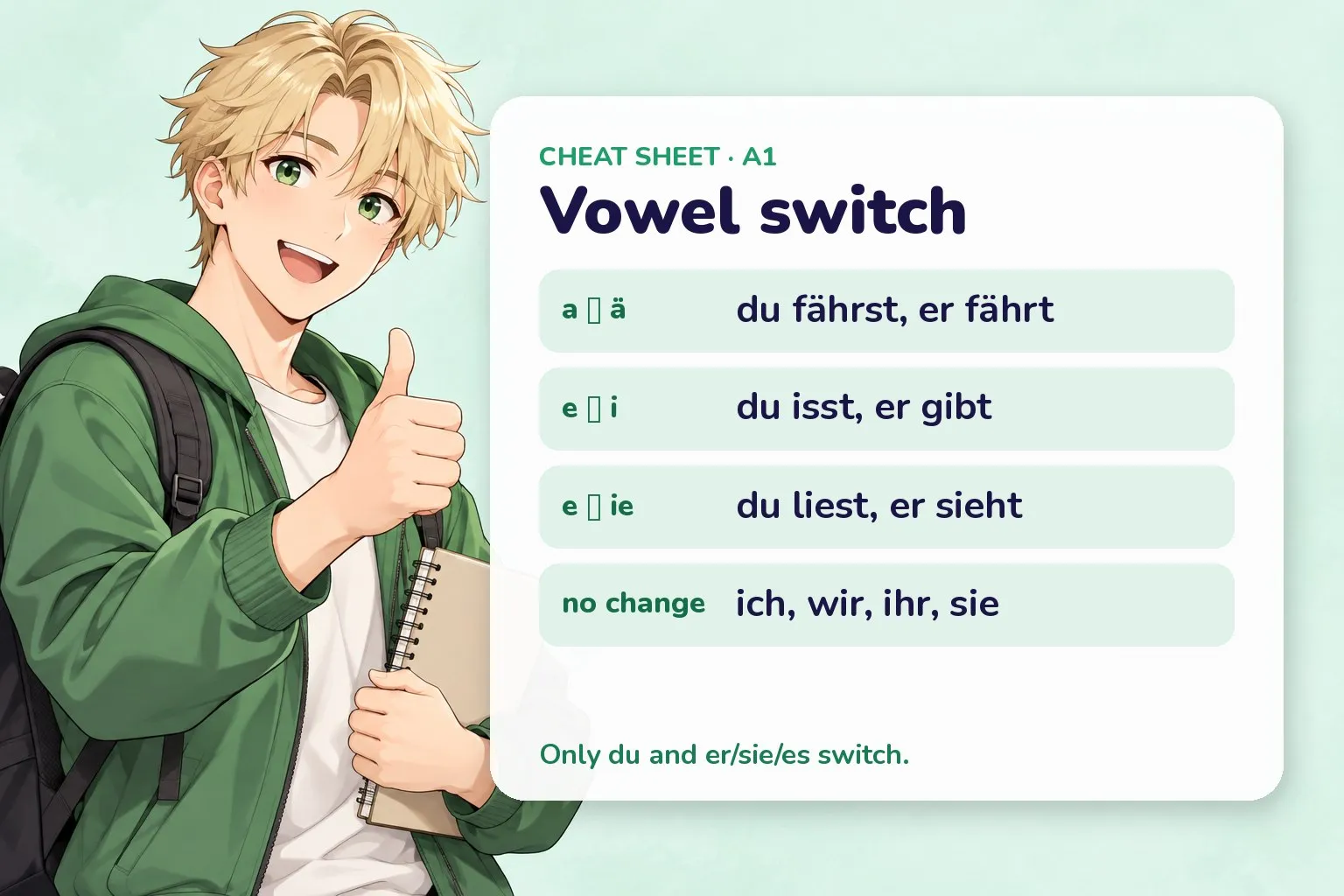
Quick recap before the quiz.
Practice
Stem-changing verbs practice
Try each one, then press Check. No sign-up, nothing is sent anywhere — it all runs in your browser.
Hint: e→ie in the er/sie/es form
Show answer
liest — lesen changes e→ie: sie liest.
3 Build: 'He takes the bus.'
Show answer
Er nimmt den Bus — nehmen: er nimmt (e→i, double m, no h).
4 Match each verb to its du form.
- fahren
- essen
- lesen
- nehmen
Show answer
- fahren → fährst
- essen → isst
- lesen → liest
- nehmen → nimmst
a→ä fährst, e→i isst, e→ie liest, special nimmst.
Hint: e→i, and the stem ends in s
Show answer
isst — essen → du isst (e→i; only -t after the s-sound).
Quiz
German stem-changing verbs
12 questions · pick an answer and you'll see straight away if it's right.
-
Show answer
du and er/sie/es — Only du and er/sie/es take the new vowel.
-
Show answer
trägst — a→ä in du: du trägst.
-
Show answer
sieht — e→ie in er/sie/es: er sieht.
-
Show answer
esse — The ich form does not change: ich esse.
-
Show answer
nimmst — nehmen → du nimmst (e→i, double m, no h).
-
Show answer
fahren — wir keeps the plain stem: wir fahren.
-
Show answer
Sprichst — e→i in du: Sprichst du?
-
Show answer
the stem lies- already ends in s, so add only -t — After an s-sound the du form adds only -t: du liest.
-
Show answer
gibt — e→i in er/sie/es: sie gibt.
-
Show answer
schläft — a→ä in er: er schläft.
-
Show answer
Iss! — The informal imperative keeps the e→i change and drops the ending: Iss!
-
Show answer
Liest — e→ie in du: Liest du gern?
Recap cheat-sheet
| Switch | Verbs | du / er form |
|---|---|---|
| a → ä | fahren, schlafen, tragen | du fährst, er fährt |
| e → i | essen, geben, sprechen, helfen | du isst, er gibt |
| e → ie | lesen, sehen, empfehlen | du liest, er sieht |
| special | nehmen | du nimmst, er nimmt |
| no change | ich, wir, ihr, sie/Sie | ich fahre, wir fahren |
Next
- Back to the German grammar section
- Practise reading these verbs: German Reading Practice: Intermediate (B1)
- New here? Start with Start Learning German Here
All German grammar topics
Every grammar point in order, from your first sentence to advanced structures. Pick one and go straight to it. New lessons go live every day, so topics marked Coming soon fill in over the next weeks.
Grammar path
A1 16 topics · 12 ready
- 01 German Articles: Der, Die, Das
- 02 Indefinite Articles: ein / eine / ein
- 03 German Personal Pronouns (ich, du, er...)
- 04 Present Tense: Regular Verbs
- 05 The Verbs sein and haben
- 06 W-Questions (wer, was, wo, wie)
- 07 Yes/No Questions (Verb First)
- 08 Stem-Changing Verbs (fahren, essen, lesen) You are here
- 09 Basic Word Order (Verb Second)
- 10 The Accusative Case (Direct Object)
- 11 Negation: nicht vs kein
- 12 Possessive Articles (mein, dein, sein)
- 13 Modal Verbs (können, müssen, wollen) Coming soon
- 14 The Imperative (Commands) Coming soon
- 15 Numbers, Time and Dates Coming soon
- 16 Common Prepositions (basic) Coming soon
A2 19 topics
- 17 The Dative Case (Indirect Object) Coming soon
- 18 Verbs with the Dative (helfen, danken) Coming soon
- 19 Accusative Prepositions (durch, für, ohne) Coming soon
- 20 Dative Prepositions (mit, nach, bei, von, zu) Coming soon
- 21 Two-Way Prepositions (Wechselpräpositionen) Coming soon
- 22 The Perfect Tense (Perfekt) Coming soon
- 23 Perfekt: Choosing haben or sein Coming soon
- 24 Past Participles (Partizip II) Coming soon
- 25 Simple Past (Präteritum): sein, haben, modals Coming soon
- 26 Separable-Prefix Verbs Coming soon
- 27 Inseparable-Prefix Verbs Coming soon
- 28 Comparative and Superlative Coming soon
- 29 Coordinating Conjunctions (und, aber, denn) Coming soon
- 30 Subordinate Clauses (weil, dass) Coming soon
- 31 Reflexive Verbs (sich freuen) Coming soon
- 32 Ein-Words in Accusative and Dative Coming soon
- 33 Pronouns in Accusative and Dative Coming soon
- 34 Requests with möchten and würden Coming soon
- 35 Ordinal Numbers and Dates Coming soon
B1 20 topics
- 36 Adjective Endings after Definite Articles Coming soon
- 37 Adjective Endings after Indefinite Articles Coming soon
- 38 Adjective Endings with No Article Coming soon
- 39 Simple Past (Präteritum): All Verbs Coming soon
- 40 Past Perfect (Plusquamperfekt) Coming soon
- 41 Future Tense (Futur I) Coming soon
- 42 The Genitive Case (Possession) Coming soon
- 43 Genitive Prepositions (wegen, trotz) Coming soon
- 44 Subordinating Conjunctions (als, wenn, obwohl) Coming soon
- 45 als vs wenn (Past vs Repeated) Coming soon
- 46 Infinitive Clauses with zu Coming soon
- 47 Purpose: um...zu vs damit Coming soon
- 48 Relative Clauses (der, die, das) Coming soon
- 49 Dative Reflexive Verbs Coming soon
- 50 Konjunktiv II: würde and Polite/Hypothetical Coming soon
- 51 Conditional Sentences (wenn-Sätze) Coming soon
- 52 Passive Voice: Present (werden) Coming soon
- 53 Verbs with Fixed Prepositions Coming soon
- 54 da- and wo- Compounds (darauf, worauf) Coming soon
- 55 Weak Nouns (N-Declension) Coming soon
B2 18 topics
- 56 Passive in All Tenses and with Modals Coming soon
- 57 Stative Passive (Zustandspassiv) Coming soon
- 58 Passive Alternatives (man, sich lassen) Coming soon
- 59 Konjunktiv II in the Past (hätte gemacht) Coming soon
- 60 Konjunktiv I and Reported Speech Coming soon
- 61 Advanced Relative Clauses (was, wo, Präposition+Pronomen) Coming soon
- 62 Nominalised Adjectives and Participles Coming soon
- 63 Participles as Adjectives (Partizip I/II) Coming soon
- 64 Extended Participle Attributes Coming soon
- 65 Two-Part Connectors (entweder...oder) Coming soon
- 66 Adverbial Connectors (deshalb, trotzdem) Coming soon
- 67 Temporal Clauses (bevor, nachdem, seitdem) Coming soon
- 68 Concessive & Conditional Clauses (obwohl, falls) Coming soon
- 69 Subjective Use of Modal Verbs Coming soon
- 70 Future Perfect (Futur II) Coming soon
- 71 Verb Valency and Objects Coming soon
- 72 Mid-Field Order: Te-Ka-Mo-Lo Coming soon
- 73 Nominal Style (Nominalisierung) Coming soon
C1 11 topics
- 74 Light-Verb Constructions (Funktionsverbgefüge) Coming soon
- 75 Advanced & Impersonal Passive Coming soon
- 76 Advanced Konjunktiv (als ob, Wunschsätze) Coming soon
- 77 Participial & Abbreviated Clauses Coming soon
- 78 Nominalisation vs Verbalisation (Umformung) Coming soon
- 79 Modal Particles (doch, ja, mal, eben, halt) Coming soon
- 80 Formal Connectors & Text Cohesion Coming soon
- 81 Advanced Genitive & Nominal Attributes Coming soon
- 82 Word Formation (Komposita & Derivation) Coming soon
- 83 Reported Speech in Extended Text Coming soon
- 84 Emphasis, Fronting and Inversion Coming soon