The Verbs sein and haben
Sein (to be) and haben (to have) are the two most useful German verbs, and both are irregular: ich bin, du bist, er ist and ich habe, du hast, er hat. Use sein for who or where you are, haben for what you own.
Level: A1. Sein (to be) and haben (to have) are the two verbs you reach for most in German — to say who you are, how you feel and what you own. Both are irregular, so there is no ending rule to apply; you learn their six present-tense forms by heart.
The rule
A verb is a word for an action or a state. Sein names the state of being; haben names having. The set of forms a verb takes for each subject is its conjugation, and because these two are irregular, the forms do not follow the stem-plus-ending pattern of regular verbs — you memorise them.
Sein answers who or what someone is, where they are, and how they feel: Ich bin Lehrer (I am a teacher), Wir sind zu Hause (We are at home). In German it also states age: Ich bin zwanzig (I am twenty).
Haben says what you possess or hold: Ich habe ein Auto (I have a car). It also carries a group of fixed feelings where English uses “to be”: Ich habe Hunger (I am hungry, literally “I have hunger”), Durst (thirst), Angst (fear), Zeit (time).
Forms
| Subject | sein (to be) | haben (to have) |
|---|---|---|
| ich | bin | habe |
| du | bist | hast |
| er / sie / es | ist | hat |
| wir | sind | haben |
| ihr | seid | habt |
| sie / Sie | sind | haben |
Notice that wir, sie (they) and the polite Sie share the same form in both verbs: sind for sein, haben for haben. The subject tells them apart.
How to say it
German spelling is regular once you know a few sounds in these forms:
| Sound | How to say it |
|---|---|
| ei in sein/seid | Say “eye”: sein ≈ “zine”, seid ≈ “zite”. |
| s before a vowel | A soft “z”: sein starts like “z”, sind ≈ “zint”. |
| final -d in sind | Devoiced to “t”: sind ≈ “zint”. |
| h in haben | A clear breathy “h”: haben ≈ “HAH-ben”. |
| final -bt in habt | The b hardens to “p”: habt ≈ “hahpt”. |
Example sentences
- Ich bin Lehrer.I am a teacher.identity
- Du bist nett.You are nice.du bist, informal you
- Er ist zu Hause.He is at home.er ist, no -s
- Wir sind Freunde.We are friends.
- Ihr seid spät.You (all) are late.ihr seid
- Sie sind aus Berlin.They are from Berlin.origin
- Ich bin zwanzig Jahre alt.I am twenty years old.age uses sein
- Bist du müde?Are you tired?state / feeling
- Das Wetter ist schön.The weather is nice.
- Ich habe ein Auto.I have a car.possession
- Hast du Zeit?Do you have time?
- Sie hat zwei Kinder.She has two children.sie hat
- Wir haben Hunger.We are hungry.haben for hunger
- Habt ihr Durst?Are you (all) thirsty?
- Die Kinder haben Angst.The children are afraid.haben + Angst
- Ich habe eine Frage.I have a question.
- Er ist Arzt und hat ein Büro.He is a doctor and has an office.sein and haben together
- Sind Sie Herr Klein?Are you Mr Klein?polite Sie
Common mistakes
- ❌ Ich habe zwanzig Jahre → ✅ Ich bin zwanzig (Jahre alt). German states age with sein, not haben.
- ❌ Er hast ein Auto → ✅ Er hat ein Auto. The er/sie/es form of haben is hat, with no -s.
- ❌ Du bis nett → ✅ Du bist nett. The du form of sein keeps its -t: bist.
- ❌ Ihr seit spät → ✅ Ihr seid spät. seid (you are) ends in -d; seit with -t means “since”.
- ❌ Ich bin Hunger → ✅ Ich habe Hunger. Hunger, thirst and fear take haben, not sein.
- ❌ Wir sein Freunde → ✅ Wir sind Freunde. A plural subject takes sind, not the infinitive sein.
A short conversation
— Hallo! Bist du neu hier? — Ja, ich bin aus Hamburg. Ich habe eine Frage. — Klar. Wir sind alle freundlich hier. Hast du schon einen Ausweis? — Noch nicht, aber ich habe Zeit heute.
Usage notes
- Sein for identity, origin, place and age. Who you are (ich bin Lehrer), where you are from (ich bin aus Berlin), where you are (wir sind zu Hause) and how old you are (ich bin dreißig) all use sein.
- Haben for the body’s states. Hunger, Durst, Angst, Zeit, Glück and a cold (Ich habe Schnupfen) take haben, where English says “to be” or “to have a…”.
- The polite Sie is always plural in form. Sind Sie…? and Haben Sie…? use the wir/sie-forms, capitalised, for one person or many when you are being formal.
- Both verbs are auxiliaries later. The perfect tense uses them as helpers: Ich habe gegessen (I have eaten), Ich bin gegangen (I have gone). The forms you learn here come straight back.
Compared with…
- Regular verbs (e.g. machen, to do/make): mache, machst, macht, machen, macht, machen. Regular verbs build from a stem plus predictable endings, so once you know machen you know most verbs. Sein and haben break that pattern and must be memorised.
- Werden (to become): werde, wirst, wird, werden, werdet, werden. Werden marks change (Es wird kalt — it is getting cold) and later forms the future tense. Keep it apart from sein (a fixed state) and haben (possession).
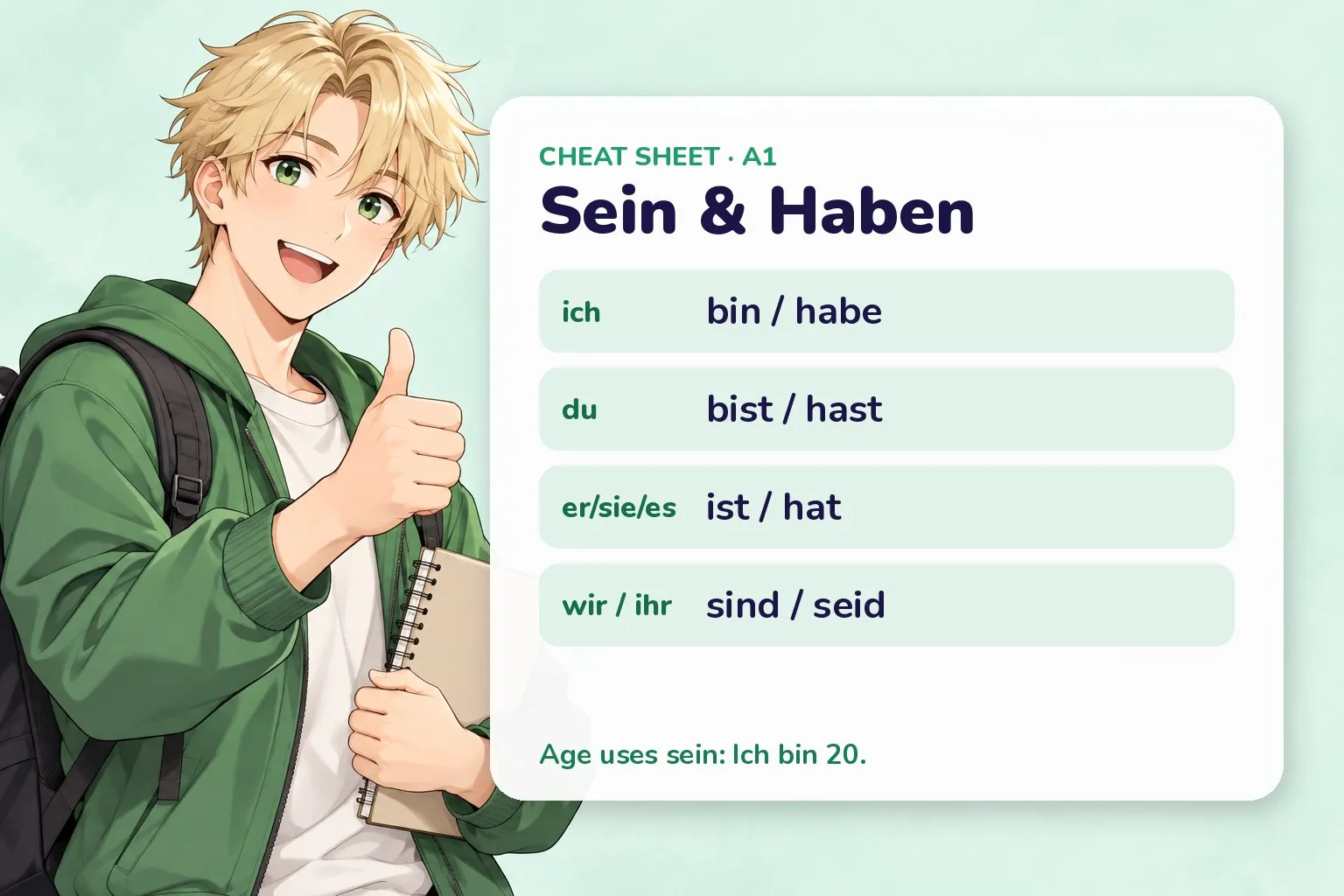
Quick recap before the quiz.
Practice
sein and haben practice
Try each one, then press Check. No sign-up, nothing is sent anywhere — it all runs in your browser.
Hint: the er/sie/es form of haben, no -s
Show answer
hat — er hat — the third person singular of haben has no -s.
3 Build: 'We are friends.'
Show answer
Wir sind Freunde — wir sind Freunde — wir takes sind.
4 Match each subject to its form of sein.
- ich
- du
- er/sie/es
- ihr
Show answer
- ich → bin
- du → bist
- er/sie/es → ist
- ihr → seid
ich bin, du bist, er ist, ihr seid.
Hint: hunger takes the verb to have
Show answer
haben — Hunger, Durst and Angst take haben: wir haben Hunger.
Quiz
sein and haben
12 questions · pick an answer and you'll see straight away if it's right.
-
Show answer
bin — ich bin.
-
Show answer
bist — du bist.
-
Show answer
ist — er/sie/es ist.
-
Show answer
sind — wir sind.
-
Show answer
seid — ihr seid.
-
Show answer
hast — du hast.
-
Show answer
hat — er/sie/es hat — no -s.
-
Show answer
habt — ihr habt.
-
Show answer
Ich habe Hunger. — Hunger takes haben: Ich habe Hunger.
-
Show answer
seid — ihr seid — ends in -d, not -t.
-
Show answer
Er hast ein Auto. — It should be er hat, not er hast.
-
Show answer
bin — Age uses sein: ich bin zwanzig.
Recap cheat-sheet
| Subject | sein | haben |
|---|---|---|
| ich | bin | habe |
| du | bist | hast |
| er/sie/es | ist | hat |
| wir / sie / Sie | sind | haben |
| ihr | seid | habt |
Next
- Back to the German grammar section
- New here? Start with Start Learning German Here
All German grammar topics
Every grammar point in order, from your first sentence to advanced structures. Pick one and go straight to it. New lessons go live every day, so topics marked Coming soon fill in over the next weeks.
Grammar path
A1 16 topics · 12 ready
- 01 German Articles: Der, Die, Das
- 02 Indefinite Articles: ein / eine / ein
- 03 German Personal Pronouns (ich, du, er...)
- 04 Present Tense: Regular Verbs
- 05 The Verbs sein and haben You are here
- 06 W-Questions (wer, was, wo, wie)
- 07 Yes/No Questions (Verb First)
- 08 Stem-Changing Verbs (fahren, essen, lesen)
- 09 Basic Word Order (Verb Second)
- 10 The Accusative Case (Direct Object)
- 11 Negation: nicht vs kein
- 12 Possessive Articles (mein, dein, sein)
- 13 Modal Verbs (können, müssen, wollen) Coming soon
- 14 The Imperative (Commands) Coming soon
- 15 Numbers, Time and Dates Coming soon
- 16 Common Prepositions (basic) Coming soon
A2 19 topics
- 17 The Dative Case (Indirect Object) Coming soon
- 18 Verbs with the Dative (helfen, danken) Coming soon
- 19 Accusative Prepositions (durch, für, ohne) Coming soon
- 20 Dative Prepositions (mit, nach, bei, von, zu) Coming soon
- 21 Two-Way Prepositions (Wechselpräpositionen) Coming soon
- 22 The Perfect Tense (Perfekt) Coming soon
- 23 Perfekt: Choosing haben or sein Coming soon
- 24 Past Participles (Partizip II) Coming soon
- 25 Simple Past (Präteritum): sein, haben, modals Coming soon
- 26 Separable-Prefix Verbs Coming soon
- 27 Inseparable-Prefix Verbs Coming soon
- 28 Comparative and Superlative Coming soon
- 29 Coordinating Conjunctions (und, aber, denn) Coming soon
- 30 Subordinate Clauses (weil, dass) Coming soon
- 31 Reflexive Verbs (sich freuen) Coming soon
- 32 Ein-Words in Accusative and Dative Coming soon
- 33 Pronouns in Accusative and Dative Coming soon
- 34 Requests with möchten and würden Coming soon
- 35 Ordinal Numbers and Dates Coming soon
B1 20 topics
- 36 Adjective Endings after Definite Articles Coming soon
- 37 Adjective Endings after Indefinite Articles Coming soon
- 38 Adjective Endings with No Article Coming soon
- 39 Simple Past (Präteritum): All Verbs Coming soon
- 40 Past Perfect (Plusquamperfekt) Coming soon
- 41 Future Tense (Futur I) Coming soon
- 42 The Genitive Case (Possession) Coming soon
- 43 Genitive Prepositions (wegen, trotz) Coming soon
- 44 Subordinating Conjunctions (als, wenn, obwohl) Coming soon
- 45 als vs wenn (Past vs Repeated) Coming soon
- 46 Infinitive Clauses with zu Coming soon
- 47 Purpose: um...zu vs damit Coming soon
- 48 Relative Clauses (der, die, das) Coming soon
- 49 Dative Reflexive Verbs Coming soon
- 50 Konjunktiv II: würde and Polite/Hypothetical Coming soon
- 51 Conditional Sentences (wenn-Sätze) Coming soon
- 52 Passive Voice: Present (werden) Coming soon
- 53 Verbs with Fixed Prepositions Coming soon
- 54 da- and wo- Compounds (darauf, worauf) Coming soon
- 55 Weak Nouns (N-Declension) Coming soon
B2 18 topics
- 56 Passive in All Tenses and with Modals Coming soon
- 57 Stative Passive (Zustandspassiv) Coming soon
- 58 Passive Alternatives (man, sich lassen) Coming soon
- 59 Konjunktiv II in the Past (hätte gemacht) Coming soon
- 60 Konjunktiv I and Reported Speech Coming soon
- 61 Advanced Relative Clauses (was, wo, Präposition+Pronomen) Coming soon
- 62 Nominalised Adjectives and Participles Coming soon
- 63 Participles as Adjectives (Partizip I/II) Coming soon
- 64 Extended Participle Attributes Coming soon
- 65 Two-Part Connectors (entweder...oder) Coming soon
- 66 Adverbial Connectors (deshalb, trotzdem) Coming soon
- 67 Temporal Clauses (bevor, nachdem, seitdem) Coming soon
- 68 Concessive & Conditional Clauses (obwohl, falls) Coming soon
- 69 Subjective Use of Modal Verbs Coming soon
- 70 Future Perfect (Futur II) Coming soon
- 71 Verb Valency and Objects Coming soon
- 72 Mid-Field Order: Te-Ka-Mo-Lo Coming soon
- 73 Nominal Style (Nominalisierung) Coming soon
C1 11 topics
- 74 Light-Verb Constructions (Funktionsverbgefüge) Coming soon
- 75 Advanced & Impersonal Passive Coming soon
- 76 Advanced Konjunktiv (als ob, Wunschsätze) Coming soon
- 77 Participial & Abbreviated Clauses Coming soon
- 78 Nominalisation vs Verbalisation (Umformung) Coming soon
- 79 Modal Particles (doch, ja, mal, eben, halt) Coming soon
- 80 Formal Connectors & Text Cohesion Coming soon
- 81 Advanced Genitive & Nominal Attributes Coming soon
- 82 Word Formation (Komposita & Derivation) Coming soon
- 83 Reported Speech in Extended Text Coming soon
- 84 Emphasis, Fronting and Inversion Coming soon