Basic Word Order (Verb Second)
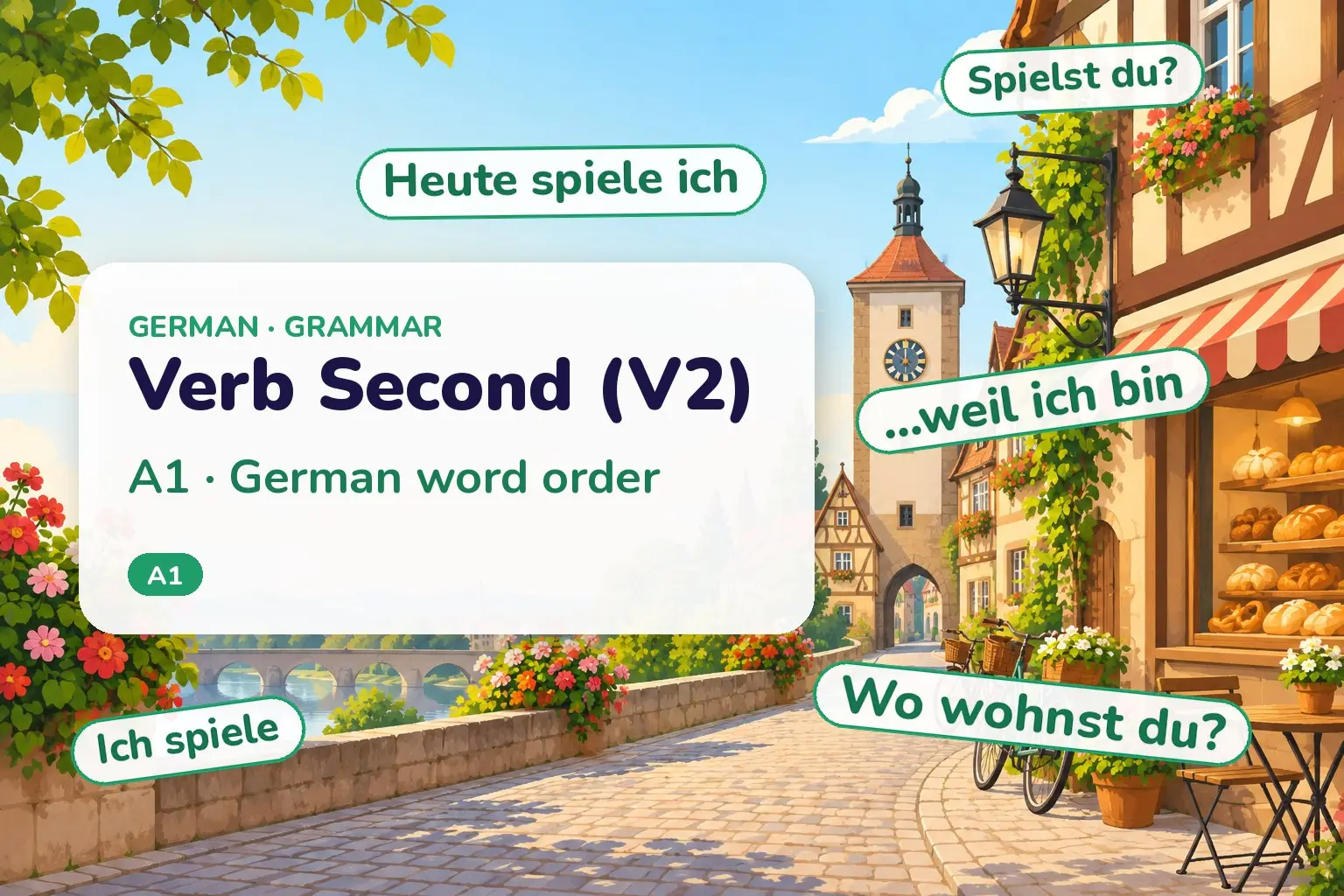
In a German statement the finite verb is always the second element. One piece of information comes first — the subject, a time word, or an object — then the verb, then the rest. If something other than the subject is first, the subject moves right after the verb.
Level: A1. German is a verb-second (V2) language: in a normal statement the conjugated verb sits in the second position, no matter what comes first. Once you see a sentence as “one element, then the verb”, German word order stops feeling random.
The rule
A finite verb is the conjugated verb — the one that changes for the subject (ich spiele, du spielst). In a German main-clause statement, that verb always holds the second position.
“Second position” counts elements, not words. The first position (the Vorfeld) takes exactly one element: it can be the subject, a time expression, a place, or an object. Whatever you choose, the finite verb comes right after it.
- Subject first: Ich | lerne | heute Deutsch. — “I am learning German today.”
- Time first: Heute | lerne | ich Deutsch. — “Today I am learning German.”
- Object first: Deutsch | lerne | ich gern. — “German, I like to learn.”
Notice what happens when the subject is not first: it moves to right after the verb. This swap is called inversion. The verb never moves out of position two — the subject does the moving.
The verb-second rule at a glance
| Position 1 (one element) | Position 2 (finite verb) | Rest |
|---|---|---|
| Ich | lerne | heute Deutsch. |
| Heute | lerne | ich Deutsch. |
| Deutsch | lerne | ich gern. |
| Am Montag | spielt | er Fußball. |
| Meine Schwester | wohnt | in Hamburg. |
How to say it
German spelling is regular; a few sounds in these sentences trip English speakers:
- w sounds like English “v”: wohnt ≈ “VOHNT”, wir ≈ “veer”.
- z is “ts”: zur ≈ “tsoor”, zusammen ≈ “tsoo-ZAM-men”.
- ei = “eye” (meine ≈ “MY-nuh”); ie = “ee” (Sie ≈ “zee”).
- sp- / st- at the start of a word sound like “shp” / “sht”: spielt ≈ “shpeelt”, Stadt ≈ “shtat”.
Example sentences
- Ich lerne heute Deutsch.I am learning German today.subject first
- Heute lerne ich Deutsch.Today I am learning German.time first, inversion
- Deutsch lerne ich gern.German, I like to learn.object first
- Am Montag spielt er Fußball.On Monday he plays football.
- Morgen fahren wir nach Berlin.Tomorrow we are going to Berlin.
- Meine Schwester wohnt in Hamburg.My sister lives in Hamburg.
- Zum Frühstück trinke ich Kaffee.For breakfast I drink coffee.phrase first, inversion
- Jeden Tag gehe ich zur Arbeit.Every day I go to work.
- Leider habe ich keine Zeit.Unfortunately I have no time.adverb first
- Nächstes Jahr besuche ich Italien.Next year I will visit Italy.
- Das Buch lese ich am Abend.The book I read in the evening.object first
- Jetzt verstehe ich das Problem.Now I understand the problem.
- Natürlich helfe ich dir.Of course I will help you.
- Nach der Arbeit treffe ich meine Freunde.After work I meet my friends.
- Hier wohnt meine Familie.My family lives here.
- Am Wochenende bleiben wir zu Hause.At the weekend we stay at home.
- In der Schule lernen die Kinder Englisch.At school the children learn English.
- Mein kleiner Bruder spielt gern Gitarre.My little brother likes to play guitar.whole phrase = one element
Common mistakes
- ❌ Heute ich lerne Deutsch. → ✅ Heute lerne ich Deutsch. Only one element goes before the verb; when the time word is first, the subject moves behind the verb.
- ❌ Ich heute lerne Deutsch. → ✅ Ich lerne heute Deutsch. The verb must be second; heute cannot slip between the subject and the verb.
- ❌ Morgen wir fahren nach Berlin. → ✅ Morgen fahren wir nach Berlin. After a fronted time word you must invert: verb, then subject.
- ❌ Natürlich ich helfe dir. → ✅ Natürlich helfe ich dir. A fronted adverb still forces inversion.
- ❌ Weil ich bin müde. → ✅ Weil ich müde bin. In a subordinate clause the finite verb goes to the very end, not to position two.
A short conversation
— Was machst du am Wochenende? — Am Samstag spiele ich Fußball. Am Sonntag besuche ich meine Eltern. — Schön! Fährst du mit dem Zug? — Nein, mit dem Zug fahre ich nicht. Ich nehme das Auto.
Usage notes
- Position counts elements, not words. A long subject like Mein kleiner Bruder is still one element, so Mein kleiner Bruder spielt Gitarre keeps the verb second.
- Coordinating conjunctions sit in “position zero”. und, aber, oder, denn, sondern do not count as position one, so the normal order continues after them: Ich lerne Deutsch, und er lernt Spanisch.
- Separable verbs split. The conjugated part stays second and the prefix goes to the end: Ich stehe früh auf (“I get up early”).
- The present also covers the near future with a time word: Morgen fahre ich nach Berlin (“Tomorrow I’ll go to Berlin”).
Compared with questions and clauses
The V2 rule is for plain statements. Three related structures move the verb differently:
- W-questions keep the verb second: the question word is the first element — Wo wohnst du? (“Where do you live?”). See German W-Questions.
- Yes/no questions put the verb first: Spielst du Fußball? (“Do you play football?”). See Yes/No Questions in German.
- Subordinate clauses send the verb to the end: …, weil ich müde bin (“…because I am tired”). To review the verb forms themselves, see Present Tense: Regular Verbs.
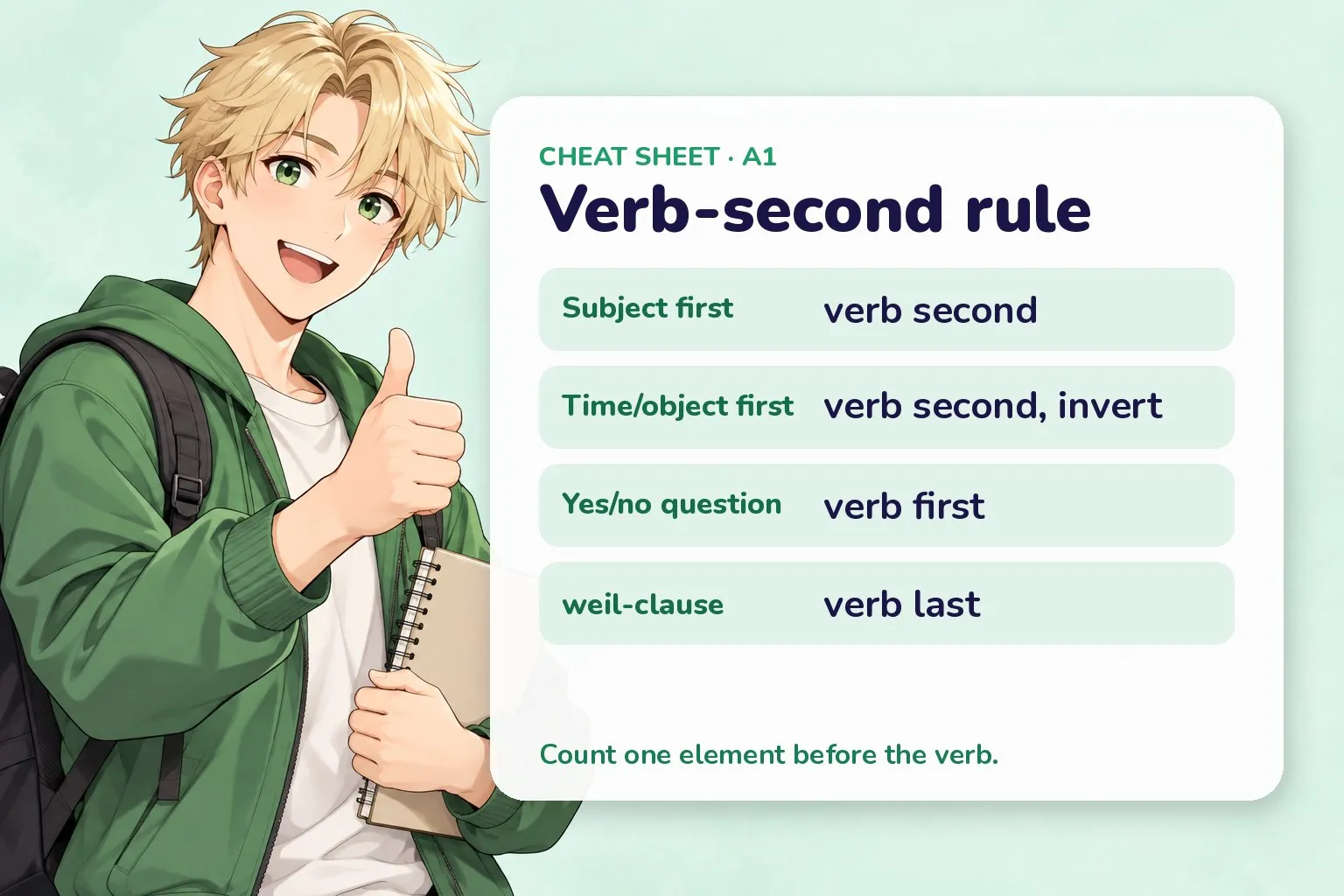
Quick recap before the quiz.
Practice
Verb-second word order practice
Try each one, then press Check. No sign-up, nothing is sent anywhere — it all runs in your browser.
Hint: the verb is second, so it comes right after Morgen
Show answer
fahre — ich + fahren = fahre, in position two: Morgen fahre ich nach Berlin.
3 Build: 'Tomorrow we are going to Berlin.'
Show answer
Morgen fahren wir nach Berlin — Fronted time word Morgen, then verb fahren, then subject wir (inversion).
4 Match each opener to the word that must follow it.
- Heute …
- Ich …
- weil …
- Spielst …?
Show answer
- Heute … → verb (spiele)
- Ich … → verb (spiele)
- weil … → verb at the end
- Spielst …? → subject (du)
The finite verb is second in a statement and a W-question, first in a yes/no question, and last in a weil-clause.
Quiz
German verb-second word order quiz
12 questions · pick an answer and you'll see straight away if it's right.
-
Show answer
second position — The finite verb holds position two in a main-clause statement.
-
Show answer
the second element (one chunk before the verb) — One element fills position one; the verb is the second element, even if element one is several words.
-
Show answer
moves to right after the verb — This swap is inversion: Heute spiele ich… — subject after the verb.
-
Show answer
Morgen fahren wir nach Berlin. — Fronted Morgen, then verb fahren, then subject wir.
-
Show answer
two elements sit before the verb — Heute and ich both come before the verb; keep one in front and invert.
-
Show answer
sit in 'position zero' and don't shift the verb — They sit outside the count, so the normal order continues after them.
-
Show answer
second — The question word is element one; the verb is still second.
-
Show answer
first — Yes/no questions begin with the finite verb.
-
Show answer
to the very end — …, weil ich müde bin — the verb lands at the end.
-
Show answer
helfe — Fronted adverb forces inversion: Natürlich helfe ich dir.
-
Show answer
Das Buch lese ich am Abend. — Object first (Das Buch), verb second (lese), then the subject.
-
Show answer
bleiben — wir + bleiben = bleiben, in position two after the fronted phrase.
Recap cheat-sheet
| What is first | Verb position | Example |
|---|---|---|
| subject | second | Ich lerne Deutsch. |
| time / place / object | second (invert subject) | Heute lerne ich Deutsch. |
| und / aber / oder / denn | “position zero” | …, und er lernt Spanisch. |
| W-question word | second | Wo wohnst du? |
| yes/no question | first | Spielst du? |
| weil / dass / wenn clause | last | …, weil ich müde bin. |
Next
- W-questions keep V2: German W-Questions
- The verb forms themselves: Present Tense: Regular Verbs
- New here? Start with Start Learning German Here
All German grammar topics
Every grammar point in order, from your first sentence to advanced structures. Pick one and go straight to it. New lessons go live every day, so topics marked Coming soon fill in over the next weeks.
Grammar path
A1 16 topics · 12 ready
- 01 German Articles: Der, Die, Das
- 02 Indefinite Articles: ein / eine / ein
- 03 German Personal Pronouns (ich, du, er...)
- 04 Present Tense: Regular Verbs
- 05 The Verbs sein and haben
- 06 W-Questions (wer, was, wo, wie)
- 07 Yes/No Questions (Verb First)
- 08 Stem-Changing Verbs (fahren, essen, lesen)
- 09 Basic Word Order (Verb Second) You are here
- 10 The Accusative Case (Direct Object)
- 11 Negation: nicht vs kein
- 12 Possessive Articles (mein, dein, sein)
- 13 Modal Verbs (können, müssen, wollen) Coming soon
- 14 The Imperative (Commands) Coming soon
- 15 Numbers, Time and Dates Coming soon
- 16 Common Prepositions (basic) Coming soon
A2 19 topics
- 17 The Dative Case (Indirect Object) Coming soon
- 18 Verbs with the Dative (helfen, danken) Coming soon
- 19 Accusative Prepositions (durch, für, ohne) Coming soon
- 20 Dative Prepositions (mit, nach, bei, von, zu) Coming soon
- 21 Two-Way Prepositions (Wechselpräpositionen) Coming soon
- 22 The Perfect Tense (Perfekt) Coming soon
- 23 Perfekt: Choosing haben or sein Coming soon
- 24 Past Participles (Partizip II) Coming soon
- 25 Simple Past (Präteritum): sein, haben, modals Coming soon
- 26 Separable-Prefix Verbs Coming soon
- 27 Inseparable-Prefix Verbs Coming soon
- 28 Comparative and Superlative Coming soon
- 29 Coordinating Conjunctions (und, aber, denn) Coming soon
- 30 Subordinate Clauses (weil, dass) Coming soon
- 31 Reflexive Verbs (sich freuen) Coming soon
- 32 Ein-Words in Accusative and Dative Coming soon
- 33 Pronouns in Accusative and Dative Coming soon
- 34 Requests with möchten and würden Coming soon
- 35 Ordinal Numbers and Dates Coming soon
B1 20 topics
- 36 Adjective Endings after Definite Articles Coming soon
- 37 Adjective Endings after Indefinite Articles Coming soon
- 38 Adjective Endings with No Article Coming soon
- 39 Simple Past (Präteritum): All Verbs Coming soon
- 40 Past Perfect (Plusquamperfekt) Coming soon
- 41 Future Tense (Futur I) Coming soon
- 42 The Genitive Case (Possession) Coming soon
- 43 Genitive Prepositions (wegen, trotz) Coming soon
- 44 Subordinating Conjunctions (als, wenn, obwohl) Coming soon
- 45 als vs wenn (Past vs Repeated) Coming soon
- 46 Infinitive Clauses with zu Coming soon
- 47 Purpose: um...zu vs damit Coming soon
- 48 Relative Clauses (der, die, das) Coming soon
- 49 Dative Reflexive Verbs Coming soon
- 50 Konjunktiv II: würde and Polite/Hypothetical Coming soon
- 51 Conditional Sentences (wenn-Sätze) Coming soon
- 52 Passive Voice: Present (werden) Coming soon
- 53 Verbs with Fixed Prepositions Coming soon
- 54 da- and wo- Compounds (darauf, worauf) Coming soon
- 55 Weak Nouns (N-Declension) Coming soon
B2 18 topics
- 56 Passive in All Tenses and with Modals Coming soon
- 57 Stative Passive (Zustandspassiv) Coming soon
- 58 Passive Alternatives (man, sich lassen) Coming soon
- 59 Konjunktiv II in the Past (hätte gemacht) Coming soon
- 60 Konjunktiv I and Reported Speech Coming soon
- 61 Advanced Relative Clauses (was, wo, Präposition+Pronomen) Coming soon
- 62 Nominalised Adjectives and Participles Coming soon
- 63 Participles as Adjectives (Partizip I/II) Coming soon
- 64 Extended Participle Attributes Coming soon
- 65 Two-Part Connectors (entweder...oder) Coming soon
- 66 Adverbial Connectors (deshalb, trotzdem) Coming soon
- 67 Temporal Clauses (bevor, nachdem, seitdem) Coming soon
- 68 Concessive & Conditional Clauses (obwohl, falls) Coming soon
- 69 Subjective Use of Modal Verbs Coming soon
- 70 Future Perfect (Futur II) Coming soon
- 71 Verb Valency and Objects Coming soon
- 72 Mid-Field Order: Te-Ka-Mo-Lo Coming soon
- 73 Nominal Style (Nominalisierung) Coming soon
C1 11 topics
- 74 Light-Verb Constructions (Funktionsverbgefüge) Coming soon
- 75 Advanced & Impersonal Passive Coming soon
- 76 Advanced Konjunktiv (als ob, Wunschsätze) Coming soon
- 77 Participial & Abbreviated Clauses Coming soon
- 78 Nominalisation vs Verbalisation (Umformung) Coming soon
- 79 Modal Particles (doch, ja, mal, eben, halt) Coming soon
- 80 Formal Connectors & Text Cohesion Coming soon
- 81 Advanced Genitive & Nominal Attributes Coming soon
- 82 Word Formation (Komposita & Derivation) Coming soon
- 83 Reported Speech in Extended Text Coming soon
- 84 Emphasis, Fronting and Inversion Coming soon