Present Tense: Regular Verbs
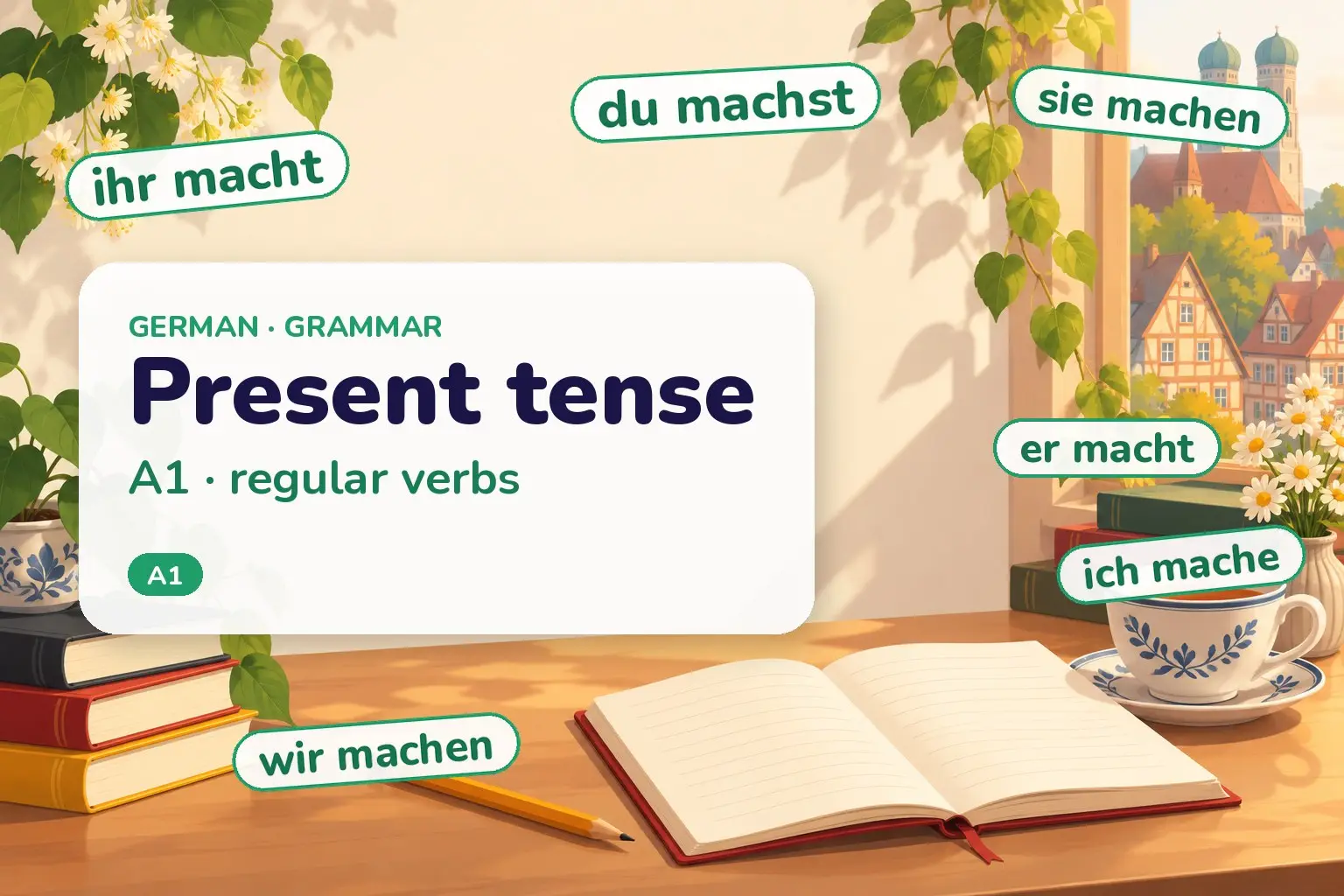
Take the verb stem (the infinitive minus -en) and add the present endings: ich -e, du -st, er/sie/es -t, wir -en, ihr -t, sie/Sie -en. So machen gives ich mache, du machst, er macht, wir machen.
Level: A1. The present tense is the first verb form you need in German, and for regular verbs it is wonderfully predictable: find the stem, add the right ending, done. Once you know the six endings you can conjugate thousands of verbs.
The rule
A verb is an action or state word (machen — to do/make, spielen — to play). Its basic dictionary form is the infinitive, and German infinitives almost all end in -en (a few end in just -n, like sammeln). Take that -en off and what is left is the stem: machen → mach-, spielen → spiel-, wohnen → wohn-.
To build the present tense you add an ending to the stem. The ending is chosen by the subject — the person or thing doing the verb (ich, du, er…). There are six of them:
- ich stem + -e — ich mache
- du stem + -st — du machst
- er / sie / es stem + -t — er macht
- wir stem + -en — wir machen
- ihr stem + -t — ihr macht
- sie / Sie stem + -en — sie machen
One more thing English speakers love: German has only one present tense. Ich spiele covers I play, I am playing and I do play — there is no separate continuous form to learn.
The present-tense forms
| Person | Ending | machen (to do) | spielen (to play) | wohnen (to live) |
|---|---|---|---|---|
| ich | -e | ich mache | ich spiele | ich wohne |
| du | -st | du machst | du spielst | du wohnst |
| er/sie/es | -t | er macht | sie spielt | es wohnt |
| wir | -en | wir machen | wir spielen | wir wohnen |
| ihr | -t | ihr macht | ihr spielt | ihr wohnt |
| sie/Sie | -en | sie machen | sie spielen | Sie wohnen |
Stems ending in -t or -d
If the stem ends in -t or -d, adding -st or -t straight on would be hard to say (arbeitst?). German inserts a helper -e- first, in the du, er/sie/es and ihr forms:
| Person | arbeiten (to work) | finden (to find) |
|---|---|---|
| ich | ich arbeite | ich finde |
| du | du arbeitest | du findest |
| er/sie/es | er arbeitet | sie findet |
| wir | wir arbeiten | wir finden |
| ihr | ihr arbeitet | ihr findet |
| sie/Sie | sie arbeiten | Sie finden |
Stems ending in a hiss (-s, -ss, -ß, -z, -x)
When the stem already ends in an s-sound, the du ending loses its s: you add only -t, not -st. So heißen (to be called) gives du heißt (not heißst), and tanzen (to dance) gives du tanzt.
How to say it
German spelling is regular, but a few sounds in these verbs need care:
| Letter / word | How to say it |
|---|---|
| -en ending | The final -en is a soft, almost swallowed “uhn”: machen ≈ “MAKH-uhn”. |
| ch in machen, lachen | Harsh throat sound after a/o/u, like Scottish “loch” — not an English “ch”. |
| w in wohnen | Like English “v”: wohnen ≈ “VOH-nuhn”. |
| ei vs ie | ei = “eye” (heißen ≈ “HYE-ssen”); ie = “ee” (spielen ≈ “SHPEE-luhn”). |
| sp- at the start | sp sounds like “shp”: spielen ≈ “SHPEE-luhn”. |
Example sentences
- Ich mache Hausaufgaben.I do homework.ich + -e
- Du spielst Fußball.You play football.du + -st
- Er wohnt in Berlin.He lives in Berlin.er + -t
- Sie lernt Deutsch.She is learning German.
- Wir kaufen Brot.We buy bread.wir + -en
- Ihr kocht sehr gut.You (all) cook very well.ihr + -t
- Sie hören Musik.They listen to music.sie + -en
- Was machst du heute?What are you doing today?du in a question
- Ich trinke Kaffee am Morgen.I drink coffee in the morning.
- Wir wohnen zusammen.We live together.
- Du arbeitest zu viel.You work too much.-t stem: du arbeitest
- Er arbeitet im Büro.He works in the office.-t stem: er arbeitet
- Sie findet den Film gut.She finds the film good.-d stem: findet
- Ihr findet den Weg.You (all) find the way.
- Du heißt Anna.Your name is Anna.s-stem: du heißt, not heißst
- Wir tanzen gern.We like to dance.
- Ich spiele jeden Tag Klavier.I play the piano every day.
- Lernt ihr zusammen?Do you (all) study together?
- Die Kinder spielen im Garten.The children play in the garden.
- Ich wohne und arbeite in Hamburg.I live and work in Hamburg.
Common mistakes
- ❌ du macht → ✅ du machst. The du ending is -st; -t belongs to er/sie/es and ihr.
- ❌ er arbeitt → ✅ er arbeitet. A stem in -t needs the helper -e- before the ending: arbeit-e-t.
- ❌ du heißst → ✅ du heißt. After an s-sound the du form drops the extra s; add only -t.
- ❌ ich bin spielen → ✅ ich spiele. There is no “am …-ing” form in German; one present tense does both jobs.
- ❌ spiele Fußball (no subject) → ✅ ich spiele Fußball. Keep the subject pronoun in German.
A short conversation
— Was machst du am Wochenende? — Ich spiele Fußball und dann lerne ich Deutsch. Und du? — Wir kochen zusammen, und am Abend hören wir Musik.
Usage notes
- The same present also talks about the near future. With a time word, the present covers plans: Morgen spiele ich Tennis (Tomorrow I’ll play tennis).
- Word order moves the verb, not the ending. In a yes/no question the verb comes first — Spielst du? — but the ending (-st for du) never changes.
- A few verbs look regular but change their stem vowel. Fahren → du fährst, sprechen → du sprichst, sehen → du siehst. Those stem-changing verbs are a separate topic; the endings above still apply to them.
- Verbs in -eln/-ern drop an e in the ich form: sammeln → ich sammle, wandern → ich wandere/wandre.
Compared with…
- Stem-changing (irregular) verbs keep these same endings but alter the stem vowel in du and er/sie/es: fahren → du fährst, geben → er gibt. Learn the regular pattern here first, then those vowel changes stand out as the exceptions.
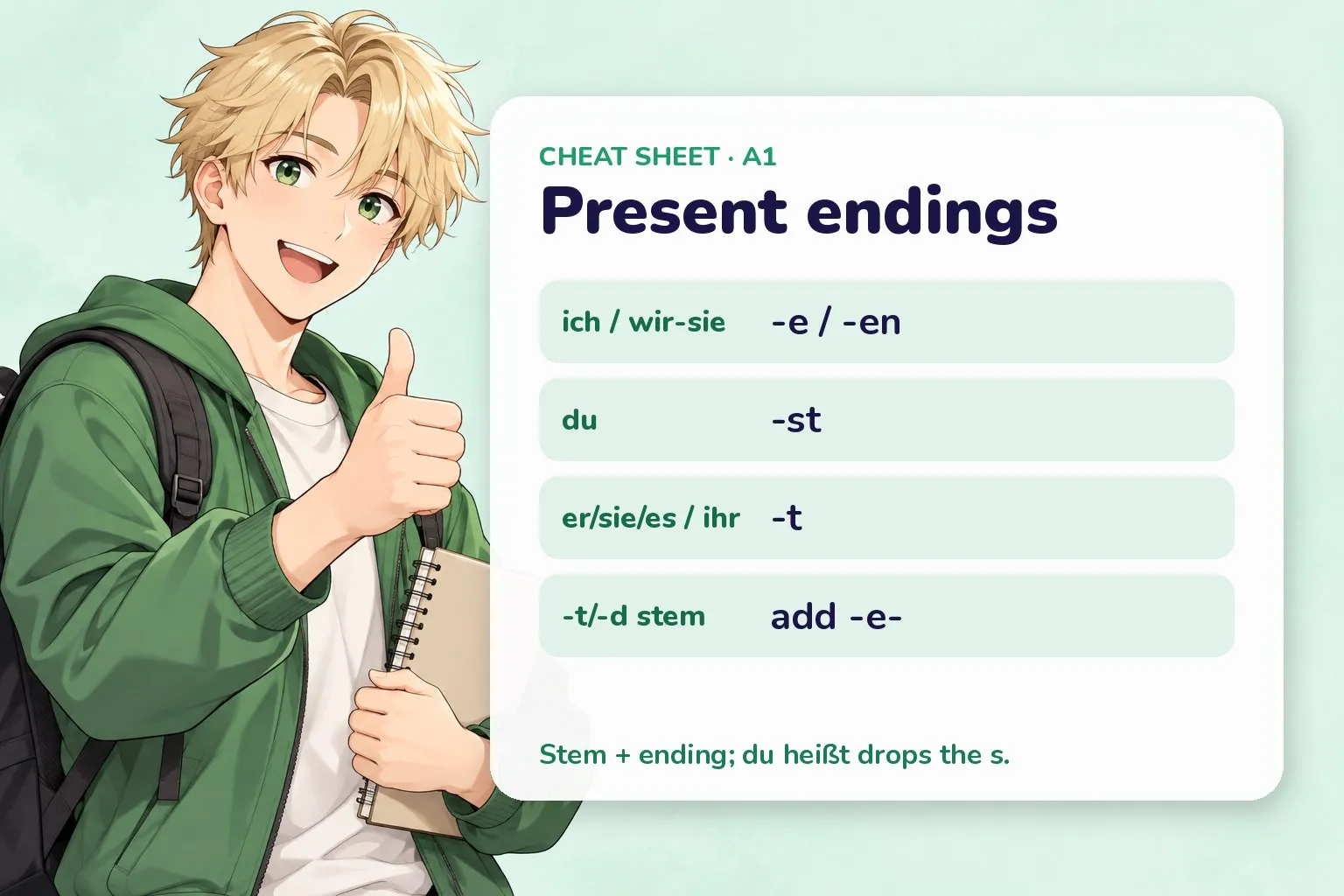
Quick recap before the quiz.
Practice
Regular present-tense practice
Try each one, then press Check. No sign-up, nothing is sent anywhere — it all runs in your browser.
Hint: stem ends in -t, so add a helper -e-
Show answer
arbeitet — A -t stem inserts -e-: er arbeitet.
3 Build: 'We buy bread.'
Show answer
Wir kaufen Brot — Subject wir + verb kaufen (-en ending) + object Brot.
4 Match each subject to its ending.
- ich
- du
- er/sie/es
- wir/sie/Sie
Show answer
- ich → -e
- du → -st
- er/sie/es → -t
- wir/sie/Sie → -en
ich -e, du -st, er/sie/es -t, wir and sie/Sie -en.
Hint: wir takes -en
Show answer
wohnen — wir + stem wohn- + -en = wir wohnen.
Quiz
German regular present tense
12 questions · pick an answer and you'll see straight away if it's right.
-
Show answer
spiel — Drop -en from the infinitive: spiel-.
-
Show answer
-e — ich + -e: ich mache, ich spiele.
-
Show answer
lernst — du + -st: du lernst.
-
Show answer
hört — er/sie/es + -t: er hört.
-
Show answer
kochen — wir + -en: wir kochen.
-
Show answer
the stem ends in -t, so a helper -e- is added — A stem in -t/-d inserts -e- before -st and -t.
-
Show answer
kocht — ihr + -t: ihr kocht.
-
Show answer
Ich spiele Fußball. — German has one present tense and keeps the subject: Ich spiele Fußball.
-
Show answer
findet — -d stem + er/sie/es: sie findet.
-
Show answer
hören — sie (they) + -en: sie hören.
-
Show answer
one, covering 'do' and 'am doing' — One present tense does the work of English play / am playing / do play.
-
Show answer
tanzt — s-sound stem: du tanzt, only -t added.
Recap cheat-sheet
| Subject | Ending | Example |
|---|---|---|
| ich | -e | ich mache |
| du | -st | du machst |
| er/sie/es | -t | er macht |
| wir / sie / Sie | -en | wir machen |
| ihr | -t | ihr macht |
| -t/-d stem | +e- | du arbeitest, er findet |
Next
- Back to the German grammar section
- New here? Start with Start Learning German Here
All German grammar topics
Every grammar point in order, from your first sentence to advanced structures. Pick one and go straight to it. New lessons go live every day, so topics marked Coming soon fill in over the next weeks.
Grammar path
A1 16 topics · 12 ready
- 01 German Articles: Der, Die, Das
- 02 Indefinite Articles: ein / eine / ein
- 03 German Personal Pronouns (ich, du, er...)
- 04 Present Tense: Regular Verbs You are here
- 05 The Verbs sein and haben
- 06 W-Questions (wer, was, wo, wie)
- 07 Yes/No Questions (Verb First)
- 08 Stem-Changing Verbs (fahren, essen, lesen)
- 09 Basic Word Order (Verb Second)
- 10 The Accusative Case (Direct Object)
- 11 Negation: nicht vs kein
- 12 Possessive Articles (mein, dein, sein)
- 13 Modal Verbs (können, müssen, wollen) Coming soon
- 14 The Imperative (Commands) Coming soon
- 15 Numbers, Time and Dates Coming soon
- 16 Common Prepositions (basic) Coming soon
A2 19 topics
- 17 The Dative Case (Indirect Object) Coming soon
- 18 Verbs with the Dative (helfen, danken) Coming soon
- 19 Accusative Prepositions (durch, für, ohne) Coming soon
- 20 Dative Prepositions (mit, nach, bei, von, zu) Coming soon
- 21 Two-Way Prepositions (Wechselpräpositionen) Coming soon
- 22 The Perfect Tense (Perfekt) Coming soon
- 23 Perfekt: Choosing haben or sein Coming soon
- 24 Past Participles (Partizip II) Coming soon
- 25 Simple Past (Präteritum): sein, haben, modals Coming soon
- 26 Separable-Prefix Verbs Coming soon
- 27 Inseparable-Prefix Verbs Coming soon
- 28 Comparative and Superlative Coming soon
- 29 Coordinating Conjunctions (und, aber, denn) Coming soon
- 30 Subordinate Clauses (weil, dass) Coming soon
- 31 Reflexive Verbs (sich freuen) Coming soon
- 32 Ein-Words in Accusative and Dative Coming soon
- 33 Pronouns in Accusative and Dative Coming soon
- 34 Requests with möchten and würden Coming soon
- 35 Ordinal Numbers and Dates Coming soon
B1 20 topics
- 36 Adjective Endings after Definite Articles Coming soon
- 37 Adjective Endings after Indefinite Articles Coming soon
- 38 Adjective Endings with No Article Coming soon
- 39 Simple Past (Präteritum): All Verbs Coming soon
- 40 Past Perfect (Plusquamperfekt) Coming soon
- 41 Future Tense (Futur I) Coming soon
- 42 The Genitive Case (Possession) Coming soon
- 43 Genitive Prepositions (wegen, trotz) Coming soon
- 44 Subordinating Conjunctions (als, wenn, obwohl) Coming soon
- 45 als vs wenn (Past vs Repeated) Coming soon
- 46 Infinitive Clauses with zu Coming soon
- 47 Purpose: um...zu vs damit Coming soon
- 48 Relative Clauses (der, die, das) Coming soon
- 49 Dative Reflexive Verbs Coming soon
- 50 Konjunktiv II: würde and Polite/Hypothetical Coming soon
- 51 Conditional Sentences (wenn-Sätze) Coming soon
- 52 Passive Voice: Present (werden) Coming soon
- 53 Verbs with Fixed Prepositions Coming soon
- 54 da- and wo- Compounds (darauf, worauf) Coming soon
- 55 Weak Nouns (N-Declension) Coming soon
B2 18 topics
- 56 Passive in All Tenses and with Modals Coming soon
- 57 Stative Passive (Zustandspassiv) Coming soon
- 58 Passive Alternatives (man, sich lassen) Coming soon
- 59 Konjunktiv II in the Past (hätte gemacht) Coming soon
- 60 Konjunktiv I and Reported Speech Coming soon
- 61 Advanced Relative Clauses (was, wo, Präposition+Pronomen) Coming soon
- 62 Nominalised Adjectives and Participles Coming soon
- 63 Participles as Adjectives (Partizip I/II) Coming soon
- 64 Extended Participle Attributes Coming soon
- 65 Two-Part Connectors (entweder...oder) Coming soon
- 66 Adverbial Connectors (deshalb, trotzdem) Coming soon
- 67 Temporal Clauses (bevor, nachdem, seitdem) Coming soon
- 68 Concessive & Conditional Clauses (obwohl, falls) Coming soon
- 69 Subjective Use of Modal Verbs Coming soon
- 70 Future Perfect (Futur II) Coming soon
- 71 Verb Valency and Objects Coming soon
- 72 Mid-Field Order: Te-Ka-Mo-Lo Coming soon
- 73 Nominal Style (Nominalisierung) Coming soon
C1 11 topics
- 74 Light-Verb Constructions (Funktionsverbgefüge) Coming soon
- 75 Advanced & Impersonal Passive Coming soon
- 76 Advanced Konjunktiv (als ob, Wunschsätze) Coming soon
- 77 Participial & Abbreviated Clauses Coming soon
- 78 Nominalisation vs Verbalisation (Umformung) Coming soon
- 79 Modal Particles (doch, ja, mal, eben, halt) Coming soon
- 80 Formal Connectors & Text Cohesion Coming soon
- 81 Advanced Genitive & Nominal Attributes Coming soon
- 82 Word Formation (Komposita & Derivation) Coming soon
- 83 Reported Speech in Extended Text Coming soon
- 84 Emphasis, Fronting and Inversion Coming soon