German Dative Verbs: helfen, danken, gefallen
A dative verb takes its object in the dative case, not the accusative. The most common are helfen, danken, gefallen and gehören — so you say Ich helfe dem Mann, with dem, never den.
Level: A2. Most German verbs put their object in the accusative. A small, fixed group does not: they demand the dative. Once you know which verbs they are, the case follows automatically.
The rule
A verb’s object is the noun it acts on. For the great majority of verbs — sehen, kaufen, haben — that object is accusative: Ich sehe den Mann (“I see the man”). A handful of verbs instead require their object in the dative, the case otherwise used for the indirect object (the receiver).
With these verbs there is no second noun and no sense of “giving to” — the single object is simply dative because the verb says so. Compare Ich sehe den Mann (accusative) with Ich helfe dem Mann (dative): same word Mann, different case, only because helfen is a dative verb.
To test it, ask wem? (“to whom / for whom?”) rather than wen? (“whom?”). If wem? fits the answer, the object is dative: Ich danke — wem? — dem Lehrer.
Common dative verbs
These are the ones you meet first. Learn the short list by heart:
| Verb | Meaning | Example |
|---|---|---|
| helfen | to help | Ich helfe dir. |
| danken | to thank | Wir danken dem Arzt. |
| gefallen | to please / to like | Das Lied gefällt mir. |
| gehören | to belong to | Das Auto gehört ihr. |
| antworten | to answer (someone) | Antworte dem Lehrer! |
| folgen | to follow | Der Hund folgt dem Kind. |
| gratulieren | to congratulate | Ich gratuliere dir. |
| passen | to suit / to fit | Der Termin passt mir nicht. |
| schmecken | to taste good (to) | Die Suppe schmeckt ihm. |
| fehlen | to be missing (to) | Du fehlst mir. |
Verbs like geben, zeigen, schicken and erklären also use the dative — but for the person, alongside an accusative thing: Ich gebe dem Kind (dat.) den Ball (acc.). They are “give”-type verbs, not pure dative verbs.
gefallen and gehören turn your sentence around
Two of the commonest verbs do not map onto English word for word, and that is where learners slip.
- gefallen means “to please”, so the thing you like is the subject and you are the dative object: Der Film gefällt mir is literally “the film pleases me” = “I like the film.”
- gehören means “to belong to”, so the owner is the dative object: Das Buch gehört mir = “the book belongs to me” = “it’s mine.”
Example sentences
- Ich helfe dir.I help you.helfen + dative pronoun dir
- Kannst du mir helfen?Can you help me?ich → mir
- Wir danken dem Arzt.We thank the doctor.danken + dem (masc. dative)
- Ich danke Ihnen.Thank you (formal).Sie → Ihnen
- Das Lied gefällt mir.I like the song.gefallen: the song is the subject
- Gefällt dir die Stadt?Do you like the city?dir = dative of du
- Das Auto gehört meiner Schwester.The car belongs to my sister.gehören + meiner (fem. dative)
- Wem gehört das Handy?Whose phone is this?wem? asks for the dative
- Antworte dem Lehrer!Answer the teacher!antworten takes the dative
- Der Hund folgt dem Kind.The dog follows the child.folgen + dem
- Ich gratuliere dir zum Geburtstag.Happy birthday! (I congratulate you.)gratulieren + dir
- Der Termin passt mir nicht.The appointment doesn't suit me.passen + mir
- Die Suppe schmeckt ihm.He likes the soup. (it tastes good to him)schmecken + ihm
- Du fehlst mir.I miss you. (you are missing to me)fehlen + mir
- Das gefällt den Kindern.The children like that.plural dative: den Kindern (+ -n)
- Ich helfe meinem Bruder.I help my brother.mein → meinem
- Sie dankt der Frau.She thanks the woman.die → der in the dative
- Dieses Hemd passt dir gut.This shirt suits you well.passen + dir
- Die Jacke gehört dem Mann dort.The jacket belongs to that man.gehören + dem
- Wir danken euch für die Hilfe.We thank you (plural) for the help.ihr → euch
Common mistakes
- ❌ Ich helfe den Mann. → ✅ Ich helfe dem Mann. helfen is dative, so the masculine article is dem, not the accusative den.
- ❌ Ich danke dich. → ✅ Ich danke dir. danken needs a dative pronoun: dir, never the accusative dich.
- ❌ Ich gefalle den Film. → ✅ Der Film gefällt mir. With gefallen the liked thing is the subject and you become the dative object.
- ❌ Das Buch gehört mich. → ✅ Das Buch gehört mir. gehören takes a dative; the pronoun is mir, not mich.
- ❌ Der Hund folgt den Kindern nicht… folgt die Kinder. → ✅ Der Hund folgt den Kindern. Plural dative: die becomes den and the noun adds -n.
A short conversation
— Wem gehört dieser Schirm? (Whose umbrella is this?) — Ich glaube, er gehört der Frau am Fenster. (I think it belongs to the woman by the window.) — Kannst du ihr den Schirm bringen? (Can you bring her the umbrella?) — Klar. Und danach hilfst du mir beim Kochen, ja? (Sure. And then you’ll help me cook, right?)
Notice gehört der Frau and the dative pronouns ihr and mir — each one is dative because of gehören and helfen.
Usage notes
- gefallen vs. mögen. Both translate “to like”. mögen takes a normal accusative object (Ich mag den Film), while gefallen flips the structure (Der Film gefällt mir). Use gefallen for a first impression, mögen for a settled taste.
- Dative + an accusative. The give-type verbs (geben, zeigen, schicken, bringen, erklären) keep the person in the dative and add the thing in the accusative: Ich zeige dem Kind (dat.) das Bild (acc.).
- Pronoun order. When both objects are pronouns, the accusative comes first: Ich gebe es (acc.) dir (dat.), not Ich gebe dir es.
- The verb list is closed. New verbs you learn are almost always accusative; only this fixed group is dative, so the safest habit is to tag each dative verb as you meet it.
Compared with…
- Accusative verbs: the default. sehen, kaufen, haben, lieben and most others take an accusative object, where only the masculine article changes (den, einen). The contrast with dative verbs is exactly the point of this page — see the full case endings on the German dative case page and the plain accusative on the German accusative case.
- Dative verbs vs. dative prepositions: both produce a dative, but for different reasons. After mit, bei, zu the dative comes from the preposition; after helfen, danken it comes from the verb. Review the fixed prepositions in common German prepositions, and the pronoun forms mir, dir, ihm, ihr in German personal pronouns.
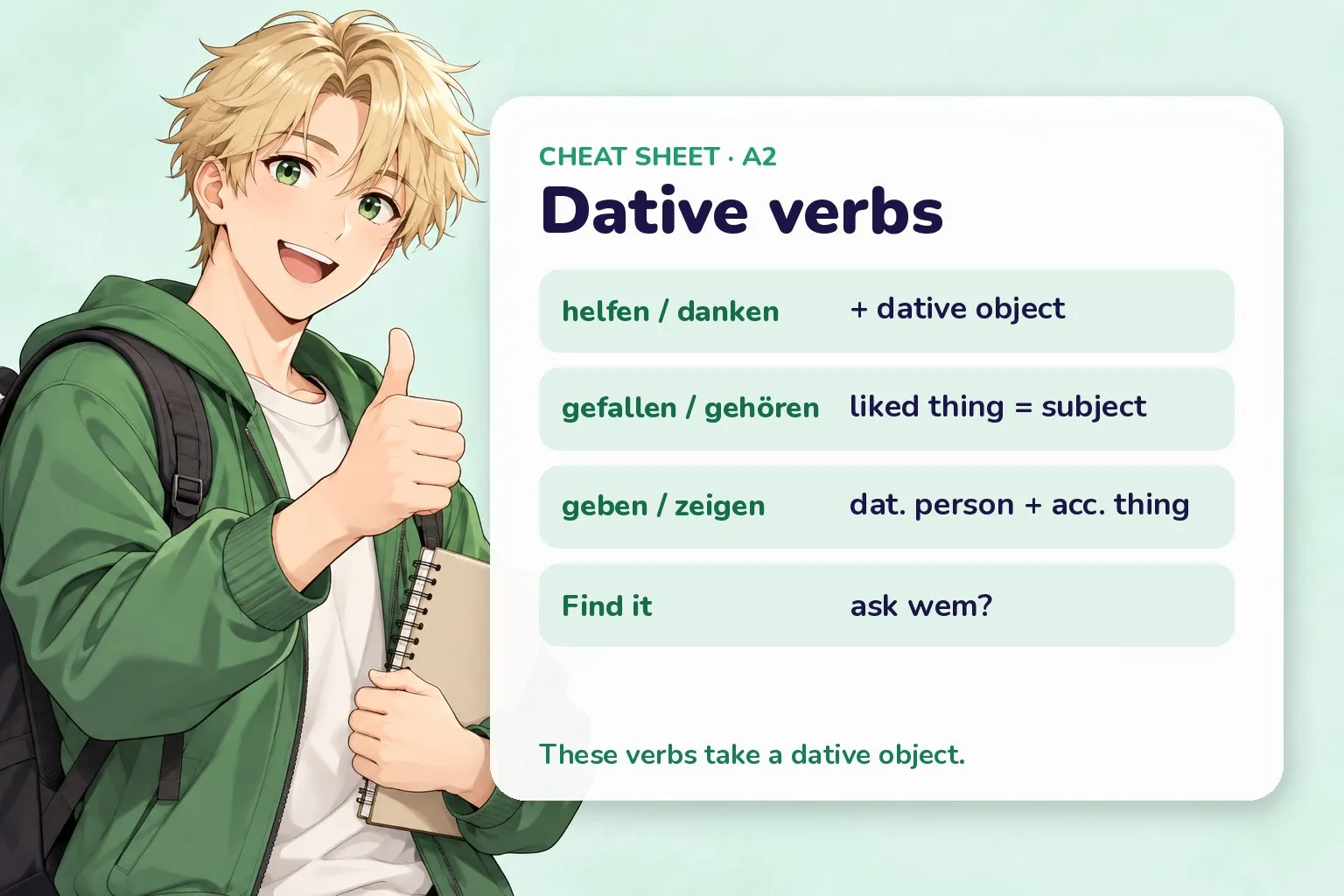
Quick recap before the quiz — these verbs take a dative object.
Practice
Dative verbs practice
Try each one, then press Check. No sign-up, nothing is sent anywhere — it all runs in your browser.
Hint: dative of ich
Show answer
mir — gehören takes the dative; the dative of ich is mir.
Hint: dative of ich
Show answer
mir — helfen + dative: the dative of ich is mir.
5 Build: 'I thank the teacher.' (der Lehrer)
Show answer
Ich danke dem Lehrer — danken + dative: Ich danke dem Lehrer.
6 Match each dative verb to its meaning.
- helfen
- danken
- gefallen
- gehören
Show answer
- helfen → to help
- danken → to thank
- gefallen → to please / like
- gehören → to belong to
These four are the core dative verbs.
Quiz
German dative verbs
13 questions · pick an answer and you'll see straight away if it's right.
-
Show answer
dative — By definition a dative verb takes a dative object.
-
Show answer
wem? — wem? ('to whom?') points to the dative; wen? points to the accusative.
-
Show answer
der — Feminine dative: die becomes der; danken is dative.
-
Show answer
kaufen — kaufen takes an accusative object; the others are dative.
-
Show answer
mir — ich → mir in the dative (mich is accusative).
-
Show answer
The car belongs to her — gehören + dative: the car belongs to her.
-
Show answer
dem — antworten is dative; masculine dative is dem.
-
Show answer
I miss you — fehlen + dative: literally 'you are missing to me' = 'I miss you'.
-
Show answer
dem Kind — dem Kind is the dative (the receiver); den Ball is the accusative thing.
-
Show answer
ihnen — The dative of sie (plural) is ihnen; helfen is dative.
-
Show answer
dem — Masculine dative article is dem; gehören is dative.
-
Show answer
The liked thing is the subject — With gefallen the thing liked is the subject and the person is the dative object.
-
Show answer
Ihnen — The formal Sie becomes Ihnen in the dative.
Recap cheat-sheet
| Verb | Case of object | Memory hook |
|---|---|---|
| helfen, danken, folgen, antworten | dative | “+ Dativ”, learn it with the verb |
| gefallen, gehören, schmecken, passen | dative | the English subject is the German dative |
| geben, zeigen, schicken, bringen | dative person + accusative thing | two objects at once |
| sehen, kaufen, haben, lieben | accusative | the normal default |
Next
- The full case endings: German dative case
- The default object case: German accusative case
- Back to the German grammar section
All German grammar topics
Every grammar point in order, from your first sentence to advanced structures. Pick one and go straight to it. New lessons go live every day, so topics marked Coming soon fill in over the next weeks.
Grammar path
A1 16 topics · 16 ready
- 01 German Articles: Der, Die, Das
- 02 Indefinite Articles: ein / eine / ein
- 03 German Personal Pronouns (ich, du, er...)
- 04 Present Tense: Regular Verbs
- 05 The Verbs sein and haben
- 06 W-Questions (wer, was, wo, wie)
- 07 Yes/No Questions (Verb First)
- 08 Stem-Changing Verbs (fahren, essen, lesen)
- 09 Basic Word Order (Verb Second)
- 10 The Accusative Case (Direct Object)
- 11 Negation: nicht vs kein
- 12 Possessive Articles (mein, dein, sein)
- 13 Modal Verbs (können, müssen, wollen)
- 14 The Imperative (Commands)
- 15 Numbers, Time and Dates
- 16 Common Prepositions (basic)
A2 19 topics · 5 ready
- 17 The Dative Case (Indirect Object)
- 18 Verbs with the Dative (helfen, danken) You are here
- 19 Accusative Prepositions (durch, für, ohne)
- 20 Dative Prepositions (mit, nach, bei, von, zu)
- 21 Two-Way Prepositions (Wechselpräpositionen)
- 22 The Perfect Tense (Perfekt) Coming soon
- 23 Perfekt: Choosing haben or sein Coming soon
- 24 Past Participles (Partizip II) Coming soon
- 25 Simple Past (Präteritum): sein, haben, modals Coming soon
- 26 Separable-Prefix Verbs Coming soon
- 27 Inseparable-Prefix Verbs Coming soon
- 28 Comparative and Superlative Coming soon
- 29 Coordinating Conjunctions (und, aber, denn) Coming soon
- 30 Subordinate Clauses (weil, dass) Coming soon
- 31 Reflexive Verbs (sich freuen) Coming soon
- 32 Ein-Words in Accusative and Dative Coming soon
- 33 Pronouns in Accusative and Dative Coming soon
- 34 Requests with möchten and würden Coming soon
- 35 Ordinal Numbers and Dates Coming soon
B1 20 topics
- 36 Adjective Endings after Definite Articles Coming soon
- 37 Adjective Endings after Indefinite Articles Coming soon
- 38 Adjective Endings with No Article Coming soon
- 39 Simple Past (Präteritum): All Verbs Coming soon
- 40 Past Perfect (Plusquamperfekt) Coming soon
- 41 Future Tense (Futur I) Coming soon
- 42 The Genitive Case (Possession) Coming soon
- 43 Genitive Prepositions (wegen, trotz) Coming soon
- 44 Subordinating Conjunctions (als, wenn, obwohl) Coming soon
- 45 als vs wenn (Past vs Repeated) Coming soon
- 46 Infinitive Clauses with zu Coming soon
- 47 Purpose: um...zu vs damit Coming soon
- 48 Relative Clauses (der, die, das) Coming soon
- 49 Dative Reflexive Verbs Coming soon
- 50 Konjunktiv II: würde and Polite/Hypothetical Coming soon
- 51 Conditional Sentences (wenn-Sätze) Coming soon
- 52 Passive Voice: Present (werden) Coming soon
- 53 Verbs with Fixed Prepositions Coming soon
- 54 da- and wo- Compounds (darauf, worauf) Coming soon
- 55 Weak Nouns (N-Declension) Coming soon
B2 18 topics
- 56 Passive in All Tenses and with Modals Coming soon
- 57 Stative Passive (Zustandspassiv) Coming soon
- 58 Passive Alternatives (man, sich lassen) Coming soon
- 59 Konjunktiv II in the Past (hätte gemacht) Coming soon
- 60 Konjunktiv I and Reported Speech Coming soon
- 61 Advanced Relative Clauses (was, wo, Präposition+Pronomen) Coming soon
- 62 Nominalised Adjectives and Participles Coming soon
- 63 Participles as Adjectives (Partizip I/II) Coming soon
- 64 Extended Participle Attributes Coming soon
- 65 Two-Part Connectors (entweder...oder) Coming soon
- 66 Adverbial Connectors (deshalb, trotzdem) Coming soon
- 67 Temporal Clauses (bevor, nachdem, seitdem) Coming soon
- 68 Concessive & Conditional Clauses (obwohl, falls) Coming soon
- 69 Subjective Use of Modal Verbs Coming soon
- 70 Future Perfect (Futur II) Coming soon
- 71 Verb Valency and Objects Coming soon
- 72 Mid-Field Order: Te-Ka-Mo-Lo Coming soon
- 73 Nominal Style (Nominalisierung) Coming soon
C1 11 topics
- 74 Light-Verb Constructions (Funktionsverbgefüge) Coming soon
- 75 Advanced & Impersonal Passive Coming soon
- 76 Advanced Konjunktiv (als ob, Wunschsätze) Coming soon
- 77 Participial & Abbreviated Clauses Coming soon
- 78 Nominalisation vs Verbalisation (Umformung) Coming soon
- 79 Modal Particles (doch, ja, mal, eben, halt) Coming soon
- 80 Formal Connectors & Text Cohesion Coming soon
- 81 Advanced Genitive & Nominal Attributes Coming soon
- 82 Word Formation (Komposita & Derivation) Coming soon
- 83 Reported Speech in Extended Text Coming soon
- 84 Emphasis, Fronting and Inversion Coming soon