Common German Prepositions and Their Cases
A German preposition decides the case of the noun after it. The basics fall into three groups: a fixed accusative set (durch, für, ohne, um), a fixed dative set (aus, bei, mit, nach, von, zu), and two-way prepositions that take either case depending on movement.
Level: A1. A preposition is a little linking word like in, with, for or to. In German every preposition forces the noun behind it into a particular case — it changes the article (der/die/das) and sometimes the noun’s ending. The good news: at A1 you only need three short groups, and two of them are just lists to memorise.
The rule
A case is the grammatical job a noun does in a sentence; German marks it mainly by changing the article in front of the noun. The three cases you meet here are the accusative (der becomes den) and the dative (der becomes dem, die becomes der, das becomes dem, plural die becomes den with an extra -n on the noun). The nominative is the plain dictionary form.
Every preposition belongs to one of three groups:
- Always accusative: durch, für, gegen, ohne, um (and bis). Memorise them as a block.
- Always dative: aus, bei, mit, nach, seit, von, zu (and außer, gegenüber). Another block to memorise.
- Two-way (Wechselpräpositionen): an, auf, hinter, in, neben, über, unter, vor, zwischen. These switch between the two cases depending on meaning, explained below.
So the case is not a free choice — the preposition dictates it. Learn which group a preposition is in, and the article follows automatically.
The common prepositions
| Preposition | Case | Meaning | Example |
|---|---|---|---|
| durch | accusative | through | durch den Park (through the park) |
| für | accusative | for | für den Freund (for the friend) |
| gegen | accusative | against | gegen die Wand (against the wall) |
| ohne | accusative | without | ohne das Auto (without the car) |
| um | accusative | around / at (time) | um den Tisch (around the table) |
| aus | dative | out of / from | aus dem Haus (out of the house) |
| bei | dative | at / near | bei dem Arzt (at the doctor’s) |
| mit | dative | with | mit dem Bus (by bus) |
| nach | dative | after / to (places) | nach der Arbeit (after work) |
| seit | dative | since / for (time) | seit dem Morgen (since morning) |
| von | dative | from / of | von dem Bahnhof (from the station) |
| zu | dative | to | zu der Schule (to the school) |
| in | two-way | in / into | in der Stadt / in die Stadt |
| auf | two-way | on / onto | auf dem Tisch / auf den Tisch |
| an | two-way | at / to (a vertical surface) | an der Wand / an die Wand |
Two-way prepositions: movement decides
The nine two-way prepositions take the accusative when there is movement towards a place (the question wohin? — where to?), and the dative when something stays at a place (the question wo? — where?).
- Ich gehe in die Stadt. — I go into the city. (movement → accusative)
- Ich bin in der Stadt. — I am in the city. (location → dative)
- Ich lege das Buch auf den Tisch. — I put the book onto the table. (movement → accusative)
- Das Buch liegt auf dem Tisch. — The book lies on the table. (location → dative)
Contractions you will see everywhere
German fuses many preposition–article pairs into one word. These are standard, not slang:
- in + das → ins, in + dem → im
- an + das → ans, an + dem → am
- zu + dem → zum, zu + der → zur
- bei + dem → beim, von + dem → vom
So Ich gehe ins Kino (into the cinema) and am Montag (on Monday) are the everyday forms; in das Kino and an dem Montag sound stiff.
Example sentences
- Wir gehen durch den Park.We walk through the park.durch + accusative
- Das Geschenk ist für dich.The present is for you.für + accusative
- Ich habe nichts gegen den Plan.I have nothing against the plan.gegen + accusative
- Sie kommt ohne ihren Mann.She comes without her husband.ohne + accusative
- Wir sitzen um den Tisch.We sit around the table.um + accusative
- Er kommt aus der Schweiz.He comes from Switzerland.aus + dative
- Ich wohne bei meinen Eltern.I live with my parents.bei + dative; plural -n
- Wir fahren mit dem Zug.We travel by train.mit + dative
- Nach der Arbeit gehe ich heim.After work I go home.nach + dative
- Ich lerne seit einem Jahr Deutsch.I have been learning German for a year.seit + dative
- Das ist ein Geschenk von meiner Oma.This is a present from my grandma.von + dative
- Ich gehe zum Arzt.I am going to the doctor.zu + dem = zum
- Die Kinder sind in der Schule.The children are at school.in + dative: location
- Die Kinder gehen in die Schule.The children go to school.in + accusative: movement
- Die Lampe hängt über dem Tisch.The lamp hangs over the table.über + dative: location
- Häng die Lampe über den Tisch.Hang the lamp over the table.über + accusative: movement
- Wir treffen uns am Bahnhof.We meet at the station.an + dem = am
- Ich fahre nach Berlin.I am travelling to Berlin.nach for cities, no article
Common mistakes
- ❌ mit den Bus → ✅ mit dem Bus. mit is always dative, so der becomes dem, never den.
- ❌ Ich gehe in der Stadt (meaning “into”) → ✅ Ich gehe in die Stadt. Movement towards needs the accusative.
- ❌ für mir → ✅ für mich. für takes the accusative, so the pronoun is mich, not mir.
- ❌ zu das Kino → ✅ ins Kino (or zum Kino). Use the fused forms; and “to a building you enter” is usually in + accusative.
- ❌ nach Hause bei meiner Mutter for “to my mother’s” → ✅ zu meiner Mutter. Use zu for people, not nach.
A short conversation
— Wohin gehst du? — In die Stadt, mit dem Bus. — Und wo ist Anna? — Sie ist schon in der Stadt, bei einer Freundin. — Gut, wir treffen uns am Bahnhof, um drei.
Notice in die Stadt (movement, accusative) against in der Stadt (location, dative), and the fused am and dative mit dem and bei.
Usage notes
- nach versus zu. Use nach for cities and most countries with no article (nach Berlin, nach Italien) and for “after”. Use zu for people and specific places (zum Arzt, zur Post).
- bei for “at someone’s place” or a workplace. bei meiner Oma (at my grandma’s), bei Siemens (at Siemens).
- seit always points to the past. seit zwei Jahren = “for the last two years, up to now” — always dative, never for future time.
- Pronouns take case too. After an accusative preposition: für mich, ohne dich. After a dative preposition: mit mir, bei dir, von ihm.
Compared with…
- Accusative versus dative articles. The split you keep meeting is der → den (accusative) against der → dem, die → der (dative). If prepositions are new, first get the article changes down: see the accusative case and der, die, das and the article system.
- Prepositions versus plain objects. Not every object follows a preposition; many verbs take a direct object with no preposition at all. Review how pronouns change in German personal pronouns so mich/mir and dich/dir come automatically after a preposition.
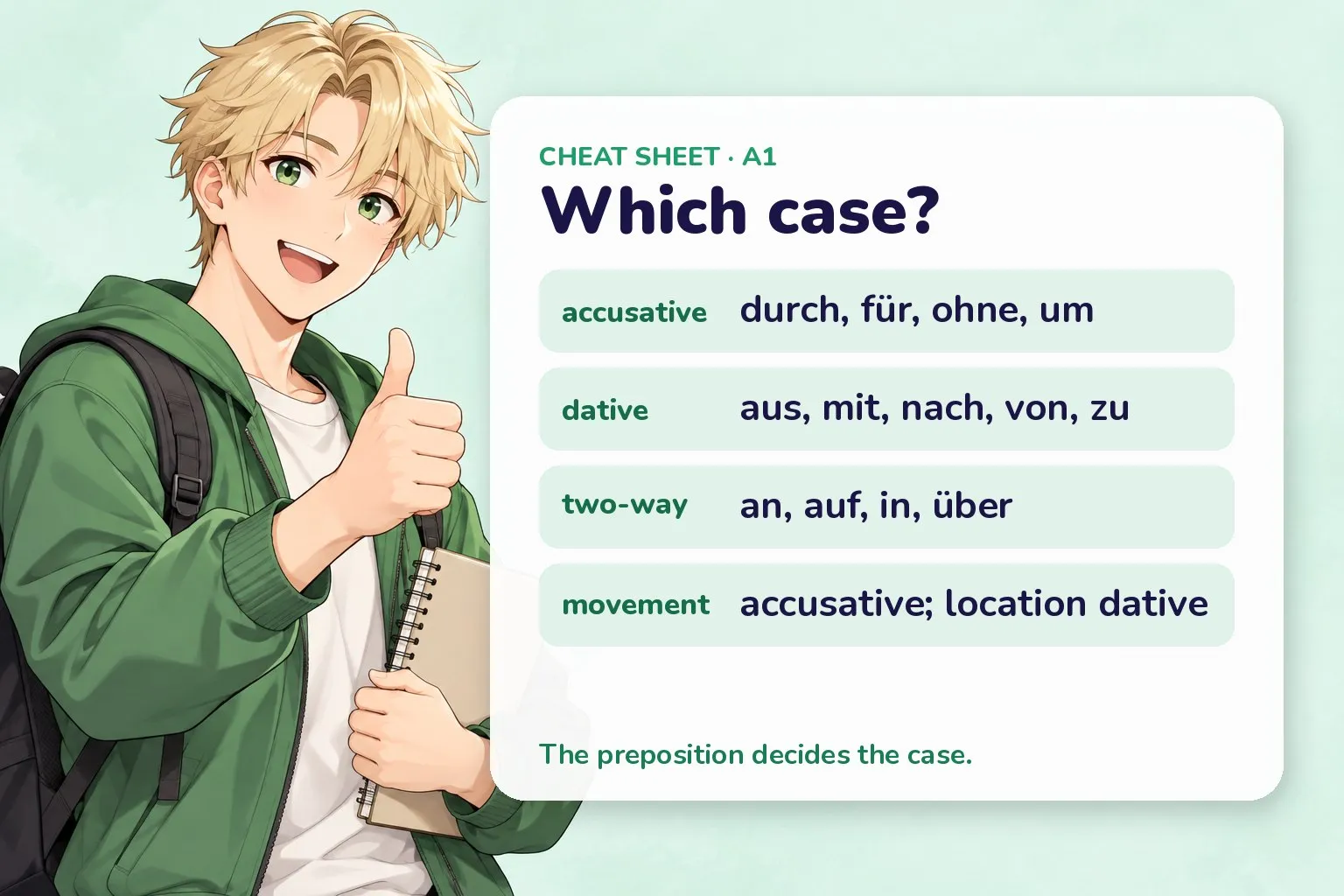
Quick recap before the quiz.
Practice
German prepositions practice
Try each one, then press Check. No sign-up, nothing is sent anywhere — it all runs in your browser.
Hint: wohin? = accusative
Show answer
die — Movement towards a place takes the accusative: in die Stadt.
Hint: wo? = dative
Show answer
der — No movement means dative: in der Stadt.
4 Build: 'We travel by train.'
Show answer
Wir fahren mit dem Zug — mit + dative: Wir fahren mit dem Zug.
5 Match each preposition to its case.
- für
- ohne
- aus
- zu
Show answer
- für → accusative
- ohne → accusative
- aus → dative
- zu → dative
für and ohne are accusative; aus and zu are dative.
Quiz
German prepositions and cases
12 questions · pick an answer and you'll see straight away if it's right.
-
Show answer
decides the case of the noun after it — Each preposition forces its noun into a particular case.
-
Show answer
durch, für, ohne, um — durch, für, gegen, ohne, um take the accusative.
-
Show answer
aus, bei, mit, nach, von, zu — aus, bei, mit, nach, seit, von, zu take the dative.
-
Show answer
there is movement towards a place — Movement (wohin?) = accusative; location (wo?) = dative.
-
Show answer
den — Putting it onto the table is movement: auf den Tisch (accusative).
-
Show answer
dem — Lying on the table is location: auf dem Tisch (dative).
-
Show answer
für mich — für is accusative, so the pronoun is mich.
-
Show answer
im — in + dem = im (in + das = ins).
-
Show answer
nach Berlin — Cities take nach: nach Berlin.
-
Show answer
zum Arzt — People and specific places take zu: zum Arzt.
-
Show answer
dem — mit is dative, so der Bus becomes mit dem Bus.
-
Show answer
Ich komme aus der Schweiz. — aus is dative: aus der Schweiz.
Recap cheat-sheet
| Group | Prepositions | Case |
|---|---|---|
| Always accusative | durch, für, gegen, ohne, um | accusative (der → den) |
| Always dative | aus, bei, mit, nach, seit, von, zu | dative (der → dem, die → der) |
| Two-way, movement (wohin?) | an, auf, in, über, unter… | accusative |
| Two-way, location (wo?) | an, auf, in, über, unter… | dative |
Next
- Lock in the articles first: the accusative case
- The articles that change: der, die, das
- Back to the German grammar section
- New here? Start Learning German Here
All German grammar topics
Every grammar point in order, from your first sentence to advanced structures. Pick one and go straight to it. New lessons go live every day, so topics marked Coming soon fill in over the next weeks.
Grammar path
A1 16 topics · 16 ready
- 01 German Articles: Der, Die, Das
- 02 Indefinite Articles: ein / eine / ein
- 03 German Personal Pronouns (ich, du, er...)
- 04 Present Tense: Regular Verbs
- 05 The Verbs sein and haben
- 06 W-Questions (wer, was, wo, wie)
- 07 Yes/No Questions (Verb First)
- 08 Stem-Changing Verbs (fahren, essen, lesen)
- 09 Basic Word Order (Verb Second)
- 10 The Accusative Case (Direct Object)
- 11 Negation: nicht vs kein
- 12 Possessive Articles (mein, dein, sein)
- 13 Modal Verbs (können, müssen, wollen)
- 14 The Imperative (Commands)
- 15 Numbers, Time and Dates
- 16 Common Prepositions (basic) You are here
A2 19 topics · 5 ready
- 17 The Dative Case (Indirect Object)
- 18 Verbs with the Dative (helfen, danken)
- 19 Accusative Prepositions (durch, für, ohne)
- 20 Dative Prepositions (mit, nach, bei, von, zu)
- 21 Two-Way Prepositions (Wechselpräpositionen)
- 22 The Perfect Tense (Perfekt) Coming soon
- 23 Perfekt: Choosing haben or sein Coming soon
- 24 Past Participles (Partizip II) Coming soon
- 25 Simple Past (Präteritum): sein, haben, modals Coming soon
- 26 Separable-Prefix Verbs Coming soon
- 27 Inseparable-Prefix Verbs Coming soon
- 28 Comparative and Superlative Coming soon
- 29 Coordinating Conjunctions (und, aber, denn) Coming soon
- 30 Subordinate Clauses (weil, dass) Coming soon
- 31 Reflexive Verbs (sich freuen) Coming soon
- 32 Ein-Words in Accusative and Dative Coming soon
- 33 Pronouns in Accusative and Dative Coming soon
- 34 Requests with möchten and würden Coming soon
- 35 Ordinal Numbers and Dates Coming soon
B1 20 topics
- 36 Adjective Endings after Definite Articles Coming soon
- 37 Adjective Endings after Indefinite Articles Coming soon
- 38 Adjective Endings with No Article Coming soon
- 39 Simple Past (Präteritum): All Verbs Coming soon
- 40 Past Perfect (Plusquamperfekt) Coming soon
- 41 Future Tense (Futur I) Coming soon
- 42 The Genitive Case (Possession) Coming soon
- 43 Genitive Prepositions (wegen, trotz) Coming soon
- 44 Subordinating Conjunctions (als, wenn, obwohl) Coming soon
- 45 als vs wenn (Past vs Repeated) Coming soon
- 46 Infinitive Clauses with zu Coming soon
- 47 Purpose: um...zu vs damit Coming soon
- 48 Relative Clauses (der, die, das) Coming soon
- 49 Dative Reflexive Verbs Coming soon
- 50 Konjunktiv II: würde and Polite/Hypothetical Coming soon
- 51 Conditional Sentences (wenn-Sätze) Coming soon
- 52 Passive Voice: Present (werden) Coming soon
- 53 Verbs with Fixed Prepositions Coming soon
- 54 da- and wo- Compounds (darauf, worauf) Coming soon
- 55 Weak Nouns (N-Declension) Coming soon
B2 18 topics
- 56 Passive in All Tenses and with Modals Coming soon
- 57 Stative Passive (Zustandspassiv) Coming soon
- 58 Passive Alternatives (man, sich lassen) Coming soon
- 59 Konjunktiv II in the Past (hätte gemacht) Coming soon
- 60 Konjunktiv I and Reported Speech Coming soon
- 61 Advanced Relative Clauses (was, wo, Präposition+Pronomen) Coming soon
- 62 Nominalised Adjectives and Participles Coming soon
- 63 Participles as Adjectives (Partizip I/II) Coming soon
- 64 Extended Participle Attributes Coming soon
- 65 Two-Part Connectors (entweder...oder) Coming soon
- 66 Adverbial Connectors (deshalb, trotzdem) Coming soon
- 67 Temporal Clauses (bevor, nachdem, seitdem) Coming soon
- 68 Concessive & Conditional Clauses (obwohl, falls) Coming soon
- 69 Subjective Use of Modal Verbs Coming soon
- 70 Future Perfect (Futur II) Coming soon
- 71 Verb Valency and Objects Coming soon
- 72 Mid-Field Order: Te-Ka-Mo-Lo Coming soon
- 73 Nominal Style (Nominalisierung) Coming soon
C1 11 topics
- 74 Light-Verb Constructions (Funktionsverbgefüge) Coming soon
- 75 Advanced & Impersonal Passive Coming soon
- 76 Advanced Konjunktiv (als ob, Wunschsätze) Coming soon
- 77 Participial & Abbreviated Clauses Coming soon
- 78 Nominalisation vs Verbalisation (Umformung) Coming soon
- 79 Modal Particles (doch, ja, mal, eben, halt) Coming soon
- 80 Formal Connectors & Text Cohesion Coming soon
- 81 Advanced Genitive & Nominal Attributes Coming soon
- 82 Word Formation (Komposita & Derivation) Coming soon
- 83 Reported Speech in Extended Text Coming soon
- 84 Emphasis, Fronting and Inversion Coming soon