German Dative Case: dem, der, den Explained
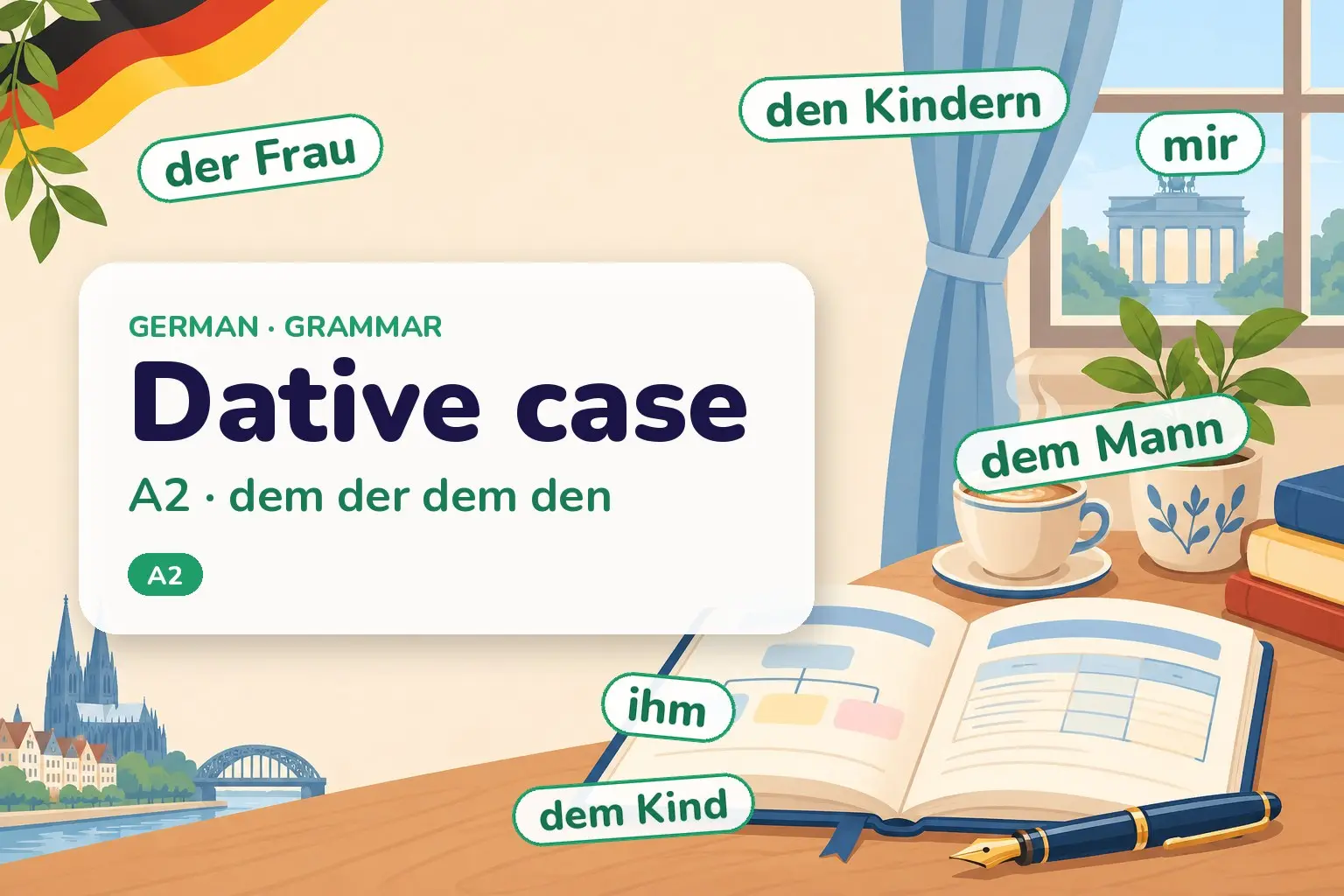
The dative is the case for the indirect object — the person something is given, shown or said to. The articles change to dem (masculine and neuter), der (feminine) and den (plural), and the plural noun adds an -n: Ich gebe dem Kind den Ball.
Level: A2. You already know the nominative (the subject) and the accusative (the direct object). The dative is the third everyday case, and it marks the indirect object — the person who receives, benefits from, or is on the other end of the action.
The rule
A case is the form a noun phrase takes to show its job in the sentence. The direct object (accusative) is the thing acted on; the indirect object (dative) is the person it goes to or for.
In Ich gebe dem Kind den Ball (“I give the child the ball”), there are two objects: den Ball is the direct object (accusative — what I give), and dem Kind is the indirect object (dative — to whom I give it). To find the dative, ask wem? (“to whom?”) after the verb: Ich gebe — wem? — dem Kind.
In the dative, every article changes, not just the masculine:
- Masculine der and neuter das both become dem.
- Feminine die becomes der.
- Plural die becomes den, and the noun adds an -n if it does not already end in -n or -s.
Article forms
| Masculine | Feminine | Neuter | Plural | |
|---|---|---|---|---|
| Nominative (subject) | der / ein | die / eine | das / ein | die / — |
| Accusative (object) | den / einen | die / eine | das / ein | die / — |
| Dative (to/for whom) | dem / einem | der / einer | dem / einem | den / — (+ noun -n) |
The kein- and possessive words follow ein: keinem, keiner, keinen; meinem, meiner, meinen. Here is the same noun across all three cases so you can see the dative in context:
| Role | Example | Article |
|---|---|---|
| Subject (nom.) | Der Mann hilft. | der |
| Direct object (acc.) | Ich sehe den Mann. | den |
| Indirect object (dat.) | Ich danke dem Mann. | dem |
Dative pronouns
Personal pronouns have their own dative forms. Learn them as a block, because several differ from the accusative:
| Nominative | Accusative | Dative | Meaning (dative) |
|---|---|---|---|
| ich | mich | mir | to me |
| du | dich | dir | to you (informal) |
| er | ihn | ihm | to him |
| sie | sie | ihr | to her |
| es | es | ihm | to it |
| wir | uns | uns | to us |
| ihr | euch | euch | to you (plural) |
| sie / Sie | sie / Sie | ihnen / Ihnen | to them / to you (formal) |
Prepositions that are always dative
A fixed group of prepositions is always followed by the dative, whatever they mean. A common way to remember them is the set aus, bei, mit, nach, seit, von, zu (plus gegenüber):
- aus (out of): aus dem Haus
- bei (at / near): bei der Arbeit
- mit (with): mit dem Bus
- nach (after / to): nach der Schule
- seit (since / for): seit einem Jahr
- von (from / of): von dem Freund (often shortened to vom)
- zu (to): zu der Party (often zur)
Example sentences
- Ich gebe dem Kind den Ball.I give the child the ball.dem Kind = dative (to whom)
- Ich danke dem Mann.I thank the man.danken takes the dative
- Sie hilft der Frau.She helps the woman.die → der; helfen is dative
- Das Buch gehört dem Lehrer.The book belongs to the teacher.gehören + dative
- Ich gebe den Kindern Schokolade.I give the children chocolate.plural die → den + Kinder → Kindern
- Er zeigt den Touristen die Stadt.He shows the tourists the city.plural dative: den Touristen
- Ich fahre mit dem Bus.I go by bus.mit is always dative
- Wir kommen aus dem Haus.We come out of the house.aus + dative
- Nach der Schule spiele ich.After school I play.nach + dative
- Ich wohne bei meiner Mutter.I live with my mother.bei + dative; meine → meiner
- Das Auto gehört meinem Bruder.The car belongs to my brother.mein → meinem
- Gib mir das Salz, bitte.Give me the salt, please.ich → mir (dative pronoun)
- Ich gebe ihm das Buch.I give him the book.er → ihm
- Das gefällt mir.I like that. (lit. that pleases me)gefallen + dative person
- Kannst du uns helfen?Can you help us?helfen + dative uns
- Ich schreibe meiner Freundin.I write to my girlfriend.meine → meiner
- Seit einem Jahr lerne ich Deutsch.I have been learning German for a year.seit + dative einem
- Der Film gefällt den Leuten.The people like the film.plural dative: den Leuten
- Wir danken Ihnen.We thank you (formal).Sie → Ihnen
- Antworte dem Lehrer!Answer the teacher!antworten + dative
Common mistakes
- ❌ Ich helfe den Mann. → ✅ Ich helfe dem Mann. helfen takes a dative object, so it is dem Mann, not the accusative den Mann.
- ❌ Ich gebe die Kinder Schokolade. → ✅ Ich gebe den Kindern Schokolade. Plural dative: die becomes den and Kinder gains an -n → Kindern.
- ❌ mit die Bus → ✅ mit dem Bus. mit is always dative, and Bus is masculine, so dem.
- ❌ Das gehört dich. → ✅ Das gehört dir. gehören needs a dative; the pronoun is dir, not the accusative dich.
- ❌ Ich danke der Mann. → ✅ Ich danke dem Mann. Masculine dative is dem; der is the feminine dative (or the masculine nominative).
A short conversation
— Wem gibst du das Geschenk? (To whom are you giving the present?) — Ich gebe es meiner Schwester. (I’m giving it to my sister.) — Und hilfst du ihr auch beim Umzug? (And are you helping her with the move too?) — Ja, ich helfe ihr am Samstag. Das Sofa gehört ihrem Freund. (Yes, I’m helping her on Saturday. The sofa belongs to her boyfriend.)
Notice meiner Schwester and ihrem Freund (dative articles), ihr (the dative of sie), and beim (= bei dem) pulling the dative after it.
Usage notes
- Find it with a question. Wem? (“to whom?”) points to the dative; wen oder was? (“whom or what?”) points to the accusative. In a give/send/show sentence the person is dative and the thing is accusative.
- Two objects, a default order. With a verb like geben, the normal order is dative then accusative when both are nouns (Ich gebe dem Kind den Ball), but a pronoun object comes first (Ich gebe es dem Kind).
- Contractions are normal. in dem → im, bei dem → beim, von dem → vom, zu dem → zum, zu der → zur. These are everyday forms, not sloppy speech.
- Dative verbs are a fixed list. The common ones are helfen, danken, gefallen, gehören, antworten, folgen, passen, schmecken. Learn each with “+ dative” attached, like vocabulary.
Compared with…
- Accusative (the direct object): the thing acted on, found with wen oder was?. There only the masculine changes (den, einen). In a two-object sentence the accusative is the thing and the dative is the person: Ich gebe dem Mann (dat.) den Ball (acc.). Review the German accusative case and the full pronoun set in German personal pronouns.
- Dative vs accusative verbs: most verbs take an accusative object (sehen, kaufen, haben), but the fixed dative group (helfen, danken, gefallen, gehören) takes a dative one instead — the main reason to learn which case a verb wants. For how the articles work in the first place, see German articles der, die, das; for the prepositions that pick a case, see common German prepositions.
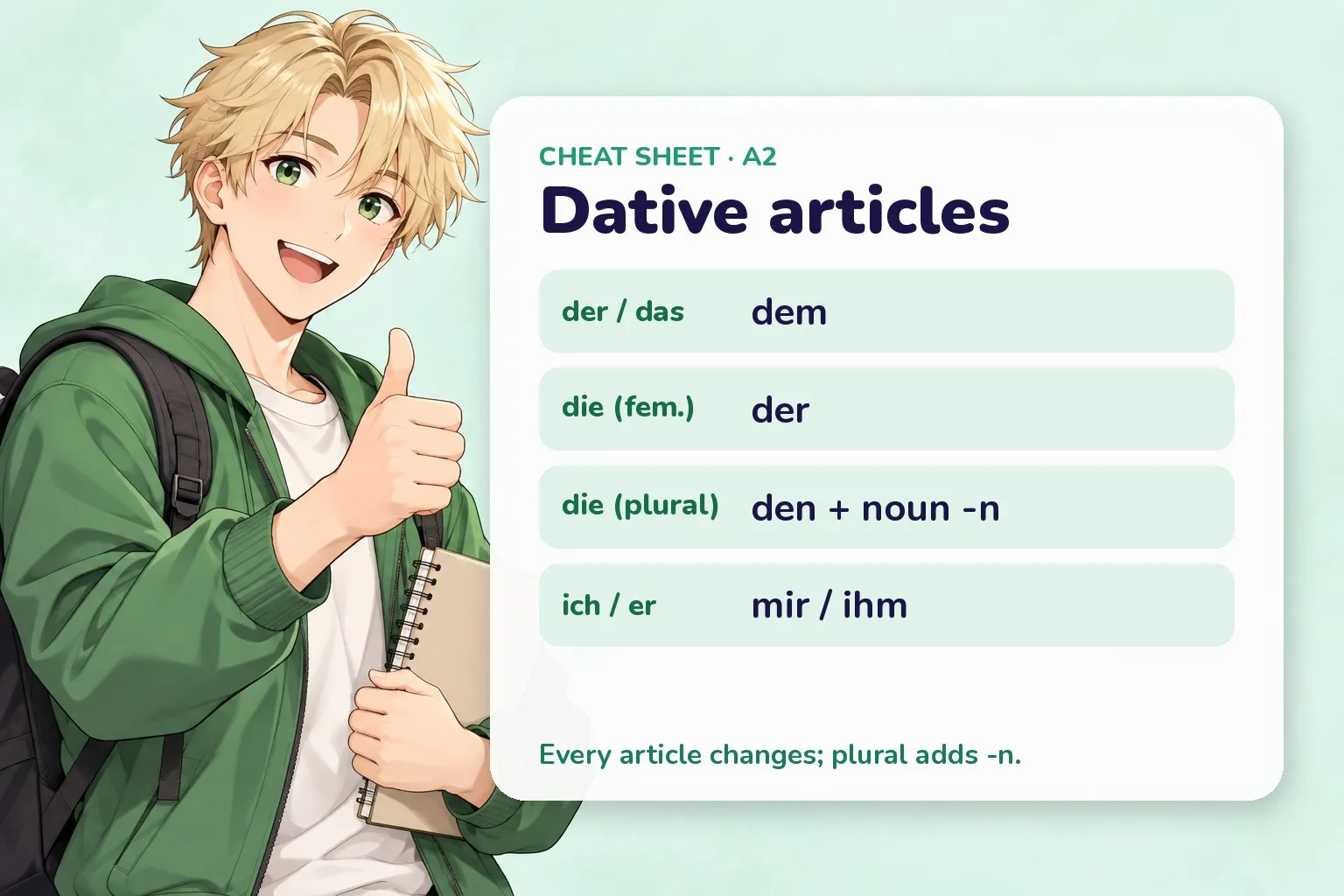
Quick recap before the quiz — every article changes, and the plural adds -n.
Practice
Dative case practice
Try each one, then press Check. No sign-up, nothing is sent anywhere — it all runs in your browser.
Hint: article + noun ending
Show answer
den / n — die → den and Kinder → Kindern: 'den Kindern'.
Hint: dative of ich
Show answer
mir — The dative of ich is mir; gehören takes the dative.
5 Build: 'I thank the man.'
Show answer
Ich danke dem Mann — danken + dative: Ich danke dem Mann.
6 Match each nominative article to its dative.
- der
- die (fem.)
- das
- die (plural)
Show answer
- der → dem
- die (fem.) → der
- das → dem
- die (plural) → den
der/das → dem, die (fem.) → der, die (plural) → den (+ noun -n).
Quiz
German dative case
13 questions · pick an answer and you'll see straight away if it's right.
-
Show answer
indirect object — The dative is the case of the indirect object — the receiver.
-
Show answer
dem — der (masc.) → dem in the dative.
-
Show answer
der — die (fem.) → der in the dative.
-
Show answer
den — Plural dative: die → den, and the noun adds -n (Kindern).
-
Show answer
mir — ich → mir in the dative (mich is accusative).
-
Show answer
ihm — er → ihm in the dative (ihn is accusative).
-
Show answer
helfen — helfen takes the dative: Ich helfe dem Mann.
-
Show answer
dem — mit is always dative, and Bus is masculine: mit dem Bus.
-
Show answer
adds -n to the noun — The plural noun gains an -n: den Kindern, den Männern.
-
Show answer
I like that — gefallen + dative: literally 'that pleases me' = 'I like that'.
-
Show answer
meinem — mein → meinem for a masculine dative: meinem Bruder.
-
Show answer
für — für takes the accusative; aus, bei and zu are dative.
-
Show answer
uns — The dative of wir is uns; helfen takes the dative.
Recap cheat-sheet
| Nominative | Accusative | Dative | |
|---|---|---|---|
| Masculine | der / ein | den / einen | dem / einem |
| Feminine | die / eine | die / eine | der / einer |
| Neuter | das / ein | das / ein | dem / einem |
| Plural | die | die | den (+ noun -n) |
| Pronouns (ich / er) | ich / er | mich / ihn | mir / ihm |
Next
- Compare it with the German accusative case
- The full pronoun table: German personal pronouns
- Back to the German grammar section
All German grammar topics
Every grammar point in order, from your first sentence to advanced structures. Pick one and go straight to it. New lessons go live every day, so topics marked Coming soon fill in over the next weeks.
Grammar path
A1 16 topics · 16 ready
- 01 German Articles: Der, Die, Das
- 02 Indefinite Articles: ein / eine / ein
- 03 German Personal Pronouns (ich, du, er...)
- 04 Present Tense: Regular Verbs
- 05 The Verbs sein and haben
- 06 W-Questions (wer, was, wo, wie)
- 07 Yes/No Questions (Verb First)
- 08 Stem-Changing Verbs (fahren, essen, lesen)
- 09 Basic Word Order (Verb Second)
- 10 The Accusative Case (Direct Object)
- 11 Negation: nicht vs kein
- 12 Possessive Articles (mein, dein, sein)
- 13 Modal Verbs (können, müssen, wollen)
- 14 The Imperative (Commands)
- 15 Numbers, Time and Dates
- 16 Common Prepositions (basic)
A2 19 topics · 5 ready
- 17 The Dative Case (Indirect Object) You are here
- 18 Verbs with the Dative (helfen, danken)
- 19 Accusative Prepositions (durch, für, ohne)
- 20 Dative Prepositions (mit, nach, bei, von, zu)
- 21 Two-Way Prepositions (Wechselpräpositionen)
- 22 The Perfect Tense (Perfekt) Coming soon
- 23 Perfekt: Choosing haben or sein Coming soon
- 24 Past Participles (Partizip II) Coming soon
- 25 Simple Past (Präteritum): sein, haben, modals Coming soon
- 26 Separable-Prefix Verbs Coming soon
- 27 Inseparable-Prefix Verbs Coming soon
- 28 Comparative and Superlative Coming soon
- 29 Coordinating Conjunctions (und, aber, denn) Coming soon
- 30 Subordinate Clauses (weil, dass) Coming soon
- 31 Reflexive Verbs (sich freuen) Coming soon
- 32 Ein-Words in Accusative and Dative Coming soon
- 33 Pronouns in Accusative and Dative Coming soon
- 34 Requests with möchten and würden Coming soon
- 35 Ordinal Numbers and Dates Coming soon
B1 20 topics
- 36 Adjective Endings after Definite Articles Coming soon
- 37 Adjective Endings after Indefinite Articles Coming soon
- 38 Adjective Endings with No Article Coming soon
- 39 Simple Past (Präteritum): All Verbs Coming soon
- 40 Past Perfect (Plusquamperfekt) Coming soon
- 41 Future Tense (Futur I) Coming soon
- 42 The Genitive Case (Possession) Coming soon
- 43 Genitive Prepositions (wegen, trotz) Coming soon
- 44 Subordinating Conjunctions (als, wenn, obwohl) Coming soon
- 45 als vs wenn (Past vs Repeated) Coming soon
- 46 Infinitive Clauses with zu Coming soon
- 47 Purpose: um...zu vs damit Coming soon
- 48 Relative Clauses (der, die, das) Coming soon
- 49 Dative Reflexive Verbs Coming soon
- 50 Konjunktiv II: würde and Polite/Hypothetical Coming soon
- 51 Conditional Sentences (wenn-Sätze) Coming soon
- 52 Passive Voice: Present (werden) Coming soon
- 53 Verbs with Fixed Prepositions Coming soon
- 54 da- and wo- Compounds (darauf, worauf) Coming soon
- 55 Weak Nouns (N-Declension) Coming soon
B2 18 topics
- 56 Passive in All Tenses and with Modals Coming soon
- 57 Stative Passive (Zustandspassiv) Coming soon
- 58 Passive Alternatives (man, sich lassen) Coming soon
- 59 Konjunktiv II in the Past (hätte gemacht) Coming soon
- 60 Konjunktiv I and Reported Speech Coming soon
- 61 Advanced Relative Clauses (was, wo, Präposition+Pronomen) Coming soon
- 62 Nominalised Adjectives and Participles Coming soon
- 63 Participles as Adjectives (Partizip I/II) Coming soon
- 64 Extended Participle Attributes Coming soon
- 65 Two-Part Connectors (entweder...oder) Coming soon
- 66 Adverbial Connectors (deshalb, trotzdem) Coming soon
- 67 Temporal Clauses (bevor, nachdem, seitdem) Coming soon
- 68 Concessive & Conditional Clauses (obwohl, falls) Coming soon
- 69 Subjective Use of Modal Verbs Coming soon
- 70 Future Perfect (Futur II) Coming soon
- 71 Verb Valency and Objects Coming soon
- 72 Mid-Field Order: Te-Ka-Mo-Lo Coming soon
- 73 Nominal Style (Nominalisierung) Coming soon
C1 11 topics
- 74 Light-Verb Constructions (Funktionsverbgefüge) Coming soon
- 75 Advanced & Impersonal Passive Coming soon
- 76 Advanced Konjunktiv (als ob, Wunschsätze) Coming soon
- 77 Participial & Abbreviated Clauses Coming soon
- 78 Nominalisation vs Verbalisation (Umformung) Coming soon
- 79 Modal Particles (doch, ja, mal, eben, halt) Coming soon
- 80 Formal Connectors & Text Cohesion Coming soon
- 81 Advanced Genitive & Nominal Attributes Coming soon
- 82 Word Formation (Komposita & Derivation) Coming soon
- 83 Reported Speech in Extended Text Coming soon
- 84 Emphasis, Fronting and Inversion Coming soon