German Accusative Prepositions: durch, für, ohne
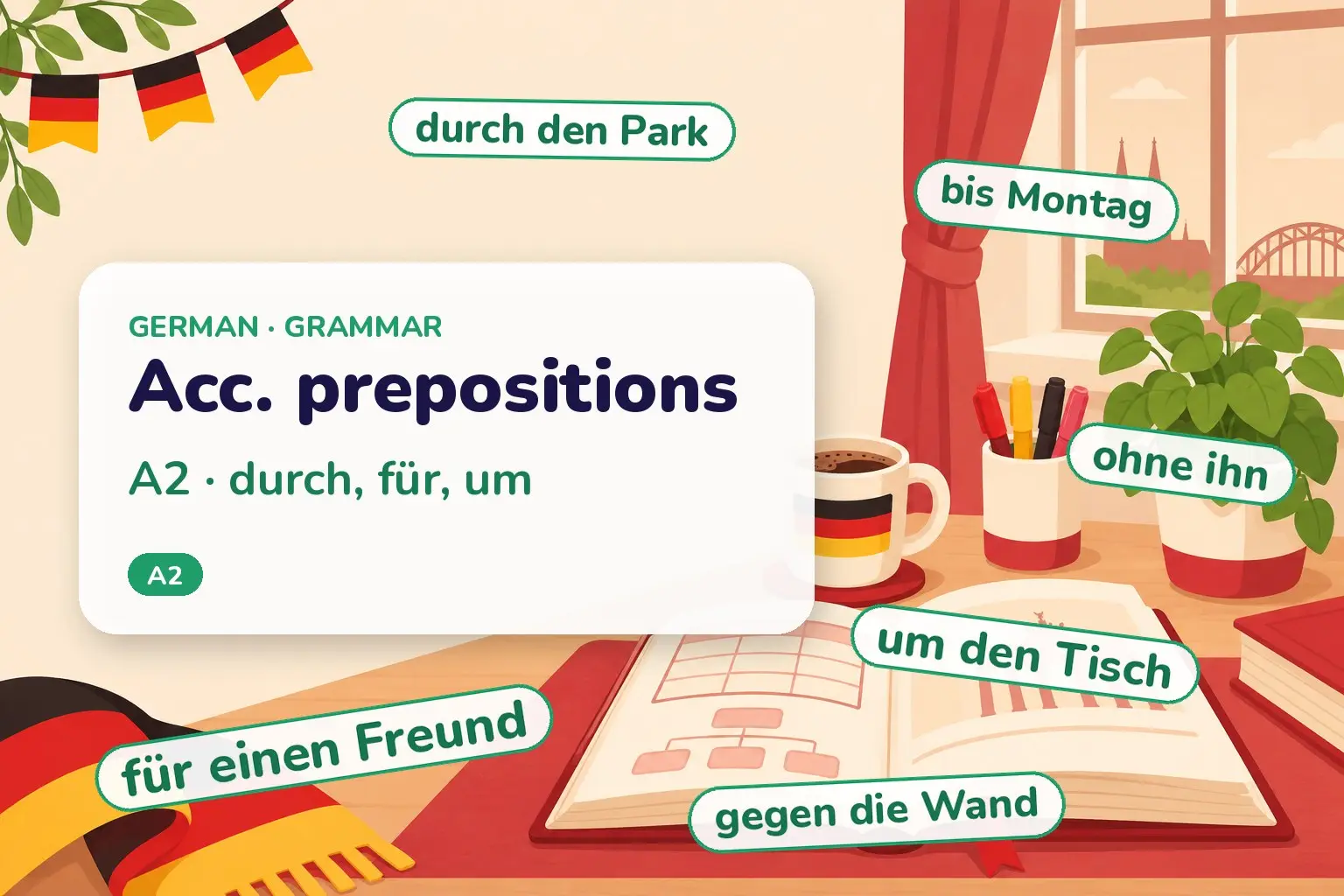
A fixed set of German prepositions always takes the accusative: durch, für, gegen, ohne, um (plus bis and wider). The noun after them is accusative no matter its role, so masculine der becomes den and ein becomes einen: durch den Park, für einen Freund.
Level: A2. German prepositions decide the case of the noun that follows them. One small group is the easiest kind: it always takes the accusative, every single time, with no exceptions to weigh up.
The rule
A preposition is a little word like through, for or without that sits in front of a noun to show a relationship: durch den Park (“through the park”). In German, every preposition forces the noun after it into a particular case — a form that marks the noun’s job.
The accusative prepositions are the friendly ones, because the case never shifts. Whatever the sentence is doing, the noun after one of these words is in the accusative. The five you meet constantly are durch, für, gegen, ohne, um. Two more belong to the same group but are rarer: bis (until/up to) and wider (against, in the sense of contrary to).
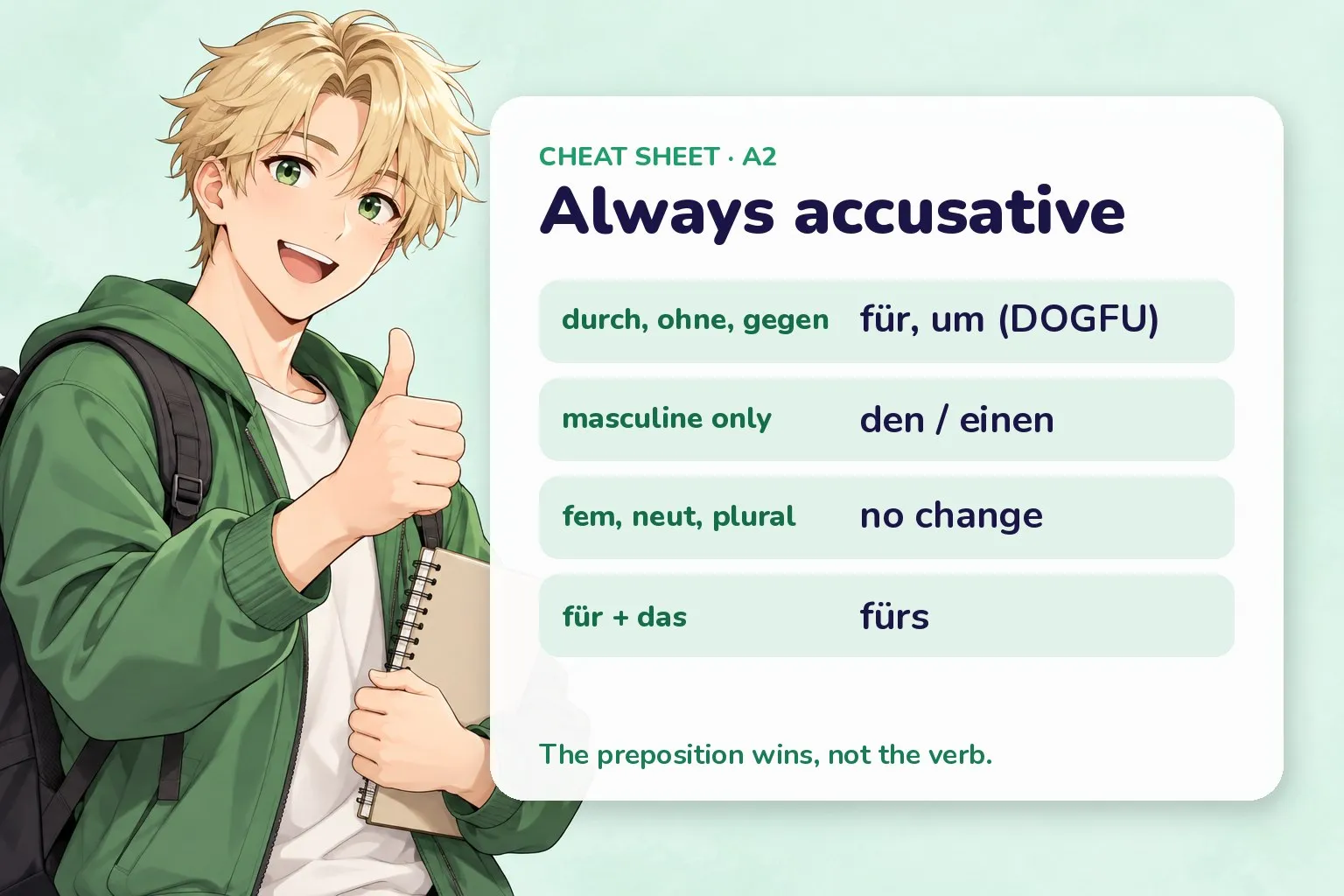
Remember the part that makes the German accusative gentle: only the masculine article changes. Der becomes den and ein becomes einen; feminine die/eine, neuter das/ein and all plurals stay exactly as they are. So durch den Park (masculine) but durch die Stadt (feminine, unchanged).
The accusative prepositions
| Preposition | Meaning | Example | Note |
|---|---|---|---|
| durch | through | durch den Park | masculine der → den |
| für | for | für einen Freund | masculine ein → einen |
| gegen | against / around (time) | gegen die Wand | feminine, no change |
| ohne | without | ohne einen Plan | masculine ein → einen |
| um | around / at (clock time) | um den Tisch | masculine der → den |
| bis | until / up to | bis nächsten Montag | often with no article |
| wider | against (contrary to) | wider den Willen | formal, less common |
Only the masculine column shows a visible change. The accusative article forms behind these prepositions are exactly the ones from the main case table:
| Masculine | Feminine | Neuter | Plural | |
|---|---|---|---|---|
| Nominative | der / ein | die / eine | das / ein | die / — |
| Accusative | den / einen | die / eine | das / ein | die / — |
Contractions
In everyday German some of these prepositions fuse with the neuter article das:
| Full form | Contraction |
|---|---|
| für das | fürs |
| um das | ums |
| durch das | durchs |
Ich kaufe das fürs Kind (“I’m buying this for the child”) is normal written and spoken German. The contraction is optional, never wrong to spell out, and only happens with das.
Example sentences
- Ich gehe durch den Park.I walk through the park.durch + der Park → den Park
- Wir fahren durch die Stadt.We drive through the city.die Stadt, feminine, no change
- Das Geschenk ist für dich.The present is for you.für → dich (pronoun)
- Ich kaufe einen Kuchen für meinen Bruder.I buy a cake for my brother.für → meinen Bruder (masculine)
- Sie hat etwas gegen den Lärm.She has something against the noise.gegen + der Lärm → den Lärm
- Das Auto fährt gegen die Wand.The car drives into the wall.gegen → die Wand, unchanged
- Ich trinke den Kaffee ohne Zucker.I drink the coffee without sugar.ohne + no article here
- Er geht ohne einen Plan.He goes without a plan.ohne → einen Plan (masculine)
- Wir sitzen um den Tisch.We sit around the table.um + der Tisch → den Tisch
- Der Film beginnt um acht Uhr.The film starts at eight o'clock.um for exact clock time
- Kommst du gegen sieben?Are you coming around seven?gegen = approximate time
- Ich bleibe bis nächsten Freitag.I'm staying until next Friday.bis + accusative time
- Das ist ein Geschenk für die Kinder.This is a present for the children.plural die, no change
- Wir spielen ohne ihn.We play without him.ohne → ihn (er as object)
- Ich kaufe das fürs Kind.I buy this for the child.für + das → fürs
- Sie läuft um den See.She runs around the lake.um + der See → den See
- Ohne meinen Schlüssel komme ich nicht rein.Without my key I can't get in.ohne → meinen Schlüssel
- Der Zug fährt durch einen Tunnel.The train goes through a tunnel.durch → einen Tunnel
- Ich habe nichts gegen dich.I have nothing against you.gegen → dich (pronoun)
- Wir gehen um die Ecke.We go around the corner.um → die Ecke, feminine
Common mistakes
- ❌ für der Freund → ✅ für den Freund. Für always takes the accusative; masculine der becomes den.
- ❌ Ich kaufe das für mein Bruder. → ✅ für meinen Bruder. Mein becomes meinen for a masculine accusative noun.
- ❌ durch dem Park → ✅ durch den Park. Dem is dative; after durch you need the accusative den.
- ❌ ohne einem Plan → ✅ ohne einen Plan. Einem is dative; the accusative of ein is einen.
- ❌ Ich sehe die Frau gegen → ✅ Ich habe etwas gegen die Frau. Gegen is a preposition, not a stray word; it must sit in front of its noun.
- ❌ für die Kinder changed to für den Kinder → ✅ für die Kinder. Plurals never change; only the masculine singular does.
A short conversation
— Was machst du heute? (What are you doing today?) — Ich kaufe ein Geschenk für meinen Vater und gehe dann durch den Park nach Hause. (I’m buying a present for my father and then walking home through the park.) — Ohne einen Regenschirm? Es regnet gegen Abend. (Without an umbrella? It rains towards evening.) — Stimmt. Ich bin um acht zurück. (True. I’ll be back around eight.)
Every bold noun sits behind an accusative preposition: für meinen Vater, durch den Park, ohne einen Regenschirm, um acht.
Usage notes
- bis rarely shows an article. bis usually points at a time or place and often stands alone: bis morgen (“until tomorrow”), bis Berlin (“as far as Berlin”). When an article does appear, it is accusative, and bis frequently teams up with a second preposition: bis zum Bahnhof (here zu brings the dative).
- wider is formal and fixed. You mostly meet wider in set phrases such as wider Willen (“against one’s will”) and wider Erwarten (“contrary to expectation”). Do not confuse it with wieder (“again”), which is a different word with a different spelling.
- ohne often drops the article. German likes ohne Zucker, ohne Auto, ohne Geld with no article at all. When you do add one, it is accusative: ohne einen Grund (“without a reason”).
- Pronouns take their accusative forms too: für mich, gegen dich, ohne ihn, um uns. These are the same object pronouns as elsewhere in the accusative.
Compared with…
- Dative-only prepositions: another fixed group — aus, bei, mit, nach, seit, von, zu — always takes the dative instead, so der and das become dem and die becomes der. Compare für den Mann (accusative) with mit dem Mann (dative). See the German dative case lesson.
- Two-way (Wechsel) prepositions: an, auf, hinter, in, neben, über, unter, vor, zwischen can take either case — accusative for movement towards a place, dative for a fixed location. Those need a decision each time; the DOGFU group never does. See German prepositions with accusative and dative.
- Build the article forms first in the German accusative case lesson, which this page relies on.
How to say it
These are the sounds English speakers trip over in this lesson’s words:
| Sound | How to say it |
|---|---|
| ü in für, über | round your lips on an “ee”: für ≈ “fuer” with tight lips, not “foor”. |
| ch in durch, nicht | soft hissed “h” after i/e: durch ≈ “doorkh”, nicht ≈ “nikht”. |
| g in gegen | a hard “g” both times: “GAY-gen”, never a “j” sound. |
| r after a vowel | a light, almost swallowed “r”: für and Tür end in a soft “-uh”. |
Quick recap before the quiz.
Practice
Accusative prepositions practice
Try each one, then press Check. No sign-up, nothing is sent anywhere — it all runs in your browser.
Hint: ein in the accusative
Show answer
einen — Masculine ein becomes einen after für.
Hint: er as an object
Show answer
ihn — The accusative of er is ihn; ohne takes the accusative.
5 Build: 'I'm walking through the park.'
Show answer
Ich gehe durch den Park — Subject, verb, then the accusative phrase durch den Park.
6 Match each preposition to its meaning.
- durch
- für
- gegen
- ohne
Show answer
- durch → through
- für → for
- gegen → against
- ohne → without
Four of the five DOGFU prepositions and their core meanings.
Hint: um takes the accusative
Show answer
den — um + der Tisch gives den Tisch.
Quiz
German accusative prepositions
13 questions · pick an answer and you'll see straight away if it's right.
-
Show answer
accusative — They are the fixed accusative prepositions.
-
Show answer
den — durch + accusative; masculine Park → den Park.
-
Show answer
einen — Masculine ein becomes einen in the accusative.
-
Show answer
die (fem.) — Feminine die stays die; only the masculine changes.
-
Show answer
einen — ohne takes the accusative: einen Plan.
-
Show answer
durch, ohne, gegen, für, um — D-O-G-F-U = durch, ohne, gegen, für, um.
-
Show answer
at eight o'clock (exact) — um marks an exact clock time; gegen acht would be 'around eight'.
-
Show answer
mich — für + accusative pronoun: für mich.
-
Show answer
durchs — durch + das = durchs, a normal contraction with neuter das.
-
Show answer
ohne — ohne is accusative; mit, bei and von are dative.
-
Show answer
die — Plurals do not change: für die Kinder.
-
Show answer
ihn — er becomes ihn; gegen takes the accusative.
-
Show answer
meinen — mein becomes meinen for a masculine accusative noun after für.
Recap cheat-sheet
| Always accusative | Meaning |
|---|---|
| durch | through |
| für | for |
| gegen | against / ~time |
| ohne | without |
| um | around / at |
| (bis, wider) | until / contrary to |
| Masculine only | der→den, ein→einen |
Next
- Build the forms first: German accusative case
- The other fixed set: German dative case
- When the case can change: German two-way prepositions
- Back to the German grammar section
All German grammar topics
Every grammar point in order, from your first sentence to advanced structures. Pick one and go straight to it. New lessons go live every day, so topics marked Coming soon fill in over the next weeks.
Grammar path
A1 16 topics · 16 ready
- 01 German Articles: Der, Die, Das
- 02 Indefinite Articles: ein / eine / ein
- 03 German Personal Pronouns (ich, du, er...)
- 04 Present Tense: Regular Verbs
- 05 The Verbs sein and haben
- 06 W-Questions (wer, was, wo, wie)
- 07 Yes/No Questions (Verb First)
- 08 Stem-Changing Verbs (fahren, essen, lesen)
- 09 Basic Word Order (Verb Second)
- 10 The Accusative Case (Direct Object)
- 11 Negation: nicht vs kein
- 12 Possessive Articles (mein, dein, sein)
- 13 Modal Verbs (können, müssen, wollen)
- 14 The Imperative (Commands)
- 15 Numbers, Time and Dates
- 16 Common Prepositions (basic)
A2 19 topics · 5 ready
- 17 The Dative Case (Indirect Object)
- 18 Verbs with the Dative (helfen, danken)
- 19 Accusative Prepositions (durch, für, ohne) You are here
- 20 Dative Prepositions (mit, nach, bei, von, zu)
- 21 Two-Way Prepositions (Wechselpräpositionen)
- 22 The Perfect Tense (Perfekt) Coming soon
- 23 Perfekt: Choosing haben or sein Coming soon
- 24 Past Participles (Partizip II) Coming soon
- 25 Simple Past (Präteritum): sein, haben, modals Coming soon
- 26 Separable-Prefix Verbs Coming soon
- 27 Inseparable-Prefix Verbs Coming soon
- 28 Comparative and Superlative Coming soon
- 29 Coordinating Conjunctions (und, aber, denn) Coming soon
- 30 Subordinate Clauses (weil, dass) Coming soon
- 31 Reflexive Verbs (sich freuen) Coming soon
- 32 Ein-Words in Accusative and Dative Coming soon
- 33 Pronouns in Accusative and Dative Coming soon
- 34 Requests with möchten and würden Coming soon
- 35 Ordinal Numbers and Dates Coming soon
B1 20 topics
- 36 Adjective Endings after Definite Articles Coming soon
- 37 Adjective Endings after Indefinite Articles Coming soon
- 38 Adjective Endings with No Article Coming soon
- 39 Simple Past (Präteritum): All Verbs Coming soon
- 40 Past Perfect (Plusquamperfekt) Coming soon
- 41 Future Tense (Futur I) Coming soon
- 42 The Genitive Case (Possession) Coming soon
- 43 Genitive Prepositions (wegen, trotz) Coming soon
- 44 Subordinating Conjunctions (als, wenn, obwohl) Coming soon
- 45 als vs wenn (Past vs Repeated) Coming soon
- 46 Infinitive Clauses with zu Coming soon
- 47 Purpose: um...zu vs damit Coming soon
- 48 Relative Clauses (der, die, das) Coming soon
- 49 Dative Reflexive Verbs Coming soon
- 50 Konjunktiv II: würde and Polite/Hypothetical Coming soon
- 51 Conditional Sentences (wenn-Sätze) Coming soon
- 52 Passive Voice: Present (werden) Coming soon
- 53 Verbs with Fixed Prepositions Coming soon
- 54 da- and wo- Compounds (darauf, worauf) Coming soon
- 55 Weak Nouns (N-Declension) Coming soon
B2 18 topics
- 56 Passive in All Tenses and with Modals Coming soon
- 57 Stative Passive (Zustandspassiv) Coming soon
- 58 Passive Alternatives (man, sich lassen) Coming soon
- 59 Konjunktiv II in the Past (hätte gemacht) Coming soon
- 60 Konjunktiv I and Reported Speech Coming soon
- 61 Advanced Relative Clauses (was, wo, Präposition+Pronomen) Coming soon
- 62 Nominalised Adjectives and Participles Coming soon
- 63 Participles as Adjectives (Partizip I/II) Coming soon
- 64 Extended Participle Attributes Coming soon
- 65 Two-Part Connectors (entweder...oder) Coming soon
- 66 Adverbial Connectors (deshalb, trotzdem) Coming soon
- 67 Temporal Clauses (bevor, nachdem, seitdem) Coming soon
- 68 Concessive & Conditional Clauses (obwohl, falls) Coming soon
- 69 Subjective Use of Modal Verbs Coming soon
- 70 Future Perfect (Futur II) Coming soon
- 71 Verb Valency and Objects Coming soon
- 72 Mid-Field Order: Te-Ka-Mo-Lo Coming soon
- 73 Nominal Style (Nominalisierung) Coming soon
C1 11 topics
- 74 Light-Verb Constructions (Funktionsverbgefüge) Coming soon
- 75 Advanced & Impersonal Passive Coming soon
- 76 Advanced Konjunktiv (als ob, Wunschsätze) Coming soon
- 77 Participial & Abbreviated Clauses Coming soon
- 78 Nominalisation vs Verbalisation (Umformung) Coming soon
- 79 Modal Particles (doch, ja, mal, eben, halt) Coming soon
- 80 Formal Connectors & Text Cohesion Coming soon
- 81 Advanced Genitive & Nominal Attributes Coming soon
- 82 Word Formation (Komposita & Derivation) Coming soon
- 83 Reported Speech in Extended Text Coming soon
- 84 Emphasis, Fronting and Inversion Coming soon