German Numbers, Time and Dates
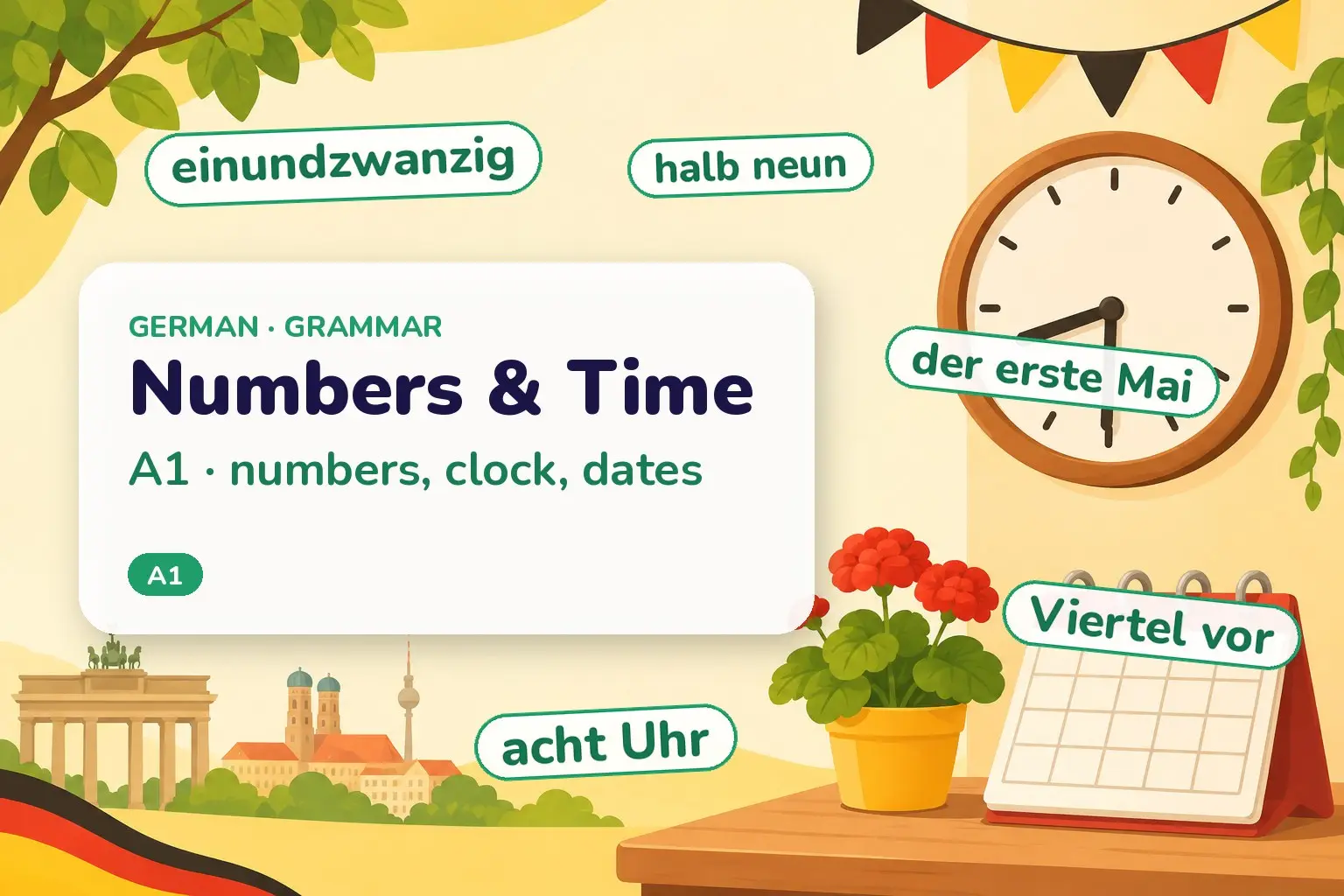
German builds tens back to front: 21 is einundzwanzig (one-and-twenty). The clock uses Uhr for full hours and halb for the coming half hour (halb neun is 8:30), and dates use ordinal numbers: der erste Mai, am ersten Mai.
Level: A1. Numbers, the clock and the calendar come up on your first day in German — prices, appointments, train times, birthdays. German numbers are regular once you spot one quirk: from 21 upward the units are said before the tens. The clock and the date then follow two small patterns.
The rule
A cardinal number is a counting number (one, two, three); an ordinal number ranks things (first, second, third). German counts with cardinals, but writes dates with ordinals.
Three patterns do most of the work:
- Counting. Learn 0–12 as single words, the teens (mostly number + zehn), and the tens (zwanzig, dreißig…). From 21 up you join unit + und + ten as one word, youngest part first: einundzwanzig (literally “one-and-twenty”).
- The clock. Ask Wie spät ist es? Answer with Es ist … For full hours add Uhr (Es ist acht Uhr). For halves German looks forward to the next hour: halb neun is 8:30 (“half to nine”).
- The date. Use an ordinal: der erste Mai (1 May). In writing, a numeral with a full stop stands for the ordinal: der 1. Mai.
The numbers
| Number | German | Number | German |
|---|---|---|---|
| 0 | null | 13 | dreizehn |
| 1 | eins | 16 | sechzehn |
| 2 | zwei | 17 | siebzehn |
| 3 | drei | 20 | zwanzig |
| 4 | vier | 21 | einundzwanzig |
| 5 | fünf | 22 | zweiundzwanzig |
| 6 | sechs | 30 | dreißig |
| 7 | sieben | 40 | vierzig |
| 8 | acht | 100 | (ein)hundert |
| 11 | elf | 1000 | (ein)tausend |
| 12 | zwölf | 1000000 | eine Million |
From 21 onward the pattern is unit + und + ten, written as a single word: dreiundvierzig (43), fünfundsechzig (65). Note the spelling tweaks: sechs loses its s in sechzehn/sechzig, sieben loses -en in siebzehn/siebzig, and thirty is dreißig with ß.
Telling the time
| Clock | Everyday German | Formal (24-hour) |
|---|---|---|
| 8:00 | acht Uhr | acht Uhr |
| 8:15 | Viertel nach acht | acht Uhr fünfzehn |
| 8:30 | halb neun | acht Uhr dreißig |
| 8:45 | Viertel vor neun | acht Uhr fünfundvierzig |
| 8:20 | zwanzig nach acht | acht Uhr zwanzig |
| 8:40 | zwanzig vor neun | acht Uhr vierzig |
In everyday speech use nach (past) and vor (to): Viertel nach acht (quarter past eight), Viertel vor neun (quarter to nine). Half hours point ahead with halb + the next hour. To say at a time use um: um acht Uhr, um halb neun. Timetables, tickets and opening hours use the 24-hour clock: Der Zug fährt um 20:30 Uhr.
Dates
Dates run day – month – year and use ordinal numbers. Build an ordinal by adding -te to numbers 2–19 and -ste from 20, with a few irregulars: erste (1st), dritte (3rd), siebte (7th), achte (8th).
- der erste Mai — 1 May, written der 1. Mai
- am dritten Oktober — on 3 October (the ending shifts to -en after am)
- Heute ist der zwanzigste März. — Today is 20 March.
Ask with Welches Datum ist heute? or Der Wievielte ist heute? Months and weekdays are capitalised like all German nouns: Januar, Montag.
How to say it
A few number words trip up English speakers:
- z in zwei, zwanzig, zehn is a hard “ts”: zwei = “tsvai”.
- ei in eins, zwei, drei rhymes with English “eye”.
- ö in zwölf and ü in fünf are rounded front vowels — say “eh”/“ee” with rounded lips.
- ß in dreißig is a sharp “s”, never a “z”.
- ch in acht, sechs is the raspy “ach” sound (though sechs ends “zeks”).
Example sentences
- Ich bin einundzwanzig Jahre alt.I am twenty-one years old.unit + und + ten: ein-und-zwanzig
- Wir sind zu dritt.There are three of us.dritt from drei
- Das kostet fünfundsechzig Euro.That costs sixty-five euros.fünf-und-sechzig
- Ich habe ein Buch.I have one book / a book.ein before a noun, not eins
- Zähl bis zehn.Count to ten.zehn = 'tsayn'
- Wie spät ist es?What time is it?the usual question
- Es ist acht Uhr.It is eight o'clock.full hour + Uhr
- Es ist halb neun.It is half past eight (8:30).halb looks forward to nine
- Es ist Viertel nach acht.It is a quarter past eight.Viertel nach = quarter past
- Es ist Viertel vor neun.It is a quarter to nine.Viertel vor = quarter to
- Der Film beginnt um zwanzig Uhr.The film starts at 20:00.um = at; 24-hour clock
- Ich stehe um halb sieben auf.I get up at half past six (6:30).um halb sieben = at 6:30
- Heute ist der erste Mai.Today is the first of May.ordinal der erste
- Mein Geburtstag ist am dritten Oktober.My birthday is on the third of October.am + ordinal in -en
- Wir treffen uns am zwanzigsten März.We meet on the twentieth of March.-ste/-sten from 20
- Der Wievielte ist heute?What's the date today?colloquial date question
- Ich komme um Viertel vor acht.I'm coming at a quarter to eight.um + Viertel vor
- Es ist zwölf Uhr mittags.It is twelve o'clock noon.zwölf = 'tsvölf'
Common mistakes
- ❌ zwanzigundeins → ✅ einundzwanzig. The unit comes first: one-and-twenty.
- ❌ halb drei for 3:30 → ✅ halb drei is 2:30. halb counts to the next hour.
- ❌ eins Buch → ✅ ein Buch. Before a noun use ein; eins is the bare counting word.
- ❌ dreizig → ✅ dreißig. Thirty is spelled with ß.
- ❌ der erste. Mai / der 1 Mai → ✅ der 1. Mai. The full stop goes straight after the numeral and means “first”.
- ❌ um acht for a full hour on a sign → ✅ um acht Uhr (or 20:00 Uhr). Keep Uhr for clarity.
A short conversation
— Entschuldigung, wie spät ist es? (Excuse me, what time is it?) — Es ist Viertel vor neun. (It’s a quarter to nine.) — Danke. Und welches Datum ist heute? (Thanks. And what’s the date today?) — Heute ist der erste Mai. Der Markt öffnet um zehn Uhr. (Today is the first of May. The market opens at 10:00.)
Usage notes
- eins vs ein. eins is the counting word (“…neun, zehn, eins”) and the answer to Wie viele? As an article before a noun it becomes ein/eine: ein Apfel, eine Stunde.
- sieben keeps its syllable in -zehn. siebzehn (17) and siebzig (70) drop -en, but siebzehn still has two syllables; do not say siebenzehn.
- Uhr vs Stunde. Uhr is the clock time (“o’clock”) and also the noun for a clock/watch; Stunde is a duration (“hour”). Es ist drei Uhr (3:00) vs drei Stunden (three hours).
- Decimals and thousands. German swaps the English separators: 1.000 (one thousand) with a dot, 3,5 (three point five) with a comma.
- Years. Up to 1999, years are read in hundreds: neunzehnhundertneunzig (1990). From 2000 they are read as plain numbers: zweitausendzwanzig (2020).
Compared with ordinal numbers
Cardinals count (eins, zwei, drei) and never change their ending. Ordinals rank (erste, zweite, dritte) and behave like adjectives, so their ending shifts with the case: der erste Mai but am ersten Mai, der zwanzigste but am zwanzigsten. On the calendar you always use the ordinal. You will meet the article forms der/die/das in German articles: der, die, das, and the verb sein behind es ist in sein and haben.
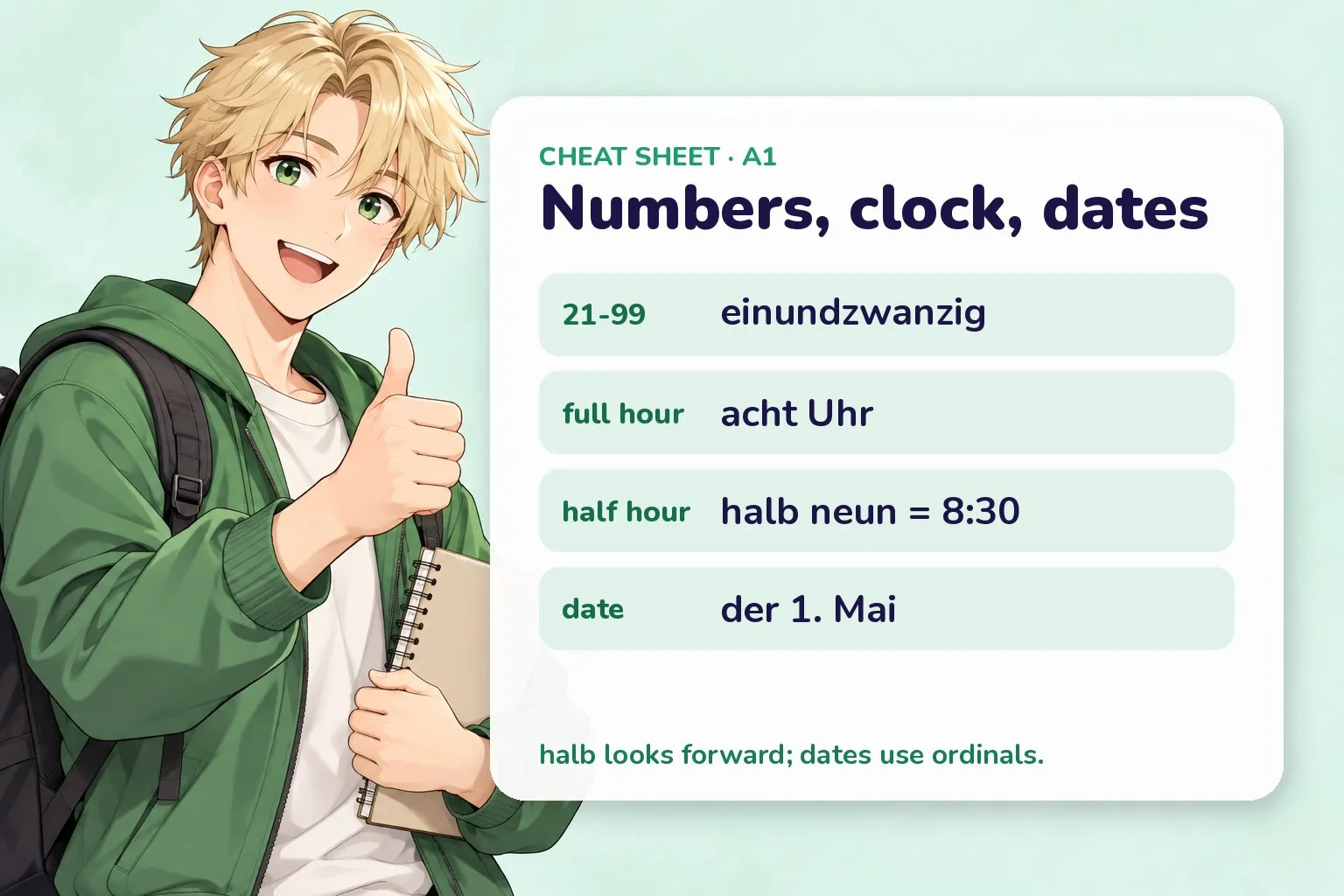
Quick recap before the quiz.
Practice
German numbers, time and dates practice
Try each one, then press Check. No sign-up, nothing is sent anywhere — it all runs in your browser.
Hint: looks forward to the next hour
Show answer
halb — halb neun = 8:30, half on the way to nine.
Hint: uses ß
Show answer
dreißig — Thirty is dreißig, the odd ten out.
4 Build the date 'the first of May'.
Show answer
der erste Mai — Dates use an ordinal: der erste Mai.
5 Match each clock time to its German.
- 8:15
- 8:30
- 8:45
- at 8:00
Show answer
- 8:15 → Viertel nach acht
- 8:30 → halb neun
- 8:45 → Viertel vor neun
- at 8:00 → um acht Uhr
nach = past, vor = to, halb = to the next hour, um = at.
Quiz
German numbers, time and dates
12 questions · pick an answer and you'll see straight away if it's right.
-
Show answer
dreiundvierzig — Unit + und + ten: drei-und-vierzig.
-
Show answer
2:30 — halb looks forward: halb drei = 2:30.
-
Show answer
dreißig — Thirty is dreißig (dreissig is the Swiss ss spelling).
-
Show answer
Viertel vor neun — vor = to: Viertel vor neun = 8:45.
-
Show answer
ein Buch — Use ein before the noun; eins is the counting form.
-
Show answer
um acht Uhr — um marks clock time: um acht Uhr.
-
Show answer
der erste Mai — The full stop means the ordinal: der erste Mai.
-
Show answer
dritten — After am the ordinal ends in -en: am dritten Oktober.
-
Show answer
sechzehn (from sechs) — sechs loses its s in sechzehn/sechzig; sieben drops -en in siebzehn/siebzig.
-
Show answer
neunzehnhundertneunzig — Pre-2000 years are read in hundreds: neunzehnhundertneunzig.
-
Show answer
Wie spät ist es? — Wie spät ist es? asks the time; Welches Datum… asks the date.
-
Show answer
the 24-hour clock — Official times use the 24-hour clock: 20:30 Uhr.
Recap cheat-sheet
| Thing | Pattern | Example |
|---|---|---|
| 21–99 | unit + und + ten (one word) | einundzwanzig |
| full hour | number + Uhr | acht Uhr |
| half hour | halb + next hour | halb neun = 8:30 |
| quarter | Viertel nach / vor | Viertel vor neun |
| at a time | um + time | um acht Uhr |
| date | ordinal + month | der erste Mai (1.) |
Next
- Back to the German grammar section
- Related: German articles der, die, das and sein and haben
- New here? Start with Start Learning German Here
All German grammar topics
Every grammar point in order, from your first sentence to advanced structures. Pick one and go straight to it. New lessons go live every day, so topics marked Coming soon fill in over the next weeks.
Grammar path
A1 16 topics · 16 ready
- 01 German Articles: Der, Die, Das
- 02 Indefinite Articles: ein / eine / ein
- 03 German Personal Pronouns (ich, du, er...)
- 04 Present Tense: Regular Verbs
- 05 The Verbs sein and haben
- 06 W-Questions (wer, was, wo, wie)
- 07 Yes/No Questions (Verb First)
- 08 Stem-Changing Verbs (fahren, essen, lesen)
- 09 Basic Word Order (Verb Second)
- 10 The Accusative Case (Direct Object)
- 11 Negation: nicht vs kein
- 12 Possessive Articles (mein, dein, sein)
- 13 Modal Verbs (können, müssen, wollen)
- 14 The Imperative (Commands)
- 15 Numbers, Time and Dates You are here
- 16 Common Prepositions (basic)
A2 19 topics · 5 ready
- 17 The Dative Case (Indirect Object)
- 18 Verbs with the Dative (helfen, danken)
- 19 Accusative Prepositions (durch, für, ohne)
- 20 Dative Prepositions (mit, nach, bei, von, zu)
- 21 Two-Way Prepositions (Wechselpräpositionen)
- 22 The Perfect Tense (Perfekt) Coming soon
- 23 Perfekt: Choosing haben or sein Coming soon
- 24 Past Participles (Partizip II) Coming soon
- 25 Simple Past (Präteritum): sein, haben, modals Coming soon
- 26 Separable-Prefix Verbs Coming soon
- 27 Inseparable-Prefix Verbs Coming soon
- 28 Comparative and Superlative Coming soon
- 29 Coordinating Conjunctions (und, aber, denn) Coming soon
- 30 Subordinate Clauses (weil, dass) Coming soon
- 31 Reflexive Verbs (sich freuen) Coming soon
- 32 Ein-Words in Accusative and Dative Coming soon
- 33 Pronouns in Accusative and Dative Coming soon
- 34 Requests with möchten and würden Coming soon
- 35 Ordinal Numbers and Dates Coming soon
B1 20 topics
- 36 Adjective Endings after Definite Articles Coming soon
- 37 Adjective Endings after Indefinite Articles Coming soon
- 38 Adjective Endings with No Article Coming soon
- 39 Simple Past (Präteritum): All Verbs Coming soon
- 40 Past Perfect (Plusquamperfekt) Coming soon
- 41 Future Tense (Futur I) Coming soon
- 42 The Genitive Case (Possession) Coming soon
- 43 Genitive Prepositions (wegen, trotz) Coming soon
- 44 Subordinating Conjunctions (als, wenn, obwohl) Coming soon
- 45 als vs wenn (Past vs Repeated) Coming soon
- 46 Infinitive Clauses with zu Coming soon
- 47 Purpose: um...zu vs damit Coming soon
- 48 Relative Clauses (der, die, das) Coming soon
- 49 Dative Reflexive Verbs Coming soon
- 50 Konjunktiv II: würde and Polite/Hypothetical Coming soon
- 51 Conditional Sentences (wenn-Sätze) Coming soon
- 52 Passive Voice: Present (werden) Coming soon
- 53 Verbs with Fixed Prepositions Coming soon
- 54 da- and wo- Compounds (darauf, worauf) Coming soon
- 55 Weak Nouns (N-Declension) Coming soon
B2 18 topics
- 56 Passive in All Tenses and with Modals Coming soon
- 57 Stative Passive (Zustandspassiv) Coming soon
- 58 Passive Alternatives (man, sich lassen) Coming soon
- 59 Konjunktiv II in the Past (hätte gemacht) Coming soon
- 60 Konjunktiv I and Reported Speech Coming soon
- 61 Advanced Relative Clauses (was, wo, Präposition+Pronomen) Coming soon
- 62 Nominalised Adjectives and Participles Coming soon
- 63 Participles as Adjectives (Partizip I/II) Coming soon
- 64 Extended Participle Attributes Coming soon
- 65 Two-Part Connectors (entweder...oder) Coming soon
- 66 Adverbial Connectors (deshalb, trotzdem) Coming soon
- 67 Temporal Clauses (bevor, nachdem, seitdem) Coming soon
- 68 Concessive & Conditional Clauses (obwohl, falls) Coming soon
- 69 Subjective Use of Modal Verbs Coming soon
- 70 Future Perfect (Futur II) Coming soon
- 71 Verb Valency and Objects Coming soon
- 72 Mid-Field Order: Te-Ka-Mo-Lo Coming soon
- 73 Nominal Style (Nominalisierung) Coming soon
C1 11 topics
- 74 Light-Verb Constructions (Funktionsverbgefüge) Coming soon
- 75 Advanced & Impersonal Passive Coming soon
- 76 Advanced Konjunktiv (als ob, Wunschsätze) Coming soon
- 77 Participial & Abbreviated Clauses Coming soon
- 78 Nominalisation vs Verbalisation (Umformung) Coming soon
- 79 Modal Particles (doch, ja, mal, eben, halt) Coming soon
- 80 Formal Connectors & Text Cohesion Coming soon
- 81 Advanced Genitive & Nominal Attributes Coming soon
- 82 Word Formation (Komposita & Derivation) Coming soon
- 83 Reported Speech in Extended Text Coming soon
- 84 Emphasis, Fronting and Inversion Coming soon