German Two-Way Prepositions: Accusative or Dative
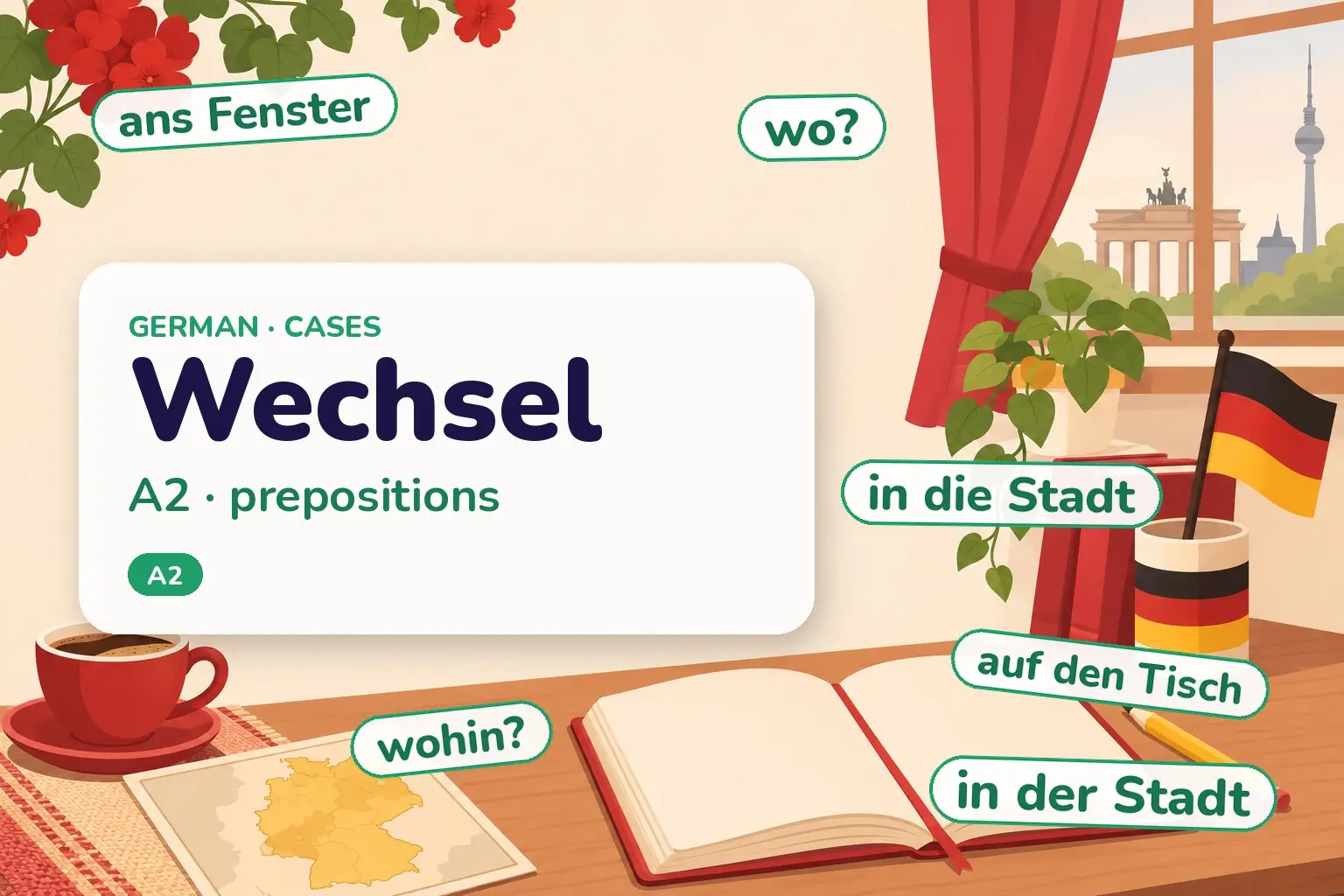
Nine German prepositions — an, auf, hinter, in, neben, über, unter, vor, zwischen — take two cases. Use the accusative for movement towards a place (wohin? where to): Ich gehe in die Stadt. Use the dative for a fixed location (wo? where): Ich bin in der Stadt.
Level: A2. Some German prepositions always take one case, but nine of them take two — the accusative or the dative — depending on what you mean. Once you learn the single question that decides between them, these prepositions become one of the most predictable parts of German.
The rule
A preposition is a small word like in, on or under that sits in front of a noun. A case is the form that marks the noun’s job; German has four, and after a preposition the noun’s article changes to match. Most prepositions fix one case, but the two-way prepositions (German Wechselpräpositionen, “change prepositions”) switch between the accusative and the dative by meaning.
There are exactly nine of them: an (at/on a vertical surface), auf (on a horizontal surface), hinter (behind), in (in/into), neben (next to), über (over/above), unter (under/among), vor (in front of), zwischen (between). Learn them as one block.
The choice is about movement. If the phrase answers wohin? (“where to?”) — something is moving towards or into the place — use the accusative. If it answers wo? (“where?”) — something simply is somewhere, with no change of location — use the dative. Compare Ich gehe in die Stadt (“I’m going into town”, movement → accusative) with Ich bin in der Stadt (“I’m in town”, location → dative).
The case forms after a two-way preposition
The article you plug in is the ordinary accusative or dative article:
| Masculine | Feminine | Neuter | Plural | |
|---|---|---|---|---|
| Accusative (wohin?) | den / einen | die / eine | das / ein | die / — |
| Dative (wo?) | dem / einem | der / einer | dem / einem | den / — (+ noun -n) |
And here is the same preposition, in, shown both ways:
| Preposition | Wohin? (accusative) | Wo? (dative) |
|---|---|---|
| in | in die Stadt (into town) | in der Stadt (in town) |
| an | an die Wand (onto the wall) | an der Wand (on the wall) |
| auf | auf den Tisch (onto the table) | auf dem Tisch (on the table) |
| unter | unter das Bett (under the bed, moving) | unter dem Bett (under the bed, resting) |
Contractions
In everyday German several of these fuse with the article. These short forms are standard in speech and writing:
| Full form | Contraction |
|---|---|
| in + das | ins |
| in + dem | im |
| an + das | ans |
| an + dem | am |
| auf + das | aufs |
Ich gehe ins Kino (“I’m going to the cinema”) and Ich bin im Kino (“I’m at the cinema”) are the normal forms; spelling them out is used only for special emphasis.
Example sentences
- Ich gehe in die Stadt.I'm going into town.wohin? → accusative: in die Stadt
- Ich wohne in der Stadt.I live in town.wo? → dative: in der Stadt
- Er hängt das Bild an die Wand.He hangs the picture on the wall.wohin? movement → an die Wand (acc.)
- Das Bild hängt an der Wand.The picture hangs on the wall.wo? location → an der Wand (dat.)
- Leg das Buch auf den Tisch.Put the book on the table.wohin? → auf den Tisch (acc.)
- Das Buch liegt auf dem Tisch.The book is lying on the table.wo? → auf dem Tisch (dat.)
- Die Katze läuft hinter das Sofa.The cat runs behind the sofa.wohin? → hinter das Sofa (acc.)
- Die Katze schläft hinter dem Sofa.The cat sleeps behind the sofa.wo? → hinter dem Sofa (dat.)
- Stell die Lampe neben das Bett.Put the lamp next to the bed.wohin? → neben das Bett (acc.)
- Die Lampe steht neben dem Bett.The lamp stands next to the bed.wo? → neben dem Bett (dat.)
- Das Flugzeug fliegt über die Stadt.The plane flies over the city.wohin? directed path → über die Stadt (acc.)
- Die Lampe hängt über dem Tisch.The lamp hangs above the table.wo? → über dem Tisch (dat.)
- Der Hund kriecht unter das Bett.The dog crawls under the bed.wohin? → unter das Bett (acc.)
- Der Hund liegt unter dem Bett.The dog lies under the bed.wo? → unter dem Bett (dat.)
- Ich stelle mich vor die Tür.I stand myself in front of the door.wohin? → vor die Tür (acc.)
- Ich warte vor der Tür.I wait in front of the door.wo? → vor der Tür (dat.)
- Setz dich zwischen die Kinder.Sit down between the children.wohin? → zwischen die Kinder (acc.)
- Er sitzt zwischen den Kindern.He sits between the children.wo? plural dative adds -n: den Kindern
- Wir gehen ins Kino.We're going to the cinema.in + das = ins (wohin?)
- Wir sind im Kino.We're at the cinema.in + dem = im (wo?)
- Häng den Mantel an den Haken.Hang the coat on the hook.wohin? → an den Haken (acc.)
- Der Mantel hängt am Haken.The coat hangs on the hook.an + dem = am (wo?)
Common mistakes
- ❌ Ich gehe in der Schule. → ✅ Ich gehe in die Schule. Going to school is movement (wohin?), so use the accusative: in die Schule. In der Schule means you are already there.
- ❌ Das Buch ist auf den Tisch. → ✅ Das Buch ist auf dem Tisch. Sein (to be) is location, not movement, so use the dative: auf dem Tisch.
- ❌ Er legt das Handy auf dem Tisch. → ✅ Er legt das Handy auf den Tisch. Legen is a motion verb (you put it there), so the accusative: auf den Tisch.
- ❌ zwischen die Kindern → ✅ zwischen den Kindern (location). In the dative plural the article is den and the noun adds -n: den Kindern.
- ❌ in dem Kino in normal speech → ✅ im Kino. In + dem almost always contracts to im; the full form sounds stiff.
A short conversation
— Wohin stellst du die Blumen? (Where are you putting the flowers?) — Ich stelle sie auf den Tisch. (I’m putting them on the table.) — wohin? → accusative — Und wo ist die Vase, die vorher da war? (And where’s the vase that was there before?) — Die steht jetzt in dem Schrank, also im Schrank. (It’s now in the cupboard.) — wo? → dative
The first answer moves the flowers (auf den Tisch, accusative); the second describes where the vase simply is (im Schrank, dative).
Usage notes
- Some uses are figurative, not physical, but the rule still holds. Ich denke an dich (accusative, “I think of you”) treats the thought as directed towards you; Ich nehme teil an der Sitzung (dative, “I take part in the meeting”) is fixed by the verb phrase. Learn these verb+preposition pairs as set phrases.
- Time phrases with an, in, vor are dative: am Montag (on Monday), im Januar (in January), vor einer Woche (a week ago). No movement is involved, so they default to the dative.
- auf and an split by surface: auf is for horizontal surfaces (auf dem Tisch, on the table) and an for vertical ones or edges (an der Wand, on the wall; am Fenster, at the window).
- über also means “about”: ein Buch über die Geschichte (“a book about history”) takes the accusative in this sense.
Compared with…
- Accusative-only prepositions: durch, für, gegen, ohne, um always take the accusative, with no wohin/wo choice. Compare für den Mann (always accusative) with vor dem Mann (location, dative). See German accusative prepositions.
- Dative-only prepositions: aus, bei, mit, nach, seit, von, zu always take the dative, whatever the meaning. Compare mit dem Bus (always dative) with in den Bus (movement, accusative). See German dative prepositions.
- Make sure the article forms are solid first: build the accusative in the German accusative case lesson and the dative in the German dative case lesson, which this page relies on.
How to say it
These are the sounds English speakers trip over in this lesson’s words:
| Sound | How to say it |
|---|---|
| ü in über, für | round your lips for “oo” but say “ee”: über ≈ “UU-ber”. |
| z in zwischen | always “ts”: zwischen ≈ “TSVISH-en”. |
| w in Wand, wohin | like English “v”: Wand ≈ “vant”, wohin ≈ “vo-HEEN”. |
| ch in Tisch | here “sh” after s: Tisch ≈ “tish”; but ich ≈ a soft “ish”. |
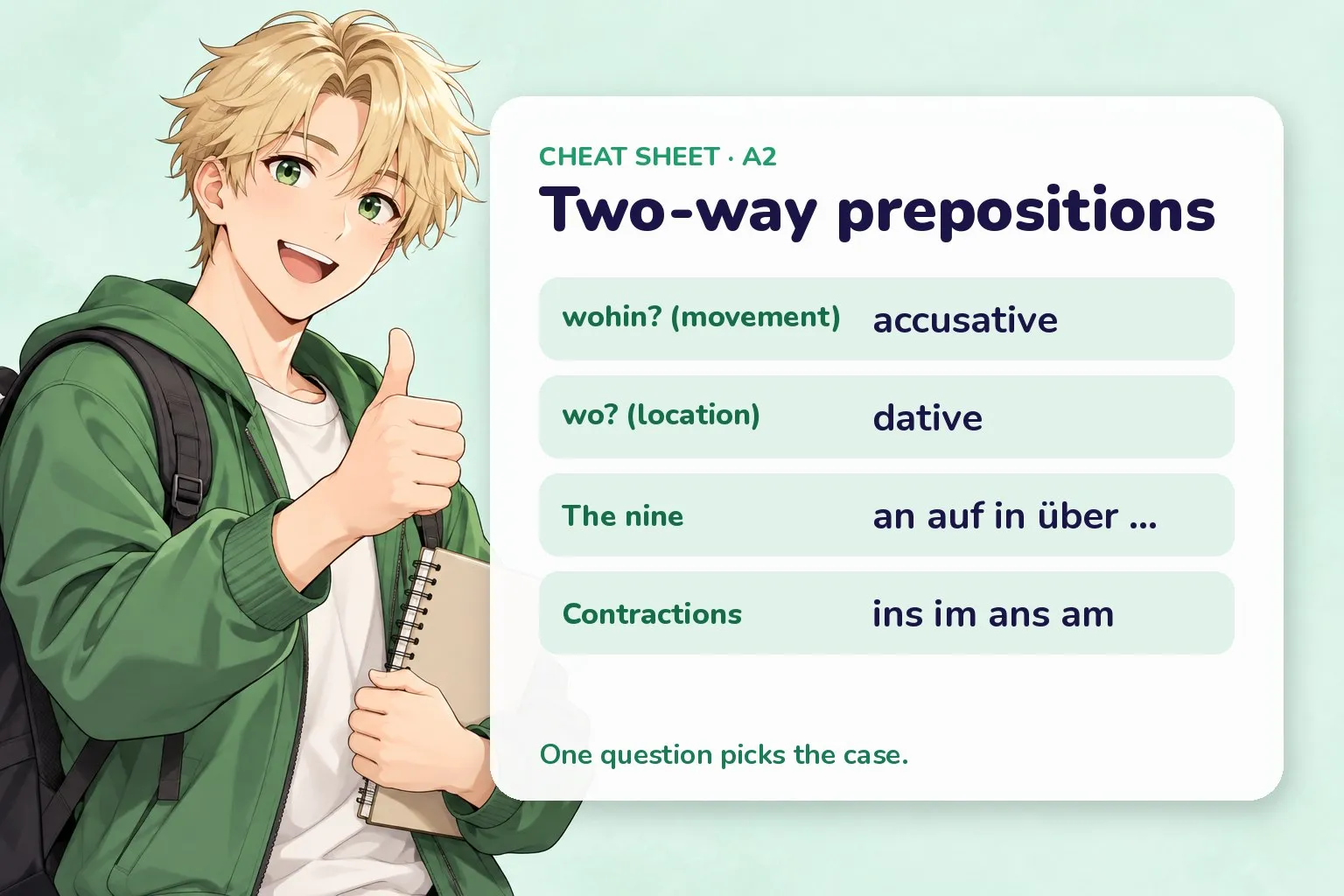
Quick recap before the quiz.
Practice
Two-way prepositions practice
Try each one, then press Check. No sign-up, nothing is sent anywhere — it all runs in your browser.
Hint: wo? → dative
Show answer
dem — liegen is a position verb; masculine der Tisch becomes dem.
Hint: ins Kino
Show answer
ins — in + das = ins; in + dem = im.
5 Build: 'I'm putting the lamp on the table.' (movement)
Show answer
ich stelle die Lampe auf den Tisch — stellen is motion (wohin?), so auf den Tisch takes the accusative den.
6 Match each two-way preposition to its meaning.
- an
- auf
- zwischen
- unter
Show answer
- an → on/at (vertical)
- auf → on (horizontal)
- zwischen → between
- unter → under/among
Four of the nine Wechselpräpositionen and their core meanings.
Hint: wohin? → accusative
Show answer
das — laufen shows movement; neuter das Sofa stays das in the accusative.
Quiz
German two-way prepositions
13 questions · pick an answer and you'll see straight away if it's right.
-
Show answer
nine — Nine: an, auf, hinter, in, neben, über, unter, vor, zwischen.
-
Show answer
accusative — Movement towards a place (wohin?) takes the accusative.
-
Show answer
die — Movement → accusative; feminine die Stadt stays die.
-
Show answer
der — Location → dative; feminine die becomes der: in der Stadt.
-
Show answer
dem — liegen = location → dative; masculine der Tisch becomes dem.
-
Show answer
den — legen = movement → accusative; der Tisch becomes den.
-
Show answer
im — in + dem = im; in + das = ins.
-
Show answer
liegen — liegen (to lie) is a position verb → dative; the others are motion verbs → accusative.
-
Show answer
ans — an + das = ans; an + dem = am.
-
Show answer
den — Plural dative: die becomes den and the noun adds -n: den Kindern.
-
Show answer
accusative-only prepositions — They always take the accusative, with no wohin/wo choice.
-
Show answer
über — über means over/above; location here, so dative: über dem Tisch.
-
Show answer
time phrases with an default to the dative — Time phrases like am Montag, im Januar take the dative; am = an + dem.
Recap cheat-sheet
| Question | Case | Example |
|---|---|---|
| wohin? (where to) | accusative | in die Stadt |
| wo? (where) | dative | in der Stadt |
| The nine | an, auf, hinter, in, neben, über, unter, vor, zwischen | |
| Motion verbs | accusative | legen, stellen, setzen, gehen |
| Position verbs | dative | liegen, stehen, sitzen, sein |
| Contractions | ins, im, ans, am, aufs |
Next
- The fixed accusative set: German accusative prepositions
- The fixed dative set: German dative prepositions
- Build the forms: German accusative case and German dative case
- Back to the German grammar section
All German grammar topics
Every grammar point in order, from your first sentence to advanced structures. Pick one and go straight to it. New lessons go live every day, so topics marked Coming soon fill in over the next weeks.
Grammar path
A1 16 topics · 16 ready
- 01 German Articles: Der, Die, Das
- 02 Indefinite Articles: ein / eine / ein
- 03 German Personal Pronouns (ich, du, er...)
- 04 Present Tense: Regular Verbs
- 05 The Verbs sein and haben
- 06 W-Questions (wer, was, wo, wie)
- 07 Yes/No Questions (Verb First)
- 08 Stem-Changing Verbs (fahren, essen, lesen)
- 09 Basic Word Order (Verb Second)
- 10 The Accusative Case (Direct Object)
- 11 Negation: nicht vs kein
- 12 Possessive Articles (mein, dein, sein)
- 13 Modal Verbs (können, müssen, wollen)
- 14 The Imperative (Commands)
- 15 Numbers, Time and Dates
- 16 Common Prepositions (basic)
A2 19 topics · 5 ready
- 17 The Dative Case (Indirect Object)
- 18 Verbs with the Dative (helfen, danken)
- 19 Accusative Prepositions (durch, für, ohne)
- 20 Dative Prepositions (mit, nach, bei, von, zu)
- 21 Two-Way Prepositions (Wechselpräpositionen) You are here
- 22 The Perfect Tense (Perfekt) Coming soon
- 23 Perfekt: Choosing haben or sein Coming soon
- 24 Past Participles (Partizip II) Coming soon
- 25 Simple Past (Präteritum): sein, haben, modals Coming soon
- 26 Separable-Prefix Verbs Coming soon
- 27 Inseparable-Prefix Verbs Coming soon
- 28 Comparative and Superlative Coming soon
- 29 Coordinating Conjunctions (und, aber, denn) Coming soon
- 30 Subordinate Clauses (weil, dass) Coming soon
- 31 Reflexive Verbs (sich freuen) Coming soon
- 32 Ein-Words in Accusative and Dative Coming soon
- 33 Pronouns in Accusative and Dative Coming soon
- 34 Requests with möchten and würden Coming soon
- 35 Ordinal Numbers and Dates Coming soon
B1 20 topics
- 36 Adjective Endings after Definite Articles Coming soon
- 37 Adjective Endings after Indefinite Articles Coming soon
- 38 Adjective Endings with No Article Coming soon
- 39 Simple Past (Präteritum): All Verbs Coming soon
- 40 Past Perfect (Plusquamperfekt) Coming soon
- 41 Future Tense (Futur I) Coming soon
- 42 The Genitive Case (Possession) Coming soon
- 43 Genitive Prepositions (wegen, trotz) Coming soon
- 44 Subordinating Conjunctions (als, wenn, obwohl) Coming soon
- 45 als vs wenn (Past vs Repeated) Coming soon
- 46 Infinitive Clauses with zu Coming soon
- 47 Purpose: um...zu vs damit Coming soon
- 48 Relative Clauses (der, die, das) Coming soon
- 49 Dative Reflexive Verbs Coming soon
- 50 Konjunktiv II: würde and Polite/Hypothetical Coming soon
- 51 Conditional Sentences (wenn-Sätze) Coming soon
- 52 Passive Voice: Present (werden) Coming soon
- 53 Verbs with Fixed Prepositions Coming soon
- 54 da- and wo- Compounds (darauf, worauf) Coming soon
- 55 Weak Nouns (N-Declension) Coming soon
B2 18 topics
- 56 Passive in All Tenses and with Modals Coming soon
- 57 Stative Passive (Zustandspassiv) Coming soon
- 58 Passive Alternatives (man, sich lassen) Coming soon
- 59 Konjunktiv II in the Past (hätte gemacht) Coming soon
- 60 Konjunktiv I and Reported Speech Coming soon
- 61 Advanced Relative Clauses (was, wo, Präposition+Pronomen) Coming soon
- 62 Nominalised Adjectives and Participles Coming soon
- 63 Participles as Adjectives (Partizip I/II) Coming soon
- 64 Extended Participle Attributes Coming soon
- 65 Two-Part Connectors (entweder...oder) Coming soon
- 66 Adverbial Connectors (deshalb, trotzdem) Coming soon
- 67 Temporal Clauses (bevor, nachdem, seitdem) Coming soon
- 68 Concessive & Conditional Clauses (obwohl, falls) Coming soon
- 69 Subjective Use of Modal Verbs Coming soon
- 70 Future Perfect (Futur II) Coming soon
- 71 Verb Valency and Objects Coming soon
- 72 Mid-Field Order: Te-Ka-Mo-Lo Coming soon
- 73 Nominal Style (Nominalisierung) Coming soon
C1 11 topics
- 74 Light-Verb Constructions (Funktionsverbgefüge) Coming soon
- 75 Advanced & Impersonal Passive Coming soon
- 76 Advanced Konjunktiv (als ob, Wunschsätze) Coming soon
- 77 Participial & Abbreviated Clauses Coming soon
- 78 Nominalisation vs Verbalisation (Umformung) Coming soon
- 79 Modal Particles (doch, ja, mal, eben, halt) Coming soon
- 80 Formal Connectors & Text Cohesion Coming soon
- 81 Advanced Genitive & Nominal Attributes Coming soon
- 82 Word Formation (Komposita & Derivation) Coming soon
- 83 Reported Speech in Extended Text Coming soon
- 84 Emphasis, Fronting and Inversion Coming soon