The Imperative (Commands) in German
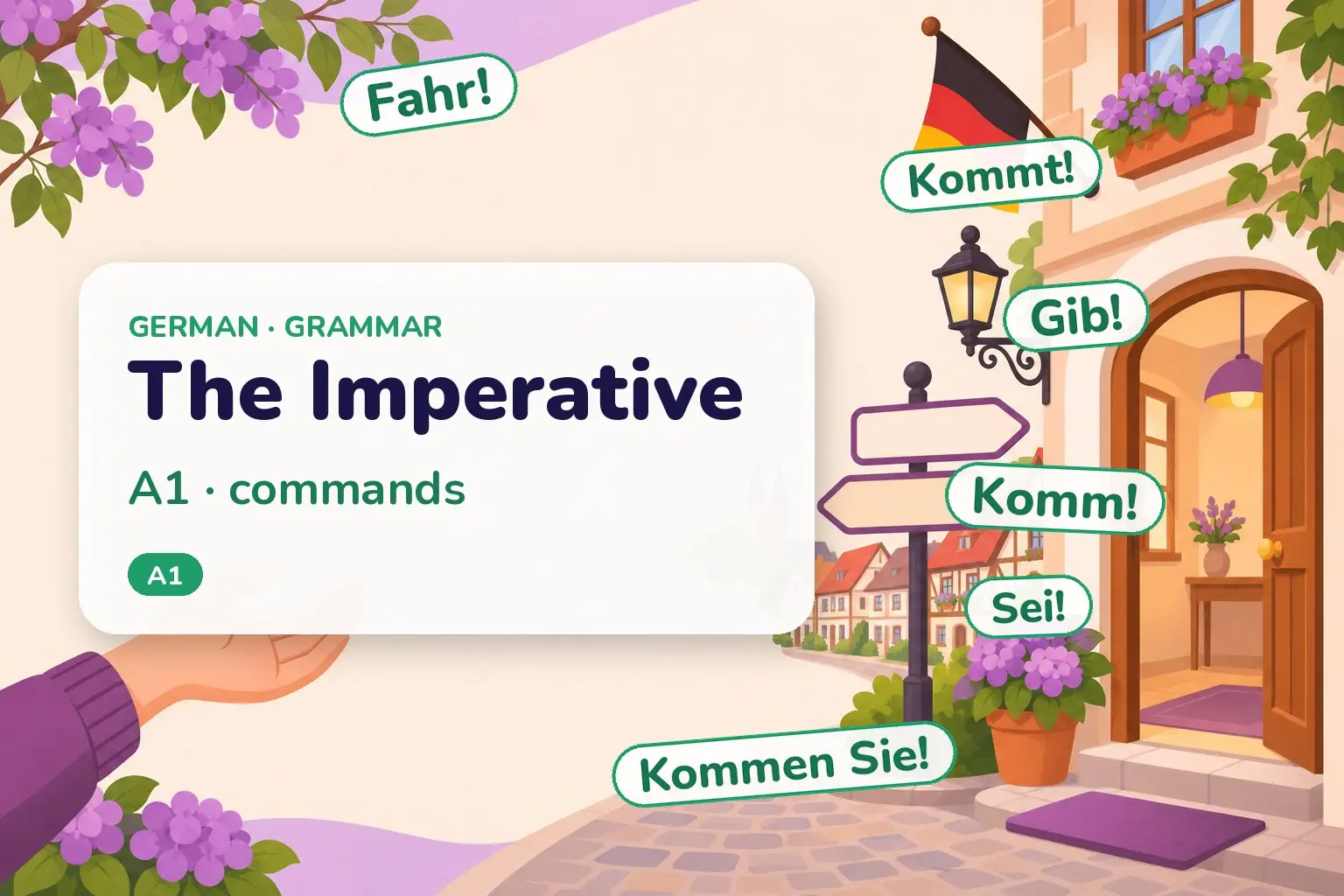
German has three command forms: du (the bare present stem — Komm!), ihr (the present ihr-form — Kommt!), and formal Sie (verb first, then Sie — Kommen Sie!). The pronoun is dropped for du and ihr but kept for Sie.
Level: A1. The imperative is how you tell someone to do something — Come here!, Wait!, Open the window! German picks one of three forms depending on who you are talking to, and the shape is close to the present tense you already know.
The rule
The imperative is the command form of a verb. Because German has three ways to say “you” — du (one friend), ihr (several friends) and Sie (one or more people, formally) — it also has three command forms, plus an optional “let’s” form with wir.
The key habit for English speakers: in the du and ihr commands you drop the pronoun. You do not say Du komm!; you just say Komm! The Sie command is different — there the verb comes first and Sie stays: Kommen Sie!
Build each form from the present tense:
- du: take the present du form (du kommst), cut the -st, and you have the command: Komm! The pronoun disappears.
- ihr: the command is simply the present ihr form with the pronoun dropped: ihr kommt → Kommt!
- Sie: turn the Sie statement around so the verb leads: Sie kommen → Kommen Sie!
A written du command may add an -e (Komme!), but this sounds formal or old-fashioned; in speech almost everyone drops it. There are two places where the -e cannot be dropped, because the bare stem is unpronounceable: stems ending in -d or -t (Arbeite!, Warte!, Rede!), and stems ending in a consonant plus -m or -n (Öffne!, Atme!).
The command forms
| Verb | du | ihr | Sie (formal) |
|---|---|---|---|
| kommen (come) | Komm! | Kommt! | Kommen Sie! |
| gehen (go) | Geh! | Geht! | Gehen Sie! |
| machen (do) | Mach! | Macht! | Machen Sie! |
| warten (wait) | Warte! | Wartet! | Warten Sie! |
| öffnen (open) | Öffne! | Öffnet! | Öffnen Sie! |
The wir form means “let’s …” and looks like the Sie form with wir: Gehen wir! (Let’s go!), Fangen wir an! (Let’s start!).
Stem-changing verbs: the e-to-i trap
This is the single most common imperative mistake, so learn the split as a pair. Strong verbs that change e to i or ie in the present du form keep that change in the command — and they never add an -e:
| Verb | du present | du command | Meaning |
|---|---|---|---|
| geben | du gibst | Gib! | Give! |
| nehmen | du nimmst | Nimm! | Take! |
| lesen | du liest | Lies! | Read! |
| sehen | du siehst | Sieh! | Look! |
| essen | du isst | Iss! | Eat! |
| sprechen | du sprichst | Sprich! | Speak! |
| helfen | du hilfst | Hilf! | Help! |
| vergessen | du vergisst | Vergiss! | Forget! |
But verbs that change a to ä (or au to äu) in the present du form drop the umlaut in the command and go back to the plain vowel:
| Verb | du present | du command | Meaning |
|---|---|---|---|
| fahren | du fährst | Fahr! | Drive! / Go! |
| schlafen | du schläfst | Schlaf! | Sleep! |
| laufen | du läufst | Lauf! | Run! |
| tragen | du trägst | Trag! | Carry! |
| halten | du hältst | Halt! | Stop! / Hold! |
The two forms that matter most, sein and haben, are irregular:
| Verb | du | ihr | Sie |
|---|---|---|---|
| sein (to be) | Sei! | Seid! | Seien Sie! |
| haben (to have) | Hab! | Habt! | Haben Sie! |
How to say it
A few of these command words hold sounds English speakers get wrong:
- ei in Sei!: like English “eye” — Sei! rhymes with “sigh”.
- ie in Lies!, Sieh!: like “ee” — Lies! sounds like “lees”.
- ss in Iss! / Vergiss! (spelled ss, not ß, because the vowel is short): a sharp, short “s” (never a “z” sound).
- ch in Sprich!, Mach!: after i a soft hiss (Sprich!); after a a throaty sound (Mach!).
- h in Geh!, Sieh!: the vowel before it is long and the h is silent — “gay”, “zee”.
Example sentences
- Komm her!Come here!du command of kommen, no pronoun
- Geh nach Hause!Go home!du, bare stem geh
- Wartet auf mich!Wait for me!ihr form = present ihr-form
- Warte einen Moment!Wait a moment!stem ends in -t, so -e stays
- Öffne bitte das Fenster.Please open the window.-ne stem keeps -e; bitte softens it
- Kommen Sie bitte herein!Please come in!formal Sie, verb first, Sie kept
- Gib mir das Buch!Give me the book!geben: e to i stays, no -e
- Nimm einen Schirm mit!Take an umbrella with you!nehmen: Nimm!, separable mit at end
- Lies den Text laut vor.Read the text aloud.lesen: e to ie stays
- Sprich bitte langsamer!Please speak more slowly!sprechen: Sprich!
- Iss dein Gemüse!Eat your vegetables!essen: Iss!, sharp ss
- Hilf mir bitte!Help me please!helfen: Hilf!
- Fahr vorsichtig!Drive carefully!fahren: a to ä dropped, Fahr!
- Schlaf gut!Sleep well!schlafen: Schlaf!, not Schläf!
- Sei ruhig!Be quiet!sein: Sei! (du)
- Seid vorsichtig, Kinder!Be careful, children!sein: Seid! (ihr)
- Seien Sie bitte geduldig.Please be patient.sein: formal Seien Sie!
- Hab keine Angst!Don't be afraid!haben: Hab!
- Steh bitte auf!Please stand up!separable aufstehen splits: Steh ... auf
- Ruf mich später an!Call me later!separable anrufen: Ruf ... an
- Machen wir eine Pause!Let's take a break!wir form = let's
- Mach das nicht!Don't do that!negative command: nicht after the verb
Common mistakes
- ❌ Du komm her! → ✅ Komm her! Drop the pronoun in the du command.
- ❌ Fähr langsam! → ✅ Fahr langsam! The a-to-ä umlaut is dropped in the command.
- ❌ Geb mir das! → ✅ Gib mir das! The e-to-i change stays: Gib!
- ❌ Wart! → ✅ Warte! A stem ending in -t keeps the -e so it can be pronounced.
- ❌ Komm Sie herein! → ✅ Kommen Sie herein! The formal command uses the full -en form with Sie.
- ❌ Sei Sie ruhig! → ✅ Seien Sie ruhig! The formal form of sein is Seien Sie, not Sei Sie.
A short conversation
— Komm rein und setz dich! (Come in and sit down!) — Danke. Gib mir bitte zwei Minuten. (Thanks. Give me two minutes, please.) — Klar. Nimm dir einen Kaffee. (Sure. Have a coffee.) — Seien Sie so nett und warten Sie kurz auf meinen Kollegen. (Be so kind and wait a moment for my colleague.)
Usage notes
- bitte and softening. A bare command can sound sharp. Add bitte (please) or the particle mal to soften it: Komm mal her!, Gib mir bitte das Salz.
- Keep the separable prefix at the end. A separable verb splits in the command, with the prefix last: aufstehen → Steh auf!, anrufen → Ruf an!, zumachen → Mach zu!
- Negative commands just add nicht (or kein-) after the verb: Geh nicht! (Don’t go!), Mach dir keine Sorgen! (Don’t worry!).
- The reflexive pronoun stays. With reflexive verbs the pronoun comes right after the verb: Setz dich! (Sit down!), Beeil dich! (Hurry up!).
- Signs and recipes are full of Sie and infinitive commands: Bitte drücken (Please push), Nicht rauchen (No smoking). The infinitive at the end is a common impersonal command on notices.
Compared with the regular present tense
The command forms come straight from the regular present tense: the du command is the du form minus -st, and the ihr command is identical to the present ihr form. The difference is word order and the missing pronoun — a statement keeps the verb in position 2 with its subject (Du kommst), while the command drops the subject and leads with the verb (Komm!). The same e-to-i and a-to-ä shifts you met in the present tense with stem changes decide the du command, so knowing du gibst and du fährst already tells you Gib! and Fahr!
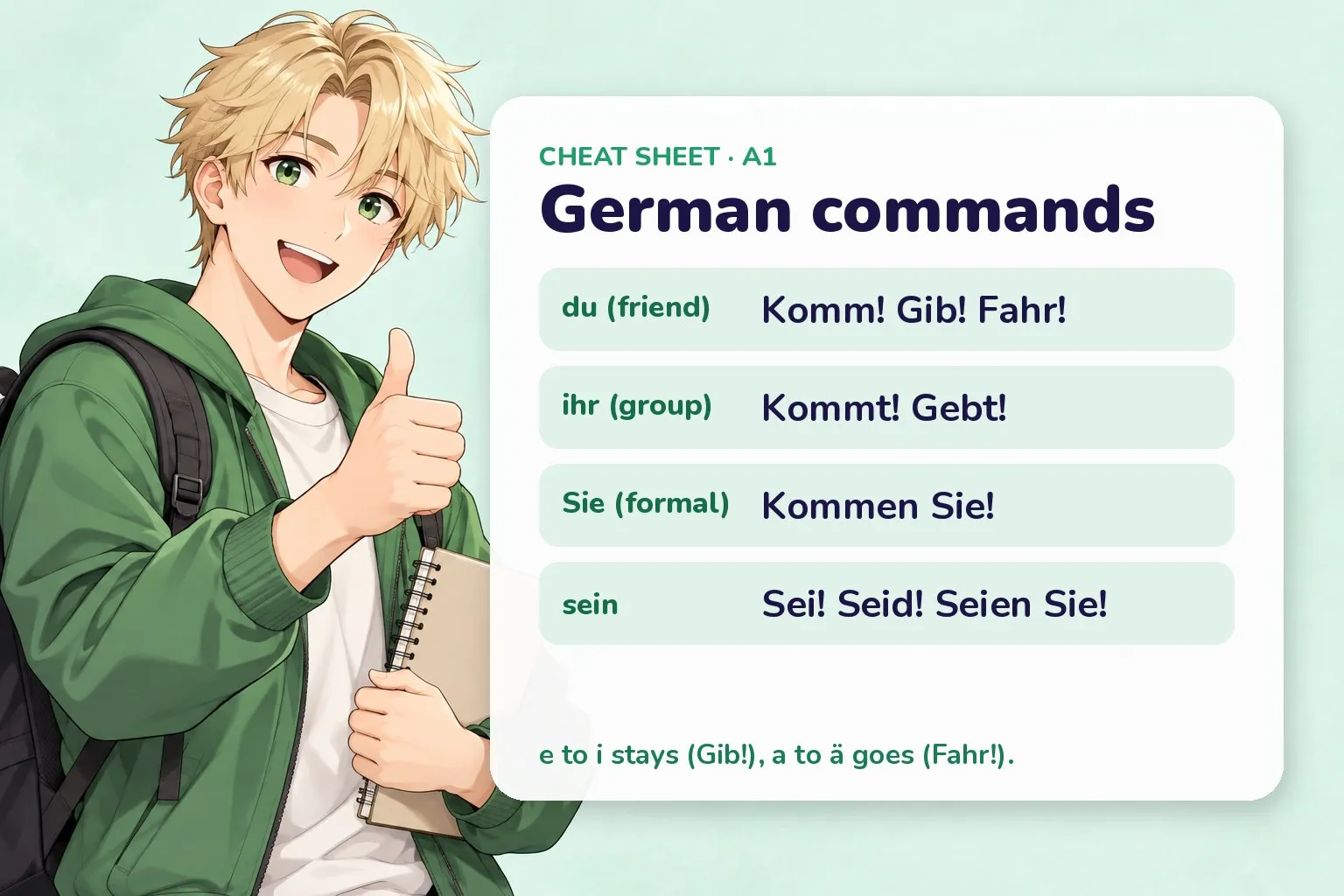
Quick recap before the quiz.
Practice
German imperative practice
Try each one, then press Check. No sign-up, nothing is sent anywhere — it all runs in your browser.
Hint: e changes to i, no -e
Show answer
Gib — geben keeps the e-to-i change: Gib!
Hint: a to ä is dropped
Show answer
Fahr — The a-to-ä umlaut disappears in the command: Fahr!, not Fähr!
4 Build the formal command: 'Please come in!'
Show answer
Kommen Sie bitte herein — Formal: verb first, then Sie — Kommen Sie bitte herein!
5 Match each verb to its du command.
- nehmen
- lesen
- sein
- warten
Show answer
- nehmen → Nimm!
- lesen → Lies!
- sein → Sei!
- warten → Warte!
nehmen/lesen keep e-to-i(e); sein is irregular Sei!; warten keeps -e.
Quiz
German imperative
12 questions · pick an answer and you'll see straight away if it's right.
-
Show answer
the pronoun (du/ihr) — You say Komm!, not Du komm!
-
Show answer
first, with Sie kept — Kommen Sie! — verb first, Sie stays.
-
Show answer
Nimm! — nehmen changes e to i: Nimm!
-
Show answer
Fahr! — a-to-ä is dropped: Fahr!
-
Show answer
a stem ending in -t keeps the -e: Warte! — Stems in -d/-t keep the -e so they can be said: Warte!
-
Show answer
Kommt! — It equals the present ihr-form: Kommt!
-
Show answer
Seid vorsichtig! — ihr form of sein is Seid!
-
Show answer
Steh auf! — The prefix goes to the end: Steh auf!
-
Show answer
Sprich — sprechen keeps e-to-i: Sprich!
-
Show answer
Mach das nicht! — nicht follows the verb and object: Mach das nicht!
-
Show answer
wir — Gehen wir! = Let's go.
-
Show answer
Hab! — haben: Hab! — e.g. Hab keine Angst!
Recap cheat-sheet
| Who | How to build | Example |
|---|---|---|
| du (one friend) | present du-form minus -st, drop pronoun | Komm! / Gib! / Fahr! |
| ihr (group) | present ihr-form, drop pronoun | Kommt! / Gebt! |
| Sie (formal) | verb first + Sie | Kommen Sie! |
| wir (let’s) | verb first + wir | Gehen wir! |
| sein | irregular | Sei! / Seid! / Seien Sie! |
Next
- Back to the German grammar section
- Build the foundation: regular present tense and present tense with stem changes
- New here? Start with Start Learning German Here
All German grammar topics
Every grammar point in order, from your first sentence to advanced structures. Pick one and go straight to it. New lessons go live every day, so topics marked Coming soon fill in over the next weeks.
Grammar path
A1 16 topics · 14 ready
- 01 German Articles: Der, Die, Das
- 02 Indefinite Articles: ein / eine / ein
- 03 German Personal Pronouns (ich, du, er...)
- 04 Present Tense: Regular Verbs
- 05 The Verbs sein and haben
- 06 W-Questions (wer, was, wo, wie)
- 07 Yes/No Questions (Verb First)
- 08 Stem-Changing Verbs (fahren, essen, lesen)
- 09 Basic Word Order (Verb Second)
- 10 The Accusative Case (Direct Object)
- 11 Negation: nicht vs kein
- 12 Possessive Articles (mein, dein, sein)
- 13 Modal Verbs (können, müssen, wollen)
- 14 The Imperative (Commands) You are here
- 15 Numbers, Time and Dates Coming soon
- 16 Common Prepositions (basic) Coming soon
A2 19 topics
- 17 The Dative Case (Indirect Object) Coming soon
- 18 Verbs with the Dative (helfen, danken) Coming soon
- 19 Accusative Prepositions (durch, für, ohne) Coming soon
- 20 Dative Prepositions (mit, nach, bei, von, zu) Coming soon
- 21 Two-Way Prepositions (Wechselpräpositionen) Coming soon
- 22 The Perfect Tense (Perfekt) Coming soon
- 23 Perfekt: Choosing haben or sein Coming soon
- 24 Past Participles (Partizip II) Coming soon
- 25 Simple Past (Präteritum): sein, haben, modals Coming soon
- 26 Separable-Prefix Verbs Coming soon
- 27 Inseparable-Prefix Verbs Coming soon
- 28 Comparative and Superlative Coming soon
- 29 Coordinating Conjunctions (und, aber, denn) Coming soon
- 30 Subordinate Clauses (weil, dass) Coming soon
- 31 Reflexive Verbs (sich freuen) Coming soon
- 32 Ein-Words in Accusative and Dative Coming soon
- 33 Pronouns in Accusative and Dative Coming soon
- 34 Requests with möchten and würden Coming soon
- 35 Ordinal Numbers and Dates Coming soon
B1 20 topics
- 36 Adjective Endings after Definite Articles Coming soon
- 37 Adjective Endings after Indefinite Articles Coming soon
- 38 Adjective Endings with No Article Coming soon
- 39 Simple Past (Präteritum): All Verbs Coming soon
- 40 Past Perfect (Plusquamperfekt) Coming soon
- 41 Future Tense (Futur I) Coming soon
- 42 The Genitive Case (Possession) Coming soon
- 43 Genitive Prepositions (wegen, trotz) Coming soon
- 44 Subordinating Conjunctions (als, wenn, obwohl) Coming soon
- 45 als vs wenn (Past vs Repeated) Coming soon
- 46 Infinitive Clauses with zu Coming soon
- 47 Purpose: um...zu vs damit Coming soon
- 48 Relative Clauses (der, die, das) Coming soon
- 49 Dative Reflexive Verbs Coming soon
- 50 Konjunktiv II: würde and Polite/Hypothetical Coming soon
- 51 Conditional Sentences (wenn-Sätze) Coming soon
- 52 Passive Voice: Present (werden) Coming soon
- 53 Verbs with Fixed Prepositions Coming soon
- 54 da- and wo- Compounds (darauf, worauf) Coming soon
- 55 Weak Nouns (N-Declension) Coming soon
B2 18 topics
- 56 Passive in All Tenses and with Modals Coming soon
- 57 Stative Passive (Zustandspassiv) Coming soon
- 58 Passive Alternatives (man, sich lassen) Coming soon
- 59 Konjunktiv II in the Past (hätte gemacht) Coming soon
- 60 Konjunktiv I and Reported Speech Coming soon
- 61 Advanced Relative Clauses (was, wo, Präposition+Pronomen) Coming soon
- 62 Nominalised Adjectives and Participles Coming soon
- 63 Participles as Adjectives (Partizip I/II) Coming soon
- 64 Extended Participle Attributes Coming soon
- 65 Two-Part Connectors (entweder...oder) Coming soon
- 66 Adverbial Connectors (deshalb, trotzdem) Coming soon
- 67 Temporal Clauses (bevor, nachdem, seitdem) Coming soon
- 68 Concessive & Conditional Clauses (obwohl, falls) Coming soon
- 69 Subjective Use of Modal Verbs Coming soon
- 70 Future Perfect (Futur II) Coming soon
- 71 Verb Valency and Objects Coming soon
- 72 Mid-Field Order: Te-Ka-Mo-Lo Coming soon
- 73 Nominal Style (Nominalisierung) Coming soon
C1 11 topics
- 74 Light-Verb Constructions (Funktionsverbgefüge) Coming soon
- 75 Advanced & Impersonal Passive Coming soon
- 76 Advanced Konjunktiv (als ob, Wunschsätze) Coming soon
- 77 Participial & Abbreviated Clauses Coming soon
- 78 Nominalisation vs Verbalisation (Umformung) Coming soon
- 79 Modal Particles (doch, ja, mal, eben, halt) Coming soon
- 80 Formal Connectors & Text Cohesion Coming soon
- 81 Advanced Genitive & Nominal Attributes Coming soon
- 82 Word Formation (Komposita & Derivation) Coming soon
- 83 Reported Speech in Extended Text Coming soon
- 84 Emphasis, Fronting and Inversion Coming soon