Modal Verbs (können, müssen, wollen)
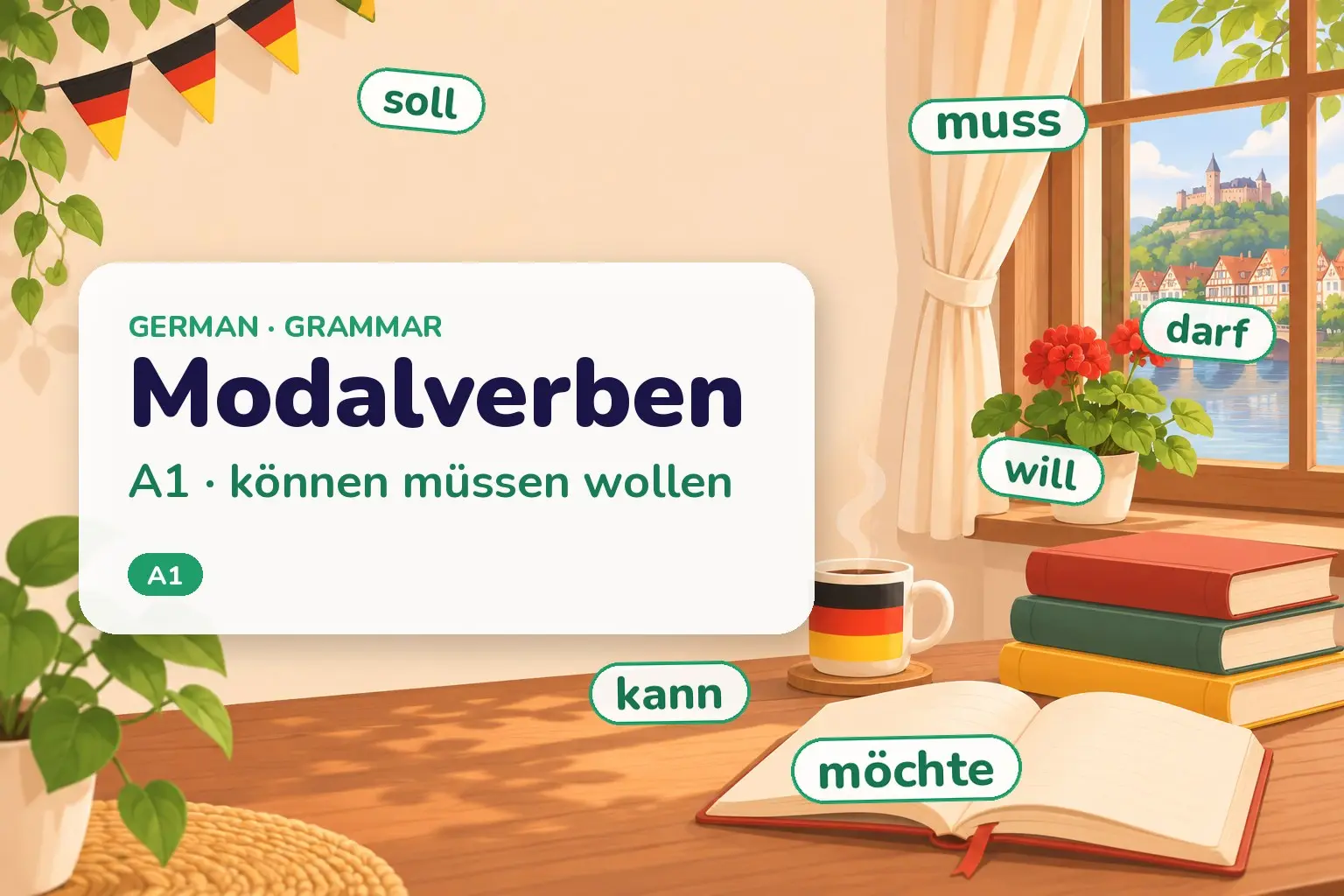
German modal verbs (können, müssen, wollen, dürfen, sollen, mögen) carry the meaning 'can, must, want…'. The modal is conjugated in position 2 and the main verb stays as an infinitive at the very end of the clause: Ich kann heute nicht kommen.
Level: A1. Modal verbs let you say what you can, must, want, may or should do. They are among the most useful words in German because almost every real sentence needs one. Once you know their shape and where the second verb goes, you can build dozens of new sentences.
The rule
A modal verb is a helper verb that changes the meaning of a main verb: kann (can), muss (must), will (want), darf (may/allowed), soll (should), mag (like). German has six of them, plus the very common polite form möchte (would like).
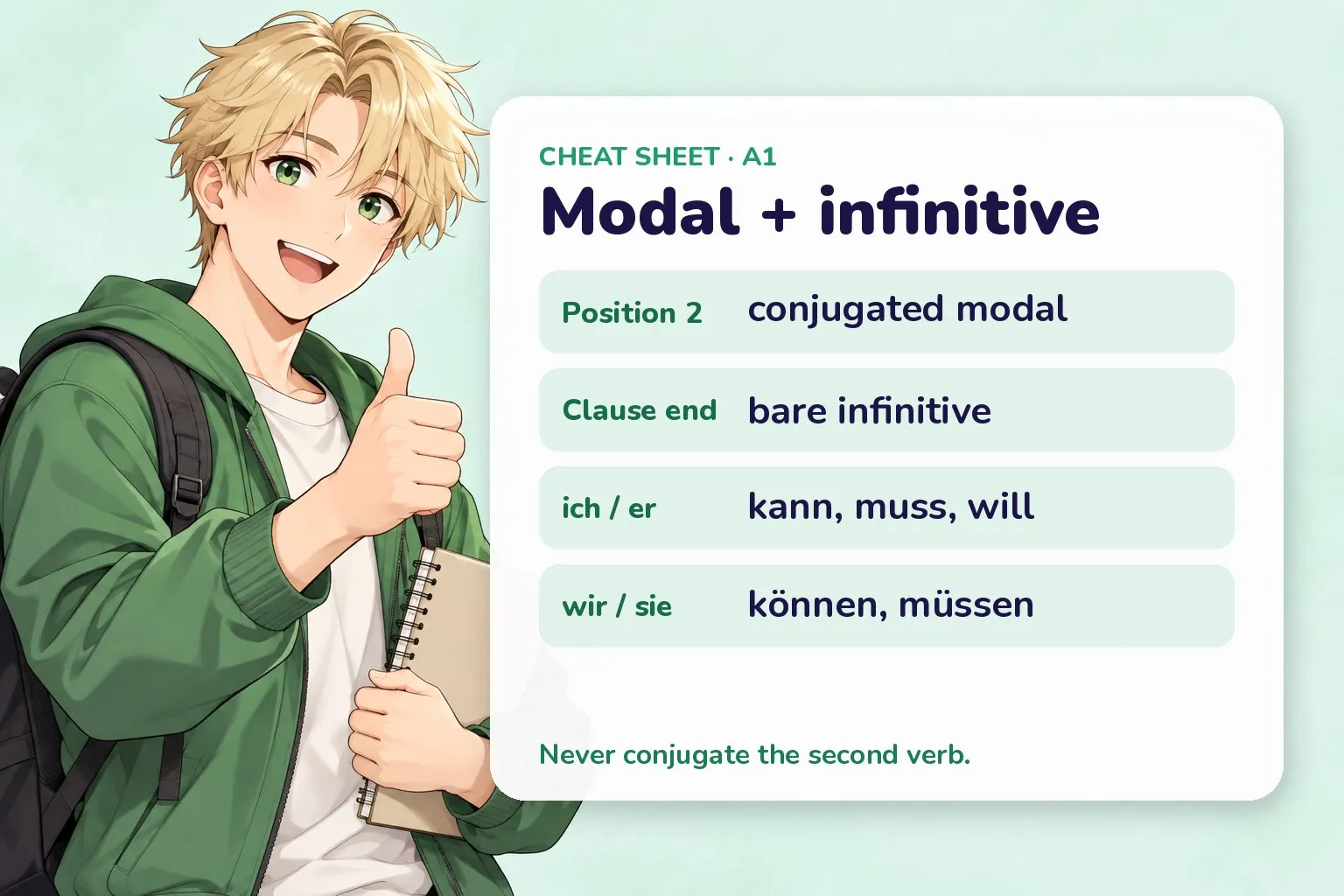
In a normal statement the modal is conjugated and stands in position 2 — the same slot as any other verb. The main verb then drops to the end of the clause as a plain infinitive (its dictionary form, ending in -en). Nothing happens to that second verb; you never add an ending to it.
The tricky part is the singular. Five of the six modals change their stem vowel in the singular and then switch back in the plural. The ich and er/sie/es forms are always identical and take no ending — this is the single most reliable fact about modals.
The present-tense forms
| Person | können (can) | müssen (must) | wollen (want) |
|---|---|---|---|
| ich | kann | muss | will |
| du | kannst | musst | willst |
| er/sie/es | kann | muss | will |
| wir | können | müssen | wollen |
| ihr | könnt | müsst | wollt |
| sie/Sie | können | müssen | wollen |
| Person | dürfen (may) | sollen (should) | mögen (like) |
|---|---|---|---|
| ich | darf | soll | mag |
| du | darfst | sollst | magst |
| er/sie/es | darf | soll | mag |
| wir | dürfen | sollen | mögen |
| ihr | dürft | sollt | mögt |
| sie/Sie | dürfen | sollen | mögen |
Notice two patterns. First, sollen is the exception that keeps its vowel (soll, not sÖll). Second, the plural forms (wir, sie/Sie) are identical to the infinitive: wir können, sie müssen.
How to say it
A few of these words hold sounds English speakers get wrong:
- ö in können, mögen: say “ay” as in “day”, then round your lips. Not “oh”.
- ü in müssen, dürfen: say “ee”, then round your lips. Not “oo”.
- ch in ich, möchte: a soft, hissing sound made at the front of the mouth, like a whispered “h” in “hue”.
- w in wollen, will: like an English “v” — will sounds like “vil”, never “will”.
Example sentences
- Ich kann gut schwimmen.I can swim well.können = ability
- Kannst du mir helfen?Can you help me?du kannst; question starts with the verb
- Er kann heute nicht kommen.He can't come today.er kann = ich kann, no ending
- Wir können am Montag anfangen.We can start on Monday.plural = infinitive form
- Ich muss jetzt gehen.I have to go now.müssen = necessity
- Du musst mehr lernen.You have to study more.
- Sie muss früh aufstehen.She has to get up early.separable verb stays whole at the end
- Ich will ein Eis essen.I want to eat an ice cream.wollen = strong wish/intention
- Was willst du trinken?What do you want to drink?
- Die Kinder wollen im Park spielen.The children want to play in the park.
- Darf ich hier rauchen?May I smoke here?dürfen = permission
- Hier darf man nicht parken.You may not park here.darf nicht = not allowed
- Du sollst deine Hausaufgaben machen.You should do your homework.sollen = should / told to
- Wir sollen um acht da sein.We're supposed to be there at eight.
- Ich mag Kaffee.I like coffee.mögen used alone, with a noun
- Magst du Schokolade?Do you like chocolate?
- Ich möchte einen Tee bestellen.I would like to order a tea.möchte = polite request
- Möchten Sie etwas trinken?Would you like something to drink?formal Sie
- Können wir das Fenster öffnen?Can we open the window?
- Er will Deutsch lernen, aber er muss zuerst arbeiten.He wants to learn German, but he has to work first.two modals, two brackets
Common mistakes
- ❌ Ich kann schwimmen gut. → ✅ Ich kann gut schwimmen. The infinitive goes to the very end; adverbs come before it.
- ❌ Er kannt nicht kommen. → ✅ Er kann nicht kommen. The er form takes no ending — it equals the ich form.
- ❌ Ich will ein Eis esse. → ✅ Ich will ein Eis essen. The second verb stays an infinitive, never conjugated.
- ❌ Du muss gehen. → ✅ Du musst gehen. Only ich and er/sie/es drop the ending; du always adds -st.
- ❌ Wir müssen zu gehen. → ✅ Wir müssen gehen. No zu after a modal — just the bare infinitive.
A short conversation
— Kannst du heute Abend kommen? — Nein, ich muss leider arbeiten. Aber morgen kann ich. — Gut. Möchtest du danach etwas essen? — Ja, gern. Ich will die neue Pizzeria probieren.
Usage notes
- No “to” and no zu. English says “I want to go”; German uses a bare infinitive after a modal: Ich will gehen.
- The main verb can be dropped when it is obvious, especially with motion or machen: Ich muss nach Hause (… gehen) — “I have to go home.”
- müssen nicht ≠ must not. Du musst nicht kommen means “you don’t have to come”. To forbid, use dürfen: Du darfst nicht kommen = “you must not come.”
- möchte vs wollen. möchte is softer and more polite; wollen is a firm wish or intention. In a café, say Ich möchte…, not Ich will…, which can sound blunt.
- In questions and after conjunctions the frame still holds: in a subordinate clause the modal moves to the very end, after the infinitive (…, weil ich arbeiten muss).
Compared with the regular present tense
A regular present-tense verb carries the meaning and the ending on its own: Ich spiele Fußball. A modal sentence splits the work in two — the modal takes the ending and the slot in position 2, while a second verb supplies the action at the end: Ich will Fußball spielen. The word order you met in German word order still applies: the conjugated verb (here the modal) stays in position 2, and the question words you know open the sentence as usual — Was willst du machen?
Quick recap before the quiz.
Practice
Modal verbs practice
Try each one, then press Check. No sign-up, nothing is sent anywhere — it all runs in your browser.
Hint: ich form, vowel change, no ending
Show answer
muss — müssen in the ich form is muss.
3 Build: 'I want to eat an ice cream.'
Show answer
Ich will ein Eis essen — Modal in position 2, infinitive at the end: Ich will ein Eis essen.
4 Match each modal to its meaning.
- können
- müssen
- dürfen
- wollen
Show answer
- können → can / be able to
- müssen → must / have to
- dürfen → may / be allowed
- wollen → want to
These are the core meanings of the six German modals.
Hint: permission, ich form
Show answer
Darf — dürfen in the ich form is darf: Darf ich hier rauchen?
Quiz
German modal verbs
12 questions · pick an answer and you'll see straight away if it's right.
-
Show answer
in position 2 — The modal takes the position-2 verb slot.
-
Show answer
to the end, as an infinitive — The main verb becomes a bare infinitive at the end of the clause.
-
Show answer
musst — The du form adds -st: du musst.
-
Show answer
kann — er kann equals ich kann, with no ending.
-
Show answer
sollen — sollen keeps its vowel: ich soll, du sollst.
-
Show answer
können — The wir form equals the infinitive: wir können.
-
Show answer
You don't have to come. — müssen nicht = not necessary. To forbid, use darfst nicht.
-
Show answer
Ich möchte einen Kaffee. — möchte (would like) is the polite request form.
-
Show answer
willst — wollen in the du form is willst.
-
Show answer
the second verb must stay an infinitive (gehen) — After a modal the main verb is a bare infinitive: gehen.
-
Show answer
darf — man takes the er/sie/es form: man darf.
-
Show answer
Möchten — The Sie form is möchten.
Recap cheat-sheet
| Modal | Meaning | ich / er form | wir form |
|---|---|---|---|
| können | can / able to | kann | können |
| müssen | must / have to | muss | müssen |
| wollen | want to | will | wollen |
| dürfen | may / allowed | darf | dürfen |
| sollen | should / told to | soll | sollen |
| mögen (möchte) | like (would like) | mag (möchte) | mögen (möchten) |
Next
- Back to the German grammar section
- Build word order next: German Word Order
- New here? Start with Start Learning German Here
All German grammar topics
Every grammar point in order, from your first sentence to advanced structures. Pick one and go straight to it. New lessons go live every day, so topics marked Coming soon fill in over the next weeks.
Grammar path
A1 16 topics · 13 ready
- 01 German Articles: Der, Die, Das
- 02 Indefinite Articles: ein / eine / ein
- 03 German Personal Pronouns (ich, du, er...)
- 04 Present Tense: Regular Verbs
- 05 The Verbs sein and haben
- 06 W-Questions (wer, was, wo, wie)
- 07 Yes/No Questions (Verb First)
- 08 Stem-Changing Verbs (fahren, essen, lesen)
- 09 Basic Word Order (Verb Second)
- 10 The Accusative Case (Direct Object)
- 11 Negation: nicht vs kein
- 12 Possessive Articles (mein, dein, sein)
- 13 Modal Verbs (können, müssen, wollen) You are here
- 14 The Imperative (Commands) Coming soon
- 15 Numbers, Time and Dates Coming soon
- 16 Common Prepositions (basic) Coming soon
A2 19 topics
- 17 The Dative Case (Indirect Object) Coming soon
- 18 Verbs with the Dative (helfen, danken) Coming soon
- 19 Accusative Prepositions (durch, für, ohne) Coming soon
- 20 Dative Prepositions (mit, nach, bei, von, zu) Coming soon
- 21 Two-Way Prepositions (Wechselpräpositionen) Coming soon
- 22 The Perfect Tense (Perfekt) Coming soon
- 23 Perfekt: Choosing haben or sein Coming soon
- 24 Past Participles (Partizip II) Coming soon
- 25 Simple Past (Präteritum): sein, haben, modals Coming soon
- 26 Separable-Prefix Verbs Coming soon
- 27 Inseparable-Prefix Verbs Coming soon
- 28 Comparative and Superlative Coming soon
- 29 Coordinating Conjunctions (und, aber, denn) Coming soon
- 30 Subordinate Clauses (weil, dass) Coming soon
- 31 Reflexive Verbs (sich freuen) Coming soon
- 32 Ein-Words in Accusative and Dative Coming soon
- 33 Pronouns in Accusative and Dative Coming soon
- 34 Requests with möchten and würden Coming soon
- 35 Ordinal Numbers and Dates Coming soon
B1 20 topics
- 36 Adjective Endings after Definite Articles Coming soon
- 37 Adjective Endings after Indefinite Articles Coming soon
- 38 Adjective Endings with No Article Coming soon
- 39 Simple Past (Präteritum): All Verbs Coming soon
- 40 Past Perfect (Plusquamperfekt) Coming soon
- 41 Future Tense (Futur I) Coming soon
- 42 The Genitive Case (Possession) Coming soon
- 43 Genitive Prepositions (wegen, trotz) Coming soon
- 44 Subordinating Conjunctions (als, wenn, obwohl) Coming soon
- 45 als vs wenn (Past vs Repeated) Coming soon
- 46 Infinitive Clauses with zu Coming soon
- 47 Purpose: um...zu vs damit Coming soon
- 48 Relative Clauses (der, die, das) Coming soon
- 49 Dative Reflexive Verbs Coming soon
- 50 Konjunktiv II: würde and Polite/Hypothetical Coming soon
- 51 Conditional Sentences (wenn-Sätze) Coming soon
- 52 Passive Voice: Present (werden) Coming soon
- 53 Verbs with Fixed Prepositions Coming soon
- 54 da- and wo- Compounds (darauf, worauf) Coming soon
- 55 Weak Nouns (N-Declension) Coming soon
B2 18 topics
- 56 Passive in All Tenses and with Modals Coming soon
- 57 Stative Passive (Zustandspassiv) Coming soon
- 58 Passive Alternatives (man, sich lassen) Coming soon
- 59 Konjunktiv II in the Past (hätte gemacht) Coming soon
- 60 Konjunktiv I and Reported Speech Coming soon
- 61 Advanced Relative Clauses (was, wo, Präposition+Pronomen) Coming soon
- 62 Nominalised Adjectives and Participles Coming soon
- 63 Participles as Adjectives (Partizip I/II) Coming soon
- 64 Extended Participle Attributes Coming soon
- 65 Two-Part Connectors (entweder...oder) Coming soon
- 66 Adverbial Connectors (deshalb, trotzdem) Coming soon
- 67 Temporal Clauses (bevor, nachdem, seitdem) Coming soon
- 68 Concessive & Conditional Clauses (obwohl, falls) Coming soon
- 69 Subjective Use of Modal Verbs Coming soon
- 70 Future Perfect (Futur II) Coming soon
- 71 Verb Valency and Objects Coming soon
- 72 Mid-Field Order: Te-Ka-Mo-Lo Coming soon
- 73 Nominal Style (Nominalisierung) Coming soon
C1 11 topics
- 74 Light-Verb Constructions (Funktionsverbgefüge) Coming soon
- 75 Advanced & Impersonal Passive Coming soon
- 76 Advanced Konjunktiv (als ob, Wunschsätze) Coming soon
- 77 Participial & Abbreviated Clauses Coming soon
- 78 Nominalisation vs Verbalisation (Umformung) Coming soon
- 79 Modal Particles (doch, ja, mal, eben, halt) Coming soon
- 80 Formal Connectors & Text Cohesion Coming soon
- 81 Advanced Genitive & Nominal Attributes Coming soon
- 82 Word Formation (Komposita & Derivation) Coming soon
- 83 Reported Speech in Extended Text Coming soon
- 84 Emphasis, Fronting and Inversion Coming soon