Progressive Aspect in Chinese (在, 正在, 呢)
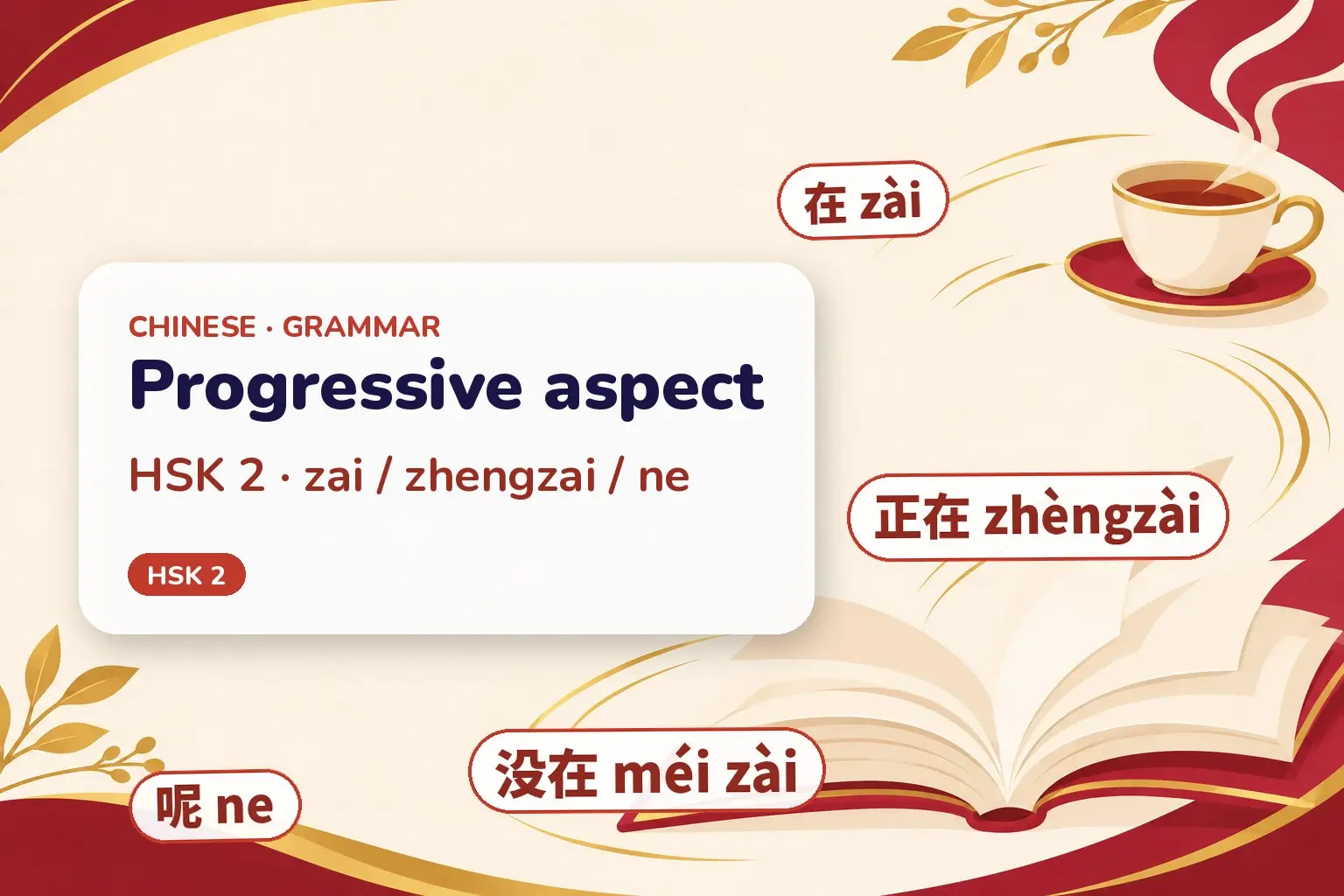
To say an action is in progress, put 在 (zài) before the verb: 我在吃饭 (wǒ zài chī fàn) means I am eating. 正在 (zhèngzài) stresses right now, and the particle 呢 (ne) at the end adds a 'currently' feel. Negate with 没在 (méi zài).
On this page10 sections · tap to jump
Level: HSK 2. To say something is happening right now — I am eating, she is working — Mandarin puts the adverb 在 (zài) in front of the verb. You can strengthen it to 正在 (zhèngzài) for “at this very moment”, and round the sentence off with the particle 呢 (ne). None of these change the verb itself: Chinese has no verb endings, so the markers do all the work.
The rule
Aspect is the part of grammar that shows whether an action is finished, repeated, or — here — still going on. The progressive aspect means an action in progress at a reference time. Mandarin builds it with a marker before the verb and, optionally, a particle after the whole clause:
- 在 (zài) + verb: the standard “doing it now” — 我在吃饭 (wǒ zài chī fàn, I am eating).
- 正在 (zhèngzài) + verb: the same, but stressing right at this moment — 他正在睡觉 (tā zhèngzài shuìjiào, he is sleeping right now).
- …呢 (ne) at the end: a soft particle that adds an “as we speak” feel; it can appear with or without 在 (zài) — 你做什么呢? (nǐ zuò shénme ne?, what are you doing?).
The verb never changes form. You are only adding 在 (zài) / 正在 (zhèngzài) before it, or 呢 (ne) after the clause, or both together: 他正在看书呢 (tā zhèngzài kàn shū ne, he is reading right now).
The forms
| Pattern | Pinyin | Use | Example |
|---|---|---|---|
| 在 + verb | zài + verb | plain “doing now” | 我在工作 (wǒ zài gōngzuò) |
| 正在 + verb | zhèngzài + verb | at this exact moment | 她正在打电话 (tā zhèngzài dǎ diànhuà) |
| verb + 呢 | verb + ne | casual, sentence-final | 他吃饭呢 (tā chī fàn ne) |
| 正在 + verb + 呢 | zhèngzài + verb + ne | full, emphatic | 我正在学习呢 (wǒ zhèngzài xuéxí ne) |
| 没(有)在 + verb | méi (yǒu) zài + verb | negative | 我没在睡觉 (wǒ méi zài shuìjiào) |
Example sentences
- 我在吃饭。Wǒ zài chī fàn.I am eating.在 + verb
- 他在看电视。Tā zài kàn diànshì.He is watching TV.
- 她在工作。Tā zài gōngzuò.She is working.
- 我们在学中文。Wǒmen zài xué Zhōngwén.We are studying Chinese.
- 孩子们在玩。Háizimen zài wán.The children are playing.
- 他正在睡觉。Tā zhèngzài shuìjiào.He is sleeping right now.正在 = this moment
- 她正在打电话。Tā zhèngzài dǎ diànhuà.She is on the phone right now.
- 我正在写作业。Wǒ zhèngzài xiě zuòyè.I am doing my homework right now.
- 你做什么呢?Nǐ zuò shénme ne?What are you doing?呢 with no 在
- 他看书呢。Tā kàn shū ne.He is reading.呢 alone
- 我吃饭呢。Wǒ chī fàn ne.I'm eating (right now).
- 他正在看书呢。Tā zhèngzài kàn shū ne.He is reading right now.正在 … 呢
- 妈妈在做饭呢。Māma zài zuò fàn ne.Mum is cooking.
- 我没在睡觉。Wǒ méi zài shuìjiào.I am not sleeping.没在 = negative
- 他没在工作,他在休息。Tā méi zài gōngzuò, tā zài xiūxi.He isn't working; he is resting.
- 你在听吗?Nǐ zài tīng ma?Are you listening?在 + 吗 question
- 外面正在下雨。Wàimiàn zhèngzài xià yǔ.It is raining outside right now.
- 我正在想这个问题。Wǒ zhèngzài xiǎng zhège wèntí.I am thinking about this question.
Common mistakes
- ❌ 我在吃饭了 (wǒ zài chī fàn le) to mean “I am eating” → ✅ 我在吃饭 (wǒ zài chī fàn). 了 (le) marks completion; do not add it to an ongoing action.
- ❌ 我不在睡觉 (wǒ bù zài shuìjiào) for “I’m not sleeping” → ✅ 我没在睡觉 (wǒ méi zài shuìjiào). The progressive is negated with 没 (méi), not 不 (bù).
- ❌ changing the verb, as if 在 (zài) needed a special form → ✅ the verb stays plain: 在吃 (zài chī), 在看 (zài kàn). Chinese has no “-ing” ending.
- ❌ 我正在是吃饭 (wǒ zhèngzài shì chī fàn) → ✅ 我正在吃饭 (wǒ zhèngzài chī fàn). Do not insert 是 (shì); 正在 (zhèngzài) attaches straight to the verb.
- ❌ using this 在 (zài) for a lasting state, as in “the door is open” → ✅ that is 着 (zhe): 门开着 (mén kāi zhe). 在 (zài) is for an action unfolding.
A short conversation
— 喂 (wéi),你在做什么呢? — Wéi, nǐ zài zuò shénme ne? — Hello, what are you doing? — 我正在做饭。你呢? — Wǒ zhèngzài zuò fàn. Nǐ ne? — I’m cooking right now. And you? — 我在看电视。 — Wǒ zài kàn diànshì. — I’m watching TV. — 孩子们呢? — Háizimen ne? — What about the kids? — 他们在睡觉。 — Tāmen zài shuìjiào. — They’re sleeping.
Usage notes
- 正在 (zhèngzài) is the strong form. Use it when you want to stress that something is happening at this exact moment. In everyday speech plain 在 (zài) is far more common.
- 呢 (ne) is casual and optional. It softens the sentence and signals “right now”; drop it in formal writing. It can stand without 在 (zài): 他看书呢 (tā kàn shū ne).
- Negate with 没 (méi). Say 没在 (méi zài), or the fuller 没有 (méi yǒu) + verb: 我没在睡觉 (wǒ méi zài shuìjiào), or 我没睡 (wǒ méi shuì). Never 不 (bù).
- Time words set the scene. 现在 (xiànzài, now) and 昨天 (zuótiān, yesterday) can anchor the progressive to past or present: 昨天八点我在吃饭 (zuótiān bā diǎn wǒ zài chī fàn, at eight yesterday I was eating). You can review place-marking 在 (zài) in the lesson on 在 (zài) for location.
Compared with 着 (zhe)
Both 在 (zài) and 着 (zhe) describe something continuing, but differently. 在 (zài) + verb is a dynamic action in progress — something happening: 他在开门 (tā zài kāi mén, he is opening the door). 着 (zhe) after a verb is a static state that lasts — the result staying put: 门开着 (mén kāi zhe, the door is open). So 在 (zài) is the film, 着 (zhe) is the freeze-frame. 着 (zhe) can also mark a lasting manner alongside another verb: 她笑着说 (tā xiào zhe shuō, she said with a smile). The particle 呢 (ne) itself is covered in the lesson on the particle 呢 (ne), and you can browse more in the Chinese grammar section.
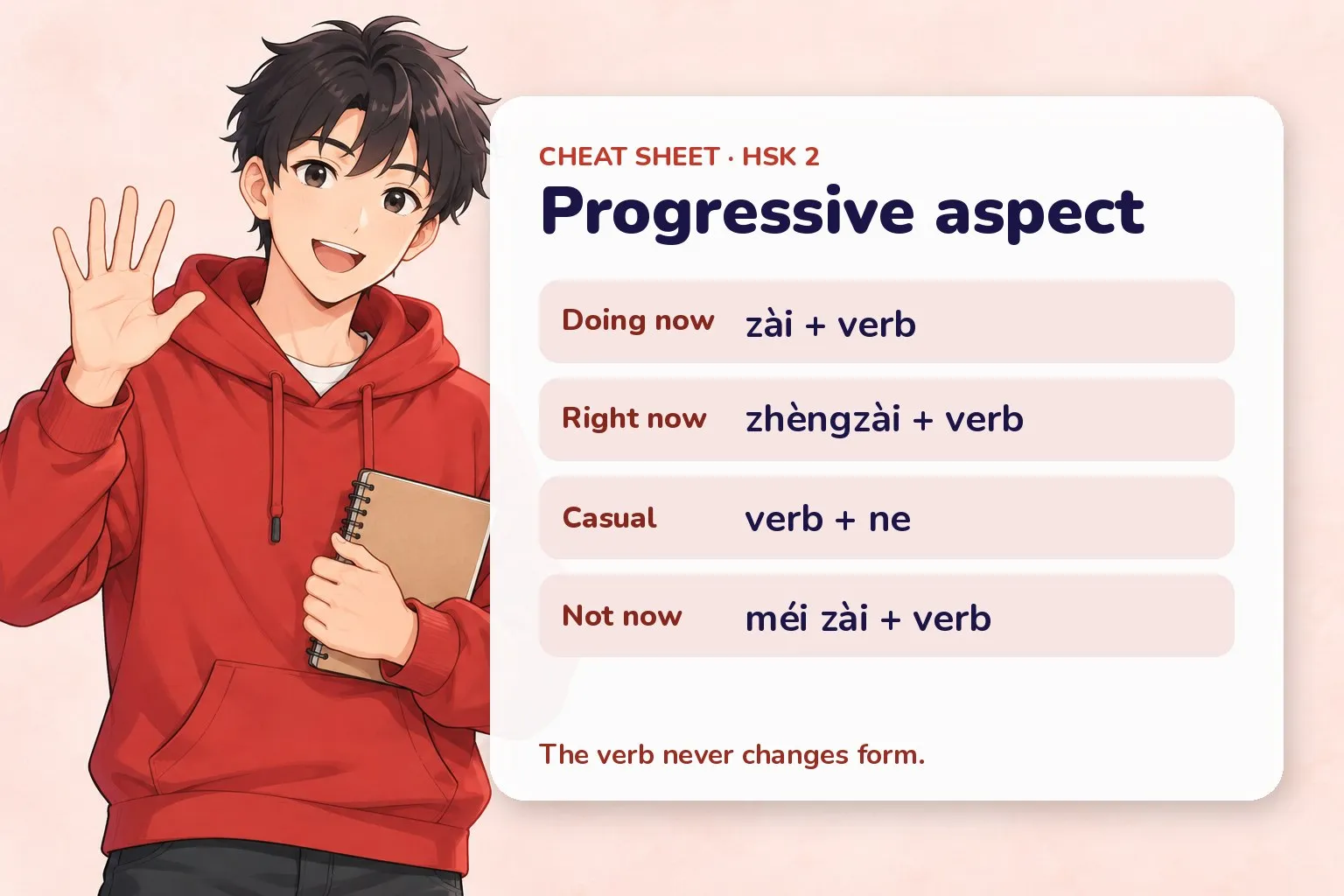
Quick recap before you practise.
Practice
Progressive aspect practice
Try each one, then press Check. No sign-up, nothing is sent anywhere — it all runs in your browser.
Hint: the emphatic 'right now' form
Show answer
zhèngzài — 正在 (zhèngzài) stresses that it is happening at this moment.
3 Order the words: 'She is on the phone.'
Show answer
她 (tā) 正在 (zhèngzài) 打电话 (dǎ diànhuà) — Subject + 正在 (zhèngzài) + verb: 她正在打电话。
4 Match each piece to its job.
- 在 (zài)
- 正在 (zhèngzài)
- 呢 (ne)
- 没 (méi)
Show answer
- 在 (zài) → plain progressive marker
- 正在 (zhèngzài) → emphatic, this moment
- 呢 (ne) → casual final particle
- 没 (méi) → negates the progressive
在 (zài)/正在 (zhèngzài) go before the verb, 呢 (ne) after the clause, 没 (méi) negates.
Quiz
Chinese progressive aspect quiz
11 questions · pick an answer and you'll see straight away if it's right.
-
Show answer
before the verb — 在 (zài) is an adverb placed before the verb.
-
Show answer
正在 (zhèngzài) — 正在 (zhèngzài) stresses the exact moment.
-
Show answer
at the end of the clause — 呢 (ne) is sentence-final and can appear with or without 在 (zài).
-
Show answer
do not change form — The verb stays plain; the markers do the work.
-
Show answer
没 (méi) — Use 没(有) (méi yǒu): 我没在睡觉 (wǒ méi zài shuìjiào).
-
Show answer
他在看书呢 (tā zài kàn shū ne) — 在 (zài) + verb (+ 呢) marks the ongoing action.
-
Show answer
了 (le) marks completion and clashes with the progressive — 了 (le) signals a finished or changed situation, not an action in progress.
-
Show answer
he is at home (zài = at a place) — Here 在 (zài) means 'at'; only 在 (zài) + verb is progressive.
-
Show answer
a lasting state (the door stays open) — 着 (zhe) marks a continuing state; 在 (zài) marks an unfolding action.
-
Show answer
yes: 他看书呢 (tā kàn shū ne) — 呢 (ne) alone can carry the 'right now' feel: 他看书呢 (tā kàn shū ne).
-
Show answer
zài — 在 (zài) before the verb: 我们在学习。
Recap cheat-sheet
| Marker | Where | Meaning |
|---|---|---|
| 在 (zài) | before the verb | doing it now |
| 正在 (zhèngzài) | before the verb | right at this moment |
| 呢 (ne) | end of clause | casual “as we speak” |
| 没有 (méi yǒu) | before the verb | not doing it now |
Next
- Compare place-marking 在 (zài) for location
- Learn more about the particle 呢 (ne)
- New here? Start with Start Learning Chinese Here
All Chinese grammar topics
Every grammar point in order, from your first sentence to advanced structures. Pick one and go straight to it. New lessons go live every day, so topics marked Coming soon fill in over the next weeks.
Grammar path
HSK 1 15 topics · 15 ready
- 01 The Verb 是 (shì): to be
- 02 Basic Word Order (Subject-Verb-Object)
- 03 Adjectives with 很 (hěn)
- 04 Yes/No Questions with 吗 (ma)
- 05 Question Words (什么 shénme, 谁 shuí, 哪 nǎ, 几 jǐ)
- 06 The Particle 的 (de): Possession & Modification
- 07 Measure Words and 个 (ge)
- 08 Numbers and Counting
- 09 The Verb 有 (yǒu): to have / there is
- 10 The Verb 在 (zài): Location
- 11 Time When (Position in Sentence)
- 12 The Particle 了 (le): Change of State
- 13 Modal Verbs 想 / 要 / 会 / 能 (xiǎng / yào / huì / néng)
- 14 The Particle 呢 (ne)
- 15 也 (yě) and 都 (dōu) Placement
HSK 2 14 topics · 6 ready
- 16 Aspectual 了 (Completed Action)
- 17 The Aspect Particle 过 (guò)
- 18 Progressive Aspect (在 / 正在 / 呢 zài / zhèngzài / ne) You are here
- 19 Comparisons with 比 (bǐ)
- 20 A Bit: 一点儿 (yìdiǎnr) vs 有一点儿 (yǒu yìdiǎnr)
- 21 Basic Conjunctions (和 hé, 也 yě, 都 dōu, 还 hái)
- 22 Coverbs 给 / 跟 / 对 (gěi / gēn / duì) Coming soon
- 23 Duration (Time How Long) Coming soon
- 24 Resultative Complements (看完 kànwán, 听懂 tīngdǒng) Coming soon
- 25 The 把 (bǎ) Construction Coming soon
- 26 The Particle 吧 (ba) Coming soon
- 27 Again: 再 (zài) vs 又 (yòu) Coming soon
- 28 Imminent Action (快要 kuàiyào...了 / 要 le / yào...了 le) Coming soon
- 29 Asking Degree with 多 (duō) Coming soon
HSK 3 10 topics
- 30 Directional Complements (出来 chūlái, 回去 huíqù) Coming soon
- 31 Potential Complements (看得懂 kàndedǒng, 做不完 zuòbùwán) Coming soon
- 32 Complement of Degree with 得 (de) Coming soon
- 33 Adverbial Modifier with 地 (de) Coming soon
- 34 The Durative Aspect 着 (zhe) Coming soon
- 35 把 (bǎ) with Complex Results Coming soon
- 36 The 被 (bèi) Passive Coming soon
- 37 Conditionals (如果 rúguǒ...就 / 要是 jiù / yàoshì) Coming soon
- 38 Pivotal Sentences (让 ràng, 叫 jiào, 请 qǐng, 使 shǐ) Coming soon
- 39 Conditional with ...的话 (dehuà) Coming soon
HSK 4 9 topics
- 40 The 是 (shì)...的 (de) Construction (Emphasis) Coming soon
- 41 The Adverbs 就 (jiù) and 才 (cái) Coming soon
- 42 Verb Reduplication (看看 kànkan, 试一试 shìyishì) Coming soon
- 43 As Soon As (一...就, yī...jiù) Coming soon
- 44 Comparing 把 (bǎ) and 被 (bèi) in Context Coming soon
- 45 Complement of Quantity / Comparison Degree Coming soon
- 46 连 (lián)...都/也 (Even) Coming soon
- 47 Time Sequence (先 xiān...然后 ránhòu, 的时候 deshíhòu, 以后/以前 yǐhòu / yǐqián) Coming soon
- 48 Approximation & 左右/多/来 (zuǒyòu / duō / lái) Coming soon
HSK 5 8 topics
- 49 Mood Adverbs (反正 fǎnzhèng, 居然 jūrán, 竟然 jìngrán, 难道 nándào) Coming soon
- 50 Complex Complements & Metaphorical Results Coming soon
- 51 Formal/Written Markers (之 zhī, 其 qí, 者 zhě, 以 yǐ) Coming soon
- 52 Colloquial Passives (让 ràng, 叫 jiào, 给 gěi) Coming soon
- 53 不但不/没 (búdànbù / méi)...反而 (Contrary to Expectation) Coming soon
- 54 一...就 (yī...jiù) vs 一旦 (yídàn): Once / As Soon As Coming soon
- 55 复合趋向补语 (Compound Directional + Object) Coming soon
- 56 Emphasis with 是 (shì)...的 (de) vs 连 (lián)...都 (dōu) Review Coming soon
HSK 6 7 topics
- 57 Four-Character Idioms (成语 chéngyǔ) in Grammar Coming soon
- 58 Literary Connectives (然而 ránér, 从而 cóngér, 鉴于 jiànyú, 乃至 nǎizhì) Coming soon
- 59 Fixed Frameworks (在 zài...下 xià, 以 yǐ...为 wèi, 对 duì...而言 éryán) Coming soon
- 60 Rhetorical & Emphatic Structures (并 bìng, 可 kě, 正是 zhèngshì) Coming soon
- 61 Nominalisation & Topic Structures (所 suǒ...的 de, 的 de nominaliser) Coming soon
- 62 Long-Sentence Cohesion & Ellipsis Coming soon
- 63 经/予/加以 (Formal Verbal Framing) Coming soon