Chinese Question Words (什么, 谁, 哪, 几)
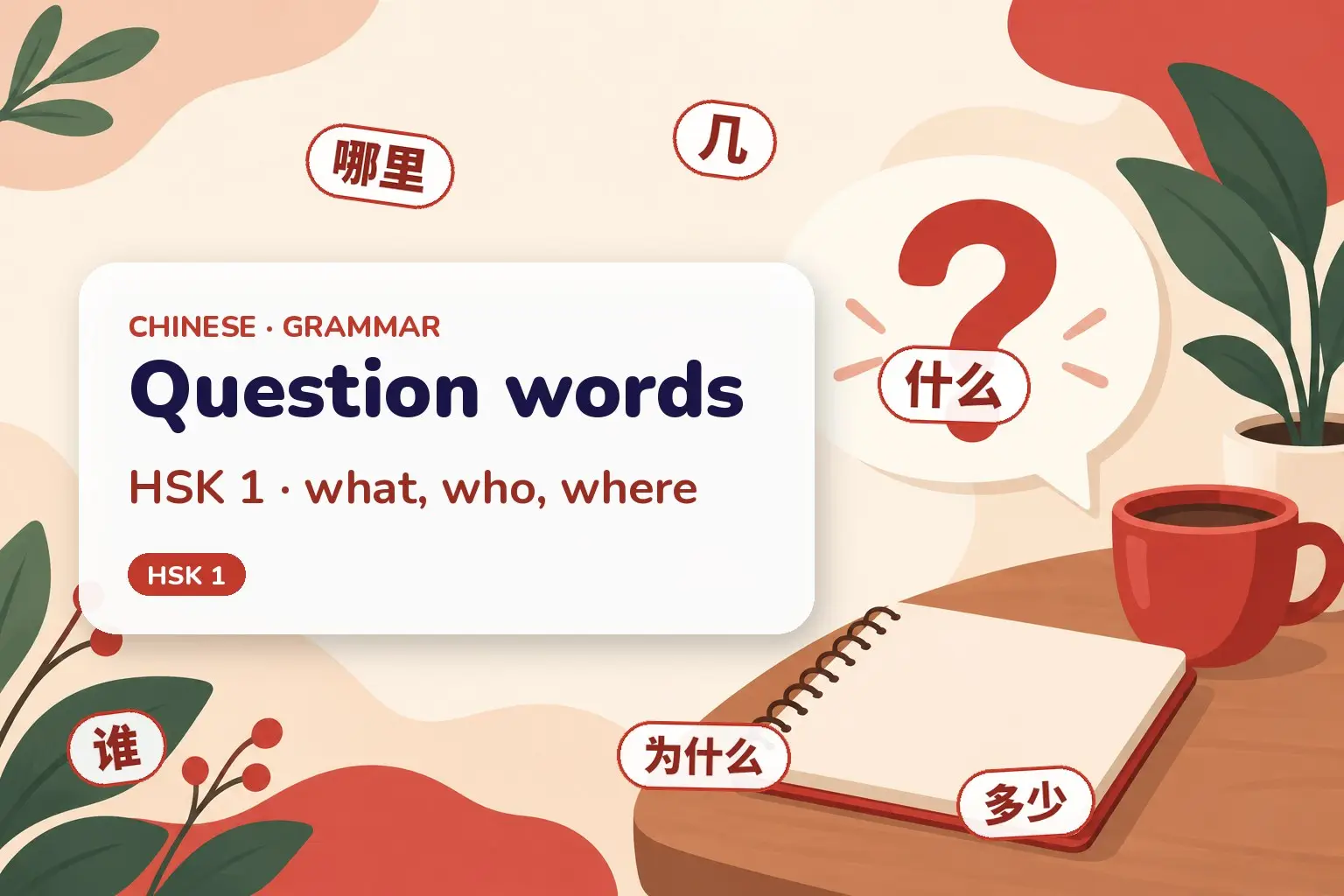
Chinese question words like 什么 (shénme, what) and 谁 (shéi, who) stay in the exact spot where the answer will go — you do not move them to the front. And because the question word already asks the question, you do not add 吗 (ma).
Level: HSK 1. Chinese asks “what”, “who” and “where” in a way that is easier than English: you keep the normal word order and simply put the question word where the answer belongs. Nothing moves to the front.
The rule
A question word — such as 什么 (shénme), meaning “what” — is a word that stands for the information you are missing. In English you move it to the front — “What do you want?” In Chinese you leave it in place: it sits exactly where the answer will later sit. This is called an in-situ (“in position”) question.
Compare the question and its answer — the order is identical, only the question word is swapped for the real information:
- 你喝什么?(nǐ hē shénme?) — “You drink what?” → 我喝茶。(wǒ hē chá.) — “I drink tea.”
Because the question word already signals a question, you do not add the yes/no particle 吗 (ma). 吗 (ma) is only for questions that expect “yes” or “no”, and a question word is asking for specific information instead.
The common question words
| Word | Reading | Meaning | Note |
|---|---|---|---|
| 什么 | shénme | what | also “什么 + noun” = which/what kind |
| 谁 | shéi (also shuí) | who / whom | shéi is the everyday reading |
| 哪 | nǎ | which | needs a measure word: 哪个 (nǎge) |
| 哪里 / 哪儿 | nǎlǐ / nǎr | where | 哪儿 (nǎr) is more northern/spoken |
| 几 | jǐ | how many (small) | takes a measure word: 几个 (jǐge) |
| 多少 | duōshao | how many / how much | no measure word needed |
| 怎么 | zěnme | how / why | 怎么 + verb |
| 为什么 | wèishénme | why | literally “for what” |
几 (jǐ) or 多少 (duōshao)?
Both ask about quantity, but they are not interchangeable:
- 几 (jǐ) expects a small number (roughly under ten) and is followed by a measure word: 几个人?(jǐ ge rén?) — “how many people?”
- 多少 (duōshao) works for any amount, large or small, and usually needs no measure word: 多少钱?(duōshao qián?) — “how much money?”
Example sentences
- 你叫什么名字?nǐ jiào shénme míngzi?What is your name?什么 (shénme) sits before the noun it asks about
- 这是什么?zhè shì shénme?What is this?
- 你喝什么?nǐ hē shénme?What are you drinking?same order as the answer 我喝茶 (wǒ hē chá)
- 他是谁?tā shì shéi?Who is he?
- 谁是你的老师?shéi shì nǐ de lǎoshī?Who is your teacher?谁 (shéi) can also be the subject
- 你去哪里?nǐ qù nǎlǐ?Where are you going?
- 洗手间在哪儿?xǐshǒujiān zài nǎr?Where is the toilet?
- 你要哪个?nǐ yào nǎge?Which one do you want?哪 (nǎ) + measure word 个 (ge)
- 你家有几个人?nǐ jiā yǒu jǐ ge rén?How many people are in your family?几 (jǐ) + measure word for a small number
- 这个多少钱?zhège duōshao qián?How much is this?多少 (duōshao) takes no measure word
- 你有多少书?nǐ yǒu duōshao shū?How many books do you have?
- 你怎么去学校?nǐ zěnme qù xuéxiào?How do you go to school?怎么 (zěnme) = by what means
- 你为什么学中文?nǐ wèishénme xué zhōngwén?Why do you study Chinese?
- 现在几点?xiànzài jǐ diǎn?What time is it now?几 (jǐ) for the hour
- 你什么时候来?nǐ shénme shíhou lái?When are you coming?什么时候 (shénme shíhou) = what time / when
- 你想吃什么菜?nǐ xiǎng chī shénme cài?What dish do you want to eat?
Common mistakes
- ❌ 你喝什么吗?(nǐ hē shénme ma?) → ✅ 你喝什么? (nǐ hē shénme?). Never add 吗 (ma) to a question that already has a question word.
- ❌ 什么你喝?(shénme nǐ hē?) → ✅ 你喝什么? (nǐ hē shénme?). Do not move the question word to the front; keep normal word order.
- ❌ 几钱?(jǐ qián?) → ✅ 多少钱? (duōshao qián?). For money (any amount) use 多少 (duōshao), not 几 (jǐ).
- ❌ 几人?(jǐ rén?) → ✅ 几个人? (jǐ ge rén?). 几 (jǐ) needs a measure word such as 个 (ge).
- ❌ 你是什么?(nǐ shì shénme?) for “who are you?” → ✅ 你是谁? (nǐ shì shéi?). Use 谁 (shéi) for people, 什么 (shénme) for things.
A short conversation
A: 你叫什么名字?(nǐ jiào shénme míngzi?) — What is your name? B: 我叫李明。你是谁?(wǒ jiào Lǐ Míng. nǐ shì shéi?) — I am Li Ming. Who are you? A: 我是新同学。洗手间在哪儿?(wǒ shì xīn tóngxué. xǐshǒujiān zài nǎr?) — I am a new classmate. Where is the toilet? B: 在那儿。(zài nàr.) — Over there.
Usage notes
- 谁 (shéi) has two readings. In everyday speech it is shéi; in careful or formal reading it is shuí. The meaning is the same.
- 哪 (nǎ) almost always needs a measure word, most often 个 (ge): 哪个 (nǎge, which one), 哪本书 (nǎ běn shū, which book).
- 怎么 (zěnme) covers both “how” and “why”. 怎么去 (zěnme qù) is “how to go”; 怎么了 (zěnme le) is “what’s wrong?”.
- Answers keep the same order. Because the question is in-situ, you can answer by putting the information straight into the question word’s slot — a handy way to check your sentence is correct.
Compared with…
- Yes/no questions with 吗 (ma): when you expect a simple “yes” or “no”, add 吗 (ma) to a statement and use no question word. See Yes/No Questions with 吗 (ma). The two systems never mix in one sentence.
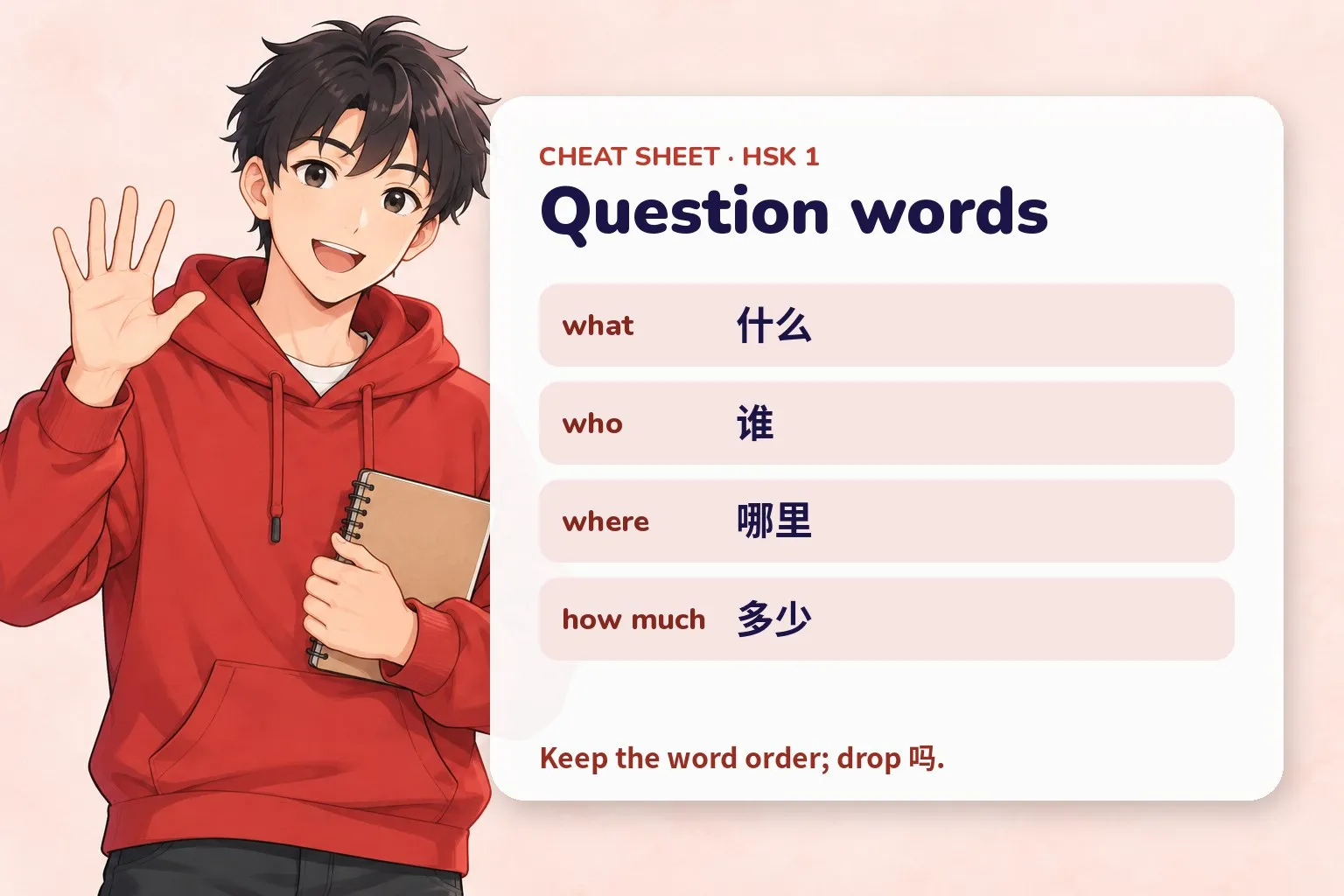
Quick recap before you practise.
Practice
Question words practice
Try each one, then press Check. No sign-up, nothing is sent anywhere — it all runs in your browser.
Hint: any amount, no measure word
Show answer
duōshao — 多少 (duōshao) asks about any amount: 多少钱 (duōshao qián).
4 Build the question 'How many people are in your family?'
Show answer
你家 (nǐ jiā) 有 (yǒu) 几个人 (jǐ ge rén) — 你家有几个人?(nǐ jiā yǒu jǐ ge rén?) — the question word stays at the end, where the number goes.
5 Match each question word to its meaning.
- 什么 (shénme)
- 谁 (shéi)
- 哪里 (nǎlǐ)
- 为什么 (wèishénme)
Show answer
- 什么 (shénme) → what
- 谁 (shéi) → who
- 哪里 (nǎlǐ) → where
- 为什么 (wèishénme) → why
These are the core HSK 1 question words.
Quiz
Chinese question words quiz
12 questions · pick an answer and you'll see straight away if it's right.
-
Show answer
where the answer would go (in place) — Chinese keeps the word order and leaves the question word in situ.
-
Show answer
吗 (ma) — 吗 (ma) is only for yes/no questions; a question word already asks the question.
-
Show answer
他是谁?(tā shì shéi?) — Use 谁 (shéi) for people, in place, with no 吗 (ma).
-
Show answer
多少钱 (duōshao qián) — 多少 (duōshao) handles any amount and needs no measure word.
-
Show answer
a measure word — 几 (jǐ) needs a measure word, e.g. 几个 (jǐ ge).
-
Show answer
哪里 (nǎlǐ) — 哪里 (nǎlǐ) — or 哪儿 (nǎr) — means 'where'.
-
Show answer
为什么 (wèishénme) — 为什么 (wèishénme) means 'why', literally 'for what'.
-
Show answer
你去哪里吗?(nǐ qù nǎlǐ ma?) — You cannot combine a question word (哪里, nǎlǐ) with 吗 (ma).
-
Show answer
你要哪个?(nǐ yào nǎge?) — 哪 (nǎ) + measure word 个 (ge) = 哪个 (nǎge), kept in place.
-
Show answer
你多大?(nǐ duō dà?) — 多 (duō) + adjective asks 'how…': 多大 (duō dà) = how old.
-
Show answer
shéi — In conversation 谁 (shéi) is usually said shéi; shuí is the formal reading.
-
Show answer
shénme — 这是什么?(zhè shì shénme?) — 什么 (shénme) sits where the answer goes.
Recap cheat-sheet
| Ask about | Word | Reading | Example |
|---|---|---|---|
| a thing | 什么 | shénme | 这是什么 (zhè shì shénme) |
| a person | 谁 | shéi | 他是谁 (tā shì shéi) |
| a place | 哪里 / 哪儿 | nǎlǐ / nǎr | 你去哪里 (nǐ qù nǎlǐ) |
| a small number | 几 | jǐ | 几个人 (jǐ ge rén) |
| any amount | 多少 | duōshao | 多少钱 (duōshao qián) |
| a reason | 为什么 | wèishénme | 你为什么来 (nǐ wèishénme lái) |
Next
- Compare with Yes/No Questions with 吗 (ma)
- Back to the Chinese grammar section
- New here? Start with Start Learning Chinese Here
All Chinese grammar topics
Every grammar point in order, from your first sentence to advanced structures. Pick one and go straight to it. New lessons go live every day, so topics marked Coming soon fill in over the next weeks.
Grammar path
HSK 1 15 topics · 12 ready
- 01 The Verb 是 (shì): to be
- 02 Basic Word Order (Subject-Verb-Object)
- 03 Adjectives with 很 (hěn)
- 04 Yes/No Questions with 吗 (ma)
- 05 Question Words (什么 shénme, 谁 shuí, 哪 nǎ, 几 jǐ) You are here
- 06 The Particle 的 (de): Possession & Modification
- 07 Measure Words and 个 (ge)
- 08 Numbers and Counting
- 09 The Verb 有 (yǒu): to have / there is
- 10 The Verb 在 (zài): Location
- 11 Time When (Position in Sentence)
- 12 The Particle 了 (le): Change of State
- 13 Modal Verbs 想 / 要 / 会 / 能 (xiǎng / yào / huì / néng) Coming soon
- 14 The Particle 呢 (ne) Coming soon
- 15 也 (yě) and 都 (dōu) Placement Coming soon
HSK 2 16 topics
- 16 Aspectual 了 (Completed Action) Coming soon
- 17 The Aspect Particle 过 (guò) Coming soon
- 18 Progressive Aspect (在 / 正在 / 呢 zài / zhèngzài / ne) Coming soon
- 19 Comparisons with 比 (bǐ) Coming soon
- 20 A Bit: 一点儿 (yìdiǎnr) vs 有一点儿 (yǒu yìdiǎnr) Coming soon
- 21 Basic Conjunctions (和 hé, 也 yě, 都 dōu, 还 hái) Coming soon
- 22 Because...So (因为 yīnwèi...所以 suǒyǐ) Coming soon
- 23 Coverbs 给 / 跟 / 对 (gěi / gēn / duì) Coming soon
- 24 Duration (Time How Long) Coming soon
- 25 Resultative Complements (看完 kànwán, 听懂 tīngdǒng) Coming soon
- 26 The 把 (bǎ) Construction Coming soon
- 27 The Particle 吧 (ba) Coming soon
- 28 Again: 再 (zài) vs 又 (yòu) Coming soon
- 29 Or: 还是 (háishì) vs 或者 (huòzhě) Coming soon
- 30 Imminent Action (快要 kuàiyào...了 / 要 le / yào...了 le) Coming soon
- 31 Asking Degree with 多 (duō) Coming soon
HSK 3 18 topics
- 32 Directional Complements (出来 chūlái, 回去 huíqù) Coming soon
- 33 Potential Complements (看得懂 kàndedǒng, 做不完 zuòbùwán) Coming soon
- 34 Complement of Degree with 得 (de) Coming soon
- 35 Adverbial Modifier with 地 (de) Coming soon
- 36 The Durative Aspect 着 (zhe) Coming soon
- 37 把 (bǎ) with Complex Results Coming soon
- 38 The 被 (bèi) Passive Coming soon
- 39 Conditionals (如果 rúguǒ...就 / 要是 jiù / yàoshì) Coming soon
- 40 Although...But (虽然 suīrán...但是 dànshì) Coming soon
- 41 Pivotal Sentences (让 ràng, 叫 jiào, 请 qǐng, 使 shǐ) Coming soon
- 42 More and More (越来越 / 越 yuèláiyuè / yuè...越 yuè) Coming soon
- 43 除了 (chúle)...以外 (Besides / Except) Coming soon
- 44 Simultaneous Actions (一边...一边, yìbiān...yìbiān) Coming soon
- 45 Sequence: 先 (xiān)...再/然后 (zài / ránhòu) Coming soon
- 46 Conditional with ...的话 (dehuà) Coming soon
- 47 From...To (从 cóng...到 / 离 dào / lí) Coming soon
- 48 Similarity: 跟 (gēn)...一样 / 像 (yíyàng / xiàng)...一样 (yíyàng) Coming soon
- 49 Both...And (又 yòu...又 / 既 yòu / jì...又 yòu) Coming soon
HSK 4 13 topics
- 50 The 是 (shì)...的 (de) Construction (Emphasis) Coming soon
- 51 The Adverbs 就 (jiù) and 才 (cái) Coming soon
- 52 No Matter (不管 / 无论 bùguǎn / wúlùn...都 dōu) Coming soon
- 53 Even If (即使 / 就算 jíshǐ / jiùsuàn...也 yě) Coming soon
- 54 Verb Reduplication (看看 kànkan, 试一试 shìyishì) Coming soon
- 55 As Soon As (一...就, yī...jiù) Coming soon
- 56 Comparing 把 (bǎ) and 被 (bèi) in Context Coming soon
- 57 Complement of Quantity / Comparison Degree Coming soon
- 58 连 (lián)...都/也 (Even) Coming soon
- 59 Time Sequence (先 xiān...然后 ránhòu, 的时候 deshíhòu, 以后/以前 yǐhòu / yǐqián) Coming soon
- 60 From the Angle Of (对 duì...来说 láishuō) Coming soon
- 61 Only After / Not Until (要 yào...才 / 等 cái / děng...才 cái) Coming soon
- 62 Approximation & 左右/多/来 (zuǒyòu / duō / lái) Coming soon
HSK 5 14 topics
- 63 Mood Adverbs (反正 fǎnzhèng, 居然 jūrán, 竟然 jìngrán, 难道 nándào) Coming soon
- 64 Not Only...But Also (不但 búdàn...而且 érqiě) Coming soon
- 65 Otherwise (否则 / 要不然 fǒuzé / yàobùrán) Coming soon
- 66 Complex Complements & Metaphorical Results Coming soon
- 67 Formal/Written Markers (之 zhī, 其 qí, 者 zhě, 以 yǐ) Coming soon
- 68 Rather...Than (宁愿/宁可 nìngyuàn / nìngkě...也不 yěbù) Coming soon
- 69 与其 (yǔqí)...不如 (Rather Than / Better To) Coming soon
- 70 Only If / Only (只有 zhǐyǒu...才 / 只要 cái / zhǐyào...就 jiù) Coming soon
- 71 Colloquial Passives (让 ràng, 叫 jiào, 给 gěi) Coming soon
- 72 不但不/没 (búdànbù / méi)...反而 (Contrary to Expectation) Coming soon
- 73 一...就 (yī...jiù) vs 一旦 (yídàn): Once / As Soon As Coming soon
- 74 尽管 (jǐnguǎn)...还是 (Even Though) Coming soon
- 75 复合趋向补语 (Compound Directional + Object) Coming soon
- 76 Emphasis with 是 (shì)...的 (de) vs 连 (lián)...都 (dōu) Review Coming soon
HSK 6 7 topics
- 77 Four-Character Idioms (成语 chéngyǔ) in Grammar Coming soon
- 78 Literary Connectives (然而 ránér, 从而 cóngér, 鉴于 jiànyú, 乃至 nǎizhì) Coming soon
- 79 Fixed Frameworks (在 zài...下 xià, 以 yǐ...为 wèi, 对 duì...而言 éryán) Coming soon
- 80 Rhetorical & Emphatic Structures (并 bìng, 可 kě, 正是 zhèngshì) Coming soon
- 81 Nominalisation & Topic Structures (所 suǒ...的 de, 的 de nominaliser) Coming soon
- 82 Long-Sentence Cohesion & Ellipsis Coming soon
- 83 经/予/加以 (Formal Verbal Framing) Coming soon