是 (shì): 'To Be' in Mandarin Chinese
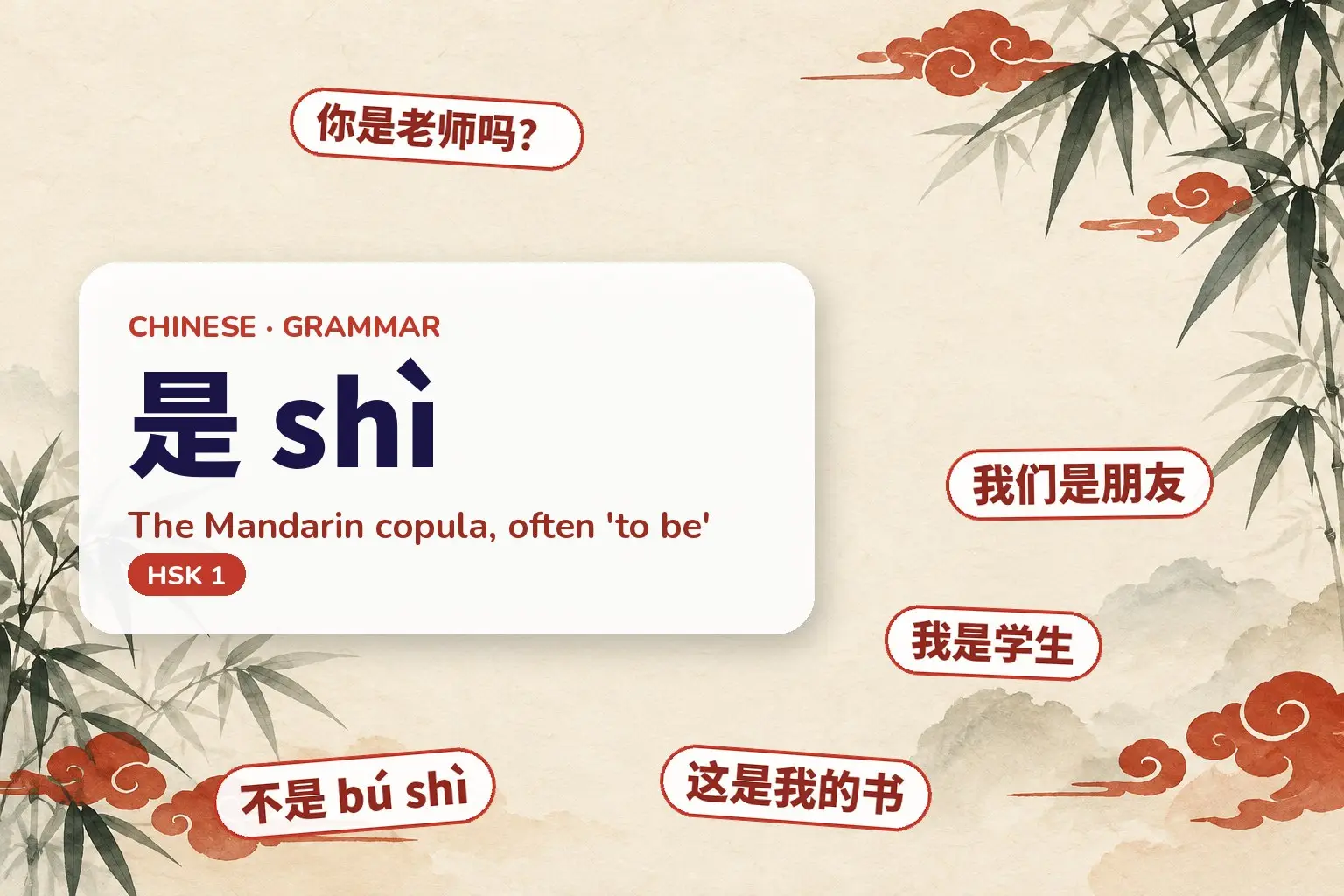
是 (shì) links two nouns, like 'am/is/are' in English: 我是学生 (Wǒ shì xuéshēng) = 'I am a student'. It never changes form. The negative is 不是 (bú shì), and you make a yes/no question by adding 吗 (ma). Adjectives normally don't take 是: say 我很忙 (Wǒ hěn máng, 'I'm busy'), not 我是忙.
Level: beginner (HSK 1). 是 (shì) is the Mandarin copula for identifying and classifying — “X is Y” with nouns. It is often translated “to be”, but many English “is” sentences (adjectives, location, age, weather) don’t use it. It is one of the first words you need to introduce yourself and name things.
The rule
Subject + 是 + noun
- 我是学生。 Wǒ shì xuéshēng. — I am a student.
- 他是老师。 Tā shì lǎoshī. — He is a teacher.
是 never changes: the same word works for I, you, she, we and they, and for past or present (time is shown with other words, like 昨天 zuótiān, “yesterday”).
Forms at a glance
| Chinese | Pinyin | Meaning | |
|---|---|---|---|
| Positive | 我是学生。 | Wǒ shì xuéshēng. | I am a student. |
| Negative | 我不是学生。 | Wǒ bú shì xuéshēng. | I am not a student. |
| Question | 你是学生吗? | Nǐ shì xuéshēng ma? | Are you a student? |
| Short answers | 是。/ 不是。 | Shì. / Bú shì. | Yes. / No. |
Tone note: 不 is normally bù (4th tone), but it is pronounced bú before another 4th tone, so 不是 is said bú shì. Dictionaries usually write bù shì; we show the spoken tone here.
Example sentences
- 我是学生。 — Wǒ shì xuéshēng. — I am a student.
- 她是医生。 — Tā shì yīshēng. — She is a doctor.
- 这是我的书。 — Zhè shì wǒ de shū. — This is my book.
- 那不是我的。 — Nà bú shì wǒ de. — That isn’t mine.
- 我们是朋友。 — Wǒmen shì péngyou. — We are friends.
- 他是中国人。 — Tā shì Zhōngguórén. — He is Chinese.
- 你是老师吗? — Nǐ shì lǎoshī ma? — Are you a teacher?
- 你是哪国人? — Nǐ shì nǎ guó rén? — Which country are you from?
- 今天是星期一。 — Jīntiān shì xīngqīyī. — Today is Monday.
- 他们不是学生。 — Tāmen bú shì xuéshēng. — They aren’t students.
Common mistakes
- ❌ 我是很忙。 → ✅ 我很忙。 Wǒ hěn máng. Adjectives normally don’t take 是. In neutral statements 很 (hěn) is usually added and often doesn’t mean “very”; a bare adjective (我忙) tends to sound contrastive.
- ❌ 我不学生。 → ✅ 我不是学生。 The negative needs both 不 and 是.
- ❌ 你是学生吗不? → ✅ 你是学生吗? or 你是不是学生? Use either 吗 or the 是不是 pattern, not both.
- ❌ bù shì → ✅ bú shì. Remember the tone change.
Compared with…
- 很 (hěn) + adjective — used for descriptions (她很高, “she’s tall”), where English would use “is”.
- 在 (zài) — used for location (“is at/in”): 我在家, “I’m at home”. Both are covered in the Chinese grammar section.
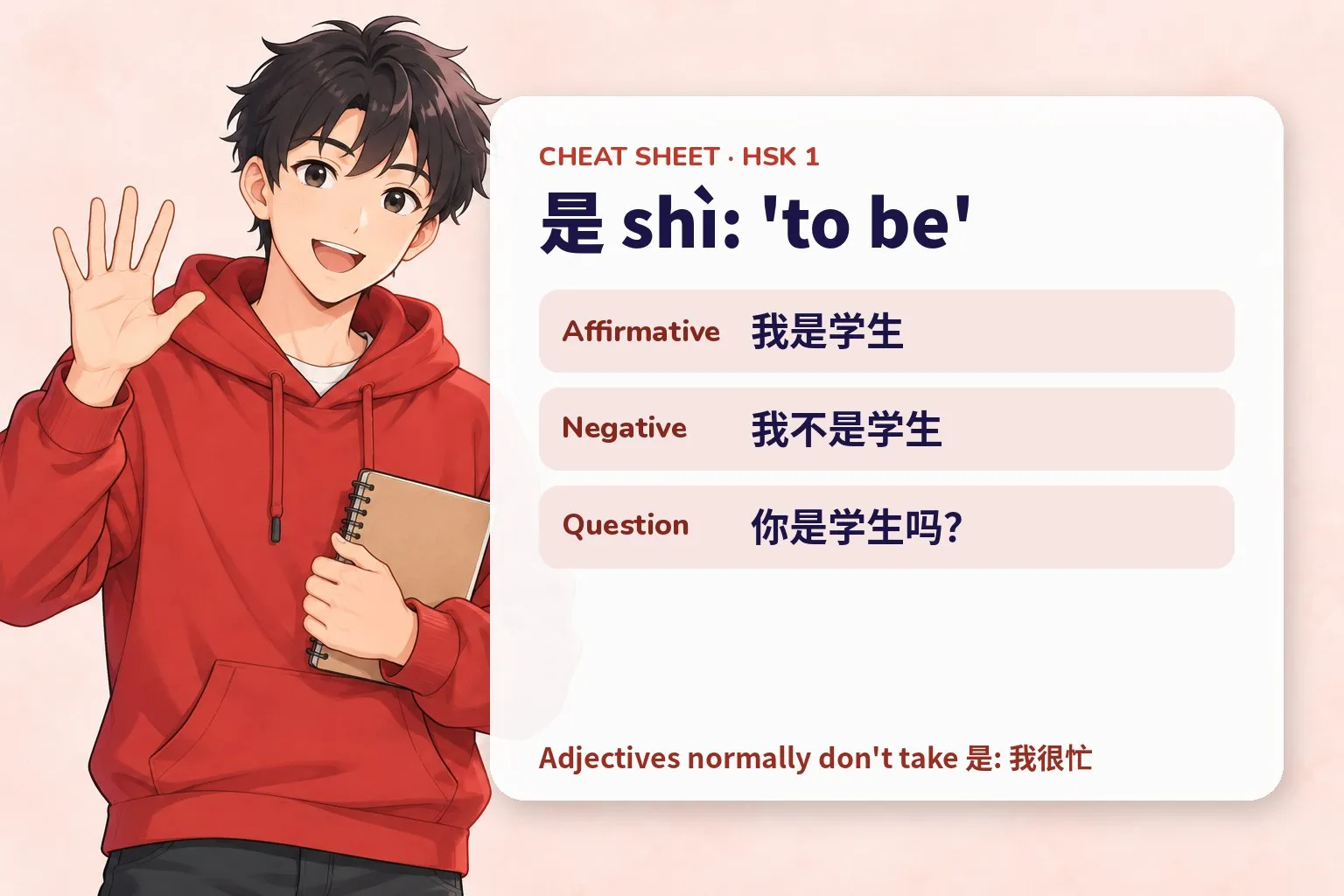
Quick recap before the quiz.
Mini quiz
- 我 ___ 老师。 (I am a teacher.)
- 他 ___ 学生。 (He is not a student.)
- 你是中国人 ___ ? (Are you Chinese?)
- Correct or not: 我是很累。
- How is 不是 pronounced?
Answers
- 是 — 我是老师。
- 不是 — 他不是学生。
- 吗 — 你是中国人吗?
- Not correct — say 我很累 (Wǒ hěn lèi, “I’m tired”).
- bú shì — 不 changes to the 2nd tone before a 4th tone.
Sources
- Rules and forms checked against the official Hanyu Pinyin scheme.
- This topic sits at beginner level (HSK 1) in common course sequencing; HSK levels are used as a general reference, not as an official topic list.
- Example sentences were written for this lesson; no third-party sentences were copied.
Next
- Back to the Chinese grammar section
- New here? Start with Start Learning Chinese Here
Sources
- 汉语拼音方案 (Scheme for the Chinese Phonetic Alphabet) — Ministry of Education of the PRC
- HSK level descriptions — Chinese Testing International (CTI)