Chinese Numbers and Counting 0 to 100
Chinese numbers 0-10 are single words; the tens and teens are built from 十 (shí, ten), so 12 is 十二 (shí'èr) and 20 is 二十 (èrshí). Before a measure word, 'two' switches from 二 (èr) to 两 (liǎng): 两个 (liǎng ge).
Level: beginner (HSK 1). Chinese numbers are wonderfully regular. Once you know the ten digits and the word 十 (shí, ten), you can build every number up to 99 by rule — no irregular forms like English “eleven” or “twelve”. The one twist is a second word for “two”, 两 (liǎng), used when you count things.
The rule
A digit is a single number word. Chinese has ten of them, 零 (líng, 0) through 九 (jiǔ, 9), plus 十 (shí, 10). From these you build the rest:
- Teens = 十 (shí) + digit. 11 is 十一 (shíyī), 12 is 十二 (shí’èr), 15 is 十五 (shíwǔ).
- Tens = digit + 十 (shí). 20 is 二十 (èrshí), 30 is 三十 (sānshí), 90 is 九十 (jiǔshí).
- In between, join them. 21 is 二十一 (èrshíyī), 45 is 四十五 (sìshíwǔ), 99 is 九十九 (jiǔshíjiǔ).
So the pattern is “how many tens, then how many ones”. 100 is 一百 (yìbǎi), literally “one hundred”.
The one thing to watch is “two”. The counting number is 二 (èr), and it is the form inside bigger numbers: 二十 (èrshí, 20), 十二 (shí’èr, 12). But when “two” comes directly before a measure word (a counting word), you switch to 两 (liǎng): 两个 (liǎng ge, two of something), not 二个 (èr ge).
The digits 0 to 10
| Number | Hanzi | Pinyin |
|---|---|---|
| 0 | 零 | líng |
| 1 | 一 | yī |
| 2 | 二 | èr |
| 3 | 三 | sān |
| 4 | 四 | sì |
| 5 | 五 | wǔ |
| 6 | 六 | liù |
| 7 | 七 | qī |
| 8 | 八 | bā |
| 9 | 九 | jiǔ |
| 10 | 十 | shí |
How the tens are built
| Number | Hanzi | Pinyin |
|---|---|---|
| 11 | 十一 | shíyī |
| 12 | 十二 | shí’èr |
| 20 | 二十 | èrshí |
| 21 | 二十一 | èrshíyī |
| 30 | 三十 | sānshí |
| 55 | 五十五 | wǔshíwǔ |
| 99 | 九十九 | jiǔshíjiǔ |
| 100 | 一百 | yìbǎi |
Example sentences
- 一、二、三。Yī, èr, sān.One, two, three.counting out loud
- 我十岁。Wǒ shí suì.I am ten years old.
- 她十二岁。Tā shí'èr suì.She is twelve years old.12 = 十二 shí'èr
- 我们班有二十个学生。Wǒmen bān yǒu èrshí ge xuéshēng.Our class has twenty students.20 = 二十 èrshí
- 现在三点。Xiànzài sān diǎn.It is three o'clock now.
- 我有两个姐姐。Wǒ yǒu liǎng ge jiějie.I have two older sisters.两 liǎng before a measure word
- 请给我两杯水。Qǐng gěi wǒ liǎng bēi shuǐ.Please give me two glasses of water.
- 这本书三十五块。Zhè běn shū sānshíwǔ kuài.This book is thirty-five yuan.35 = 三十五 sānshíwǔ
- 我家有五口人。Wǒ jiā yǒu wǔ kǒu rén.There are five people in my family.
- 今天十一号。Jīntiān shíyī hào.Today is the eleventh.11 = 十一 shíyī
- 一共六十块。Yígòng liùshí kuài.Sixty yuan in total.60 = 六十 liùshí
- 他九十岁了。Tā jiǔshí suì le.He is ninety years old now.
- 我的房间是一百零一号。Wǒ de fángjiān shì yìbǎi líng yī hào.My room is number 101.零 líng for the inner zero
- 一年有十二个月。Yì nián yǒu shí'èr ge yuè.A year has twelve months.
- 一个星期有七天。Yí ge xīngqī yǒu qī tiān.A week has seven days.
- 两百块太贵了。Liǎngbǎi kuài tài guì le.Two hundred yuan is too expensive.两百 liǎngbǎi for 200
- 你几岁?Nǐ jǐ suì?How old are you?asking a young child's age
- 八加二是十。Bā jiā èr shì shí.Eight plus two is ten.
Common mistakes
- ❌ 二个人 (èr ge rén) → ✅ 两个人 (liǎng ge rén). Before a measure word, “two” is 两 (liǎng), not 二 (èr).
- ❌ 两十 (liǎngshí) → ✅ 二十 (èrshí). Inside a number, “two” stays 二 (èr): twenty is 二十 (èrshí).
- ❌ 一十一 (yīshíyī) for 11 → ✅ 十一 (shíyī). You do not say “one ten” for the teens; 11 is just 十一 (shíyī).
- ❌ 一百一 (yìbǎi yī) for 101 → ✅ 一百零一 (yìbǎi líng yī). Read an inner zero with 零 (líng); 一百一 (yìbǎi yī) means 110, not 101.
- ❌ Saying 一 (yī) in a flat first tone before 岁 (suì) → ✅ say yí before a fourth-tone syllable: 一岁 (yí suì, one year old).
A short conversation
A: 你家有几口人? (Nǐ jiā yǒu jǐ kǒu rén?) — How many people are in your family? B: 四口人。我有两个妹妹。 (Sì kǒu rén. Wǒ yǒu liǎng ge mèimei.) — Four. I have two younger sisters. A: 这个多少钱? (Zhè ge duōshao qián?) — How much is this? B: 三十五块。 (Sānshíwǔ kuài.) — Thirty-five yuan.
Usage notes
- The system keeps going past 100. 百 (bǎi) is hundred, 千 (qiān) is thousand, 万 (wàn) is ten-thousand. At HSK 1 you mainly need 0-100, but the building logic is the same.
- 两 (liǎng) also fronts big round numbers. For 200 and 2000, speakers usually say 两百 (liǎngbǎi) and 两千 (liǎngqiān) rather than 二百 (èrbǎi); both are understood, but 两 (liǎng) is more common here.
- Digit strings are read one by one. Phone numbers, room numbers and years are read digit by digit, and the digit 1 is usually said 幺 (yāo) on the mainland so it is not mistaken for 七 (qī, seven): a phone number with a 1 in it is read with 幺 (yāo).
- Money needs a measure word too. The everyday word for the yuan is 块 (kuài): 三十五块 (sānshíwǔ kuài, 35 yuan). This is why the number sits with a counting word, just like other nouns.
Compared with…
- Numbers vs measure words. A number almost never touches a noun directly; a measure word sits between them, and that is where 两 (liǎng) replaces 二 (èr). Say 两个人 (liǎng ge rén, two people), not 二个人 (èr ge rén). Learn the counting words on Measure Words and 个 (ge).
- 二 (èr) vs 两 (liǎng) in one line. 二 (èr) is the pure number and lives inside tens (二十, èrshí); 两 (liǎng) appears right before a measure word (两杯, liǎng bēi). More patterns are in the Chinese grammar section.
Practice
Numbers practice
Try each one, then press Check. No sign-up, nothing is sent anywhere — it all runs in your browser.
Hint: ten + two
Show answer
shí'èr — 12 = 十二 (shí'èr), 十 then 二.
3 Build the number 35.
Show answer
三 (sān) 十 (shí) 五 (wǔ) — 35 = 三十五 (sānshíwǔ): three-ten-five.
5 Match each number to its characters.
- 3
- 7
- 10
- 100
Show answer
- 3 → 三 (sān)
- 7 → 七 (qī)
- 10 → 十 (shí)
- 100 → 一百 (yìbǎi)
三 (sān) 3; 七 (qī) 7; 十 (shí) 10; 一百 (yìbǎi) 100.
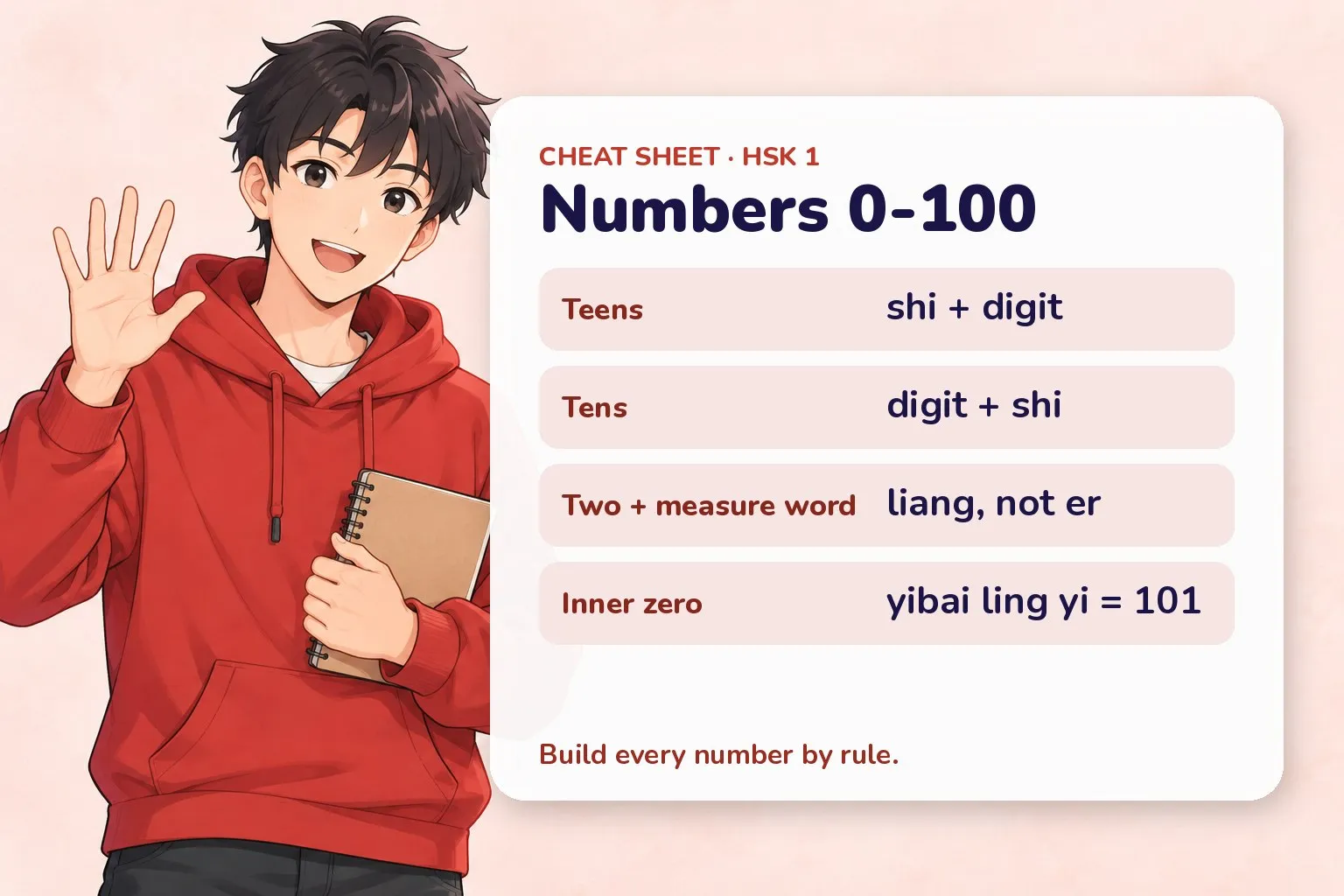
Quick recap before you practise.
Quiz
Numbers and counting quiz
12 questions · pick an answer and you'll see straight away if it's right.
-
Show answer
十 (shí) + digit — Teens are 十 + digit: 11 = 十一 (shíyī), 15 = 十五 (shíwǔ).
-
Show answer
digit + 十 (shí) — Tens are digit + 十: 20 = 二十 (èrshí).
-
Show answer
十二 (shí'èr) — 12 = 十二 (shí'èr): ten then two.
-
Show answer
二十 (èrshí) — 20 = 二十 (èrshí): two tens.
-
Show answer
两个人 (liǎng ge rén) — Before a measure word, 'two' is 两: 两个人 (liǎng ge rén).
-
Show answer
二 (èr) — Inside a number 'two' stays 二: 二十 (èrshí).
-
Show answer
一百零一 (yìbǎi líng yī) — Read the inner zero: 一百零一 (yìbǎi líng yī). 一百一 means 110.
-
Show answer
九十九 (jiǔshíjiǔ) — 99 = 九十九 (jiǔshíjiǔ): nine-ten-nine.
-
Show answer
yí — 一 becomes yí before a fourth tone: 一岁 (yí suì).
-
Show answer
两百 (liǎngbǎi) — 两百 (liǎngbǎi) is the common form for 200.
-
Show answer
幺 (yāo) — On the mainland, 1 is read 幺 (yāo) in digit strings to avoid confusion with 七 (qī).
-
Show answer
sānshí — 30 = 三十 (sānshí): three tens.
Recap cheat-sheet
| Point | Example |
|---|---|
| Digits 0-10 | 零 一 二 … 十 (líng, yī, èr … shí) |
| Teens | 十 (shí) + digit: 十五 (shíwǔ) 15 |
| Tens | digit + 十 (shí): 四十 (sìshí) 40 |
| Two before a measure word | 两 (liǎng), not 二 (èr) |
| Inner zero | 一百零一 (yìbǎi líng yī) 101 |
Next
- Learn the counting words these numbers attach to: Measure Words and 个 (ge)
- Back to the Chinese grammar section
- New here? Start with Start Learning Chinese Here
All Chinese grammar topics
Every grammar point in order, from your first sentence to advanced structures. Pick one and go straight to it. New lessons go live every day, so topics marked Coming soon fill in over the next weeks.
Grammar path
HSK 1 15 topics · 12 ready
- 01 The Verb 是 (shì): to be
- 02 Basic Word Order (Subject-Verb-Object)
- 03 Adjectives with 很 (hěn)
- 04 Yes/No Questions with 吗 (ma)
- 05 Question Words (什么 shénme, 谁 shuí, 哪 nǎ, 几 jǐ)
- 06 The Particle 的 (de): Possession & Modification
- 07 Measure Words and 个 (ge)
- 08 Numbers and Counting You are here
- 09 The Verb 有 (yǒu): to have / there is
- 10 The Verb 在 (zài): Location
- 11 Time When (Position in Sentence)
- 12 The Particle 了 (le): Change of State
- 13 Modal Verbs 想 / 要 / 会 / 能 (xiǎng / yào / huì / néng) Coming soon
- 14 The Particle 呢 (ne) Coming soon
- 15 也 (yě) and 都 (dōu) Placement Coming soon
HSK 2 16 topics
- 16 Aspectual 了 (Completed Action) Coming soon
- 17 The Aspect Particle 过 (guò) Coming soon
- 18 Progressive Aspect (在 / 正在 / 呢 zài / zhèngzài / ne) Coming soon
- 19 Comparisons with 比 (bǐ) Coming soon
- 20 A Bit: 一点儿 (yìdiǎnr) vs 有一点儿 (yǒu yìdiǎnr) Coming soon
- 21 Basic Conjunctions (和 hé, 也 yě, 都 dōu, 还 hái) Coming soon
- 22 Because...So (因为 yīnwèi...所以 suǒyǐ) Coming soon
- 23 Coverbs 给 / 跟 / 对 (gěi / gēn / duì) Coming soon
- 24 Duration (Time How Long) Coming soon
- 25 Resultative Complements (看完 kànwán, 听懂 tīngdǒng) Coming soon
- 26 The 把 (bǎ) Construction Coming soon
- 27 The Particle 吧 (ba) Coming soon
- 28 Again: 再 (zài) vs 又 (yòu) Coming soon
- 29 Or: 还是 (háishì) vs 或者 (huòzhě) Coming soon
- 30 Imminent Action (快要 kuàiyào...了 / 要 le / yào...了 le) Coming soon
- 31 Asking Degree with 多 (duō) Coming soon
HSK 3 18 topics
- 32 Directional Complements (出来 chūlái, 回去 huíqù) Coming soon
- 33 Potential Complements (看得懂 kàndedǒng, 做不完 zuòbùwán) Coming soon
- 34 Complement of Degree with 得 (de) Coming soon
- 35 Adverbial Modifier with 地 (de) Coming soon
- 36 The Durative Aspect 着 (zhe) Coming soon
- 37 把 (bǎ) with Complex Results Coming soon
- 38 The 被 (bèi) Passive Coming soon
- 39 Conditionals (如果 rúguǒ...就 / 要是 jiù / yàoshì) Coming soon
- 40 Although...But (虽然 suīrán...但是 dànshì) Coming soon
- 41 Pivotal Sentences (让 ràng, 叫 jiào, 请 qǐng, 使 shǐ) Coming soon
- 42 More and More (越来越 / 越 yuèláiyuè / yuè...越 yuè) Coming soon
- 43 除了 (chúle)...以外 (Besides / Except) Coming soon
- 44 Simultaneous Actions (一边...一边, yìbiān...yìbiān) Coming soon
- 45 Sequence: 先 (xiān)...再/然后 (zài / ránhòu) Coming soon
- 46 Conditional with ...的话 (dehuà) Coming soon
- 47 From...To (从 cóng...到 / 离 dào / lí) Coming soon
- 48 Similarity: 跟 (gēn)...一样 / 像 (yíyàng / xiàng)...一样 (yíyàng) Coming soon
- 49 Both...And (又 yòu...又 / 既 yòu / jì...又 yòu) Coming soon
HSK 4 13 topics
- 50 The 是 (shì)...的 (de) Construction (Emphasis) Coming soon
- 51 The Adverbs 就 (jiù) and 才 (cái) Coming soon
- 52 No Matter (不管 / 无论 bùguǎn / wúlùn...都 dōu) Coming soon
- 53 Even If (即使 / 就算 jíshǐ / jiùsuàn...也 yě) Coming soon
- 54 Verb Reduplication (看看 kànkan, 试一试 shìyishì) Coming soon
- 55 As Soon As (一...就, yī...jiù) Coming soon
- 56 Comparing 把 (bǎ) and 被 (bèi) in Context Coming soon
- 57 Complement of Quantity / Comparison Degree Coming soon
- 58 连 (lián)...都/也 (Even) Coming soon
- 59 Time Sequence (先 xiān...然后 ránhòu, 的时候 deshíhòu, 以后/以前 yǐhòu / yǐqián) Coming soon
- 60 From the Angle Of (对 duì...来说 láishuō) Coming soon
- 61 Only After / Not Until (要 yào...才 / 等 cái / děng...才 cái) Coming soon
- 62 Approximation & 左右/多/来 (zuǒyòu / duō / lái) Coming soon
HSK 5 14 topics
- 63 Mood Adverbs (反正 fǎnzhèng, 居然 jūrán, 竟然 jìngrán, 难道 nándào) Coming soon
- 64 Not Only...But Also (不但 búdàn...而且 érqiě) Coming soon
- 65 Otherwise (否则 / 要不然 fǒuzé / yàobùrán) Coming soon
- 66 Complex Complements & Metaphorical Results Coming soon
- 67 Formal/Written Markers (之 zhī, 其 qí, 者 zhě, 以 yǐ) Coming soon
- 68 Rather...Than (宁愿/宁可 nìngyuàn / nìngkě...也不 yěbù) Coming soon
- 69 与其 (yǔqí)...不如 (Rather Than / Better To) Coming soon
- 70 Only If / Only (只有 zhǐyǒu...才 / 只要 cái / zhǐyào...就 jiù) Coming soon
- 71 Colloquial Passives (让 ràng, 叫 jiào, 给 gěi) Coming soon
- 72 不但不/没 (búdànbù / méi)...反而 (Contrary to Expectation) Coming soon
- 73 一...就 (yī...jiù) vs 一旦 (yídàn): Once / As Soon As Coming soon
- 74 尽管 (jǐnguǎn)...还是 (Even Though) Coming soon
- 75 复合趋向补语 (Compound Directional + Object) Coming soon
- 76 Emphasis with 是 (shì)...的 (de) vs 连 (lián)...都 (dōu) Review Coming soon
HSK 6 7 topics
- 77 Four-Character Idioms (成语 chéngyǔ) in Grammar Coming soon
- 78 Literary Connectives (然而 ránér, 从而 cóngér, 鉴于 jiànyú, 乃至 nǎizhì) Coming soon
- 79 Fixed Frameworks (在 zài...下 xià, 以 yǐ...为 wèi, 对 duì...而言 éryán) Coming soon
- 80 Rhetorical & Emphatic Structures (并 bìng, 可 kě, 正是 zhèngshì) Coming soon
- 81 Nominalisation & Topic Structures (所 suǒ...的 de, 的 de nominaliser) Coming soon
- 82 Long-Sentence Cohesion & Ellipsis Coming soon
- 83 经/予/加以 (Formal Verbal Framing) Coming soon