The Particle 的 (de): Possession and Modification
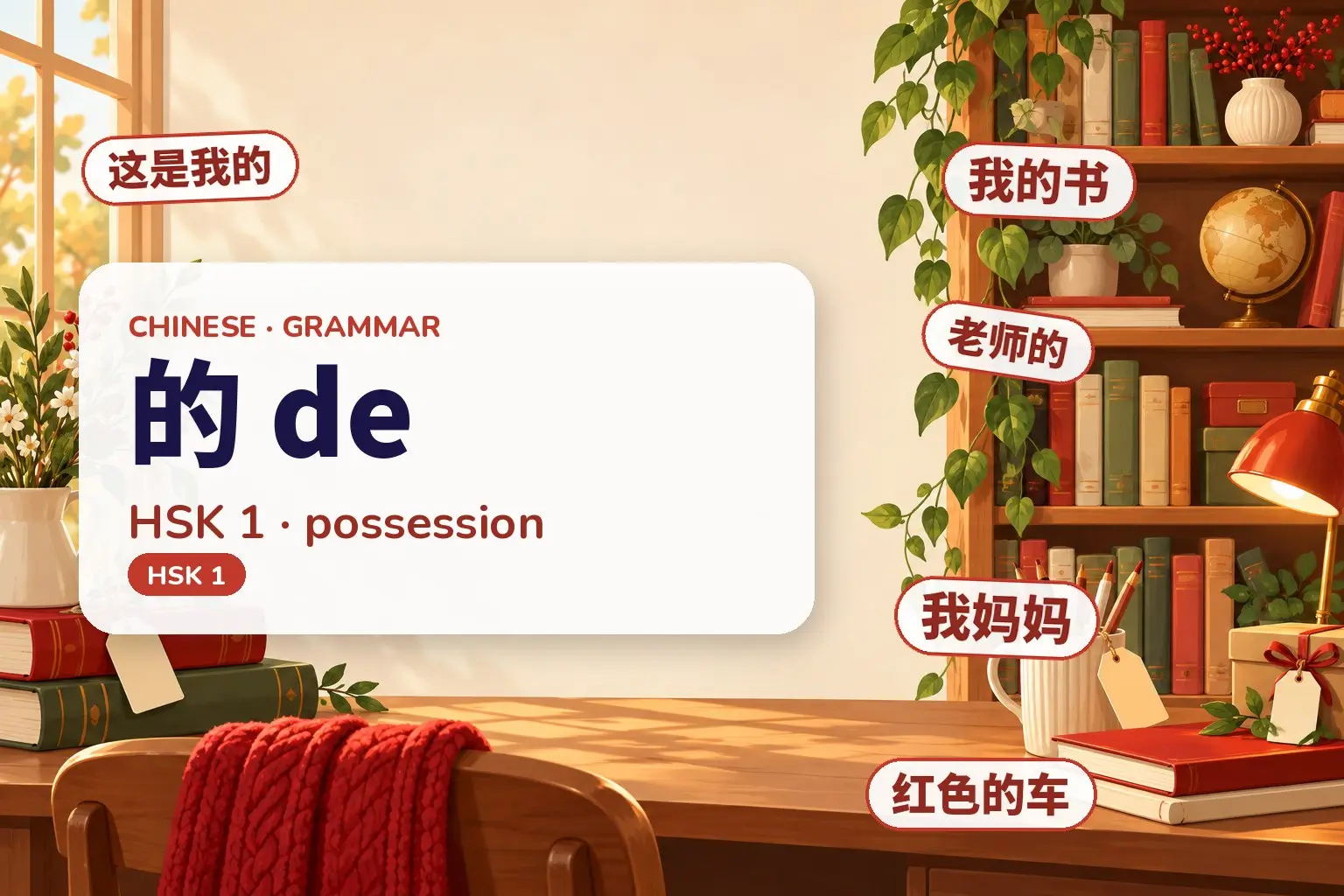
的 (de) links a modifier to a noun and most often shows possession: 我的书 (wǒ de shū) means 'my book'. Put the owner or describer before 的 (de) and the thing after it. Family words and fixed phrases often drop it.
Level: beginner (HSK 1). 的 (de) is the most common character in written Mandarin, and its main job is simple: it joins a modifier — the owner or describer — to the noun it belongs to. Learn the order “owner + 的 (de) + thing” and you can already say “my book”, “the teacher’s car” and “a red cup”.
The rule
A modifier is a word or phrase that tells you more about a noun (a word for a person, place or thing): whose it is, or what it is like. In Mandarin the modifier comes first, then 的 (de), then the noun:
Modifier + 的 (de) + noun
- 我的书 (wǒ de shū) — my book.
- 老师的车 (lǎoshī de chē) — the teacher’s car.
- 红色的杯子 (hóngsè de bēizi) — a red cup.
The same pattern covers possession (我的, wǒ de, “mine”), description (红色的, hóngsè de, “red”) and longer phrases (昨天买的书, zuótiān mǎi de shū, “the book I bought yesterday”). 的 (de) never changes form.
Forms at a glance
| Use | Chinese | Pinyin | Meaning |
|---|---|---|---|
| Possession | 我的书 | wǒ de shū | my book |
| Possession (person) | 老师的名字 | lǎoshī de míngzi | the teacher’s name |
| Description | 红色的车 | hóngsè de chē | a red car |
| Phrase modifier | 昨天买的书 | zuótiān mǎi de shū | the book (I) bought yesterday |
| Noun on its own | 这是我的 | zhè shì wǒ de | this is mine |
When to drop 的 (de)
Native speakers leave 的 (de) out in two common cases:
- Close relationships and your own groups: 我妈妈 (wǒ māma, my mum), 我爸爸 (wǒ bàba, my dad), 你朋友 (nǐ péngyou, your friend), 我们公司 (wǒmen gōngsī, our company). Adding 的 (de) here is not wrong, but it sounds heavier and less natural.
- A one-syllable describer fixed to a noun: 好人 (hǎo rén, a good person), 新车 (xīn chē, a new car), 中国人 (Zhōngguó rén, a Chinese person). These behave like set words, so 好的人 (hǎo de rén) sounds odd.
Example sentences
- 这是我的书。Zhè shì wǒ de shū.This is my book.
- 那是老师的车。Nà shì lǎoshī de chē.That is the teacher's car.
- 我喜欢红色的杯子。Wǒ xǐhuan hóngsè de bēizi.I like the red cup.
- 这本书是我的。Zhè běn shū shì wǒ de.This book is mine.noun left unsaid after 的 de
- 他的名字很长。Tā de míngzi hěn cháng.His name is long.
- 你的手机在桌子上。Nǐ de shǒujī zài zhuōzi shàng.Your phone is on the table.
- 我妈妈是医生。Wǒ māma shì yīshēng.My mum is a doctor.family: 的 de dropped
- 我们学校很大。Wǒmen xuéxiào hěn dà.Our school is big.own group: no 的 de
- 这是一个好人。Zhè shì yí ge hǎo rén.This is a good person.one-syllable describer, no 的 de
- 漂亮的花儿是她的。Piàoliang de huār shì tā de.The pretty flowers are hers.
- 这是我朋友的电话。Zhè shì wǒ péngyou de diànhuà.This is my friend's phone number.
- 昨天买的书很有意思。Zuótiān mǎi de shū hěn yǒuyìsi.The book I bought yesterday is interesting.
- 老师的问题很难。Lǎoshī de wèntí hěn nán.The teacher's question is hard.
- 这件衣服是新的。Zhè jiàn yīfu shì xīn de.This piece of clothing is new.
- 我的和你的一样。Wǒ de hé nǐ de yíyàng.Mine and yours are the same.two 的 de nouns
- 会说中文的人在这里。Huì shuō Zhōngwén de rén zài zhèlǐ.The person who can speak Chinese is here.
- 这是谁的伞?Zhè shì shéi de sǎn?Whose umbrella is this?
Common mistakes
- ❌ 书我的 (shū wǒ de) → ✅ 我的书 (wǒ de shū). The modifier comes before the noun, not after it.
- ❌ 我的妈妈是医生 (wǒ de māma shì yīshēng) → ✅ 我妈妈是医生 (wǒ māma shì yīshēng). With close family, everyday Mandarin drops 的 (de).
- ❌ 好的人 (hǎo de rén) → ✅ 好人 (hǎo rén). A single-syllable describer in a set phrase takes no 的 (de).
- ❌ 跑的很快 (pǎo de hěn kuài) → ✅ 跑得很快 (pǎo de hěn kuài). After a verb, “how” uses 得 (de), not 的 (de).
A short conversation
A: 这是谁的伞? (Zhè shì shéi de sǎn?) — Whose umbrella is this? B: 是我的。 (Shì wǒ de.) — It’s mine. A: 那个红色的也是你的吗? (Nàge hóngsè de yě shì nǐ de ma?) — Is the red one also yours? B: 不是。那是我朋友的。 (Bú shì. Nà shì wǒ péngyou de.) — No, that’s my friend’s.
Usage notes
- 的 (de) can stand in for the noun. Once the thing is known, you can stop at 的 (de): 我的 (wǒ de, “mine”), 红色的 (hóngsè de, “the red one”), 老师的 (lǎoshī de, “the teacher’s”). This is how 这是我的 (zhè shì wǒ de) means “this is mine”.
- Pronounced in the neutral tone. 的 (de) is always toneless and light; do not stress it. In fast speech it almost disappears between the modifier and the noun.
- Long modifiers come before 的 (de) too. A whole clause can modify a noun: 会说中文的人 (huì shuō Zhōngwén de rén, “a person who can speak Chinese”). English puts such a clause after the noun; Mandarin keeps it before 的 (de).
- Don’t confuse it with 得 (de) and 地 (de). All three are read de in the neutral tone but do different jobs — see below.
Compared with…
- 得 (de) — after a verb. 得 (de) links a verb to a comment on how well it is done: 他跑得很快 (tā pǎo de hěn kuài, “he runs fast”). This is a degree, not possession.
- 地 (de) — before a verb. 地 (de) turns a describer into a manner adverb before the verb: 高兴地说 (gāoxìng de shuō, “say happily”).
- 的 (de) — before a noun. The one on this page: 红色的车 (hóngsè de chē, “a red car”). Remember it by position: 的 (de) sits before a noun, 得 (de) after a verb, 地 (de) before a verb. All three live in the Chinese grammar section.
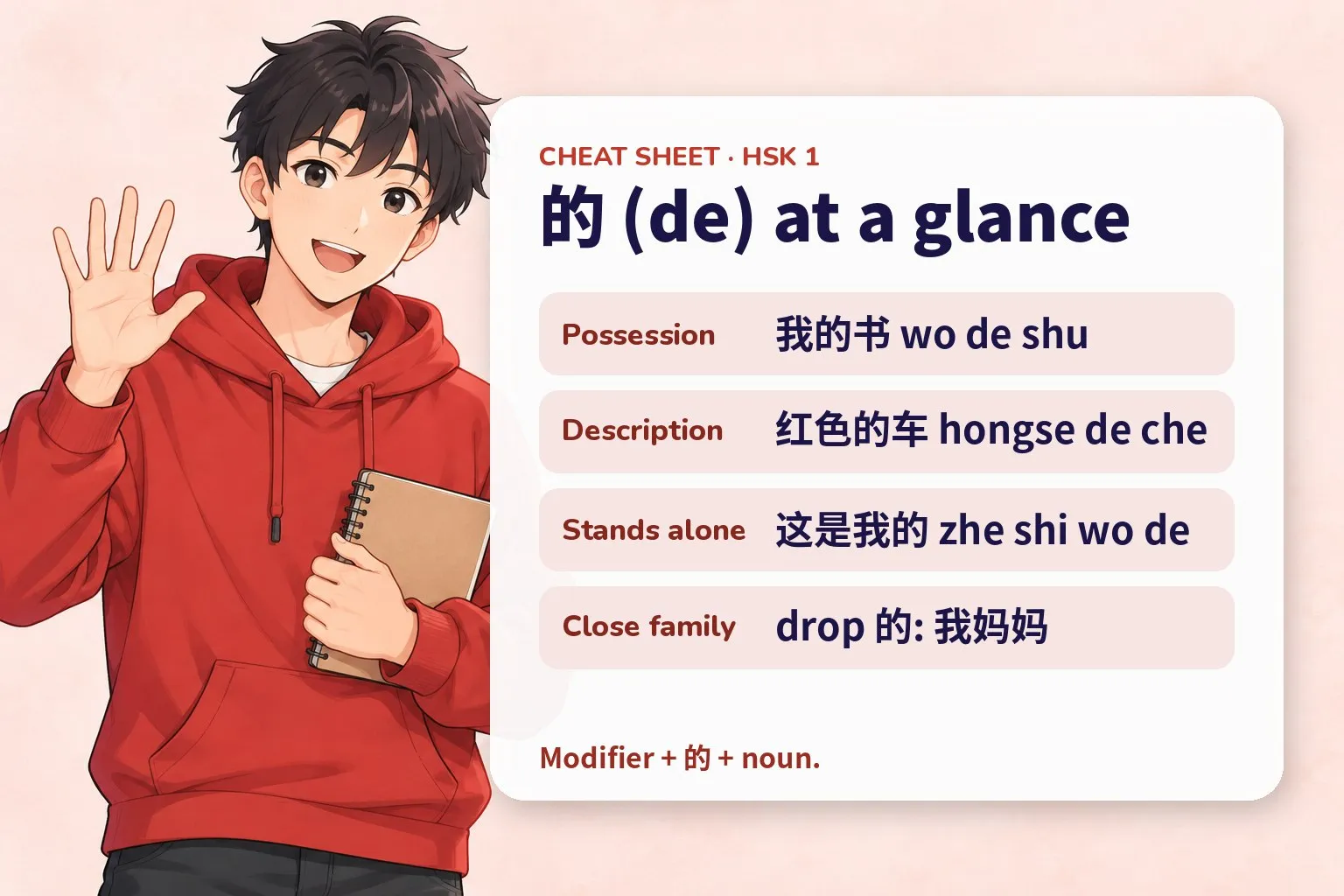
Quick recap before you practise.
Practice
的 (de) possession and modification practice
Try each one, then press Check. No sign-up, nothing is sent anywhere — it all runs in your browser.
Hint: it links the owner to the thing
Show answer
de — 的 (de) links the owner to the noun: 老师的车 (lǎoshī de chē).
3 Put the words in order: 'a red cup'.
Show answer
红色 (hóngsè) 的 (de) 杯子 (bēizi) — Describer + 的 (de) + noun: 红色的杯子 (hóngsè de bēizi).
5 Match each de-word to its job.
- 的 (de)
- 得 (de)
- 地 (de)
- 我的 (wǒ de)
Show answer
- 的 (de) → before a noun (modifier)
- 得 (de) → after a verb (degree)
- 地 (de) → before a verb (manner)
- 我的 (wǒ de) → stands in for 'mine'
的 (de) before a noun, 得 (de) after a verb, 地 (de) before a verb; 的 (de) alone can mean 'mine'.
Quiz
的 (de) possession quiz
12 questions · pick an answer and you'll see straight away if it's right.
-
Show answer
before 的 (de), then the noun — Modifier + 的 (de) + noun: 我的书 (wǒ de shū).
-
Show answer
的 (de) — Possession before a noun uses 的 (de): 老师的名字 (lǎoshī de míngzi).
-
Show answer
我 ___ 妈妈 (wǒ ___ māma) — Close family drops 的 (de): 我妈妈 (wǒ māma).
-
Show answer
的 (de) — 的 (de) can end the phrase and stand for the noun: 是我的 (shì wǒ de), 'is mine'.
-
Show answer
好的人 (hǎo de rén) — A one-syllable describer in a set phrase takes no 的 (de): 好人 (hǎo rén).
-
Show answer
得 (de) — After a verb, how well it is done uses 得 (de): 跑得很快 (pǎo de hěn kuài).
-
Show answer
地 (de) — Manner before a verb uses 地 (de): 高兴地说 (gāoxìng de shuō).
-
Show answer
neutral tone, light — 的 (de) is always toneless and light; it never changes form.
-
Show answer
before 的 (de) and the noun — Mandarin keeps the modifying clause before 的 (de): 昨天买的书 (zuótiān mǎi de shū).
-
Show answer
的 (de) — Possession uses 的 (de): 谁的伞 (shéi de sǎn), 'whose umbrella'.
-
Show answer
mine — 的 (de) can stand for the noun, so 我的 (wǒ de) means 'mine'.
-
Show answer
de — A describer links to its noun with 的 (de): 红色的车 (hóngsè de chē).
Recap cheat-sheet
| Job | Example | Pinyin |
|---|---|---|
| Possession | 我的书 | wǒ de shū |
| Description | 红色的车 | hóngsè de chē |
| Phrase modifier | 昨天买的书 | zuótiān mǎi de shū |
| Stands for a noun | 这是我的 | zhè shì wǒ de |
| Dropped (close ties) | 我妈妈 | wǒ māma |
Next
- Next grammar point: Measure Words and 个 (ge)
- Back to the Chinese grammar section
- New here? Start with Start Learning Chinese Here
All Chinese grammar topics
Every grammar point in order, from your first sentence to advanced structures. Pick one and go straight to it. New lessons go live every day, so topics marked Coming soon fill in over the next weeks.
Grammar path
HSK 1 15 topics · 12 ready
- 01 The Verb 是 (shì): to be
- 02 Basic Word Order (Subject-Verb-Object)
- 03 Adjectives with 很 (hěn)
- 04 Yes/No Questions with 吗 (ma)
- 05 Question Words (什么 shénme, 谁 shuí, 哪 nǎ, 几 jǐ)
- 06 The Particle 的 (de): Possession & Modification You are here
- 07 Measure Words and 个 (ge)
- 08 Numbers and Counting
- 09 The Verb 有 (yǒu): to have / there is
- 10 The Verb 在 (zài): Location
- 11 Time When (Position in Sentence)
- 12 The Particle 了 (le): Change of State
- 13 Modal Verbs 想 / 要 / 会 / 能 (xiǎng / yào / huì / néng) Coming soon
- 14 The Particle 呢 (ne) Coming soon
- 15 也 (yě) and 都 (dōu) Placement Coming soon
HSK 2 16 topics
- 16 Aspectual 了 (Completed Action) Coming soon
- 17 The Aspect Particle 过 (guò) Coming soon
- 18 Progressive Aspect (在 / 正在 / 呢 zài / zhèngzài / ne) Coming soon
- 19 Comparisons with 比 (bǐ) Coming soon
- 20 A Bit: 一点儿 (yìdiǎnr) vs 有一点儿 (yǒu yìdiǎnr) Coming soon
- 21 Basic Conjunctions (和 hé, 也 yě, 都 dōu, 还 hái) Coming soon
- 22 Because...So (因为 yīnwèi...所以 suǒyǐ) Coming soon
- 23 Coverbs 给 / 跟 / 对 (gěi / gēn / duì) Coming soon
- 24 Duration (Time How Long) Coming soon
- 25 Resultative Complements (看完 kànwán, 听懂 tīngdǒng) Coming soon
- 26 The 把 (bǎ) Construction Coming soon
- 27 The Particle 吧 (ba) Coming soon
- 28 Again: 再 (zài) vs 又 (yòu) Coming soon
- 29 Or: 还是 (háishì) vs 或者 (huòzhě) Coming soon
- 30 Imminent Action (快要 kuàiyào...了 / 要 le / yào...了 le) Coming soon
- 31 Asking Degree with 多 (duō) Coming soon
HSK 3 18 topics
- 32 Directional Complements (出来 chūlái, 回去 huíqù) Coming soon
- 33 Potential Complements (看得懂 kàndedǒng, 做不完 zuòbùwán) Coming soon
- 34 Complement of Degree with 得 (de) Coming soon
- 35 Adverbial Modifier with 地 (de) Coming soon
- 36 The Durative Aspect 着 (zhe) Coming soon
- 37 把 (bǎ) with Complex Results Coming soon
- 38 The 被 (bèi) Passive Coming soon
- 39 Conditionals (如果 rúguǒ...就 / 要是 jiù / yàoshì) Coming soon
- 40 Although...But (虽然 suīrán...但是 dànshì) Coming soon
- 41 Pivotal Sentences (让 ràng, 叫 jiào, 请 qǐng, 使 shǐ) Coming soon
- 42 More and More (越来越 / 越 yuèláiyuè / yuè...越 yuè) Coming soon
- 43 除了 (chúle)...以外 (Besides / Except) Coming soon
- 44 Simultaneous Actions (一边...一边, yìbiān...yìbiān) Coming soon
- 45 Sequence: 先 (xiān)...再/然后 (zài / ránhòu) Coming soon
- 46 Conditional with ...的话 (dehuà) Coming soon
- 47 From...To (从 cóng...到 / 离 dào / lí) Coming soon
- 48 Similarity: 跟 (gēn)...一样 / 像 (yíyàng / xiàng)...一样 (yíyàng) Coming soon
- 49 Both...And (又 yòu...又 / 既 yòu / jì...又 yòu) Coming soon
HSK 4 13 topics
- 50 The 是 (shì)...的 (de) Construction (Emphasis) Coming soon
- 51 The Adverbs 就 (jiù) and 才 (cái) Coming soon
- 52 No Matter (不管 / 无论 bùguǎn / wúlùn...都 dōu) Coming soon
- 53 Even If (即使 / 就算 jíshǐ / jiùsuàn...也 yě) Coming soon
- 54 Verb Reduplication (看看 kànkan, 试一试 shìyishì) Coming soon
- 55 As Soon As (一...就, yī...jiù) Coming soon
- 56 Comparing 把 (bǎ) and 被 (bèi) in Context Coming soon
- 57 Complement of Quantity / Comparison Degree Coming soon
- 58 连 (lián)...都/也 (Even) Coming soon
- 59 Time Sequence (先 xiān...然后 ránhòu, 的时候 deshíhòu, 以后/以前 yǐhòu / yǐqián) Coming soon
- 60 From the Angle Of (对 duì...来说 láishuō) Coming soon
- 61 Only After / Not Until (要 yào...才 / 等 cái / děng...才 cái) Coming soon
- 62 Approximation & 左右/多/来 (zuǒyòu / duō / lái) Coming soon
HSK 5 14 topics
- 63 Mood Adverbs (反正 fǎnzhèng, 居然 jūrán, 竟然 jìngrán, 难道 nándào) Coming soon
- 64 Not Only...But Also (不但 búdàn...而且 érqiě) Coming soon
- 65 Otherwise (否则 / 要不然 fǒuzé / yàobùrán) Coming soon
- 66 Complex Complements & Metaphorical Results Coming soon
- 67 Formal/Written Markers (之 zhī, 其 qí, 者 zhě, 以 yǐ) Coming soon
- 68 Rather...Than (宁愿/宁可 nìngyuàn / nìngkě...也不 yěbù) Coming soon
- 69 与其 (yǔqí)...不如 (Rather Than / Better To) Coming soon
- 70 Only If / Only (只有 zhǐyǒu...才 / 只要 cái / zhǐyào...就 jiù) Coming soon
- 71 Colloquial Passives (让 ràng, 叫 jiào, 给 gěi) Coming soon
- 72 不但不/没 (búdànbù / méi)...反而 (Contrary to Expectation) Coming soon
- 73 一...就 (yī...jiù) vs 一旦 (yídàn): Once / As Soon As Coming soon
- 74 尽管 (jǐnguǎn)...还是 (Even Though) Coming soon
- 75 复合趋向补语 (Compound Directional + Object) Coming soon
- 76 Emphasis with 是 (shì)...的 (de) vs 连 (lián)...都 (dōu) Review Coming soon
HSK 6 7 topics
- 77 Four-Character Idioms (成语 chéngyǔ) in Grammar Coming soon
- 78 Literary Connectives (然而 ránér, 从而 cóngér, 鉴于 jiànyú, 乃至 nǎizhì) Coming soon
- 79 Fixed Frameworks (在 zài...下 xià, 以 yǐ...为 wèi, 对 duì...而言 éryán) Coming soon
- 80 Rhetorical & Emphatic Structures (并 bìng, 可 kě, 正是 zhèngshì) Coming soon
- 81 Nominalisation & Topic Structures (所 suǒ...的 de, 的 de nominaliser) Coming soon
- 82 Long-Sentence Cohesion & Ellipsis Coming soon
- 83 经/予/加以 (Formal Verbal Framing) Coming soon