Adjectives with 很 (hěn) in Chinese
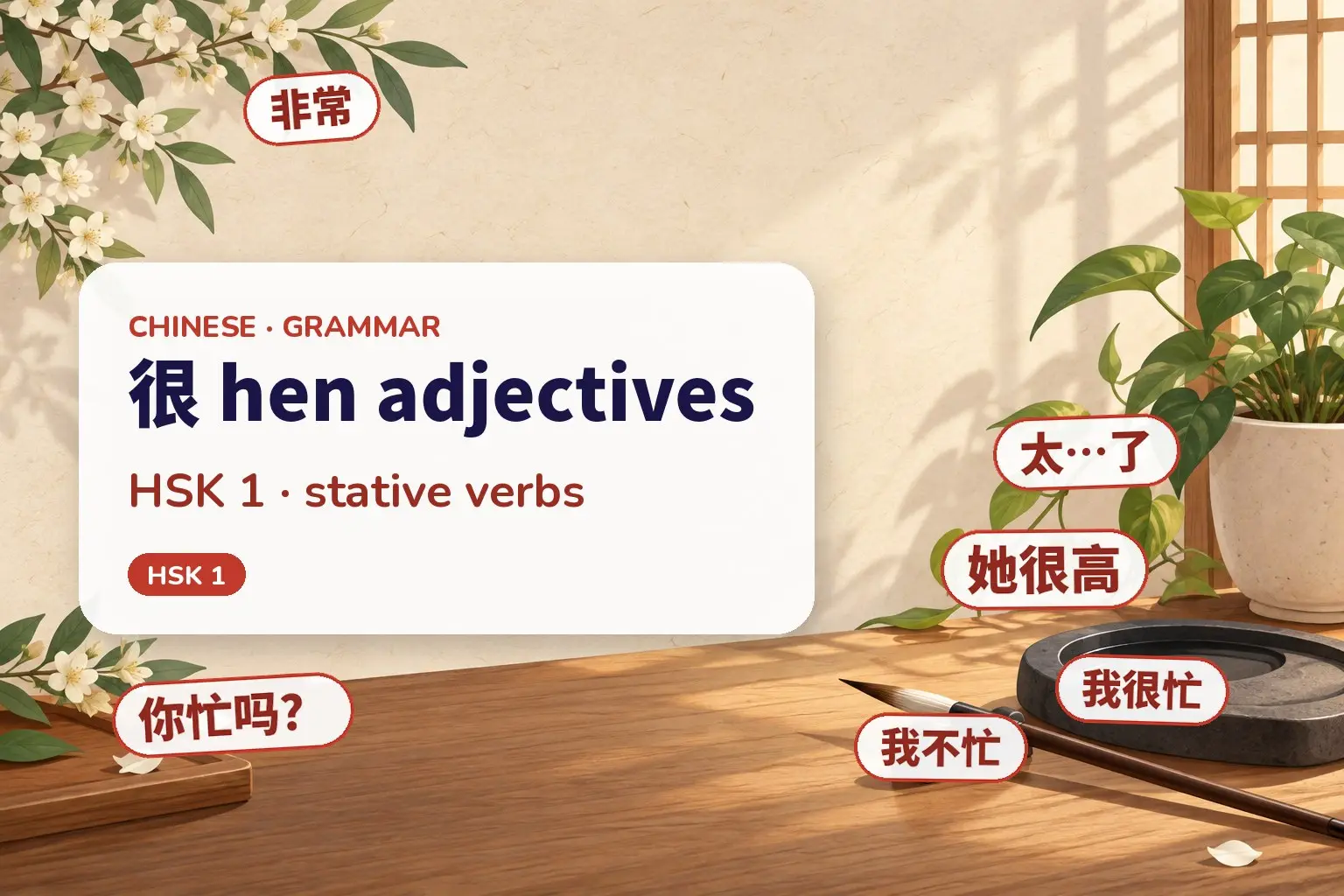
In Mandarin an adjective acts as the verb, so you do not use 是 (shì). A plain statement usually adds 很 (hěn) before the adjective: 我很忙 (Wǒ hěn máng) means 'I'm busy'. Negate with 不 (bù) and drop 很: 我不忙 (Wǒ bù máng).
On this page10 sections · tap to jump
Level: beginner (HSK 1). In Mandarin you do not say “I am busy” with a word for “am”. The adjective itself does the work of the verb, and a short word — most often 很 (hěn) — sits in front of it: 我很忙 (Wǒ hěn máng), “I’m busy”.
The rule
An adjective (a describing word such as busy, tall, good) behaves in Chinese like a stative verb — a verb that describes a state. So it needs no separate “to be”: you link the subject straight to the adjective.
But a bare adjective rarely stands alone in a neutral statement. Chinese normally puts a degree word in front of it, and the default one is 很 (hěn). On its own 很 (hěn) means “very”, yet in this everyday pattern it is usually unstressed and bleached — it simply links the subject to the adjective and does not really mean “very”. A truly bare adjective like 我忙 (wǒ máng) tends to sound unfinished or to imply a contrast (“I’m busy [but she isn’t]”).
To make it negative, put 不 (bù) before the adjective and drop 很 (hěn): 我不忙 (wǒ bù máng), “I’m not busy”. For a yes/no question add 吗 (ma) at the end — again with no 很 (hěn): 你忙吗? (nǐ máng ma), “Are you busy?”
Forms at a glance
| Form | Chinese | Pinyin | Meaning |
|---|---|---|---|
| Positive | 我很忙。 | Wǒ hěn máng. | I’m busy. |
| Negative | 我不忙。 | Wǒ bù máng. | I’m not busy. |
| Yes/no question | 你忙吗? | Nǐ máng ma? | Are you busy? |
| A-not-A question | 你忙不忙? | Nǐ máng bu máng? | Are you busy (or not)? |
Tone notes. 不 (bù) is 4th tone on its own, but before another 4th-tone syllable it rises to bú, so 不累 (bú lèi) is said with the rising tone. And when two 3rd tones meet, the first is read as a 2nd tone: 很好 (hěn hǎo) is said hén hǎo.
Example sentences
- 我很忙。Wǒ hěn máng.I'm busy.
- 她很高。Tā hěn gāo.She is tall.
- 这本书很好。Zhè běn shū hěn hǎo.This book is good.hěn hǎo is said hén hǎo (tone sandhi)
- 今天天气很冷。Jīntiān tiānqì hěn lěng.The weather is cold today.
- 中文很有意思。Zhōngwén hěn yǒuyìsi.Chinese is interesting.
- 我今天很高兴。Wǒ jīntiān hěn gāoxìng.I'm happy today.
- 他们很累。Tāmen hěn lèi.They are tired.
- 她很漂亮。Tā hěn piàoliang.She is pretty.
- 他不高。Tā bù gāo.He isn't tall.
- 我不累。Wǒ bú lèi.I'm not tired.不 rises to bú before 4th-tone 累 lèi
- 房间不大。Fángjiān bú dà.The room isn't big.bú dà
- 你忙吗?Nǐ máng ma?Are you busy?
- 你累不累?Nǐ lèi bu lèi?Are you tired?A-not-A question
- 这里非常安静。Zhèlǐ fēicháng ānjìng.It's very quiet here.非常 fēicháng replaces 很
- 咖啡太热了。Kāfēi tài rè le.The coffee is too hot.太…了 tài…le
- 这个很贵。Zhège hěn guì.This is expensive.
Common mistakes
- ❌ 我是忙。 (wǒ shì máng) → ✅ 我很忙。 (wǒ hěn máng) Adjectives don’t take 是 (shì); use 很 (hěn).
- ❌ 我忙。 (wǒ máng) as a neutral statement → ✅ 我很忙。 (wǒ hěn máng) A bare adjective sounds contrastive; add the default 很 (hěn).
- ❌ 我不很忙。 (wǒ bù hěn máng) → ✅ 我不忙。 (wǒ bù máng) Drop 很 (hěn) in the negative.
- ❌ 你很忙吗? (nǐ hěn máng ma) for a neutral question → ✅ 你忙吗? (nǐ máng ma) Drop 很 (hěn) in a yes/no question (unless you truly mean “very”).
- ❌ 我不累 (wǒ bù lèi) said with bù → ✅ 我不累 (wǒ bú lèi). 不 (bù) rises to bú before a 4th tone.
A short conversation
A: 你今天忙吗? (Nǐ jīntiān máng ma?) — Are you busy today? B: 我很忙。你呢? (Wǒ hěn máng. Nǐ ne?) — I’m busy. And you? A: 我不忙。 (Wǒ bù máng.) — I’m not busy.
Usage notes
- 是…的 (shì…de) for emphasis is different. You may later see 是 (shì) with an adjective in the 是…的 (shì…de) emphasis pattern. That is a separate structure; in a plain description, keep 是 (shì) out.
- 有点儿 (yǒudiǎnr) for complaints. To say “a bit (too)” with a negative feel, use 有点儿 (yǒudiǎnr) before the adjective: 今天有点儿冷 (jīntiān yǒudiǎnr lěng), “it’s a bit cold today”.
Compared with…
- 是 (shì) sentences link two nouns (“I am a student”), not a subject to an adjective. Compare 我是学生 (wǒ shì xuéshēng, “I am a student”) with 我很高 (wǒ hěn gāo, “I’m tall”). See 是 (shì): To Be in Mandarin.
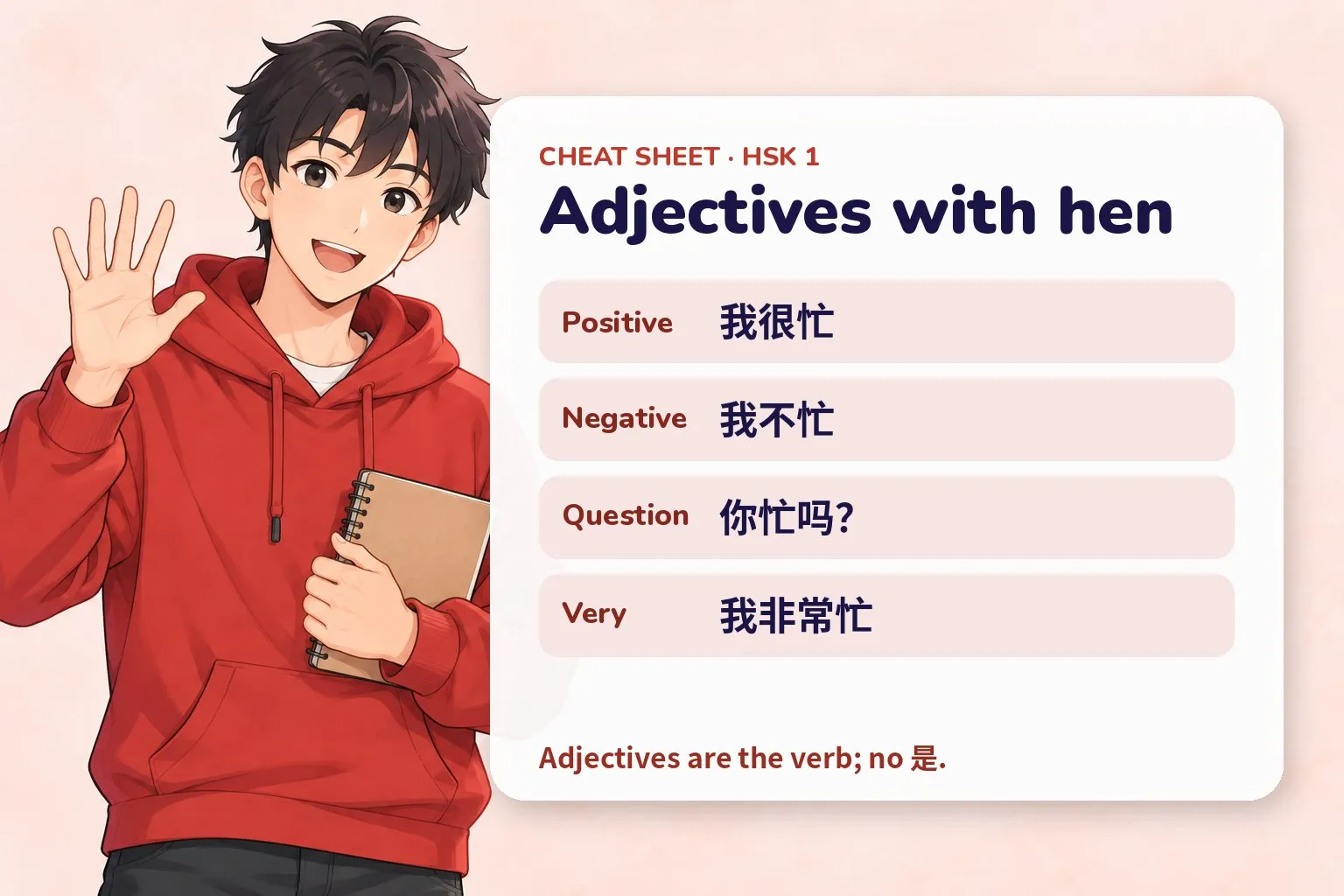
Quick recap before you practise.
Practice
Adjectives with 很 (hěn) practice
Try each one, then press Check. No sign-up, nothing is sent anywhere — it all runs in your browser.
Hint: the negator, and drop 很 (hěn)
Show answer
bù — Negate with 不 (bù) and drop 很: 我不忙 (wǒ bù máng).
3 Put the words in order: 'She is tall.'
Show answer
她 (tā) 很 (hěn) 高 (gāo) — Subject + 很 (hěn) + adjective: 她很高 (tā hěn gāo).
5 Match each degree word to its meaning.
- 很 (hěn)
- 非常 (fēicháng)
- 太…了 (tài…le)
- 有点儿 (yǒudiǎnr)
Show answer
- 很 (hěn) → neutral default linker
- 非常 (fēicháng) → very / extremely
- 太…了 (tài…le) → too (excessive)
- 有点儿 (yǒudiǎnr) → a bit (often negative)
很 (hěn) is the plain linker; 非常 (fēicháng) is a true intensifier; 太…了 (tài…le) means 'too'; 有点儿 (yǒudiǎnr) means 'a bit'.
Quiz
Adjectives with 很 (hěn) quiz
12 questions · pick an answer and you'll see straight away if it's right.
-
Show answer
verb — Adjectives work like stative verbs, so no separate 是 (shì) is needed.
-
Show answer
很 (hěn) — The default linker is 很 (hěn): 我很忙 (wǒ hěn máng).
-
Show answer
a neutral linker, not really 'very' — Here 很 (hěn) is bleached — it mainly links subject and adjective.
-
Show answer
他不高 (tā bù gāo) — Negate with 不 (bù) and drop 很: 他不高 (tā bù gāo).
-
Show answer
是 (shì) can't go before an adjective — 是 (shì) links two nouns; an adjective doesn't take 是. Say 我很忙 (wǒ hěn máng).
-
Show answer
unfinished or contrastive — Without 很 (hěn) it feels incomplete or implies a contrast.
-
Show answer
bú (2nd tone) — 不 (bù) rises to bú before a 4th-tone syllable, so 不累 is bú lèi.
-
Show answer
我非常忙 (wǒ fēicháng máng) — Use a true intensifier: 非常 (fēicháng) means 'very / extremely'.
-
Show answer
你累吗? (nǐ lèi ma) — Add 吗 (ma) and drop 很: 你累吗? (nǐ lèi ma).
-
Show answer
a 2nd tone — Third-tone sandhi: 很好 (hěn hǎo) is said hén hǎo.
-
Show answer
máng — The A-not-A pattern repeats the adjective around 不: 你忙不忙? (nǐ máng bu máng).
-
Show answer
我不很高 (wǒ bù hěn gāo) — 我不很高 (wǒ bù hěn gāo) is wrong; drop 很 in the negative: 我不高 (wǒ bù gāo).
Recap cheat-sheet
| Form | Example | Pinyin |
|---|---|---|
| Positive | 我很忙 | Wǒ hěn máng |
| Negative | 我不忙 | Wǒ bù máng |
| Question | 你忙吗? | Nǐ máng ma? |
| Intensified | 我非常忙 | Wǒ fēicháng máng |
Next
- Back to the Chinese grammar section
- New here? Start with Start Learning Chinese Here
All Chinese grammar topics
Every grammar point in order, from your first sentence to advanced structures. Pick one and go straight to it. New lessons go live every day, so topics marked Coming soon fill in over the next weeks.
Grammar path
HSK 1 15 topics · 12 ready
- 01 The Verb 是 (shì): to be
- 02 Basic Word Order (Subject-Verb-Object)
- 03 Adjectives with 很 (hěn) You are here
- 04 Yes/No Questions with 吗 (ma)
- 05 Question Words (什么 shénme, 谁 shuí, 哪 nǎ, 几 jǐ)
- 06 The Particle 的 (de): Possession & Modification
- 07 Measure Words and 个 (ge)
- 08 Numbers and Counting
- 09 The Verb 有 (yǒu): to have / there is
- 10 The Verb 在 (zài): Location
- 11 Time When (Position in Sentence)
- 12 The Particle 了 (le): Change of State
- 13 Modal Verbs 想 / 要 / 会 / 能 (xiǎng / yào / huì / néng) Coming soon
- 14 The Particle 呢 (ne) Coming soon
- 15 也 (yě) and 都 (dōu) Placement Coming soon
HSK 2 16 topics
- 16 Aspectual 了 (Completed Action) Coming soon
- 17 The Aspect Particle 过 (guò) Coming soon
- 18 Progressive Aspect (在 / 正在 / 呢 zài / zhèngzài / ne) Coming soon
- 19 Comparisons with 比 (bǐ) Coming soon
- 20 A Bit: 一点儿 (yìdiǎnr) vs 有一点儿 (yǒu yìdiǎnr) Coming soon
- 21 Basic Conjunctions (和 hé, 也 yě, 都 dōu, 还 hái) Coming soon
- 22 Because...So (因为 yīnwèi...所以 suǒyǐ) Coming soon
- 23 Coverbs 给 / 跟 / 对 (gěi / gēn / duì) Coming soon
- 24 Duration (Time How Long) Coming soon
- 25 Resultative Complements (看完 kànwán, 听懂 tīngdǒng) Coming soon
- 26 The 把 (bǎ) Construction Coming soon
- 27 The Particle 吧 (ba) Coming soon
- 28 Again: 再 (zài) vs 又 (yòu) Coming soon
- 29 Or: 还是 (háishì) vs 或者 (huòzhě) Coming soon
- 30 Imminent Action (快要 kuàiyào...了 / 要 le / yào...了 le) Coming soon
- 31 Asking Degree with 多 (duō) Coming soon
HSK 3 18 topics
- 32 Directional Complements (出来 chūlái, 回去 huíqù) Coming soon
- 33 Potential Complements (看得懂 kàndedǒng, 做不完 zuòbùwán) Coming soon
- 34 Complement of Degree with 得 (de) Coming soon
- 35 Adverbial Modifier with 地 (de) Coming soon
- 36 The Durative Aspect 着 (zhe) Coming soon
- 37 把 (bǎ) with Complex Results Coming soon
- 38 The 被 (bèi) Passive Coming soon
- 39 Conditionals (如果 rúguǒ...就 / 要是 jiù / yàoshì) Coming soon
- 40 Although...But (虽然 suīrán...但是 dànshì) Coming soon
- 41 Pivotal Sentences (让 ràng, 叫 jiào, 请 qǐng, 使 shǐ) Coming soon
- 42 More and More (越来越 / 越 yuèláiyuè / yuè...越 yuè) Coming soon
- 43 除了 (chúle)...以外 (Besides / Except) Coming soon
- 44 Simultaneous Actions (一边...一边, yìbiān...yìbiān) Coming soon
- 45 Sequence: 先 (xiān)...再/然后 (zài / ránhòu) Coming soon
- 46 Conditional with ...的话 (dehuà) Coming soon
- 47 From...To (从 cóng...到 / 离 dào / lí) Coming soon
- 48 Similarity: 跟 (gēn)...一样 / 像 (yíyàng / xiàng)...一样 (yíyàng) Coming soon
- 49 Both...And (又 yòu...又 / 既 yòu / jì...又 yòu) Coming soon
HSK 4 13 topics
- 50 The 是 (shì)...的 (de) Construction (Emphasis) Coming soon
- 51 The Adverbs 就 (jiù) and 才 (cái) Coming soon
- 52 No Matter (不管 / 无论 bùguǎn / wúlùn...都 dōu) Coming soon
- 53 Even If (即使 / 就算 jíshǐ / jiùsuàn...也 yě) Coming soon
- 54 Verb Reduplication (看看 kànkan, 试一试 shìyishì) Coming soon
- 55 As Soon As (一...就, yī...jiù) Coming soon
- 56 Comparing 把 (bǎ) and 被 (bèi) in Context Coming soon
- 57 Complement of Quantity / Comparison Degree Coming soon
- 58 连 (lián)...都/也 (Even) Coming soon
- 59 Time Sequence (先 xiān...然后 ránhòu, 的时候 deshíhòu, 以后/以前 yǐhòu / yǐqián) Coming soon
- 60 From the Angle Of (对 duì...来说 láishuō) Coming soon
- 61 Only After / Not Until (要 yào...才 / 等 cái / děng...才 cái) Coming soon
- 62 Approximation & 左右/多/来 (zuǒyòu / duō / lái) Coming soon
HSK 5 14 topics
- 63 Mood Adverbs (反正 fǎnzhèng, 居然 jūrán, 竟然 jìngrán, 难道 nándào) Coming soon
- 64 Not Only...But Also (不但 búdàn...而且 érqiě) Coming soon
- 65 Otherwise (否则 / 要不然 fǒuzé / yàobùrán) Coming soon
- 66 Complex Complements & Metaphorical Results Coming soon
- 67 Formal/Written Markers (之 zhī, 其 qí, 者 zhě, 以 yǐ) Coming soon
- 68 Rather...Than (宁愿/宁可 nìngyuàn / nìngkě...也不 yěbù) Coming soon
- 69 与其 (yǔqí)...不如 (Rather Than / Better To) Coming soon
- 70 Only If / Only (只有 zhǐyǒu...才 / 只要 cái / zhǐyào...就 jiù) Coming soon
- 71 Colloquial Passives (让 ràng, 叫 jiào, 给 gěi) Coming soon
- 72 不但不/没 (búdànbù / méi)...反而 (Contrary to Expectation) Coming soon
- 73 一...就 (yī...jiù) vs 一旦 (yídàn): Once / As Soon As Coming soon
- 74 尽管 (jǐnguǎn)...还是 (Even Though) Coming soon
- 75 复合趋向补语 (Compound Directional + Object) Coming soon
- 76 Emphasis with 是 (shì)...的 (de) vs 连 (lián)...都 (dōu) Review Coming soon
HSK 6 7 topics
- 77 Four-Character Idioms (成语 chéngyǔ) in Grammar Coming soon
- 78 Literary Connectives (然而 ránér, 从而 cóngér, 鉴于 jiànyú, 乃至 nǎizhì) Coming soon
- 79 Fixed Frameworks (在 zài...下 xià, 以 yǐ...为 wèi, 对 duì...而言 éryán) Coming soon
- 80 Rhetorical & Emphatic Structures (并 bìng, 可 kě, 正是 zhèngshì) Coming soon
- 81 Nominalisation & Topic Structures (所 suǒ...的 de, 的 de nominaliser) Coming soon
- 82 Long-Sentence Cohesion & Ellipsis Coming soon
- 83 经/予/加以 (Formal Verbal Framing) Coming soon