The Verb 有 (yǒu): to have / there is
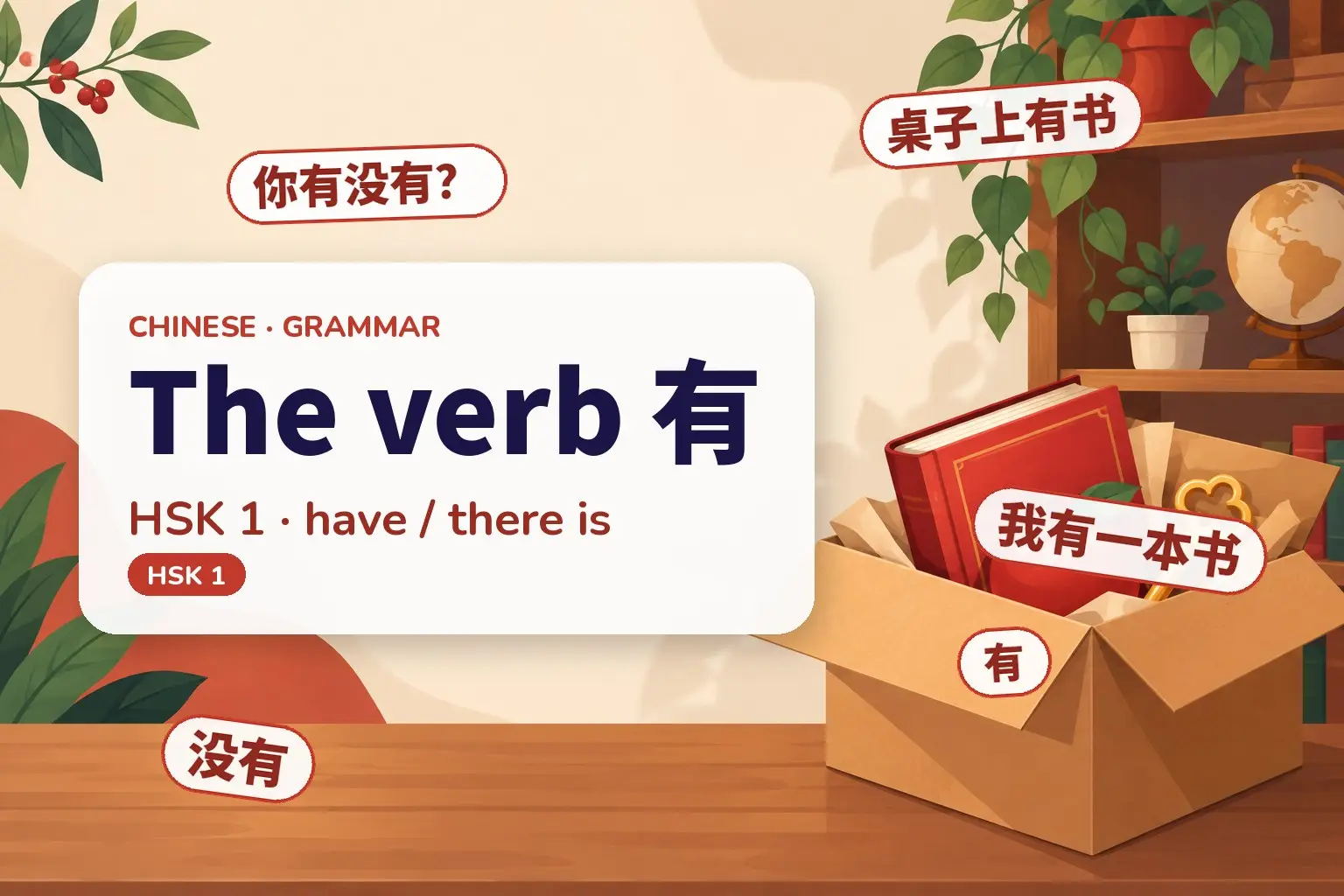
有 (yǒu) means 'to have' and 'there is/are': 我有一本书 (Wǒ yǒu yì běn shū) = 'I have a book'. Its one special rule: negate it only with 没 (méi) → 没有 (méiyǒu), never with 不 (bù).
On this page10 sections · tap to jump
Level: beginner (HSK 1). 有 (yǒu) is one of the first verbs you need. It does two jobs English splits into different words: “to have” (possession) and “there is / there are” (existence). It also has a single rule that trips up almost every learner — its negative is built with 没 (méi), never with 不 (bù).
The rule
有 (yǒu) is a verb, the word that carries the action or state in a sentence. It covers two meanings:
- Possession — “to have”. Subject + 有 (yǒu) + object: 我有一本书 (wǒ yǒu yì běn shū), “I have a book”.
- Existence — “there is / there are”. Place + 有 (yǒu) + thing: 桌子上有一本书 (zhuōzi shàng yǒu yì běn shū), “There is a book on the table”.
The one rule to memorise: the negative of 有 (yǒu) is 没有 (méiyǒu), using 没 (méi). Every other verb negates with 不 (bù), but 有 (yǒu) is the exception. 不有 (bù yǒu) does not exist in Mandarin.
Forms at a glance
| Form | Chinese | Pinyin | Meaning |
|---|---|---|---|
| Affirmative | 我有一本书。 | Wǒ yǒu yì běn shū. | I have a book. |
| Negative | 我没有书。 | Wǒ méiyǒu shū. | I don’t have a book. |
| Question (吗) | 你有书吗? | Nǐ yǒu shū ma? | Do you have a book? |
| Question (有没有) | 你有没有书? | Nǐ yǒu méiyǒu shū? | Do you have a book? |
| Short answers | 有。/ 没有。 | Yǒu. / Méiyǒu. | Yes (I do). / No (I don’t). |
Note: the short “no” answer is 没有 (méiyǒu), not 不 (bù). To answer “yes”, just repeat the verb: 有 (yǒu).
Example sentences
- 我有一本书。Wǒ yǒu yì běn shū.I have a book.
- 她有两个孩子。Tā yǒu liǎng ge háizi.She has two children.counted noun → measure word 个 ge
- 我没有钱。Wǒ méiyǒu qián.I don't have money.negative uses 没 méi
- 你有时间吗?Nǐ yǒu shíjiān ma?Do you have time?
- 你有没有问题?Nǐ yǒu méiyǒu wèntí?Do you have any questions?有没有 question form
- 桌子上有一台电脑。Zhuōzi shàng yǒu yì tái diànnǎo.There is a computer on the table.existence: place + 有
- 家里有三个人。Jiā lǐ yǒu sān ge rén.There are three people at home.
- 这儿没有厕所。Zhèr méiyǒu cèsuǒ.There is no toilet here.
- 我有一个哥哥。Wǒ yǒu yí ge gēge.I have an older brother.
- 他有一辆车。Tā yǒu yí liàng chē.He has a car.measure word 辆 liàng for vehicles
- 我们没有时间。Wǒmen méiyǒu shíjiān.We don't have time.
- 冰箱里有牛奶吗?Bīngxiāng lǐ yǒu niúnǎi ma?Is there milk in the fridge?
- 学校有图书馆。Xuéxiào yǒu túshūguǎn.The school has a library.
- 我没有兄弟姐妹。Wǒ méiyǒu xiōngdì jiěmèi.I have no siblings.
- 你有几个朋友?Nǐ yǒu jǐ ge péngyou?How many friends do you have?
- 房间里有两张床。Fángjiān lǐ yǒu liǎng zhāng chuáng.There are two beds in the room.
- 我有问题,但是没有答案。Wǒ yǒu wèntí, dànshì méiyǒu dá'àn.I have a question, but no answer.
- 今天有雨吗?Jīntiān yǒu yǔ ma?Is there rain today?
Common mistakes
- ❌ 我不有书。 (wǒ bù yǒu shū) → ✅ 我没有书。 (wǒ méiyǒu shū) 有 (yǒu) is negated with 没 (méi), never 不 (bù).
- ❌ 我有不钱。 (wǒ yǒu bù qián) → ✅ 我没有钱。 (wǒ méiyǒu qián) The negator goes before 有 (yǒu): 没有 (méiyǒu).
- ❌ 我有两书。 (wǒ yǒu liǎng shū) → ✅ 我有两本书。 (wǒ yǒu liǎng běn shū) A counted noun needs a measure word (here 本 (běn) for books).
- ❌ 你有书吗没有? (nǐ yǒu shū ma méiyǒu) → ✅ 你有没有书? (nǐ yǒu méiyǒu shū) or 你有书吗? (nǐ yǒu shū ma) Use 吗 (ma) or 有没有 (yǒu méiyǒu), not both.
- ❌ 桌子上是一本书。 (zhuōzi shàng shì yì běn shū) → ✅ 桌子上有一本书。 (zhuōzi shàng yǒu yì běn shū) Existence (“there is”) uses 有 (yǒu), not 是 (shì).
A short conversation
A: 你有没有手机? (Nǐ yǒu méiyǒu shǒujī?) — Do you have a phone? B: 有。你呢? (Yǒu. Nǐ ne?) — Yes. And you? A: 我没有。家里有一台电脑。 (Wǒ méiyǒu. Jiā lǐ yǒu yì tái diànnǎo.) — I don’t, but there’s a computer at home.
Usage notes
- 有 (yǒu) does not take 了 (le) for a simple negative past. “I didn’t have” is still 没有 (méiyǒu): 昨天我没有时间 (zuótiān wǒ méiyǒu shíjiān), “Yesterday I didn’t have time”.
- Existence sentences start with the place. Put the location first, then 有 (yǒu), then the thing: 房间里有人 (fángjiān lǐ yǒu rén), “There is someone in the room”.
- 有 (yǒu) also builds “some” and set phrases. 有的 (yǒude) means “some”; 有点儿 (yǒudiǎnr) means “a little / somewhat”. These grow from the same verb.
- “Yes/no” answers reuse the verb. Answer 有 (yǒu) for “yes” and 没有 (méiyǒu) for “no”; Mandarin has no single word for “yes”.
Compared with…
- 是 (shì) links two nouns to say what something is (identity): 这是书 (zhè shì shū, “this is a book”). 有 (yǒu) says something exists or is owned: 这儿有书 (zhèr yǒu shū, “there are books here”). See 是 (shì): ‘To Be’ in Mandarin.
- 在 (zài) says a known thing is located somewhere (书在桌子上, shū zài zhuōzi shàng, “the book is on the table”), while 有 (yǒu) introduces something new at a place (桌子上有书, zhuōzi shàng yǒu shū, “there are books on the table”). Both patterns live in the Chinese grammar section.
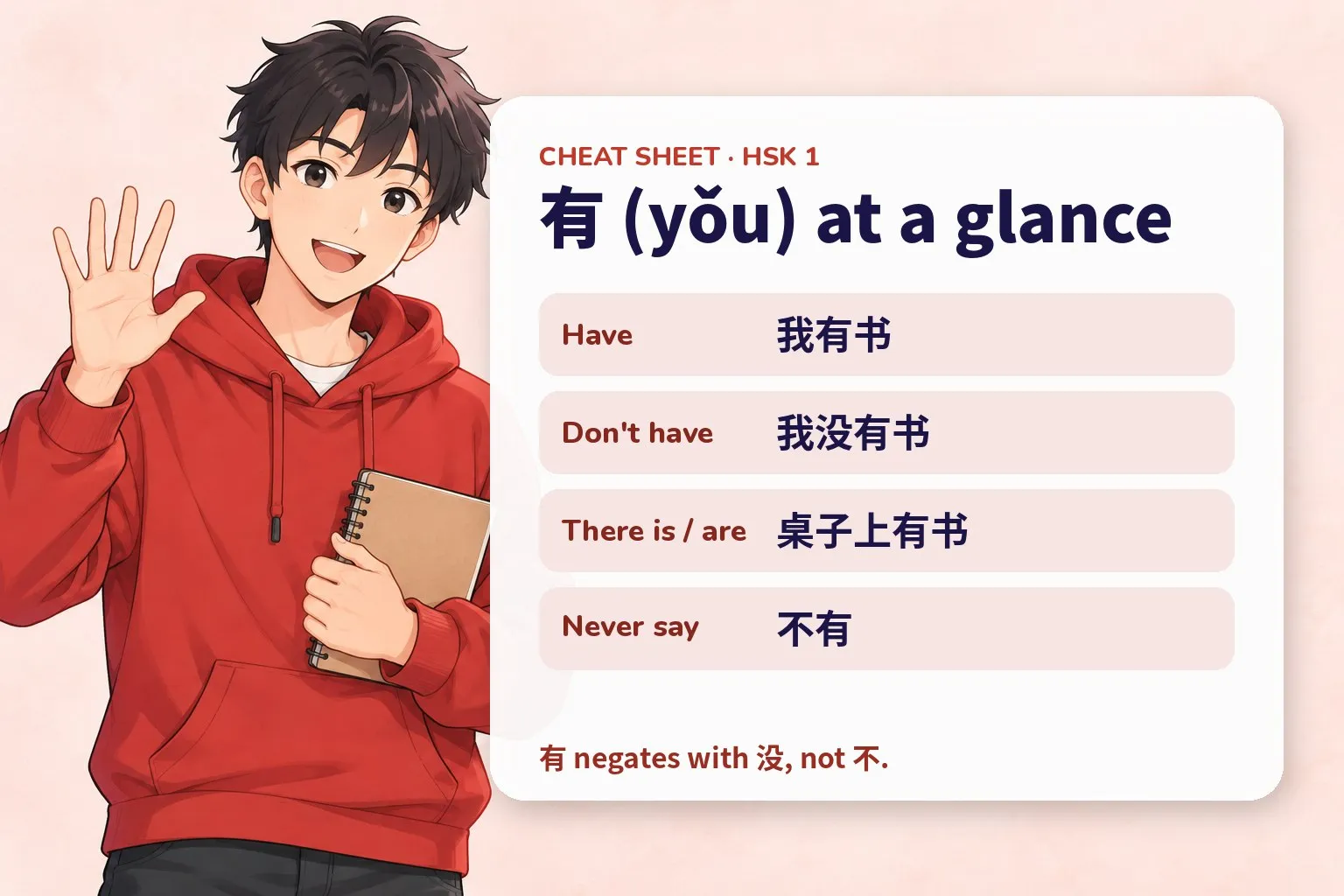
Quick recap before you practise.
Practice
有 (yǒu) to have / there is practice
Try each one, then press Check. No sign-up, nothing is sent anywhere — it all runs in your browser.
Hint: the negator 没 (méi) plus 有 (yǒu)
Show answer
méiyǒu — The negative of 有 (yǒu) is 没有 (méiyǒu).
3 Put the words in order: 'There is a computer on the table.'
Show answer
桌子上 (zhuōzi shàng) 有一台电脑 (yǒu yì tái diànnǎo) — Existence: place first, then 有 — 桌子上有一台电脑 (zhuōzi shàng yǒu yì tái diànnǎo).
5 Match each verb to the job it does.
- 有 (yǒu)
- 是 (shì)
- 在 (zài)
- 没 (méi)
Show answer
- 有 (yǒu) → have / there is (existence)
- 是 (shì) → links two nouns (identity)
- 在 (zài) → a known thing's location
- 没 (méi) → negates 有 (yǒu)
有 (yǒu) possession/existence; 是 (shì) identity; 在 (zài) location; 没 (méi) negates 有 (yǒu).
Quiz
you existence quiz
11 questions · pick an answer and you'll see straight away if it's right.
-
Show answer
'to have' and 'there is/are' — 有 (yǒu) means both possession ('have') and existence ('there is/are').
-
Show answer
with 没 (méi) → 没有 (méiyǒu) — 有 (yǒu) is the exception: it negates with 没 (méi), giving 没有 (méiyǒu).
-
Show answer
我不有书 (wǒ bù yǒu shū) — 不有 (bù yǒu) does not exist; use 没有 (méiyǒu).
-
Show answer
桌子上有电脑 (zhuōzi shàng yǒu diànnǎo) — Existence uses 有 (yǒu), with the place first: 桌子上有电脑 (zhuōzi shàng yǒu diànnǎo).
-
Show answer
没有 (méiyǒu) — Answer with the verb: 'no' is 没有 (méiyǒu); 'yes' is 有 (yǒu).
-
Show answer
a measure word, e.g. 个 (ge) — A counted noun takes a measure word: 我有三个朋友 (wǒ yǒu sān ge péngyou).
-
Show answer
你有没有问题? (nǐ yǒu méiyǒu wèntí) — 有没有 (yǒu méiyǒu) forms a yes/no question without 吗 (ma).
-
Show answer
在 (zài) — A known item's location uses 在 (zài): 书在桌子上 (shū zài zhuōzi shàng).
-
Show answer
昨天我没有时间 (zuótiān wǒ méiyǒu shíjiān) — The negative past of 有 (yǒu) is still 没有 (méiyǒu).
-
Show answer
'some' — 有的 (yǒude) grows from 有 (yǒu) and means 'some'.
-
Show answer
méi — 有 (yǒu) takes 没 (méi): 没有 (méiyǒu).
Recap cheat-sheet
| Use | Example | Pinyin |
|---|---|---|
| Have (affirmative) | 我有一本书 | Wǒ yǒu yì běn shū |
| Negative | 我没有书 | Wǒ méiyǒu shū |
| There is / are | 桌子上有书 | Zhuōzi shàng yǒu shū |
| Question (有没有) | 你有没有书? | Nǐ yǒu méiyǒu shū? |
| Short no | 没有 | Méiyǒu |
Next
- Compare the identity verb: 是 (shì): ‘To Be’ in Mandarin
- Count things after 有 (yǒu) with Measure Words with 个 (ge)
- Show possession with 的 (de): 的 (de) for Possession
- Back to the Chinese grammar section
All Chinese grammar topics
Every grammar point in order, from your first sentence to advanced structures. Pick one and go straight to it. New lessons go live every day, so topics marked Coming soon fill in over the next weeks.
Grammar path
HSK 1 15 topics · 12 ready
- 01 The Verb 是 (shì): to be
- 02 Basic Word Order (Subject-Verb-Object)
- 03 Adjectives with 很 (hěn)
- 04 Yes/No Questions with 吗 (ma)
- 05 Question Words (什么 shénme, 谁 shuí, 哪 nǎ, 几 jǐ)
- 06 The Particle 的 (de): Possession & Modification
- 07 Measure Words and 个 (ge)
- 08 Numbers and Counting
- 09 The Verb 有 (yǒu): to have / there is You are here
- 10 The Verb 在 (zài): Location
- 11 Time When (Position in Sentence)
- 12 The Particle 了 (le): Change of State
- 13 Modal Verbs 想 / 要 / 会 / 能 (xiǎng / yào / huì / néng) Coming soon
- 14 The Particle 呢 (ne) Coming soon
- 15 也 (yě) and 都 (dōu) Placement Coming soon
HSK 2 16 topics
- 16 Aspectual 了 (Completed Action) Coming soon
- 17 The Aspect Particle 过 (guò) Coming soon
- 18 Progressive Aspect (在 / 正在 / 呢 zài / zhèngzài / ne) Coming soon
- 19 Comparisons with 比 (bǐ) Coming soon
- 20 A Bit: 一点儿 (yìdiǎnr) vs 有一点儿 (yǒu yìdiǎnr) Coming soon
- 21 Basic Conjunctions (和 hé, 也 yě, 都 dōu, 还 hái) Coming soon
- 22 Because...So (因为 yīnwèi...所以 suǒyǐ) Coming soon
- 23 Coverbs 给 / 跟 / 对 (gěi / gēn / duì) Coming soon
- 24 Duration (Time How Long) Coming soon
- 25 Resultative Complements (看完 kànwán, 听懂 tīngdǒng) Coming soon
- 26 The 把 (bǎ) Construction Coming soon
- 27 The Particle 吧 (ba) Coming soon
- 28 Again: 再 (zài) vs 又 (yòu) Coming soon
- 29 Or: 还是 (háishì) vs 或者 (huòzhě) Coming soon
- 30 Imminent Action (快要 kuàiyào...了 / 要 le / yào...了 le) Coming soon
- 31 Asking Degree with 多 (duō) Coming soon
HSK 3 18 topics
- 32 Directional Complements (出来 chūlái, 回去 huíqù) Coming soon
- 33 Potential Complements (看得懂 kàndedǒng, 做不完 zuòbùwán) Coming soon
- 34 Complement of Degree with 得 (de) Coming soon
- 35 Adverbial Modifier with 地 (de) Coming soon
- 36 The Durative Aspect 着 (zhe) Coming soon
- 37 把 (bǎ) with Complex Results Coming soon
- 38 The 被 (bèi) Passive Coming soon
- 39 Conditionals (如果 rúguǒ...就 / 要是 jiù / yàoshì) Coming soon
- 40 Although...But (虽然 suīrán...但是 dànshì) Coming soon
- 41 Pivotal Sentences (让 ràng, 叫 jiào, 请 qǐng, 使 shǐ) Coming soon
- 42 More and More (越来越 / 越 yuèláiyuè / yuè...越 yuè) Coming soon
- 43 除了 (chúle)...以外 (Besides / Except) Coming soon
- 44 Simultaneous Actions (一边...一边, yìbiān...yìbiān) Coming soon
- 45 Sequence: 先 (xiān)...再/然后 (zài / ránhòu) Coming soon
- 46 Conditional with ...的话 (dehuà) Coming soon
- 47 From...To (从 cóng...到 / 离 dào / lí) Coming soon
- 48 Similarity: 跟 (gēn)...一样 / 像 (yíyàng / xiàng)...一样 (yíyàng) Coming soon
- 49 Both...And (又 yòu...又 / 既 yòu / jì...又 yòu) Coming soon
HSK 4 13 topics
- 50 The 是 (shì)...的 (de) Construction (Emphasis) Coming soon
- 51 The Adverbs 就 (jiù) and 才 (cái) Coming soon
- 52 No Matter (不管 / 无论 bùguǎn / wúlùn...都 dōu) Coming soon
- 53 Even If (即使 / 就算 jíshǐ / jiùsuàn...也 yě) Coming soon
- 54 Verb Reduplication (看看 kànkan, 试一试 shìyishì) Coming soon
- 55 As Soon As (一...就, yī...jiù) Coming soon
- 56 Comparing 把 (bǎ) and 被 (bèi) in Context Coming soon
- 57 Complement of Quantity / Comparison Degree Coming soon
- 58 连 (lián)...都/也 (Even) Coming soon
- 59 Time Sequence (先 xiān...然后 ránhòu, 的时候 deshíhòu, 以后/以前 yǐhòu / yǐqián) Coming soon
- 60 From the Angle Of (对 duì...来说 láishuō) Coming soon
- 61 Only After / Not Until (要 yào...才 / 等 cái / děng...才 cái) Coming soon
- 62 Approximation & 左右/多/来 (zuǒyòu / duō / lái) Coming soon
HSK 5 14 topics
- 63 Mood Adverbs (反正 fǎnzhèng, 居然 jūrán, 竟然 jìngrán, 难道 nándào) Coming soon
- 64 Not Only...But Also (不但 búdàn...而且 érqiě) Coming soon
- 65 Otherwise (否则 / 要不然 fǒuzé / yàobùrán) Coming soon
- 66 Complex Complements & Metaphorical Results Coming soon
- 67 Formal/Written Markers (之 zhī, 其 qí, 者 zhě, 以 yǐ) Coming soon
- 68 Rather...Than (宁愿/宁可 nìngyuàn / nìngkě...也不 yěbù) Coming soon
- 69 与其 (yǔqí)...不如 (Rather Than / Better To) Coming soon
- 70 Only If / Only (只有 zhǐyǒu...才 / 只要 cái / zhǐyào...就 jiù) Coming soon
- 71 Colloquial Passives (让 ràng, 叫 jiào, 给 gěi) Coming soon
- 72 不但不/没 (búdànbù / méi)...反而 (Contrary to Expectation) Coming soon
- 73 一...就 (yī...jiù) vs 一旦 (yídàn): Once / As Soon As Coming soon
- 74 尽管 (jǐnguǎn)...还是 (Even Though) Coming soon
- 75 复合趋向补语 (Compound Directional + Object) Coming soon
- 76 Emphasis with 是 (shì)...的 (de) vs 连 (lián)...都 (dōu) Review Coming soon
HSK 6 7 topics
- 77 Four-Character Idioms (成语 chéngyǔ) in Grammar Coming soon
- 78 Literary Connectives (然而 ránér, 从而 cóngér, 鉴于 jiànyú, 乃至 nǎizhì) Coming soon
- 79 Fixed Frameworks (在 zài...下 xià, 以 yǐ...为 wèi, 对 duì...而言 éryán) Coming soon
- 80 Rhetorical & Emphatic Structures (并 bìng, 可 kě, 正是 zhèngshì) Coming soon
- 81 Nominalisation & Topic Structures (所 suǒ...的 de, 的 de nominaliser) Coming soon
- 82 Long-Sentence Cohesion & Ellipsis Coming soon
- 83 经/予/加以 (Formal Verbal Framing) Coming soon