Measure Words and 个 (ge)
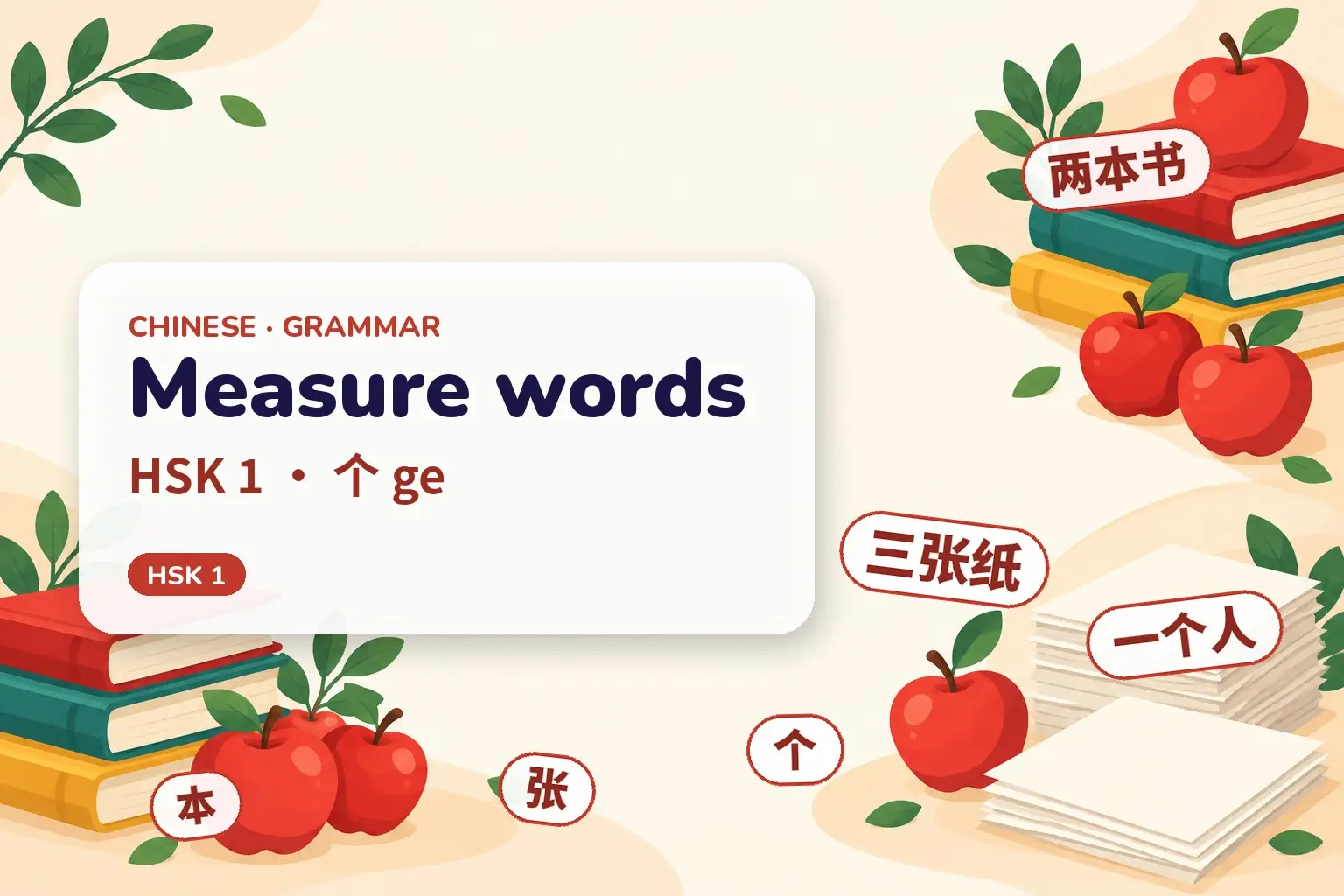
Chinese counts nouns with a measure word between the number and the noun: 三个人 (sān ge rén) means 'three people'. 个 (ge) is the default classifier for people and many things, but specific nouns take their own, like 本 (běn) for books and 张 (zhāng) for flat things.
Level: beginner (HSK 1). A measure word (量词, liàngcí), also called a classifier, is a small word you put between a number and a noun. English does this only sometimes (“two slices of bread”); Chinese does it every time you count. Learn the pattern, then the general classifier 个 (gè / ge), and you can count almost anything.
The rule
Number + measure word + noun.
- 三个人 (sān ge rén) — three people
- 两本书 (liǎng běn shū) — two books
A measure word is the counting word that sits between the number and the thing. You cannot leave it out: you say 三个人 (sān ge rén), never 三人 (sān rén). Different nouns take different measure words, in the way English picks “a sheet of paper” but “a loaf of bread”.
个 (gè / ge) is the default classifier. It covers people and a great many everyday objects, and it is the one to use when you are unsure. In speech it is almost always said in the neutral tone — light and short, ge — even though its dictionary tone is the 4th tone gè.
Demonstratives and question words follow the same pattern. 这 (zhè, this), 那 (nà, that) and 几 (jǐ, how many) also take a measure word before the noun: 这个人 (zhè ge rén, this person), 几个人 (jǐ ge rén, how many people).
Common measure words
| Measure word | Pinyin | Used for | Example |
|---|---|---|---|
| 个 | ge | general: people, many objects | 一个人 (yí ge rén) one person |
| 本 | běn | books, bound volumes | 两本书 (liǎng běn shū) two books |
| 张 | zhāng | flat things: paper, tables, tickets | 三张纸 (sān zhāng zhǐ) three sheets |
| 条 | tiáo | long, thin things: fish, roads | 一条鱼 (yì tiáo yú) one fish |
| 件 | jiàn | clothing (tops), matters | 一件衣服 (yí jiàn yīfu) one garment |
| 杯 | bēi | cups, glasses of | 一杯茶 (yì bēi chá) a cup of tea |
| 只 | zhī | many animals; one of a pair | 一只猫 (yì zhī māo) one cat |
| 位 | wèi | people, politely | 一位老师 (yí wèi lǎoshī) a teacher |
Example sentences
- 一个人yí ge rénone person个 ge, the default classifier
- 三个学生sān ge xuéshēngthree students
- 两本书liǎng běn shūtwo books两 liǎng, not 二; 本 běn for books
- 我有一个弟弟。Wǒ yǒu yí ge dìdi.I have one younger brother.
- 这个人是老师。Zhè ge rén shì lǎoshī.This person is a teacher.这 zhè + 个 ge
- 你要几个?Nǐ yào jǐ ge?How many do you want?几 jǐ + 个 ge
- 三张纸sān zhāng zhǐthree sheets of paper张 zhāng for flat things
- 一杯茶yì bēi cháa cup of tea
- 两杯咖啡liǎng bēi kāfēitwo cups of coffee
- 一条鱼yì tiáo yúone fish条 tiáo for long things
- 一只猫yì zhī māoone cat只 zhī for animals
- 一件衣服yí jiàn yīfuone piece of clothing
- 那个书包是我的。Nà ge shūbāo shì wǒ de.That schoolbag is mine.
- 我们班有二十个学生。Wǒmen bān yǒu èrshí ge xuéshēng.Our class has twenty students.
- 一位老师yí wèi lǎoshīa teacher (polite)位 wèi is polite for people
- 请给我两张票。Qǐng gěi wǒ liǎng zhāng piào.Please give me two tickets.
- 桌子上有几本书。Zhuōzi shàng yǒu jǐ běn shū.There are a few books on the table.
- 我买了三个苹果。Wǒ mǎi le sān ge píngguǒ.I bought three apples.
Common mistakes
- ❌ 三人 (sān rén) → ✅ 三个人 (sān ge rén). You cannot put a number straight before a noun; a measure word is required.
- ❌ 二个人 (èr ge rén) → ✅ 两个人 (liǎng ge rén). Before a measure word, “two” is 两 (liǎng), not 二 (èr).
- ❌ 一个书 (yí ge shū) → ✅ 一本书 (yì běn shū). Books take their own classifier 本 (běn); 个 (ge) is only the fallback.
- ❌ 这人 (zhè rén) → ✅ 这个人 (zhè ge rén). 这 (zhè) and 那 (nà) still need a measure word before the noun.
- ❌ 几人 (jǐ rén) → ✅ 几个人 (jǐ ge rén). 几 (jǐ, how many) also takes a measure word.
A short conversation
A: 你家有几个人? (Nǐ jiā yǒu jǐ ge rén?) — How many people are in your family? B: 四个人。我还有两只猫。 (Sì ge rén. Wǒ hái yǒu liǎng zhī māo.) — Four people. I also have two cats. A: 我想买这本书。多少钱? (Wǒ xiǎng mǎi zhè běn shū, duōshao qián?) — I’d like to buy this book, how much is it?
Usage notes
- The noun can be dropped when it is clear. If you both know what is meant, you keep the measure word but drop the noun: 我要三个 (wǒ yào sān ge, “I want three [of them]”).
- 一 (yī) changes tone before a measure word. On its own 一 (yī) is 1st tone, but before a 4th-tone measure word such as 个 (gè) it becomes yí: 一个 (yí ge) is said yí ge. Before most other measure words it is yì (a falling tone), e.g. 一张 (yì zhāng).
- 位 (wèi) is the polite classifier for people. Use 位 (wèi) for teachers, guests and customers; 个 (ge) is neutral and fine for everyday reference.
- Measure words also mark “each/every”. Doubling gives “every”: 个个 (gè gè, “every one”), but at HSK 1 you mainly need the counting pattern above.
Compared with…
- 个 (ge) vs specific classifiers. 个 (ge) is the general one, but many common nouns have their own: 本 (běn) for books, 张 (zhāng) for flat things like paper and tickets, 条 (tiáo) for long thin things like fish and roads. Say 一本书 (yì běn shū), 一张票 (yì zhāng piào), 一条鱼 (yì tiáo yú) — using 个 (ge) here is understood but sounds non-standard.
- 两 (liǎng) vs 二 (èr). Both mean “two”: 二 (èr) is the counting number (and in 二十, èrshí, twenty), while 两 (liǎng) is the form used directly before a measure word. More number patterns live in the Chinese grammar section.
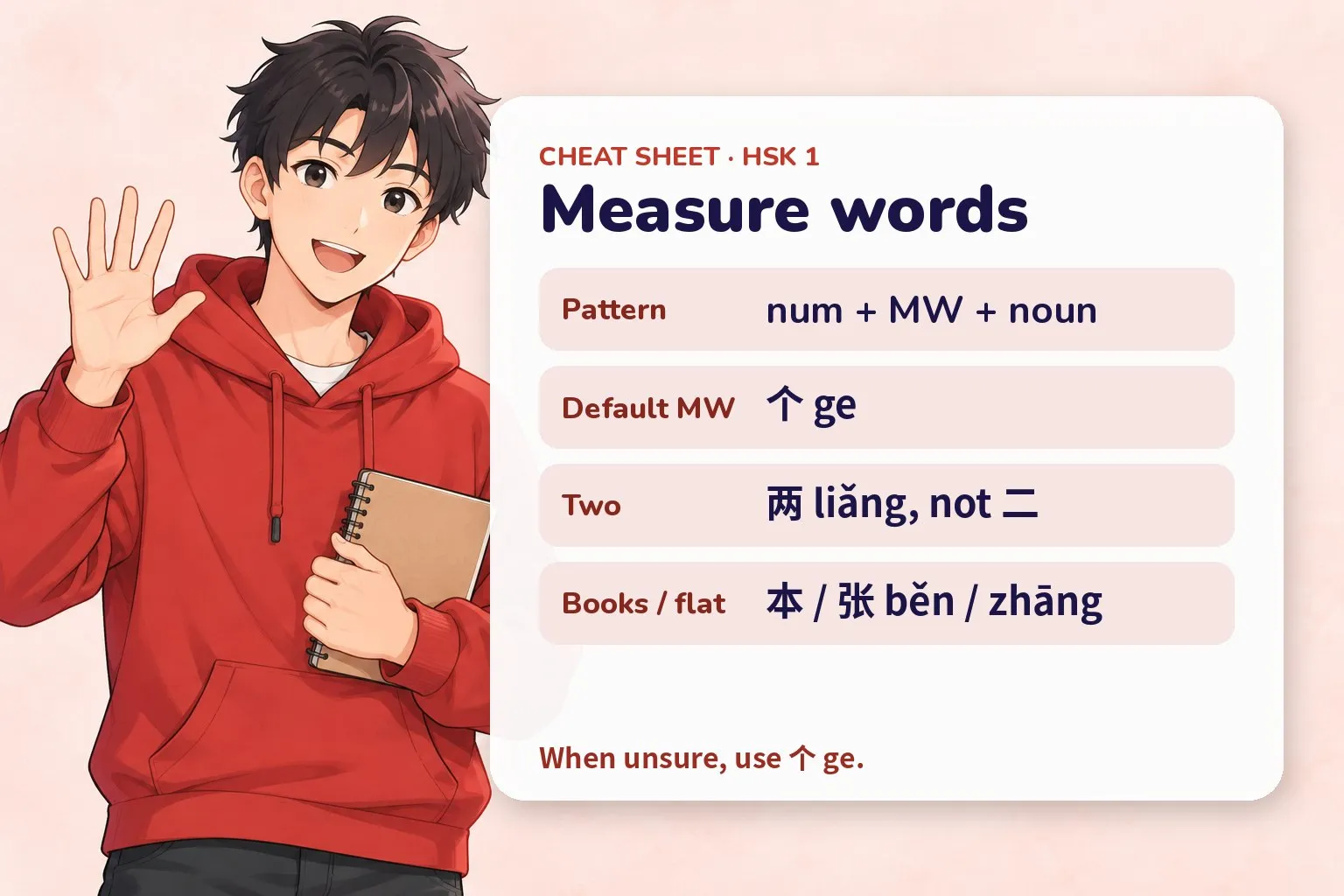
Quick recap before you practise.
Practice
Measure words practice
Try each one, then press Check. No sign-up, nothing is sent anywhere — it all runs in your browser.
Hint: the classifier for books
Show answer
běn — Books take 本 (běn): 两本书 (liǎng běn shū).
3 Put the words in order: 'this person'.
Show answer
这 (zhè) 个 (ge) 人 (rén) — 这 + 个 + noun: 这个人 (zhè ge rén).
5 Match each measure word to what it counts.
- 个 (ge)
- 本 (běn)
- 张 (zhāng)
- 条 (tiáo)
Show answer
- 个 (ge) → people / general
- 本 (běn) → books
- 张 (zhāng) → flat things
- 条 (tiáo) → long thin things
个 (ge) general; 本 (běn) books; 张 (zhāng) flat; 条 (tiáo) long and thin.
Quiz
Measure words and ge quiz
12 questions · pick an answer and you'll see straight away if it's right.
-
Show answer
number + measure word + noun — Number + measure word + noun: 三个人 (sān ge rén).
-
Show answer
三个人 (sān ge rén) — A measure word is required: 三个人 (sān ge rén).
-
Show answer
两 (liǎng) — 两 (liǎng) is used directly before a measure word: 两个 (liǎng ge).
-
Show answer
个 (ge) — 个 (ge) is the general classifier, used when unsure.
-
Show answer
本 (běn) — Books take 本 (běn): 一本书 (yì běn shū).
-
Show answer
张 (zhāng) — 张 (zhāng) is for flat things: 一张纸 (yì zhāng zhǐ).
-
Show answer
几个人 (jǐ ge rén) — 几 (jǐ) also takes a measure word: 几个人 (jǐ ge rén).
-
Show answer
这本书 (zhè běn shū) — 这 + measure word + noun, and books take 本: 这本书 (zhè běn shū).
-
Show answer
the neutral (toneless) tone, ge — 个 (ge) is normally neutral-tone ge, though its dictionary tone is gè.
-
Show answer
二个人 (èr ge rén) — Before a measure word use 两, not 二: 两个人 (liǎng ge rén).
-
Show answer
位 (wèi) — 位 (wèi) is the polite classifier for people.
-
Show answer
ge — 个 (ge) is the default classifier: 三个人 (sān ge rén).
Recap cheat-sheet
| Point | Example |
|---|---|
| Pattern | 三个人 (sān ge rén) |
| Default classifier | 个 (ge) |
| Two before MW | 两 (liǎng), not 二 (èr) |
| Books / flat / long | 本 / 张 / 条 (běn / zhāng / tiáo) |
| 这/那/几 (zhè/nà/jǐ) need a MW | 这个 (zhè ge), 几个 (jǐ ge) |
Next
- Revise the verb behind these sentences: 是 (shì): To Be in Mandarin
- Back to the Chinese grammar section
- New here? Start with Start Learning Chinese Here
All Chinese grammar topics
Every grammar point in order, from your first sentence to advanced structures. Pick one and go straight to it. New lessons go live every day, so topics marked Coming soon fill in over the next weeks.
Grammar path
HSK 1 15 topics · 12 ready
- 01 The Verb 是 (shì): to be
- 02 Basic Word Order (Subject-Verb-Object)
- 03 Adjectives with 很 (hěn)
- 04 Yes/No Questions with 吗 (ma)
- 05 Question Words (什么 shénme, 谁 shuí, 哪 nǎ, 几 jǐ)
- 06 The Particle 的 (de): Possession & Modification
- 07 Measure Words and 个 (ge) You are here
- 08 Numbers and Counting
- 09 The Verb 有 (yǒu): to have / there is
- 10 The Verb 在 (zài): Location
- 11 Time When (Position in Sentence)
- 12 The Particle 了 (le): Change of State
- 13 Modal Verbs 想 / 要 / 会 / 能 (xiǎng / yào / huì / néng) Coming soon
- 14 The Particle 呢 (ne) Coming soon
- 15 也 (yě) and 都 (dōu) Placement Coming soon
HSK 2 16 topics
- 16 Aspectual 了 (Completed Action) Coming soon
- 17 The Aspect Particle 过 (guò) Coming soon
- 18 Progressive Aspect (在 / 正在 / 呢 zài / zhèngzài / ne) Coming soon
- 19 Comparisons with 比 (bǐ) Coming soon
- 20 A Bit: 一点儿 (yìdiǎnr) vs 有一点儿 (yǒu yìdiǎnr) Coming soon
- 21 Basic Conjunctions (和 hé, 也 yě, 都 dōu, 还 hái) Coming soon
- 22 Because...So (因为 yīnwèi...所以 suǒyǐ) Coming soon
- 23 Coverbs 给 / 跟 / 对 (gěi / gēn / duì) Coming soon
- 24 Duration (Time How Long) Coming soon
- 25 Resultative Complements (看完 kànwán, 听懂 tīngdǒng) Coming soon
- 26 The 把 (bǎ) Construction Coming soon
- 27 The Particle 吧 (ba) Coming soon
- 28 Again: 再 (zài) vs 又 (yòu) Coming soon
- 29 Or: 还是 (háishì) vs 或者 (huòzhě) Coming soon
- 30 Imminent Action (快要 kuàiyào...了 / 要 le / yào...了 le) Coming soon
- 31 Asking Degree with 多 (duō) Coming soon
HSK 3 18 topics
- 32 Directional Complements (出来 chūlái, 回去 huíqù) Coming soon
- 33 Potential Complements (看得懂 kàndedǒng, 做不完 zuòbùwán) Coming soon
- 34 Complement of Degree with 得 (de) Coming soon
- 35 Adverbial Modifier with 地 (de) Coming soon
- 36 The Durative Aspect 着 (zhe) Coming soon
- 37 把 (bǎ) with Complex Results Coming soon
- 38 The 被 (bèi) Passive Coming soon
- 39 Conditionals (如果 rúguǒ...就 / 要是 jiù / yàoshì) Coming soon
- 40 Although...But (虽然 suīrán...但是 dànshì) Coming soon
- 41 Pivotal Sentences (让 ràng, 叫 jiào, 请 qǐng, 使 shǐ) Coming soon
- 42 More and More (越来越 / 越 yuèláiyuè / yuè...越 yuè) Coming soon
- 43 除了 (chúle)...以外 (Besides / Except) Coming soon
- 44 Simultaneous Actions (一边...一边, yìbiān...yìbiān) Coming soon
- 45 Sequence: 先 (xiān)...再/然后 (zài / ránhòu) Coming soon
- 46 Conditional with ...的话 (dehuà) Coming soon
- 47 From...To (从 cóng...到 / 离 dào / lí) Coming soon
- 48 Similarity: 跟 (gēn)...一样 / 像 (yíyàng / xiàng)...一样 (yíyàng) Coming soon
- 49 Both...And (又 yòu...又 / 既 yòu / jì...又 yòu) Coming soon
HSK 4 13 topics
- 50 The 是 (shì)...的 (de) Construction (Emphasis) Coming soon
- 51 The Adverbs 就 (jiù) and 才 (cái) Coming soon
- 52 No Matter (不管 / 无论 bùguǎn / wúlùn...都 dōu) Coming soon
- 53 Even If (即使 / 就算 jíshǐ / jiùsuàn...也 yě) Coming soon
- 54 Verb Reduplication (看看 kànkan, 试一试 shìyishì) Coming soon
- 55 As Soon As (一...就, yī...jiù) Coming soon
- 56 Comparing 把 (bǎ) and 被 (bèi) in Context Coming soon
- 57 Complement of Quantity / Comparison Degree Coming soon
- 58 连 (lián)...都/也 (Even) Coming soon
- 59 Time Sequence (先 xiān...然后 ránhòu, 的时候 deshíhòu, 以后/以前 yǐhòu / yǐqián) Coming soon
- 60 From the Angle Of (对 duì...来说 láishuō) Coming soon
- 61 Only After / Not Until (要 yào...才 / 等 cái / děng...才 cái) Coming soon
- 62 Approximation & 左右/多/来 (zuǒyòu / duō / lái) Coming soon
HSK 5 14 topics
- 63 Mood Adverbs (反正 fǎnzhèng, 居然 jūrán, 竟然 jìngrán, 难道 nándào) Coming soon
- 64 Not Only...But Also (不但 búdàn...而且 érqiě) Coming soon
- 65 Otherwise (否则 / 要不然 fǒuzé / yàobùrán) Coming soon
- 66 Complex Complements & Metaphorical Results Coming soon
- 67 Formal/Written Markers (之 zhī, 其 qí, 者 zhě, 以 yǐ) Coming soon
- 68 Rather...Than (宁愿/宁可 nìngyuàn / nìngkě...也不 yěbù) Coming soon
- 69 与其 (yǔqí)...不如 (Rather Than / Better To) Coming soon
- 70 Only If / Only (只有 zhǐyǒu...才 / 只要 cái / zhǐyào...就 jiù) Coming soon
- 71 Colloquial Passives (让 ràng, 叫 jiào, 给 gěi) Coming soon
- 72 不但不/没 (búdànbù / méi)...反而 (Contrary to Expectation) Coming soon
- 73 一...就 (yī...jiù) vs 一旦 (yídàn): Once / As Soon As Coming soon
- 74 尽管 (jǐnguǎn)...还是 (Even Though) Coming soon
- 75 复合趋向补语 (Compound Directional + Object) Coming soon
- 76 Emphasis with 是 (shì)...的 (de) vs 连 (lián)...都 (dōu) Review Coming soon
HSK 6 7 topics
- 77 Four-Character Idioms (成语 chéngyǔ) in Grammar Coming soon
- 78 Literary Connectives (然而 ránér, 从而 cóngér, 鉴于 jiànyú, 乃至 nǎizhì) Coming soon
- 79 Fixed Frameworks (在 zài...下 xià, 以 yǐ...为 wèi, 对 duì...而言 éryán) Coming soon
- 80 Rhetorical & Emphatic Structures (并 bìng, 可 kě, 正是 zhèngshì) Coming soon
- 81 Nominalisation & Topic Structures (所 suǒ...的 de, 的 de nominaliser) Coming soon
- 82 Long-Sentence Cohesion & Ellipsis Coming soon
- 83 经/予/加以 (Formal Verbal Framing) Coming soon